Anti‑Corruption and Integrity Outlook 2026: Colombia

Table of contents
Colombia adopted the National Strategy on the Fight against Corruption in 2024 through Presidential Decree No. 1600/2024. The strategy was developed by the Secretariat of Transparency of the Presidency of the Republic, the body also charged with monitoring the strategy’s implementation. Additionally, certain strategic objectives on integrity and anti-corruption can be found in the CONPES 4070 document, which is adopted at the level of government and deals with the policy guidelines for the implementation of an open government model. The National Planning Department is the body charged with the coordination between the different institutions responsible for the CONPES 4070.
The Administrative Department of the Civil Service is the authority in charge of administrating and providing implementation guidelines for interest declarations in the civil service. The National Electoral Council is the independent body with the mandate to oversee the financing of political parties and election campaigns. The Public Ministry, headed by the Attorney General's Office, oversees compliance with access to public information obligations, while the Secretariat for Transparency of the Presidency of the Republic leads the design and coordination of public policy in the area. The Digital Government Directorate in the Ministry of Information and Communications Technologies is responsible for open data policy. Since Colombia has not enacted any regulations on lobbying, there is no supervisory function in central government overseeing transparency of lobbying activities. The Superior Council of the Judiciary (CSJ) is the independent body charged with deciding on the appointment and promotion of judges. The National Inspector’s Office is the central government body that issues guidelines on the standardisation of disciplinary procedures.

Note: 2025 and 2020 data or latest year available. Data for prosecutorial integrity is not available.
Source: OECD Public Integrity Indicators Database (data extracted on 7 March 2026).
Data on where Colombia’s integrity system is strongest and could be most improved can be found at the link below:

Note: 2025 data or latest year available.
Source: OECD Public Integrity Indicators Database (data extracted on 7 March 2026).
Colombia fulfils 60% of criteria on the strength of the strategic framework, and 67% on practice, compared to the OECD average of 38% and 32%, respectively.
Colombia adopted its first National Strategy on the Fight against Corruption in 2024 through Presidential Decree No. 1600/2024. The strategy was developed and is monitored by the Secretariat of Transparency of the Presidency. In addition, integrity and anti-corruption objectives are reflected in CONPES 4070, which sets government-wide policy guidelines for implementing an open government model and is coordinated by the National Planning Department.
Both frameworks include a situation analysis which identifies the integrity risks the country is facing. Additionally, both strategic documents underwent inter-institutional and public consultations. The CONPES 4070 was developed through an extended consultation process, which included inviting experts, developing perception surveys, and hosting roundtables with stakeholders.
Both strategies have action plans in place that identify the lead organisations for each objective and set a list of activities with outcome-level indicators. Both CONPES and the National Strategy have websites with details on the level of completion of activities which allow to monitor progress. While CONPES 4070 contains centralised budgetary planning, the National Strategy requires each public entity to allocate its own budget to ensure implementation, and therefore there are no centralised cost estimates.

Note: 2025 data or latest year available.
Source: OECD Public Integrity Indicators Database (data extracted on 7 March 2026).
Colombia fulfils 20% of criteria on lobbying regulations, and 0% on practice, compared to the OECD average of 43% and 38%, respectively.
Article 144 of Colombia’s Constitution mandates that lobbying activities should be regulated through law, but no such regulation has yet been enacted. Therefore, Colombia’s legislative framework does not provide a definition of lobbying, nor does it define which actors are considered lobbyists, nor sanctions for breaches of lobbying rules. Cooling off periods are established for public officials in Law 734/2002, but they do not apply to lobbyists taking up public functions.
There is no supervisory function in central government overseeing transparency of lobbying activities. While there is no lobbying register, Colombia as established a “Single Registry of Beneficial Owners” created under Article 12 of Law No. 2195 of 2022 and administered by the National Tax and Customs Directorate (DIAN). However, the register is accessible only to a selected list of public institutions.
Note: 2025 data or latest year available.
Source: OECD Public Integrity Indicators Database (data extracted on 7 March 2026).
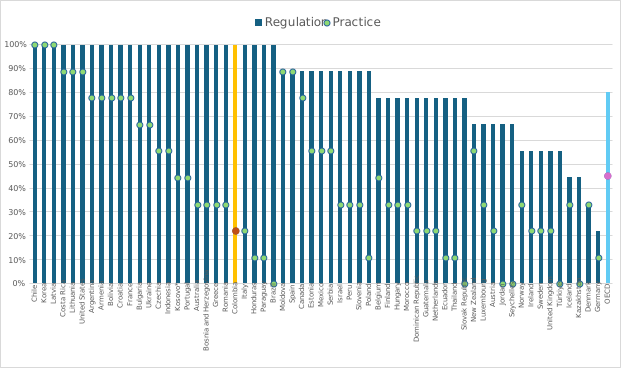
Colombia fulfils 100% of criteria on conflict-of-interest regulations, and 22% on practice, compared to the OECD average of 80% and 45%, respectively.
Colombia’s regulations define incompatibilities between public functions and other public or private activities, and define the circumstances that can lead to conflict-of-interest situations in multiple laws, including Law No.2003 of 2019 regulating conflicts of interest for members of Congress and Law No.2013/2019 on asset and interest declarations. The regulatory framework outlines submission procedures for interest declarations for both members of Government and parliament and define sanctions for breaches of conflict-of-interest provisions.
The submission rate of interest declarations from members of parliament was 100% for the past 6 years, but rates for members of the government and high-ranking members of the judiciary are not tracked by the relevant authority, the Administrative Department of the Civil Service. However, the judiciary discloses information on judges through its transparency platform, including their interest declarations. Additionally, while declarations of interest are submitted electronically, data is not available on the extent to which this information is verified.

Note: 2025 data or latest year available.
Source: OECD Public Integrity Indicators Database (data extracted on 7 March 2026).
Colombia fulfils 90% of criteria on political finance regulations, and 86% on practice, compared to the OECD average of 76% and 58%, respectively.
The Law No.1475/2011 establishes that political parties have the obligation to report their finances regularly and to make their financial reports public, including all contributions exceeding a fixed ceiling. The same law bans anonymous donations, contributions from foreign states and enterprises, and contributions from publicly owned enterprises to political parties.
The National Electoral Council is the independent body with the mandate to oversee the financing of political parties and election campaigns. It has certified auditors on its payroll and has publicly available information on its institutional website, but it has not made available information on the aggregated number of cases related to breaches of political finance regulations. In practice, financial reports from all political parties are publicly available on a single online platform in a user-friendly format. All political parties in Colombia have submitted annual accounts within the timelines defined by national legislation for the past five years, and accounts related to elections for the past two election cycles.

Note: 2025 data or latest year available.
Source: OECD Public Integrity Indicators Database (data extracted on 7 March 2026).
Colombia fulfils 89% of criteria on public information regulations, and 65% on practice, compared to the OECD average of 72% and 62%, respectively.
The right of access to public information in Colombia is established for everyone, including non-citizens and legal persons, by Law No. 1712/2014. The law also defines the entities subject to its provisions, applying both to public bodies and private persons or entities that perform public functions, administer public resources or provide public services. The only restrictions on accessing public information are listed by law and are in line with the Tromso Convention. Regulations establish the right to appeal in the case of refusal of an administrative agency. Although certain reproduction charges can be charged for information requests, requesters are not obliged to provide justification for their requests.
The Attorney General's Office is the body responsible for public information issues. It has conducted inspections of compliance, and in cases of non-compliance issued sanctions over the last year. The Ministry of Information and Communications Technologies is responsible for open data policy, through the Digital Government Directorate. In practice, there is proactive disclosure of the following integrity-related datasets: consolidated versions of all primary laws, the state budget for the current calendar year, the results of the last national elections, legislative proposals of the government, the company registry, and public tenders and their results. However, Colombia does not make Government session agendas and Ministers’ agendas public.

Note: 2025 data or latest year available.
Source: OECD Public Integrity Indicators Database (data extracted on 7 March 2026).
Colombia fulfils 76% of criteria on judicial integrity regulations, and 48% on practice, compared to the OECD average of 66% and 45%, respectively.
The principle of independence of judges is enshrined in Article 228 of the Constitution. Law 270 of 1996, as amended by Law 2430 of 2024, guarantees tenure for judges and sets objective grounds for their dismissal. The Superior Council of the Judiciary (CSJ) is responsible for the appointment and promotion of judges. Entry into the judicial career is based on open public competitions, including exams and evaluations of candidates. The appointment of Supreme Court Magistrates includes interviews, and promotions are also conducted through merit-based procedures managed by the CSJ.
The CSJ issued the “Declaration of Principles of Judicial Ethics” in 2025, and work is underway to publish an Integrity Code for Judicial Employees in 2026 under the Judicial Branch’s Transparency and Public Ethics Programme (2025-2026). Law 1952 of 2019 and Law 1437 of 2011 define the circumstances and relationships that can lead to conflict-of-interest situations for the public service, which includes judges and court employees. Law 270 of 1996 further defines the specific incompatibilities of judicial branch duties.
Furthermore, Law 2013 of 2019 and CSJ circulars state that all members of the highest bodies of the judiciary must submit interest declarations upon entry in judicial office, when leaving office and periodically during tenure. However, no aggregated data is available to determine the submission rate of interest declarations, and the content verification of these declarations is not required by law. Declarations are nonetheless published through the Judicial Branch’s transparency platform and required to take office. Although a complaints procedure for judicial misconduct is in place, there are no dedicated regulations on whistleblower protection.
Data not available.

Note: 2025 data or latest year available.
Source: OECD Public Integrity Indicators Database (data extracted on 7 March 2026).
Colombia fulfils 83% of criteria on disciplinary system regulations, and 33% on practice, compared to the OECD average of 66% and 22%, respectively.
In Colombia, the Disciplinary Code (Law 1952 of 2019) establishes the disciplinary framework for civil servants. The Disciplinary Code defines what constitutes as a disciplinary offence, establishes a disciplinary procedure for public servants, and sets a range of disciplinary sanctions for each type of offence. It also includes provisions on the presumption of innocence, the right to access and contest evidence, the right to a hearing, and the right to legal counsel. However, appeals against disciplinary rulings are generally resolved by a second-instance officials, and not a judicial body.
The National Inspector’s Office, which is established as the highest disciplinary body by the Constitution, has issued guidelines on the standardisation of disciplinary procedures. Trainings on how to conduct disciplinary investigations is offered to officials by the Administrative Department of the Civil Service, among others. There is no obligation for central government bodies to use an electronic case management system for disciplinary cases and proceedings. While case-level information on disciplinary sanctions is available online, there is no aggregated data on the number of disciplinary procedures or sanctions issued.
This work is published under the responsibility of the Secretary-General of the OECD. The opinions expressed and arguments employed herein do not necessarily reflect the official views of the Member countries of the OECD.
This document, as well as any data and map included herein, are without prejudice to the status of or sovereignty over any territory, to the delimitation of international frontiers and boundaries and to the name of any territory, city or area.
The statistical data for Israel are supplied by and under the responsibility of the relevant Israeli authorities. The use of such data by the OECD is without prejudice to the status of the Golan Heights, East Jerusalem and Israeli settlements in the West Bank under the terms of international law.
Kosovo: This designation is without prejudice to positions on status, and is in line with United Nations Security Council Resolution 1244/99 and the Advisory Opinion of the International Court of Justice on Kosovo’s declaration of independence.
The full book is available in English: OECD (2026), Anti-Corruption and Integrity Outlook 2026: Harnessing the Integrity Advantage, OECD Publishing, Paris, https://doi.org/10.1787/16708b78-en.
© OECD 2026
 Attribution 4.0 International (CC BY 4.0)
This work is made available under the Creative Commons Attribution 4.0 International licence. By using this work, you accept to be bound by the terms of this licence (https://creativecommons.org/licenses/by/4.0/).
Attribution – you must cite the work.
Translations – you must cite the original work, identify changes to the original and add the following text: In the event of any discrepancy between the original work and the translation, only the text of the original work should be considered valid.
Adaptations – you must cite the original work and add the following text: This is an adaptation of an original work by the OECD. The opinions expressed and arguments employed in this adaptation should not be reported as representing the official views of the OECD or of its Member countries.
Third-party material – the licence does not apply to third-party material in the work. If using such material, you are responsible for obtaining permission from the third party and for any claims of infringement.
You must not use the OECD logo, visual identity or cover image without express permission or suggest the OECD endorses your use of the work.
Any dispute arising under this licence shall be settled by arbitration in accordance with the Permanent Court of Arbitration (PCA) Arbitration Rules 2012. The seat of arbitration shall be Paris (France). The number of arbitrators shall be one.