Too few students are participating in career development activities which are most strongly linked with better ultimate outcomes in employment.
The State of Global Teenage Career Preparation

Abstract
Career guidance systems are funded by societies with a primary purpose of enhancing the job outcomes of students and enabling the more efficient operation of economies. Historically, evidence concerning the extent to which guidance interventions enable better employment outcomes for youth has been limited. In recent years however substantial new evidence has emerged, providing considerable confidence that public investments in teenage career development are well placed.
In order to assess the likely long-term impacts of guidance provision, it is necessary to compare the outcomes of large numbers of young people who participate in interventions against those of similar peers who do not, following both groups into adulthood and using statistical controls to ensure that any benefits are not masks for other characteristics which shape employment success. Such assessments can be undertaken by randomized control trials, but in the field of career development these are very rare. It is possible however to use longitudinal cohort studies to identify teenagers who participated in guidance activities while in school and then follow them into adulthood. The OECD has reviewed such studies in the research literature and overseen new analyses in ten countries (Australia, Canada, People’s Republic of China, Denmark, Germany, Korea, Switzerland, United Kingdom, United States and Uruguay).
As summarised in the publication How youth explore, experience and think about their future: a new look at effective career guidance (OECD, 2021), the analysis produced compelling new evidence of significant links between forms of teenage career development and better ultimate employment outcomes.
The study confirmed three forms of teenage career development which are strongly linked with greater job success around the age of 25. These relate to ways in which students around the age of 15 explore, experience and think about their potential futures in work. Specific predictors include participation in activities such as job fairs and workplace visits, participation in career conversations and experiences of work through part-time work, volunteer work and internships/short work placements. Such activities are linked in turn to forms of career thinking (certainty, alignment, ambition, instrumental motivation) which are also associated with better ultimate employment outcomes. While not comprehensive, the PISA studies provide important opportunity to assess levels of student engagement against such predictors of better ultimate transitions into work.
Figure 5.1 compares average student participation levels across a range of career development activities in countries for which data are available for both 2018 and 2022. It finds that in spite of the COVID-19 pandemic, students increased their engagement in most activities. However, comparatively few students still participate in many important activities. Three types of career development bring students into firsthand contact with workplaces and people in work, which provide important sources of information and experience to students.
Looking across all OECD countries, in 2022 by the age of 15 only 45% of students had visited a workplace or job shadowed (Figure 5.2), 35% had attended a job fair (Figure 5.3) and 35% completed an internship (Figure 5.4). In general, students who could recall such activities generally said that it had happened on just a single occasion, limiting opportunities to gain useful, new information and experiences. Opportunity for thinking and reflection are greater but also limited. PISA 2022 shows that on average 64% of students across the OECD had completed a career questionnaire (Figure 5.5) and 55% had spoken with a career advisor either in or out of school (Figure 5.6) by the age of 15.
Where students are engaging most strongly is online. On average, 76% of students said that they had used the internet to explore possible careers and 66% to research post-secondary programmes with majorities of both groups doing so on two or more occasions. While digital provision promises to make guidance more effective, efficient and equitable, to date very little research has explored the quality of such resources and how students respond to them. In a field where innovation is rapid, the OECD Observatory on Digital technologies in Career guidance for Youth has begun the process of collating examples of online provision linked to specific forms of career development, laying the basis for future reviews of effective practice.
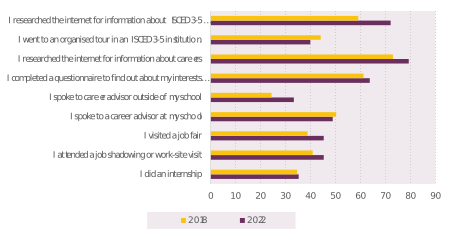
Note. The figure presents the average participation rates for the following countries providing relevant data in PISA 2018 and 2022: Australia, Austria, Belgium, Costa Rica, Denmark, Germany, Greece, Hungary, Iceland, Ireland, Italy, Korea, Lithuania, New Zealand, Poland, Slovak Republic, Slovenia, Spain and the United Kingdom.
Source. OECD PISA 2018 and 2022 databases.
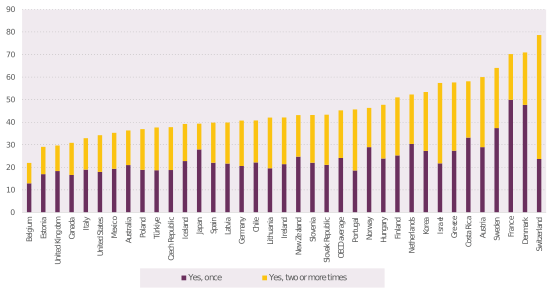
Source. OECD PISA database 2022.
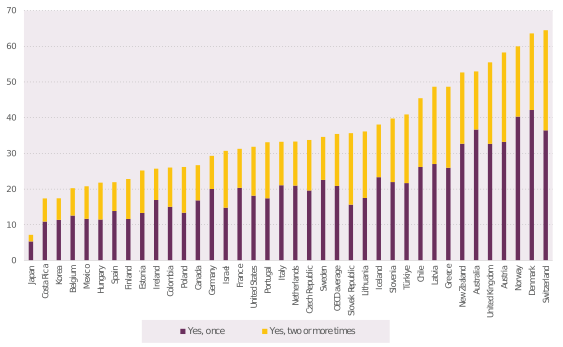
Source. OECD PISA database 2022.
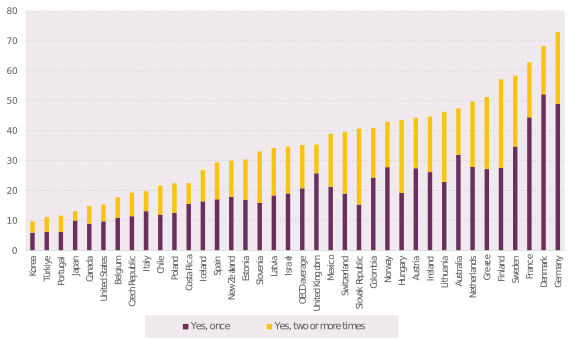
Source. OECD PISA database 2022.
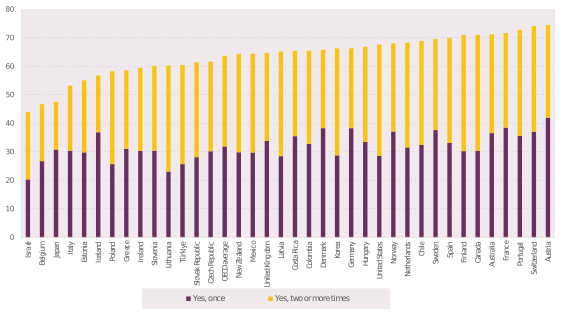
Source. OECD PISA database 2022.
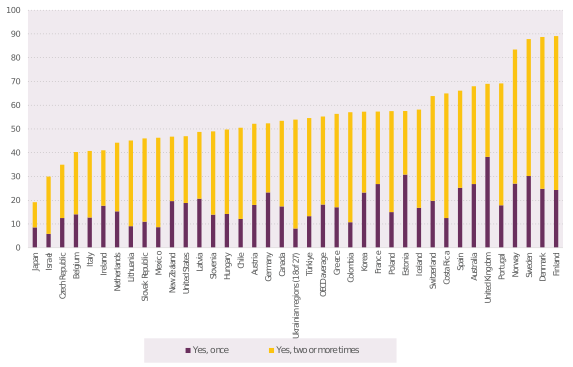
Source. OECD PISA database 2022.
It was very useful for me to speak to someone doing a job that I’m interested in doing. I learnt the ins and outs of the job and became sure that I want to do it because of the salary!
- Aaron, 17