Many students feel poorly prepared for their futures and doubt that their schools are helping them in their career preparation.
The State of Global Teenage Career Preparation
8. Fears for the future: What do students think about the state of their career preparation?
Copy link to 8. Fears for the future: What do students think about the state of their career preparation?Abstract
PISA 2022 includes a series of questions exploring student attitudes related to how well prepared they feel for their futures. Responses to questions reveal levels of confidence and concern expressed by students. In some cases, questions provide insight into the instrumental or extrinsic motivations felt by students that influence their engagement in education. While most students do feel confident about their futures, sizeable numbers do not.
In addition, one-third of students say that they feel pressure from their families to follow a specific path after formal education. One in ten say that they feel this pressure very strongly.
Looking across student characteristics, attitudes are comparable across all groups with the exception of two statements. On average, compared to their peers from the highest quartile by economic, social and cultural (ESCS) status, students from the lowest ESCS quartile are 9 percentage points more likely to agree that that worry that lack of money will prevent them from following their interests. They are also 7 percentage points more likely to agree that school has been a waste of time. This statement is often seen as a test of student instrumental motivation: the belief that engagement in education will lead to desirable rewards in work later in life. In many longitudinal studies, this teenage belief is significantly associated with better ultimate employment outcomes. Analysis of PISA data shows that participation in different forms of career development can also be significantly linked with higher or lower levels of instrumental motivation with further research required to understand relationships more deeply.
Figures 8.1 to 8.8 set out data from OECD countries in response to statements which reveal widespread anxiety among teenagers about their futures. The data show that on average across the OECD.
Key takeaways
Copy link to Key takeaways|
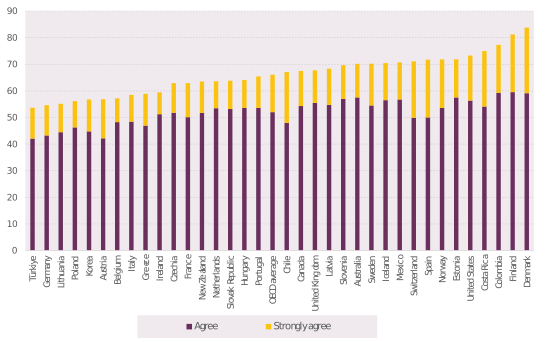
47.3% |
of students agree that they worry that they are not prepared for life after compulsory education, 13.3% agreeingly strongly (Figure 8.1). |
|
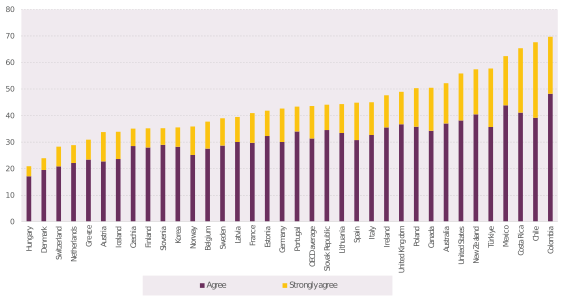
34% |
of students do not agree that they feel well-informed about possible paths after compulsory education, 8% disagreeing strongly (Figure 8.2). |
|
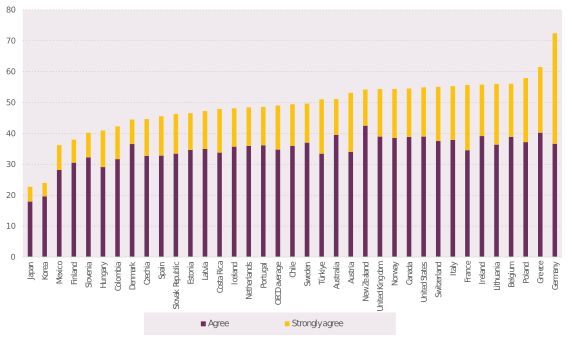
43.6% |
of students agree that they worry that they will not have enough money to do what they would like after compulsory education, 12.2% agreeing strongly (Figure 8.3) |
|
49% |
of students agree that school has done little to prepare them for adult life, 14.2% agreeing strongly (Figure 8.4). |
|
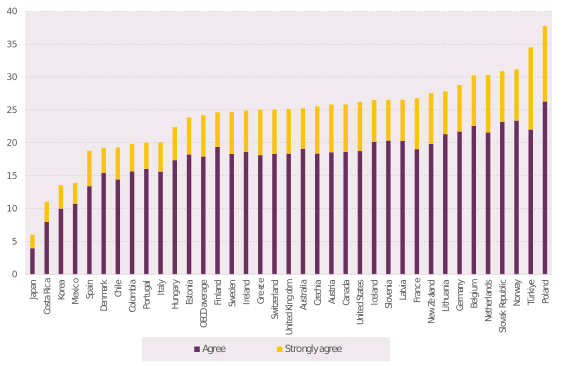
24.2% |
of students agree that school has been a waste of time, 6.3% agreeing strongly (Figure 8.5) |
|
46.1% |
of students do not agree that school has helped give them confidence to make decisions, 12.6% disagreeing strongly (Figure 8.6). |
|
32.6% |
of students do not agree that school has taught them things which could be useful in a job, 9.5% disagreeing strongly (Figure 8.7). |
|
41.5% |
of students do not agree they feel well-prepared for their future path, with 10.3% disagreeing strongly (Figure 8.8). |
Figure 8.1. Percentage of students agreeing with the statement, ‘I worry that I am not prepared for life after <the final year of compulsory education>. OECD countries, PISA 2022
Copy link to Figure 8.1. Percentage of students agreeing with the statement, ‘I worry that I am not prepared for life after <the final year of compulsory education>. OECD countries, PISA 2022Source. OECD PISA database 2022.
Figure 8.2. Percentage of students agreeing with the statement, ‘I feel well-informed about possible paths for me after <the final year of compulsory education>. OECD countries, PISA 2022
Copy link to Figure 8.2. Percentage of students agreeing with the statement, ‘I feel well-informed about possible paths for me after <the final year of compulsory education>. OECD countries, PISA 2022Source. OECD PISA database 2022.
Figure 8.3. Percentage of students agreeing with the statement, ‘I worry that I won’t have enough money to do what I’d like after <the final years of compulsory education>’. OECD countries, PISA 2022
Copy link to Figure 8.3. Percentage of students agreeing with the statement, ‘I worry that I won’t have enough money to do what I’d like after <the final years of compulsory education>’. OECD countries, PISA 2022Source. OECD PISA database 2022.
Figure 8.4. Percentage of students agreeing with the statement, ‘School has done little to prepare me for adult life when I leave school’. OECD countries, PISA 2022
Copy link to Figure 8.4. Percentage of students agreeing with the statement, ‘School has done little to prepare me for adult life when I leave school’. OECD countries, PISA 2022Source. OECD PISA database 2022.
Figure 8.5. Percentage of students agreeing with the statement, ‘School has been a waste of time’. OECD countries, PISA 2022
Copy link to Figure 8.5. Percentage of students agreeing with the statement, ‘School has been a waste of time’. OECD countries, PISA 2022Source. OECD PISA database 2022.
Figure 8.6. Percentage of students agreeing with the statement, “School has helped give me confidence to make decisions”, OECD countries, PISA 2022
Copy link to Figure 8.6. Percentage of students agreeing with the statement, “School has helped give me confidence to make decisions”, OECD countries, PISA 2022Source. OECD PISA database 2022.
Figure 8.7. Percentage of students agreeing with the statement, ‘School has taught me things which could be useful in a job’. OECD countries, PISA 2022
Copy link to Figure 8.7. Percentage of students agreeing with the statement, ‘School has taught me things which could be useful in a job’. OECD countries, PISA 2022Source. OECD PISA database 2022.
Figure 8.8. Percentage of students agreeing with the statement, “I feel well-prepared for my future path after <the final year of compulsory education>”. OECD countries, PISA 2022
Copy link to Figure 8.8. Percentage of students agreeing with the statement, “I feel well-prepared for my future path after <the final year of compulsory education>”. OECD countries, PISA 2022Source. OECD PISA database 2022.
I don’t feel anxious about going into work, but fairly confident that I will find something for me. I feel this way because there are many opportunities waiting. The only problem is that I don’t know what they are.
- Mahmoud, 17