The interest of students in occupational fields of strategic importance where their gender is underrepresented has changed little over the last generation.
The State of Global Teenage Career Preparation

Abstract
Across the OECD, several occupational fields have been highlighted as being both of particular strategic importance and suffering from skills shortages. These include healthcare, information technology, the skilled crafts and trades, and teaching. PISA provides considerable insight into the attitudes of students towards work in these areas. Drawing on data from 2000 onward, it is possible to see if interest in these occupations has changed over the last generation. Moreover, it is possible to explore how attractive jobs are to students from different backgrounds. Notably, workforces across the four fields are all characterised by gender imbalance.
Figure 7.1 tracks the occupational expectations of students from 2000 to 2022 in the occupational areas by gender. It shows the average interest levels of 15-year-old girls and boys from the 13 OECD countries which participated in all PISA studies which asked respondents about their occupational expectations. It reveals that the gender gap in aspiration has only strongly closed in one area, teaching, and this is due to falling interest among young women, rather than increases in the expectations of young men. Girls were as unlikely to anticipate a career in information technology or in the skilled trades in 2022 as they were in 2000. The interest of boys in working in healthcare has increased since 2000, but modestly. Combining results for girls and boys, over this period expectation levels have fallen for teaching, changed little for information technology and the skilled trades and risen for careers in healthcare.
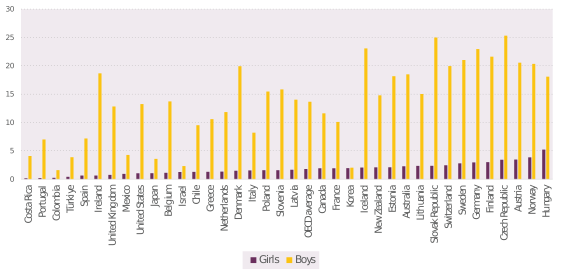
Figure 7.2 to Figure 7.4 unpack the 2022 PISA data related to expectation of working in the crafts and skilled trades (ISCO major group 7). This includes many occupations which are commonly entered through programmes of vocational education and training, including: builders, carpenters, electricians, fitters, insulation workers, motor vehicle mechanics, plumbers, printers and welders. On average across the OECD, PISA 2022 shows that 13.7% of boys and 1.8% of girls expect to work in such a trade. While in all countries, it is more often boys who expect such employment, in some countries such as Hungary and Norway 4-5% of girls share the job ambition, outnumbering the total percentage of interested boys in Colombia, Israel, Korea, Turkey, Costa Rica, Japan and Mexico. Student interest in such professions will respond to genuine or perceived fears that workplaces may be unwelcoming to the minority gender, but also reflect socially constructed assumptions about the forms of work which are reasonable for girls and boys to pursue and the extent to which education and training systems actively seek to attract and accommodate all potential learners.
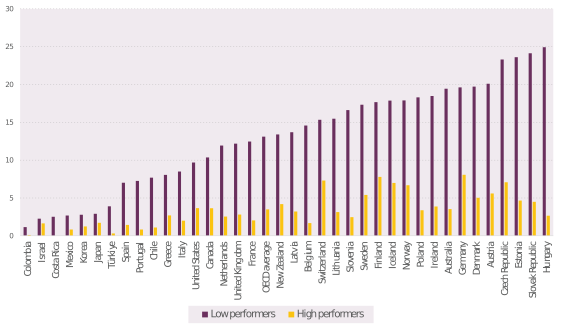
Attitudes also reflect the status and quality of jobs. In some countries, programmes of vocational education and training are perceived to be of poor quality and to provide limited opportunities in work. Figure 7.3 shows that it is rare for students from the most advantaged social backgrounds to expect to work in the skilled trades. On average, they are more than four times less likely to express this job plan than peers from the most disadvantaged backgrounds. However, national variations are again apparent: 6% of socially advantaged students in Denmark and 7.1% in Norway anticipate working in a skilled trade. Equally, as seen in Figure 7.4, while across the OECD the skilled trades remain predominantly the expectation of lower academic performers (13.1% of whom anticipate working in the field, compared to 3.5% of high performers), in some countries, high performers on the PISA assessments demonstrate strong interest. This is the case in Finland (7.8%), Germany (8.1%), Iceland (7.0%) and Switzerland (7.3%). PISA data shows that it not impossible to design a VET system that is found to be attractive to a broad range of students, but that it is certainly unusual.
Figure 7.5 to Figure 7.7 explore the occupational expectations of students with regard to careers in information technology (IT). As with the skilled trades, student interest is highly gendered. Across the OECD in 2022, on average 11.2% of boys say that they will work in the field around the age of 30 compared to 1.5% of girls. As Figure 7.5 illustrates, in every OECD country this pattern of expectation is apparent. In many OECD countries, including Iceland, Italy and Norway fewer than one girl in 200 with a job plan expects it to be in the field of information technology. PISA data also show that students anticipating working in IT tend to be from more socially advantaged backgrounds (Figure 7.6) and especially to be higher achievers on the PISA academic assessments (Figure 7.7). This analysis combines student expectations to work as both IT professionals (ISCO group 25) and as IT technicians (ISCO group 35).
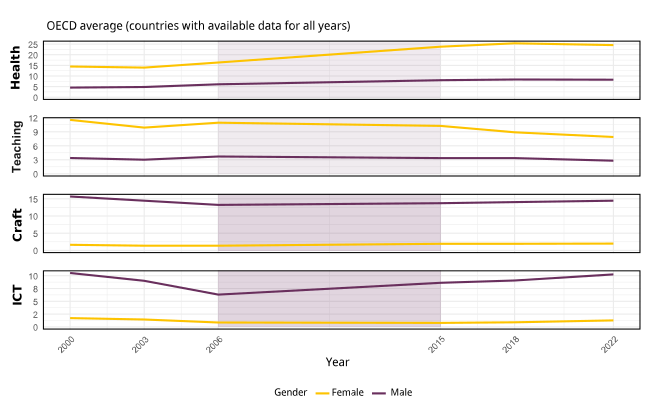
Note. The figure shows the average percentage of students (expressing an occupational expectation) in the profession from among PISA participants in Australia, Austria, Czechia, France, Germany, Greece, Hungary, Ireland, Italy, Mexico, Portugal, South Korea and the United Kingdom. In the PISA surveys of 2009 and 2012 students were not asked about their occupational expectations. Health careers are captured by ISCO groups 22 and 32, information technology (25 and 35), the skilled trades (group 7) and teaching (group 23).
Source. OECD PISA databases 2000-2022.
Source. OECD PISA database 2022

Source. OECD PISA database 2022
Source. OECD PISA database 2022

Note. ISCO 25 and 35.
Source. OECD PISA database 2022.

Note. ISCO 25 and 35.
Source. OECD PISA database 2022.

Note. ISCO 25 and 35.
Source. OECD PISA database 2022.
The most important thing that I’ve learned from career guidance in school is that a lot more women are now doing male dominant careers.
- Nadine, 17