Many students, especially from more disadvantaged backgrounds, are confused about what they need to do to achieve their career plans.
The State of Global Teenage Career Preparation

Abstract
What students think about their futures in work matters. It is predictive of likely outcomes later on. As discussed, young people who are uncertain about their career plans on average go on to do worse in work than would otherwise be expected. The same also applies to a large group of students who can be described as ‘misaligned’ in their career thinking.
Over recent years, a growing number of studies have looked at the alignment and misalignment of the professional and educational plans of secondary school students. Longitudinal surveys commonly ask students about the careers they plan to pursue and the highest levels of education they expect to complete. Where the education level is well- matched with the typical qualifications required for entry into the anticipated profession, students can be described as being ‘career aligned’. When their expected levels of education are much higher or lower than that which is normally required, they are seen as misaligned. It is of greatest concern when students effectively underestimate the education required and this form of misalignment is routinely found in longitudinal studies to be linked with worse employment outcomes than would otherwise be expected in early adulthood.
Across OECD countries, on average one student in five who expects to work in a profession which typically requires tertiary education as an entry qualification (jobs classified within major groups 1, 2 and 3 in the International Standardised Classification of Occupations), but does not plan on continuing in education beyond the completion of upper secondary education. It does not pay to be confused about how the education and training system works.
PISA 2022 shows that it is students who are from the most socially disadvantaged backgrounds who are systematically more likely to be so misaligned in their career thinking (Figure 3.1).
On average, across OECD countries, 34% of students from the least advantaged quarter of students can be described in this way compared to 11% of the most advantaged students. In some countries, around half of disadvantaged students express such confusion in their future planning. Equally, students who perform at the lowest levels on the PISA academic assessments demonstrate high levels of misalignment (Figure 3.1). While studies show that such low-performing students are likely to struggle to complete tertiary education, at the age of 15 many expect to work in a profession that typically requires a university qualification.
Over the last 20 years, levels of such misalignment have fallen as the educational ambitions of students have increased. Looking at OECD countries for which data are available in both 2003 and 2022 shows that the percentage of students expecting to complete some form of tertiary education rose from 58% to 67%. Increases in educational ambition are in general to be welcomed as young people with higher levels of qualifications can expect to enjoy, on average, greater security in the labour market and teenage educational ambitions do have a predictive quality. Analysis of PISA data shows that students who engage more strongly in career development activities are less likely to demonstrate misalignment. For schools, tests for career misalignment are further simple ways of helping students to explore what employers will ultimately demand in terms of education and training to allow entry into desirable professions.
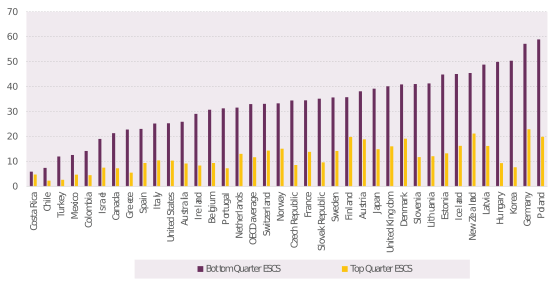
Note. Students are categorised as misaligned where they expect to work in an ISCO 1-3 occupation and expect to complete education at a level lower than ISCED 5.
Source. OECD PISA 2022 database.
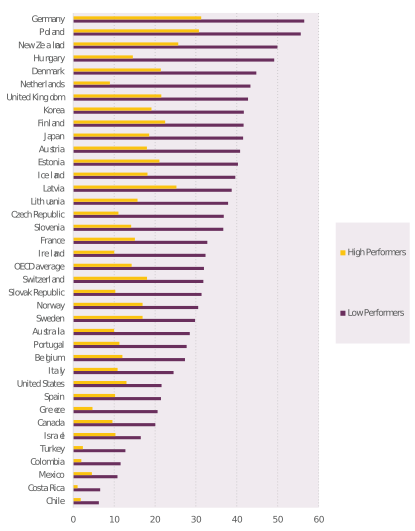
Note. Students are categorised as misaligned where they expect to work in an ISCO 1-3 occupation and expect to complete education at a level lower than ISCED 5. High performers are students who achieved above level 4 in at least one of the PISA assessments in science, mathematics and reading and above level 2 in the other two assessments. Low performers are students who achieved below level 2 proficiency in one of the three assessments.
Source. OECD PISA data 2022
It is pretty difficult to decide what I want to do because I have no clue what grades I am going to get and what opportunities in and out of school I’ll have.
- Mahmoud, 17