The percentage of students who are uncertain about their career plans has grown substantially since 2018, increasing the risk of poor employment outcomes.
The State of Global Teenage Career Preparation

Abstract
Since 2000, students completing the PISA surveys have often been asked to name the type of job they expect to work in around the age of 30. As explored later in this paper, answers to the question provide valuable insights into how student career plans relate to actual patterns of demand for labour. But more than this, it is important to know whether students have clear expectations at all.
Many longitudinal studies have explored whether teenage career uncertainty can be related to later employment outcomes. A recent OECD review of 19 studies found that 15 provide evidence that uncertainty is bad for young people. Uncertain teenagers on average go on to experience poorer employment outcomes in adulthood than would be otherwise expected given their educational success, social background, gender, migrant status and other characteristics. It pays to have a clear vision for the future.
Why is this? It is known that student career plans do have a predictive quality. Someone with a clear job plan at 15 is more likely to end up working in that profession than in any other random occupation. Consequently, it matters whether teenagers express interest in working in fields of strategic importance and if not, there is an onus on societies to consider how student understanding of such occupations and progression routes into them can be improved. In general however most young people do not go on to secure the exact job they expected when in school. The larger importance of career certainty and uncertainty lies in what it says about how much a young person is actively thinking about their future lives in work.
PISA shows clearly that young people who participate more in career development activities are less likely to be uncertain about their plans. A student with a career plan can begin a deep exploration of a professional area, investigating what it would mean in practice to work in such a field by speaking to people employed in related jobs and seeking out first-hand experiences through internships, voluntary work or part-time employment. Importantly, they can also begin working out what they need to do to achieve their career goal: how hard they will need to work to secure grades at the right level in the right subjects to allow them to have a good chance ultimately of entering their desired profession.
In most OECD countries, students focus their attention on a narrower range of subjects within upper secondary education often with significant consequences for their further progression in education, training and work. For students to make informed investments in their schooling, they need help in understanding whether different roles in the labour market would be fulfilling and obtainable to them personally. As will be seen, many young people express plans for the future that will be challenging given the levels of academic success they demonstrate in the PISA assessments on mathematics, reading and science.
It is likely moreover that career uncertainty contributes to poorer educational success. PISA shows that career uncertainty is especially high among students who performed at the lowest levels on the study’s academic assessments. In 2022, whereas 34% of the highest performers can be classified as career uncertain, this applies to 44% of the lowest performers.
Students are classified in PISA as being uncertain if they provide no answer to the survey’s question on their occupational expectation, but also if the response given is too vague or broad to allow for identification within the International Standardised Classification of Occupations. Checks are undertaken to see if students who failed to write in an answer to this question also failed to respond to other questions that required written answers, such as those related to parental occupation. In PISA 2022, more than three-quarters of students who did not enter a classifiable occupation did write in details for at least one parental occupation.
Since the turn of the century, the percentage of students with clear career plans has fallen with uncertainty rising substantially over the last decade. Figure 1.1 compares results for all PISA surveys since 2000 which have featured this same question concerning student job plans. Across the OECD, PISA 2022 shows that 39% of students can now be classified as career uncertain. While levels of uncertainty vary considerably across OECD countries, in very few are more than three in four students now clear about their future plans (Figure 1.2).
An important question for schools to ask students around the age of 15 is what type of job they expect to have when they are around 30. Students may be thinking of a few different professions or change their plans over time and this is very reasonable. The important thing is that they are encouraged to begin imagining their futures in work through lower secondary, allowing them time to explore fields of potential interest while they have plenty of time to build an understanding of how the choices they make in education and training can either enable or hinder easy access towards desirable ultimate employment.
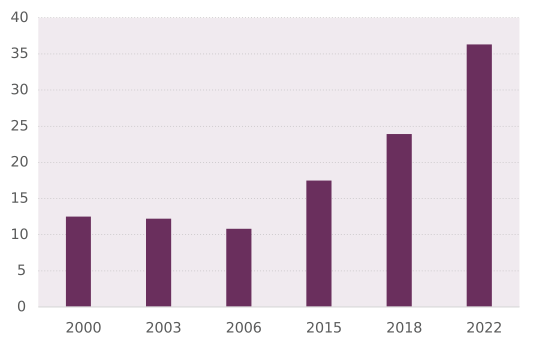
Note. The figure shows the average level of uncertainty among students from countries participating in all PISA surveys asking: ‘What kind of job do you expect to have when you are about 30 years old?’ This question was not asked in 2009 or 2012. The countries participating in all relevant surveys are: Australia, Austria, Czechia, France, Germany, Greece, Hungary, Ireland, Italy, Mexico, Portugal, South Korea and the United Kingdom.
Source. OECD PISA databases 2000-2022.
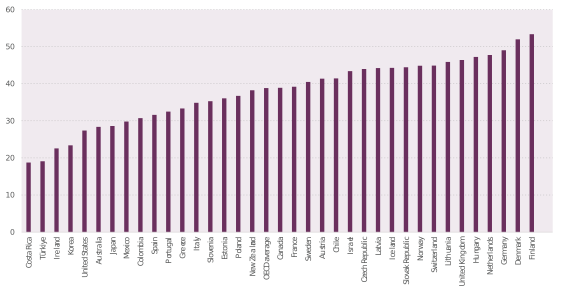
Source: OECD PISA databases 2022.
I feel anxious about working life. I want to be able to enjoy my career and have a stable income, but I don’t know what options would be available for me as I’m not sure what career to do.
- Bella, 17