The education plans of students are driven more by social background than by ability.
The State of Global Teenage Career Preparation

Abstract
By the age of 15, students in most OECD countries are approaching important decision points. In many countries, it is around this age that students decide whether they will continue in secondary education and if so, whether they will pursue general education pathways which commonly enable access to tertiary education or to enrol on programmes of vocational education and training.
It has long been understood that the social background of students plays an influential role in the decision-making of students. Data from PISA 2022 provides new insight into just how strongly the family background of students shapes their aspirations.
PISA uses an algorithm that draws on parental occupation, educational levels and household possessions to place all students on a spectrum by economic, social and cultural status (ESCS). Figure 4.1 compares educational plans of high performing students on the PISA assessments in mathematics, reading and science by their ESCS status. The figure illustrates a consistent ‘aspiration gap’ in educational plans. Across OECD countries, on average the most socially disadvantaged students are 22 percentage points less likely to anticipate completing some form of tertiary education. In Czechia, Estonia, Hungary, Korea, Latvia, Sweden and the United Kingdom, this gap in 30 percentage points or more.
Figure 4.2 further explores the data and finds that on average across the OECD countries, low performing students from the highest ESCS backgrounds are more likely to expect to complete some form of tertiary education than high performing students from the lowest ESCS backgrounds. This gap averages 8 percentage points across the OECD and is found in most member countries. It is only in nine jurisdictions where the two figures are comparable or where academic ability is a better measure of educational plans than social background. Analysis of PISA data shows that students who have engaged in different career development activities in general demonstrate significantly higher levels of educational ambition.
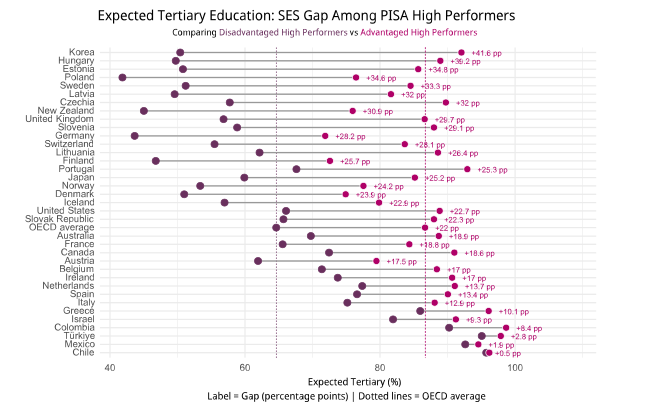
Note. High performers are students who achieved above level 4 in at least one of the PISA assessments in science, mathematics and reading and above level 2 in the other two assessments. The figure compares the percentages of students from the most socially advantaged and disadvantaged quartiles by assessment of economic, social and cultural status expecting to complete ISCED levels 5-8.
Source. OECD PISA 2022 database.
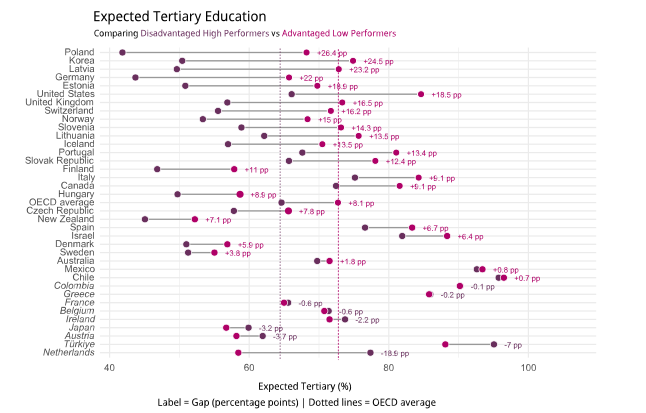
Note. High performers are students who achieved above level 4 in at least one of the PISA assessments in science, mathematics and reading and above level 2 in the other two assessments. Low performers are defined as students who failed to achieve level 2 in one of the three assessments. The figure compares the percentages of students from the most socially advantaged and disadvantaged quartiles by assessment of economic, social and cultural status expecting to complete ISCED levels 5-8.
Source. OECD PISA 2022 database.