This is the second OECD overview of the global state of teenage career preparation. The first was launched in January 2020 at the World Economic Forum in Davos, Switzerland. Our publication, Dream Jobs: Teenagers' Career Aspirations and the Future of Work, provided important new insights into the significant challenges that young people face as they complete formal schooling.
The study showed that by the age of 15 career aspirations were strongly shaped by social background and highly concentrated with many students planning to work in jobs at significant risk of automation. Career guidance could be seen in the data to enhance the readiness of young people to progress through education towards desired careers, but many students had not yet engaged in beneficial activities.
Dream Jobs was based on data from the 2018 round of the OECD Programme for International Student Assessment (PISA). We now present key findings from PISA 2022, the world’s largest dataset on young people’s educational experiences and attitudes. In PISA 2022, 690 000 students from 81 countries completed assessments on their proficiency in mathematics, reading and science and provided substantial background information about their lives and schools. They responded moreover to questions concerning their career and educational plans, their participation in career development activities, attitudes towards career progression and participation in part-time work.
With large representative samples from each participating jurisdiction, not only can PISA compare national experiences, but we can also unpack the data to explore how career preparation varies by student characteristics such as gender and social background. PISA 2022 represents the largest ever comparative international survey of student career thinking and preparation.
Between the two studies, much has changed. We have endured a global pandemic, inflation and economic instability, growing concerns over climate change and a period of intense technological change with Artificial Intelligence becoming adopted across economic and educational life. All these factors serve to create greater instability in the labour market, making career planning both more challenging and more important for young people. Over the same period, it has become clearer than ever that teenage career development works. Guidance interventions can be expected to make a positive difference to young people as they transition into the world of work.
Within the data on the career preparation of students contained in PISA 2022, some points of information are particularly important. This is because recent analyses of multiple longitudinal datasets from different countries consistently highlight strong statistical relationships between different forms of teenage career development and thinking and better ultimate employment outcomes. Our 2021 paper, How youth explore, experience and think about their future, summarises analyses of datasets from ten countries. It finds strong associations between the ways in which students, typically around the age of 15, engage in different forms of career development and better results in the labour market as found in employment/unemployment rates, earnings and career satisfaction, typically around the age of 25.
The analysis, which takes account of student gender, social background, academic achievement and other factors which influence success in the competition for work, identifies important teenage predictors of better outcomes. PISA gathers information about many of these indicators. We know that when students actively explore their potential futures in work, they can expect them to do better later than would otherwise be expected.
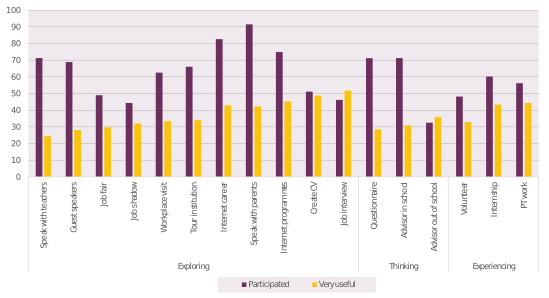
In PISA, data is available on student career exploration through workplace visits or job shadowing, in job fairs and career conversations. Such activities connect students with people in work, a hugely valuable resource within career development. Studies find too that first-hand experiences of undertaking tasks under supervision within workplaces are also routinely associated with better long-term employment prospects for young people. PISA 2022 allows us to compare how students engage in short work placements (internships) and for some countries in part-time employment while PISA 2018 gathered information about volunteer work. These are all forms of career development that give students unrivalled opportunity to gain skills and insights relevant to occupations of interest, to meet and learn from people doing such jobs, and to build confident insight into how they can best navigate systems of education and training to achieve job ambitions.
Longitudinal studies show us moreover that the ways in which teenagers think about their potential futures in work matters. Young people who express clear job plans around the age of 15 can expect to do better ten years later than comparable peers who are uncertain about their ambitions. Equally, students who are confident that their schools will be able to help them to achieve their aspirations and who understand what desired occupations typically require in terms of educational achievement can anticipate better outcomes. PISA asks students many relevant questions surrounding such career thinking. It also allows us to observe how student participation in career development activities is linked to the career thinking that makes a difference. For schools, insights from longitudinal studies shape many useful questions that can be asked of students as staff seek to identify girls and boys in need of greater support.