The engagement of employers and people in work is at the heart of effective teenage career development. Their involvement provides students with opportunities for gaining information and experience which are very difficult to replicate without their participation. Such activities are strongly associated with better outcomes for both young people – and their employers. Research studies provide valuable insight into how benefits can be maximised and how the connections between schools and employers can be most effectively, efficiently and equitably delivered.
The State of Global Teenage Career Preparation

Analysis of large-scale datasets that explore the links between teenage career development and adult employment outcomes identify compelling evidence of benefits to young people. Of the nine forms of teenage career exploration and experience where international longitudinal datasets are sufficient to allow an assessment of long-term impact, seven either require students to engage with employers or are commonly enhanced (and delivered) through employer engagement. These include: career insight talks and job fairs, workplace visits and job shadowing, career conversations, career pathway programmes, application and interview skills development activities, part-time working, volunteer work and internships. Across all these areas, positive impacts can be identified linked to the later likelihood of being in employment, education or training, earnings and/or job satisfaction. Such career activities are also associated with more beneficial forms of teenage career thinking (clear, ambitious, aligned plans that recognise the value of education in employment transition).
Retrospective user studies have also found strong relationships between more successful transitions after secondary school, including lower unemployment rates and (if in work) higher wages, and teenage participation in forms of career development that require students to connect with employers and people in work. Figure 9.1 illustrates descriptive results from a recent survey of young adults aged 19-26 educated in the community of Madrid, Spain. The figure compares the agreement of respondents that their schools had prepared them well for adult life and their recollections of the number of times that their secondary schools had connected them with employers and people in work in the context of career development. It finds that whereas two-thirds of young adults who recalled no interactions felt that their schools had prepared them poorly, this applied to only one-third of their peers who recalled four or more engagements. Similar results have been found in surveys of young adults in the UK. Higher levels of recalled employer engagement have been significantly linked with lower rates of young adults being Not in Education, Employment or Training (NEET).
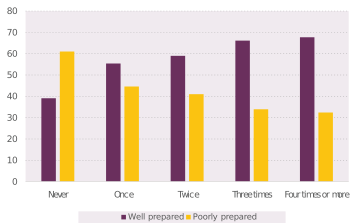
Note. Survey of 1 015 young adults (aged 19-26) who had attended secondary education in the Community of Madrid, Spain. The survey was undertaken in the summer of 2024.
Source. OECD survey of young adults in Madrid, Mann, A. et al. (2025), Career Readiness in Madrid (Spain): insights from a survey of young adults (19-26), OECD Publishing, Paris.
Studies of the role of employer engagement in teenage career development highlight its capacity to provide students with information and experiences which are new, useful, and difficult to ignore. Students are especially likely to trust insights gained from employer engagement. They see first-hand experiences as being authentic and up to date. Studies show too that they frequently use their experiences to build up resources that enable more confident navigation through education and training and support successful ultimate transitions into work. Episodes of employer engagement are seen to enhance the knowledge and skills of students and to build their social networks, gaining access to useful career-related information and often recommendations or job offers. Perhaps most importantly, students are seen to increase both their understanding of potential careers and confidence in how they can best be secured, allowing them to invest their time more strategically and with greater certainty in schooling. These benefits are often conceptualised as forms of human, social and cultural capital that are ultimately assessed by recruiters in deciding the suitability of candidates applying for jobs.
Surveys show that the primary reason why employers engage with schools is to enhance short-term or long-term recruitment. As noted in this paper, the career ambitions of young people are strongly concentrated around a small number of traditional careers. Employer engagement programmes, such as career talks, workplace visits, and job fairs can be very effective means of broadening (as well as deepening) career aspirations. Studies also show that employers value working with schools because it provides opportunity for staff development, increases staff happiness at work and allows them to work with young people on business questions. Many also are determined to contribute to their communities and do social good. More than this however, a larger more significant benefit is apparent. Many studies find evidence of adult wage premiums linked to teenage participation in career development activities which engage employers. This means that such students often go on to earn more than comparable peers who did not engage in such a way while in school. It is an orthodox economic assumption, that higher wages reflect higher individual productivity. It is not difficult to imagine that students who progress through education into employment with a deep understanding of a working area of interest will be more likely to thrive in a field of employment that is well-matched with their interests and abilities.
For employers in sectors which are experiencing skills shortages, employer engagement with schools is particularly important. This is especially the case where shortages are accentuated by gender or other disparities and there is determination to create more balanced workforces (so increasingly opportunity to attract interested and able young people). Surveys of young adults show that large minorities wished their schools had provided opportunity to explore occupations where people like them are poorly represented, but such opportunities through schools is commonly limited. Young people considering such occupations need to be able to see for themselves whether such workplaces would be welcoming and supportive.
As summarised in the OECD paper, Meet the Future: How employers gain from helping young people get career ready (2022), reviews of multiple studies of employer involvement in career development show that more effective provision will be seen as authentic and trustworthy by young people. It will be frequent and often mandatory for students whose perceptions of its usefulness should be taken seriously. In effective practice, students will have opportunity to engage in a variety of different employer-related opportunities. Particularly through lower secondary education (but beginning in primary schooling), career exploration with people in work is especially valuable. As students get older, it is important for them to gain first-hand experience of undertaking tasks under supervision within workplaces of interest for extended periods of time. This could be through volunteer work, part-time employment or through internships/work placements. Effective provision is personalised to the needs and interests of the student. Effective schools will encourage a culture of active curiosity in the world of work, linking learning with the world of work to help students see the relevance of the subjects they are studying. It will also encourage and enable learners to reflect on positive and negative attributes of the working world from their own individual perspectives.
Effective programmes of employer engagement will ensure that school staff and students will have extensive opportunity to engage with the world of work, enabling them to connect with working professionals and workplaces which match most closely with their emerging interests. The primary costs involved in enabling employer engagement with schools are in finding the right people to support the right activities at the right time.
More efficient systems will draw on intermediary organisations to identify individuals and workplaces open to engaging. Intermediaries can also enable more equitable provision by ensuring that schools serving students in greatest need (and where parental and local contacts may be limited) are prioritised. Online mechanisms can pre-identify thousands of workplaces and professionals open to working with schools, making them available to schools to select based on students’ needs.
I have been extremely indecisive about my job plans because I’m not sure what job pays well without mentally draining you at the same time. I’m still in the process of deciding.
- Noora, 17