Smaller settlements have fewer social infrastructure facilities and while those farther from more densely populated places have comparatively more, this does not guarantee everybody can meet in a nearby café, bar, restaurant or fast-food outlet.
Social infrastructure refers to spaces that enable social interaction, including eating and drinking facilities, cultural venues and public community facilities. Accessible, high-quality social infrastructure can strengthen social capital and belonging, improve well-being and community resilience and support cultural participation. Thriving local amenities can contribute to the vitality and attractiveness of places, while their disappearance can reinforce a cycle of declining confidence and investment in a community's future. Digitalisation of services and social interaction, combined with population decline, can reduce demand for local facilities, making them harder to sustain in remote and sparsely populated areas.
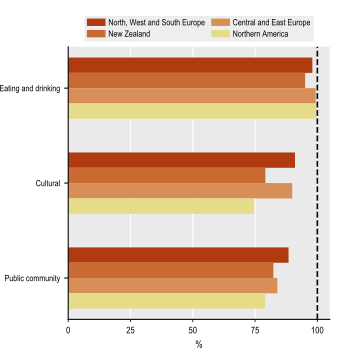
The provision of social infrastructure closely follows settlement size. Eating and drinking facilities increase roughly in proportion to population: a settlement with twice as many inhabitants has, on average, about twice as many cafés, bars and restaurants (Figure 3.8). Cultural and public community facilities also increase with population, but less than proportionally, possibly reflecting public or community support in smaller settlements. Some cultural facilities also serve as multifunctional community hubs, combining cultural activities with adult learning, employment support and other public services.
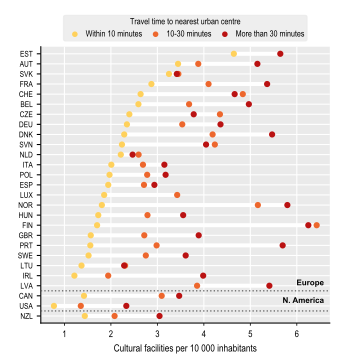
Access to cultural facilities also varies across countries and with proximity to larger cities. Small urban centres often have more cultural facilities per capita but fewer facilities overall. Vienna, for example, has 18% fewer cultural facilities per capita than the average Austrian urban centre, but about five times as many in total. Differences in cultural provision across cities are larger in Italy and the United States than in Northern European countries (Figure 3.12 and Figure 3.13). Among towns, those closer to cities tend to have fewer local cultural facilities: the median is 2.1 cultural facilities per 10 000 inhabitants within a 10-minute drive of a city, compared with 4.2 more than 30 minutes away. In all 27 OECD countries with available data, towns closest to a city have the fewest cultural facilities per capita (Figure 3.9).
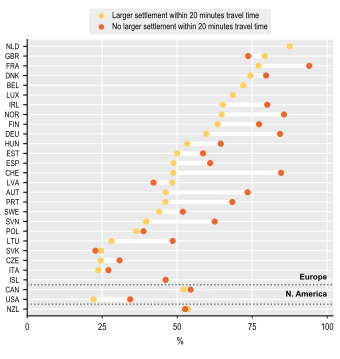
Public community facilities in villages also vary widely across countries and with proximity to larger settlements. The share of villages with such a facility is 53% across 28 OECD countries with data, and ranges from 88% in the Netherlands to 24% in Italy. Across countries, 52% of villages within a 20-minute drive of a larger settlement have a public community facility, compared with 60% of more remote villages (Figure 3.10). In Switzerland, where the gap is largest, the shares are 49% and 85%, respectively.
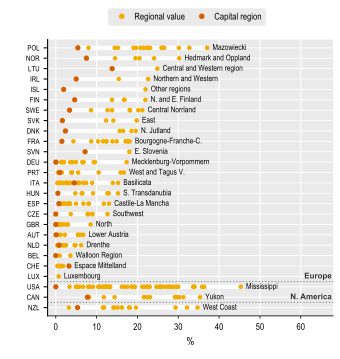
Access is also poorer in less densely populated regions. In the median OECD region, 9% of people lack an eating and drinking facility within a short commute, but regional differences are large: almost everyone in Berlin and the District of Columbia has easy access, while 17% in Mecklenburg-Vorpommern and 45% in Mississippi do not (Figure 3.11). Lower population density can make nearby facilities harder to sustain, while even short driving distances may represent much longer journeys for people who cannot drive or lack access to a car.