Knowledge-intensive business services have driven productivity growth in recent years, but their higher concentration in leading regions can reinforce disparities in productivity across regions.
Productivity gains in knowledge-intensive business services (KIBS) tend to be more spatially concentrated than those in manufacturing. KIBS often rely on specialised labour markets, proximity to clients and knowledge spillovers, which favour their concentration in major cities and knowledge hubs. Manufacturing activity, while also geographically clustered, is typically distributed across a broader range of regions.
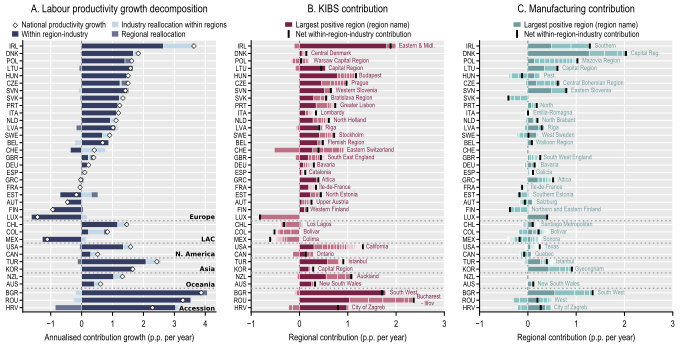
Between 2018 and 2024, productivity growth was driven primarily by improvements within existing industries, driven by technological progress, efficiency gains or the exit of less productive firms, rather than shifts in employment between industries or regions. In the period, 91% of labour productivity growth in large regions came from within-industry gains, with little variation across countries (Figure 1.6, Panel A). This is in line with national-level analysis (OECD, 2026).
Breaking down gains shows that KIBS made a larger contribution to within-industry productivity than other individual sectors in 17 of the 34 OECD Member and accession countries with available data (Figure 1.6, Panel B). The contribution of KIBS was geographically concentrated in most cases: in 21 countries, at least half of the KIBS contribution came from a single economically important region. In 13 countries, this region was the capital-city region. KIBS contributed to within-industry productivity more than manufacturing in 23 out of 34 countries with available data. In the United States, for example, KIBS in California alone contributed more than manufacturing across all US regions combined (0.29 vs. 0.24 p.p.).
Manufacturing contributions, in turn, were more evenly spread across regions. Notable exceptions include Denmark (mostly through the effect of a single pharmaceutical company), Poland, and Ireland (Figure 1.6, Panel C). In Poland, for example, manufacturing accounted for 70% of within-industry productivity growth, but its contribution was relatively evenly distributed across regions, with Mazovia, the largest contributor, accounting for just 13%.
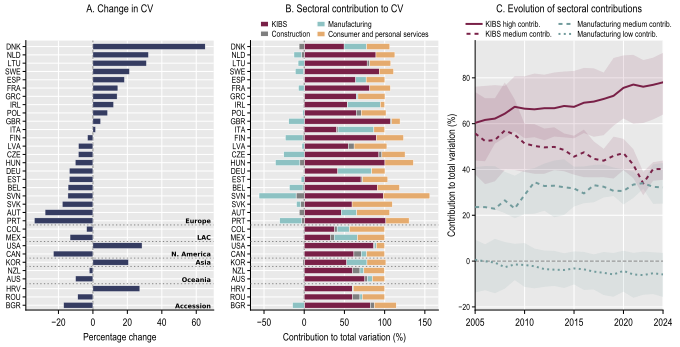
The geographic concentration of KIBS helps explain its growing contribution to regional productivity disparities. In 2024, KIBS contributed 50% or more to disparities in regional GVA per worker in 26 out of 32 countries. KIBS contributions were positive across all countries, amounting to 70% on average, while manufacturing contributions were positive in 16 countries and negative in 16, exceeding those of KIBS in only Germany and Italy (Figure 1.7, Panel B). Between 2005 and 2024, the contribution of KIBS to regional productivity disparities increased in 25 of 32 countries with available data, while the contribution of manufacturing declined in 27 countries (Figure 1.7, Panel C). These sectoral trends occurred amid diverging national trends in regional productivity disparities, which rose in 13 countries and fell in 16 countries (Figure 1.7, Panel A).