Population growth concentrates mostly in capital-city and metropolitan regions while other regions are shrinking, ageing faster and experiencing more deaths than births, with these disparities projected to persist or intensify over time.
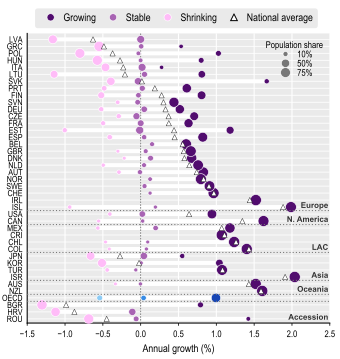
Population decline and ageing are strongly uneven within countries (OECD, 2025). In many countries where the population is falling, capital-city regions continue to grow while most people live in shrinking regions. This trend is putting regions within the same country on increasingly different demographic paths. In shrinking OECD Member and accession countries such as Bulgaria, Croatia and Greece, more than half of the population lives in a region that is losing people, while fewer than one in five live in a growing region (Figure 2.1). Growth is usually concentrated in the capital region, where populations have risen by as much as 1.4% a year in recent years. On average, the average difference in annual population growth between growing and shrinking regions is 1.4 percentage points, with the largest differences in Bulgaria, Canada, Estonia, Iceland, and Romania.
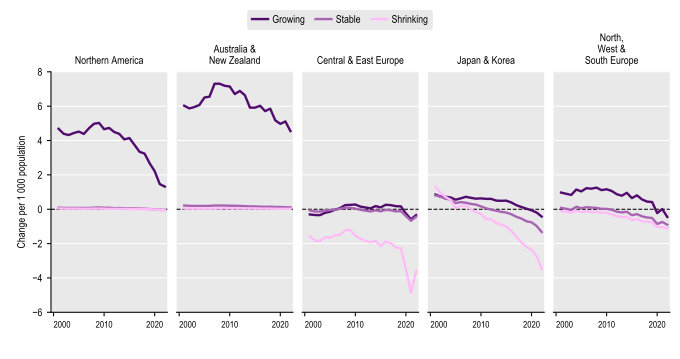
In European and Asian countries with available data, natural population decrease (more deaths than births) in shrinking regions has become an increasingly important contributor to population decline, compared to people moving away (Figure 2.3). Over the past two decades, high shares of elderly population and low fertility have led to increasingly more deaths than births in these shrinking regions, especially since 2010. By contrast, in Australia, Canada, Costa Rica and New Zealand, where national populations have continued to grow, births and deaths are closer to balance in shrinking and stable regions. Population change in shrinking regions in these countries is most likely due to out-migration.
Many shrinking regions also face greater pressure to support ageing communities, especially in shrinking regions that are also affected by out-migration. In 2025, shrinking regions had higher old-age dependency rates than stable or growing regions in all 10 countries that experienced population decline between 2015 to 2024 (Figure 2.4 and Figure 2.5). Among these countries, old-age dependency ratios were highest in shrinking regions of Japan (57%), Bulgaria (41%), Italy (41%), and Croatia (39%). Within-country regional differences in old-age dependency rates reached over 50 percentage points in Belgium, Canada and France.
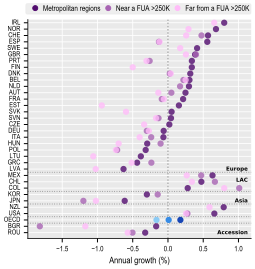
Population projections predict these trends will be reinforced over time. Metropolitan regions in most countries continue to grow, while most non-metropolitan regions shrink. Across 32 OECD Member and accession countries with available data, the gap between the fastest- and slowest-growing regions in projected population change over 2025–45 averages 0.5 percentage points annually. Metropolitan regions are expected to record the strongest population growth, or the smallest declines, in 27 out of 32 countries (Figure 2.2). In contrast, regions far from a midsize or large FUA are projected to experience the weakest population growth, or largest population declines, in 24 countries. The divergence is particularly marked in several European countries. For example, metropolitan populations are projected to grow by around 0.39% annually in Finland and 0.16% in Estonia, while populations in regions far from a midsize or large FUA are projected to decline by around 0.43% and 0.94%, respectively. Chile, Colombia, Greece, Hungary and Korea are exceptions, where regions near a midsize or large FUA are expected to experience stronger growth.