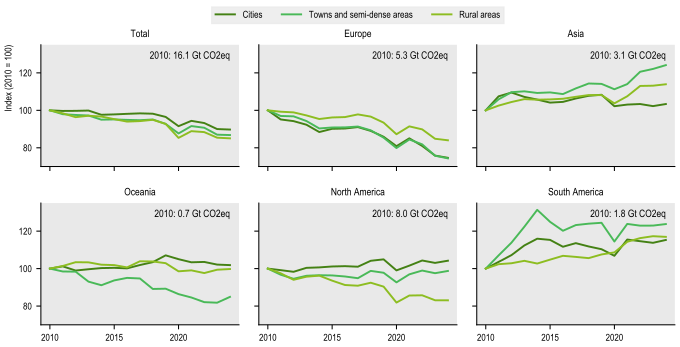
GHG emissions in OECD countries have continued to decline, falling below COVID-lockdown levels across all settlement types.
Greenhouse gas (GHG) emissions have continued to decrease in OECD countries in 2024. Emissions fell below the levels observed during COVID-19 lockdown in 2020 across all types of settlements: cities recorded the steepest decline at -2.0%, followed by towns and semi-dense areas at -1.0%, and rural areas at -0.3%. Regional trends, however, tell a more nuanced story. In North America and Oceania emissions in cities have remained broadly stable, emissions in other types of settlements have decreased. In contrast, Asia has followed a different trajectory, with emissions increasing in rural areas, towns and semi-dense areas from 2010 to 2024. South America has also recorded rising emissions in all settlement types, although from a much lower baseline than North America (1.8 Gt CO₂eq in 2010 compared with 8.0 Gt CO₂eq) (Figure 4.5).
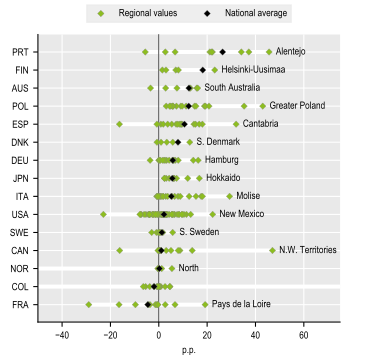
Transitioning to net zero requires both decarbonising electricity generation and electrifying most end-use sectors. Progress has been particularly evident in electricity generation. Over the past four years, the share of electricity produced from non-fossil fuel sources increased in 154 out of 222 regions with available data, rising by an average of 4.5 p.p. Some regions have advanced particularly rapidly. Alentejo (Portugal) recorded the largest increase (+45.6 p.p.), supported by abundant solar and wind resources and the availability of land suitable for renewable energy deployment. Cantabria (Spain), Greater Poland and Northwestern Territories (Canada) also record notable increases (Figure 4.6).
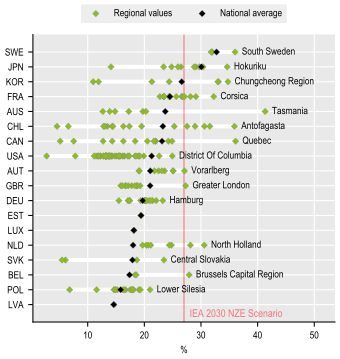
Progress in electrifying final energy consumption has been slower and remains insufficient. Electrification has advanced in most OECD regions in recent years, but progress is particularly challenging in regions with energy-intensive industries, where many industrial processes remain difficult to electrify compared to low-temperature heat processes. Under the IEA Net Zero Emissions by 2050 (NZE) Scenario, the share of electricity in total final energy consumption is expected to increase from 20% in 2022 to over 27% in 2030. Yet 84% of OECD regions (162 out of 191) currently fall below this threshold, with many still below a 20% electrification rate. Sweden stands out as a notable outlier, with most of its regions, led by South Sweden, already exceeding the 2030 benchmark. Tasmania (Australia) records one of the highest electrification rates in the OECD, with more than 41% of total final energy consumption. At the other end of the spectrum, several regions in Chile, Canada, the United States, the Slovak Republic and, Poland record electrification rates below 10%. In Alaska, for example, electricity accounts for just 2.8% of the final energy consumption (Figure 4.7).