The net-zero transition depends largely on electrifying end-use sectors, yet progress remains uneven, particularly in industry and transport.
The net-zero transition depends largely on electrifying end-use sectors. Most electrification needs can be met through the widespread deployment of electric vehicles and heat pumps, while in the industrial sector, the greatest electrification potential lies in low-temperature heat processes. High-temperature processes such as cement or steel production will likely require alternative solutions such as green hydrogen and carbon capture.
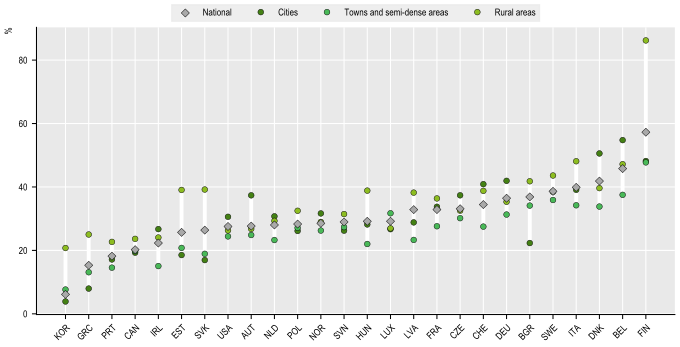
Improving the energy performance of buildings requires both greater energy efficiency and cleaner heating systems. Space heating accounts for the largest share of residential energy consumption in most OECD countries. Modernising the residential sector therefore requires a dual approach: improving the energy efficiency of the building stock through renovation and insulation, while replacing fossil fuel-based heating systems with heat pumps or district heating. Older dwellings generally have lower energy efficiency performance, making the share of dwellings built before 1960 a useful proxy for the scale of the renovation challenge. This challenge is particularly acute in rural areas, where dwellings tend to be larger, older and more costly to retrofit. In 15 out of the 26 countries with available data, rural areas have a higher share of dwellings built before 1960 than cities, towns and semi-dense areas. On average, this share is more than 9 p.p. higher in rural areas than in towns and semi-dense areas. However, it should be noted that this indicator may not fully capture energy efficiency improvements resulting from recent renovation programmes in some countries (Figure 4.8).
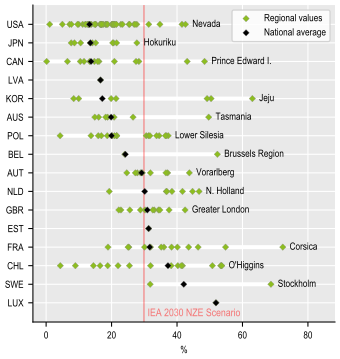
Electrification of industry has progressed more slowly, reflecting the technical challenges of decarbonising industrial processes. Today, industrial electrification mainly applies to low-temperature processes (food, paper, light manufacturing and some chemicals) using industrial heat pumps and electric/plasma arc furnaces, already common in secondary steel production. Under the IEA Net Zero Emissions by 2050 (NZE) Scenario, electricity is expected to account for nearly 30% in 2030 of industry’s final energy consumption, up from 22.6% in 2022. Yet industrial electrification remains relatively low in most regions: in two third of regions with available data, electricity accounts for less than 30% of industry’s final energy consumption. A few regions stand out, such as Stockholm (Sweden), where electrification rates exceed 68%. These regions also have relatively small industrial sectors, with industry contributing only 5-10% of regional gross value added. For high-temperature processes, such as steel, glass and cement production, low-carbon hydrogen from electrolysis is technically available but costlier than fossil-fuel based alternatives. Cement also requires carbon capture to address unavoidable process emissions (Figure 4.9).
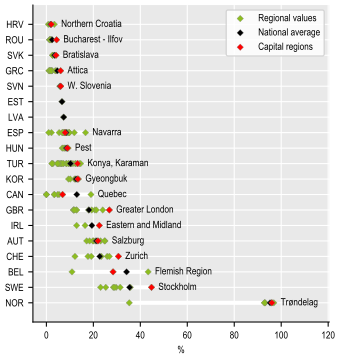
The electrification of transport is accelerating, driven by rapid growth in electric vehicle (EV) adoption, although uptake remains geographically uneven. Electric car sales increased by 20% in 2025, surpassing 20 million sales and accounting for one in four new cars sold worldwide. Within and across OECD countries, however, this growth remains spatially uneven. Electric vehicles tend to be more present in capital regions in almost all OECD countries, with Oslo and Viken by far leading with close to 39% of electric vehicles. Regional disparities are also evident in new vehicle sales, although several non-capital regions are catching up. In Salzburg (Austria), for example, close to one-quarter of new private passenger vehicles sold were electric, while in Trøndelag and Northern Norway this share exceeds 90% (Figure 4.10).