Labour market areas without a city generally have lower unemployment rates but less favourable working-age population trends and lower shares of foreign-born residents.
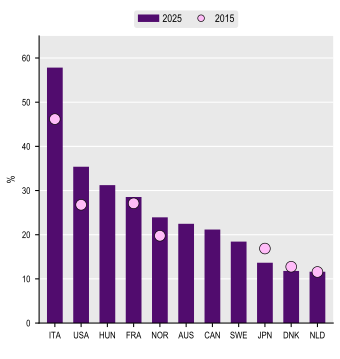
Where people live can make a big difference to their chances of finding work. Labour market areas (LMAs) bring together the places where people live with the places where they work and thus offer a meaningful geography to compare local employment conditions. On this basis, relative geographic disparities in unemployment across LMAs are widest in Italy and narrowest in the Netherlands, with a five-fold difference in the coefficient of variation of unemployment rates (Figure 2.12). In Italy, unemployment became even more geographically uneven since 2015, with differences across LMAs increasing by about one-quarter. In contrast, geographic disparities declined in Japan. These shifts took place against a backdrop of generally falling unemployment rates.
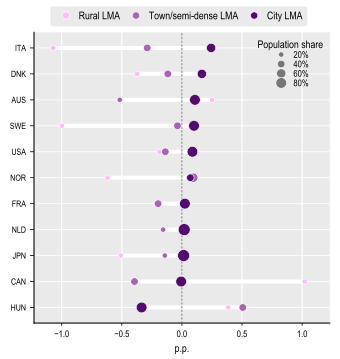
Part of the geographic variation in unemployment rates reflects a rural-urban divide in labour markets. In 7 out of 11 countries with available data, unemployment is highest in LMAs that contain a city, while rural LMAs have the lowest rates in 7 of the 10 countries where this LMA type exists (Figure 2.13). The unemployment-rate gap between city and rural LMAs is largest in Sweden and Italy (around 1.2 p.p.), compared to the United States (0.3 p.p.). Lower unemployment rates do not necessarily indicate better employment opportunities, particularly where labour-force participation is low or working-age populations are declining. Unemployment rates also vary substantially among LMAs of the same type, especially in town/semi-dense and rural LMAs. For instance, the gap between the rural LMA with the lowest and highest unemployment in the United States reaches 13.4 p.p.
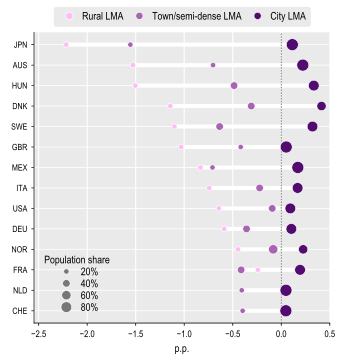
These local differences in unemployment are unfolding alongside a broader shift in the geography of the working-age population. Between 2015 and 2025, city LMAs gained working-age residents relative to the national average in all 14 countries with available data, while town and semi-dense LMAs—and especially rural LMAs—generally lost them (Figure 2.14). The contrast is particularly pronounced in Japan, Australia, Hungary and Sweden. The striking consistency in the direction of change points to an ongoing concentration of the working-age population in the densest labour markets. As working-age populations decline or grow more slowly, LMAs without a city may face increasing difficulties in replacing workers and filling skilled jobs.
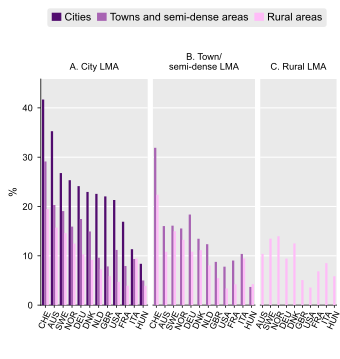
International migration could help offset these workforce losses, but foreign-born residents tend to concentrate in cities. The foreign-born share is highest in city LMAs and lowest in rural LMAs. Foreign-born residents account for about 9–10% of the population of the rural parts of LMAs on average across the countries with available data, whether these belong to a city, town/semi-dense or rural LMAs (Figure 2.15). However, rural parts of city LMAs can benefit from foreign-born workers living nearby, while those in rural LMAs typically have a smaller pool to draw from, making migration less likely to offset workforce decline.