Life satisfaction improved in most regions, but young people in rural areas less satisfied with social opportunities and residents of non-metropolitan regions reporting lower trust in national institutions.
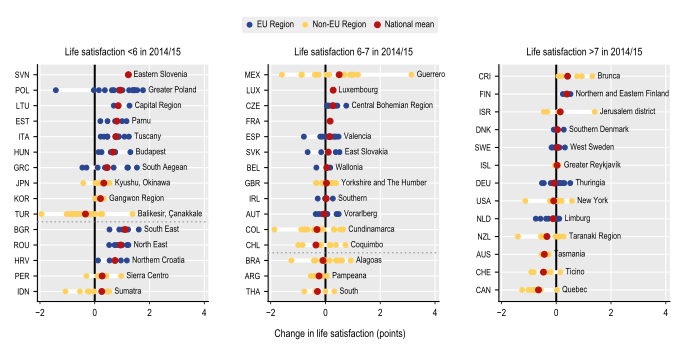
Life satisfaction has generally improved across OECD regions over the past decade, with the strongest gains occurring in regions that started from relatively low levels. Life satisfaction increased in six out of ten TL2 regions across OECD Member and accession countries with available data over the past decade. In EU countries where average life satisfaction was low (below 6 out of 10) in 2014/15, it increased in 67 of 71 regions with available data over the following decade (Figure 3.5). Across these 71 regions, mostly located in Central and Eastern Europe, the median gain was substantial at 0.8 points – more than one standard deviation of regional life satisfaction scores in 2014/15. By contrast, regions in EU countries with medium to high levels of average life satisfaction (scores above 7) saw little change overall. In several EU countries, declining regional disparities in life satisfaction coincided with declining regional disparities in GDP per capita. Outside the EU, improvements in initially low-scoring countries were less widespread: life satisfaction increased in 56% of regions in countries with average scores below 6, compared with 39% in countries with scores above 7. The corresponding median changes were +0.05 and -0.23 points.
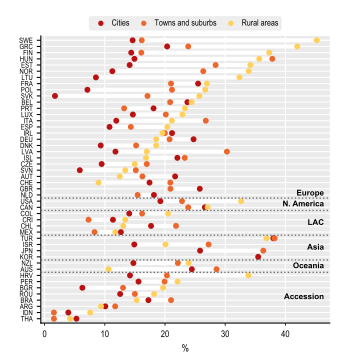
However, convergence in overall life satisfaction does not imply that territorial gaps have disappeared across all dimensions of well-being. Differences remain in more relational aspects of well-being, including opportunities for social interaction. For instance, young people report more dissatisfaction with opportunities to meet people and make friends in rural areas than in cities. Across countries, 22% of people under 35 in rural areas report dissatisfaction with social opportunities, compared with 19% in towns and suburbs and 15% in cities (Figure 3.6). This rural-city gap averages 7 percentage points among people under 35, but only 1 percentage point among those aged 35 or older. It is particularly large in several Central, Eastern and Northern European countries and tends to be wider where rural population growth is low or negative. Put differently, the age difference in dissatisfaction with opportunities to meet people and make friends is driven mainly by higher dissatisfaction among young people in rural areas, while dissatisfaction in cities varies little by age.
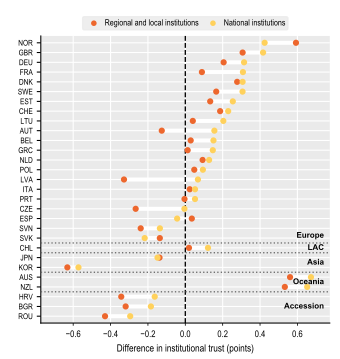
Territorial differences also extend beyond opportunities for social connection to people’s relationship with institutions. Survey results show higher trust in local than national government and smaller changes of trust in local government over time in most countries (OECD, 2026). Within countries, in metropolitan regions trust in national institutions is 0.10 points higher compared to non-metropolitan regions. In contrast, trust in regional and local institutions is roughly similar in metropolitan and non-metropolitan regions (Figure 3.7). This is a widespread phenomenon: in 25 of 29 countries with available data, the metropolitan advantage in trust is larger for national institutions than for regional and local institutions. This pattern also holds where metropolitan regions report higher trust in both, such as Australia and New Zealand, and where non-metropolitan regions do so, such as Korea and Romania.