Climate change is intensifying the frequency and severity of hazards such as heatwaves, droughts, floods and wildfires, generating growing economic, environmental and social costs across OECD regions.
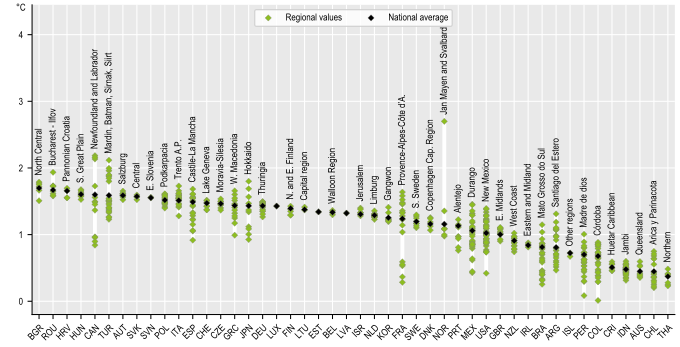
Global temperatures remain at historically high levels. After the unprecedented warmth of 2023 and the record-breaking temperatures of 2024, 2025 ranked as the third warmest year on record. Globally, average temperatures in 2025 were 1.47°C above pre-industrial levels, only marginally lower than in 2023, while 2024 remains the hottest year ever recorded and the first to clearly exceed 1.5°C above pre-industrial levels. Early observations suggest that 2026 is also likely to rank among the warmest years on record, with June 2026 becoming the hottest June ever recorded in Western Europe and the second warmest globally. Warming trends vary considerably across regions. During 2021-2025, average air temperatures across OECD large regions were 1.07°C higher than during the 1981-2010 reference period. Nearly one-fifth of OECD large regions experienced warming exceeding 1.5°C, with the largest increases observed in Northern Canada, Norway and Türkiye. The Arctic regions of Jan Mayen and Svalbard experienced the greatest increase, with average temperatures in 2021-2025 reaching 2.7°C above the 1981-2010 average. Canada's Newfoundland and Labrador and Nunavut followed, with increases of 2.2°C (Figure 4.1).
Precipitation patterns are also shifting across OECD countries, with important implications for water resources, ecosystems and agriculture. Many high-latitude and humid regions are becoming wetter and experiencing more frequent extreme precipitation days while already dry regions are becoming drier, though these shifts are often concentrated in specific seasons rather than spread evenly across the year. In North America, precipitation has generally increased in eastern regions, whereas the western United States and northern Mexico have experienced substantial declines, particularly in summer. In Europe, precipitation has increased across much of the north, particularly in winter, but declined in southern and eastern regions, especially in summer. Across the Asia-Pacific, Japan, Korea and, in particular, Indonesia have generally become wetter, while much of inland and southern Australia has experienced substantial drying.
Beyond the OECD, similar shifts are evident in globally significant ecosystems. Between 2021-2025 and the 1981-2010 reference period, the Amazon basin exhibited a marked north-south contrast. The northeastern Amazon has recorded increases in both total precipitation and frequency of extreme precipitation days, while the southern Amazon experienced substantial declines, with cumulative rainfall deficits exceeding 300 mm in some areas. This sustained drying, compounded by deforestation-induced reductions in moisture, raises concerns that parts of the Amazon basin may be approaching a tipping point towards “savannisation”, undermining the forest's capacity to maintain itself as a tropical rainforest. The impacts of changing precipitation depend not only on the magnitude of change but also on typical local climate conditions. The same absolute decline in rainfall may have relatively limited consequences in humid regions, such as much of South America, but severe impacts in already water-scarce areas, including large parts of Australia (Figure 4.3 and Figure 4.4).
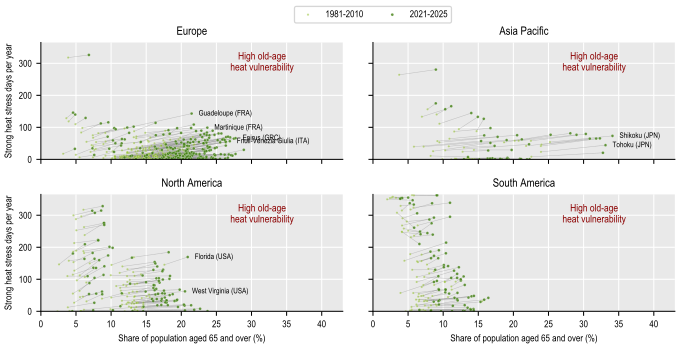
Heat-related risks are increasing across OECD regions as more frequent extreme heat coincides with population ageing. Older people are particularly vulnerable to heat stress because ageing reduces the body's ability to regulate temperature, while chronic health conditions, such as cardiovascular disease, can be exacerbated during heat waves. During the 1981-2010 reference period, only 16 OECD large regions combined a high share of old-age population (over 20% aged 65 and above) with more than one month of strong heat stress per year. By 2021-2025, this number had increased more than fourfold, to 74 regions. These high-risk regions are concentrated primarily in Japan and around the Mediterranean Basin, including Spain, Italy, Greece, southern France, and Portugal, where rapidly ageing populations coincide with increasingly frequent heat stress. This growing overlap of climate hazard and demographic vulnerability is creating regional hotspots of heat-related risk (Figure 4.2).