The concentration of skilled workers in leading metropolitan and capital regions supports higher generative AI adoption and innovation, potentially leading to differences in where the effects of AI will first emerge.
Different forms of artificial intelligence (AI) could reshape local labour markets in differing ways, by increasing productivity, creating or displacing jobs, and changing job content and quality. The OECD “exposure to GenAI” indicator measures the potential for Large Language Models (LLMs) – a type of generative AI including tools designed to generate and analyse text – to reduce the time needed to perform tasks associated with individual occupations (OECD, 2024).
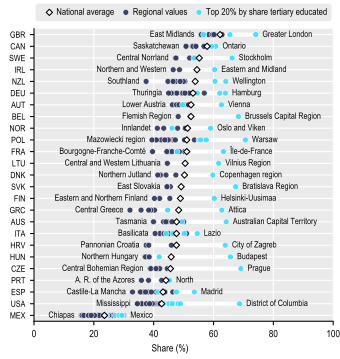
Because LLMs are particularly well suited to complex, non-routine tasks, exposure tends to be higher in occupations held by tertiary-educated workers. Across OECD countries, regions in the top national quintile for the share of tertiary-educated residents have, on average, 52% of employment highly exposed to GenAI, compared with 42% in other regions (Figure 1.8). In capital-city regions, where tertiary-educated workers concentrate, this share reaches on average 63.6% and is highest in Greater London (74.1%), Warsaw (70.7%) and Prague (69.2%). In the United States, where the gap is largest, the District of Columbia has almost twice the share of tertiary-educated residents (1.9 times) and twice (1.99 times) the GenAI exposure of Mississippi, the least exposed state.
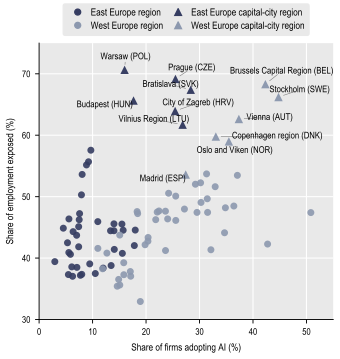
Regional differences in firms’ AI adoption may influence where the effects of GenAI first emerge. In the European countries covered by the data, an average of 11% of firms in Central and Eastern European regions use AI, compared with 26% in the other regions covered (Figure 1.9). Adoption rates reach 40% in capital-city regions such as Vienna, Stockholm and Brussels, while fewer than 30% of firms use AI in Budapest, Zagreb and Prague, despite similarly high levels of employment exposure to GenAI compared to other capital-city regions. This suggests that potential exposure and current adoption do not necessarily coincide geographically.
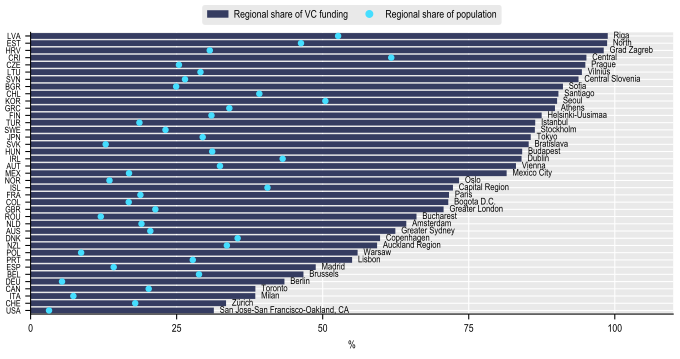
Metropolitan regions with highly skilled workers and high AI adoption are also well placed to attract the venture capital (VC) funding needed to grow innovative startups. In 32 out of 39 OECD countries, a single TL3 region receives more than half of national VC funding and has a share of funding greater than would be expected from their share of the national population (Figure 1.10). For example, in the United States, the San Jose–San Francisco–Oakland region receives 31% of national venture capital, while accounting for just 3% of the national population. In most countries, the region with the highest concentration is the largest city or capital region. This concentration may further strengthen the role of leading metropolitan regions in future AI-related innovation and growth.
Patent activity reinforces this picture of metropolitan regions as major centres of investment and innovation. In 27 out of 31 OECD countries, the largest FUA accounted for the largest share of patents between 2019 and 2024. This pattern has persisted over time: between 2001 and 2006, the largest FUA led patent activity in 17 of the 23 countries with available data. However, some smaller and mid-sized FUAs generate more patents relative to their population (Figure 1.11 and Figure 1.12). Across FUAs with available data, only 25% produce a larger share of national patents than their population share, and just 7% produce at least twice as much. These highly specialised FUAs, including Cambridge, Eindhoven, Daejeon and Modena, are often mid-sized.