Teacher appraisals are covered by a policy framework in 24 of the 30 countries and economies with available data. Except appraisal for reward schemes, the different types of teacher appraisals are mandatory in the majority of countries where they are covered by a policy framework.
School head appraisals are covered by a policy framework in 21 of 30 countries and economies with available data. Both types of school head appraisals are mandatory in nearly all countries where they are regulated. The exceptions are Chile and the Flemish Community of Belgium, for regular appraisals, and Brazil for initial certification.
Teacher appraisals are used for both formative and summative purpose in half the 30 countries and economies where they are used, whereas school head appraisals are used for both purposes in more than one-third of these countries.
Education at a Glance 2026

Context
The monitoring and appraisal of teachers is central to improving schools and learning environments. Well‑designed teacher appraisal and feedback systems can be used as tools to increase teacher effectiveness and achieve better learning outcomes. Appraisal can sharpen the focus on instruction and teachers’ professional learning, while also contributing to school organisation by allowing teachers to progress in their careers and take on new roles and responsibilities based on a solid evaluation of their performance. Appraisal systems can also provide an opportunity to recognise and reward effective teaching (OECD, 2013[1]).
Policymakers have become increasingly aware of the significance of school leadership for effective teaching and learning. Research confirms that school leadership matters for teaching quality and student outcomes, with effective school heads contributing to gains in student achievement, attendance, and teacher retention (Grissom, Egalite and Lindsay, 2021[2]). In recent years, several OECD countries and other economies have introduced or consolidated standards-based frameworks that integrate developmental and accountability functions within a single appraisal structure. Comparative data on school head appraisal, however, remain limited.
In general programmes, at primary and secondary levels

1. Secondary education (for school heads' appraisals in France, for teachers' completion of probation in Luxembourg).
For data, see Table D7.2 and Table D7.5. The data for this figure can be accessed via https://stat.link/58zx6m.
Other findings
Among teachers, regular appraisal, appraisal for the completion of probation, appraisal for registration and appraisal for promotion are mandatory in the majority of countries for which data are available.
Most countries have at least two different types of teacher appraisal covered by regulations but Costa Rica, the Flemish and French Communities of Belgium, and Japan only regulate regular appraisals; Lithuania only regulates appraisal for promotion; and Luxembourg only regulates appraisal for the completion of probation.
Teachers are usually appraised in relation to decisions about their employment status, such as promotion, contract renewal, or the conversion or awarding of a permanent contract. Regular appraisals are conducted as frequently in relation to decisions on employment as in response to performance concerns. They are also frequently used at the discretion of the school head. School heads are most often subject to regular appraisals in relation to decisions on employment status (in nine countries and economies), followed by in response to a complaint (in six countries) and at the discretion of the school board (in four countries).
The procedures for teacher and school head appraisals are most commonly determined by the central or state education authorities. They are involved in at least two-thirds of countries and economies for the various types of teacher appraisals, and in about two-thirds or more countries for school head appraisals.
Appraisals in most countries cover teachers’ planning and preparation, instruction, classroom environment, professional development and contribution to school development, all of which are covered across the different types of teacher appraisal in most countries.
In at least half of the relevant countries and economies, classroom observation and interviews with teachers are the most frequently used methods in regular appraisals and those on completion of probation and teacher registration.
Results from regular teacher appraisals and those on completion of probation have the most impact on decisions about teachers’ professional development activities and career advancement. The results of appraisals for promotion affect teacher’s professional development activities in half the countries and economies which use them but affect teachers’ career advancement in almost all countries and economies.
Note
This chapter analyses appraisals of teachers and school heads at the primary and secondary levels of education based on the results of a data collection on evaluation of teachers, school heads and schools. It complements Chapter D6, on the evaluation of schools. An overview of the different forms of evaluation of school, teachers and school heads used by countries is available in Box D6.1 of Chapter D6.
The analysis relates to primary and secondary education as a whole and in most countries, appraisals of teachers and school heads are similar across primary, lower secondary and upper secondary levels. However, in a few countries (France and Luxembourg), there are some differences between primary and secondary levels of education. When there are differences, the analysis focusses on secondary level (information on primary level is available in tables).
Teacher appraisal
Teacher appraisal refers to the formal evaluation of individual teachers' performance, serving both a developmental (formative) function, identifying strengths and supporting improvement in teaching practice, and an accountability (summative) function to analyse how effective teachers are and holding them accountable. Appraisal systems have developed considerably, and formal appraisal is now near universal: on average across 27 OECD countries, in 2024 most teachers (94.5%) worked in schools where they have been formally appraised (Table 3.47 in (OECD, 2025[3])). The following discussion focuses on teachers’ appraisals in public and government-dependent private institutions at the primary and secondary level. It reviews the requirements for teacher appraisals and their characteristics as defined in official frameworks (for information on actual appraisal of teachers see Box D7.1).
Requirements and periodicity
In systems where appraisal is covered by a policy requirement, they are more likely to operate consistently across schools, providing more harmonised feedback and more equal development opportunities to teachers. Among the 30 countries and economies taking part in the data collection, 24 reported having policy frameworks (national or state laws or regulations) in place to regulate one or more types of teacher appraisal. This includes three – Brazil, Bulgaria and England (United Kingdom) – where teachers are only appraised in some schools. In England (United Kingdom) appraisal arrangements differ between public and government‑dependent private institutions, whereas in Bulgaria they are the same across both types of institution (Table D7.1). Among the six remaining countries, there is no policy framework in Finland, Norway, Portugal and Scotland (United Kingdom). Although Denmark and the Netherlands have no government policy for teacher appraisal, similar practices are observed across schools in both countries (Box D7.2).
According to the results of the Teaching and Learning International Survey (TALIS) 2024 (see Box D7.1 for more details), at least three-quarters of teachers are formally appraised in most of these 30 countries and economies: all teachers in Colombia, Israel, Latvia, Lithuania, the Netherlands, Poland, the Slovak Republic and Slovenia, over 90% in most other countries and economies, but less than 85% of teachers in Denmark and Spain and less than 76% of teachers in Finland, Italy and Norway (see Table 3.47 in (OECD, 2025[3])).
Countries and economies use a range of different approaches for appraisal, depending on its purpose. The survey for this chapter (see Sources) gathered information on five different types of teacher appraisal:
Completion of probation involves a teacher’s entry into the profession and is designed to evaluate the competence and progress of a newly hired teacher.
Regular appraisal typically involves an internal school process regulated by general labour law provisions requiring teachers’ employers to regularly appraise the performance and results of their employees.
Teacher registration is designed to determine and officially confirm a teacher as competent for teaching and then to award or renew teachers’ registered teaching status after the probationary period has been completed.
Appraisal for promotion is often voluntary and takes place in relation to decisions on employment status (most countries integrate this activity with regular appraisals).
Appraisal for rewards involves teacher appraisals explicitly designed to identify a select number of high-performing teachers to reward and acknowledge.
Policy frameworks often cover one or several types of teachers’ appraisals to support continuous learning for individual teachers throughout their career and for the profession as a whole (Darling-Hammond, 2012[4]). In most countries the policy framework covers at least two types of teacher appraisal. However, a few only cover a single type: regular appraisal in the French Community of Belgium and Japan (in Costa Rica too, but information is missing for few other types of appraisal); appraisal for promotion in Lithuania; and appraisal for the completion of probation in Luxembourg (Figure D7.1).
The 2024 OECD Teaching and Learning International Survey (TALIS) provides some insights into actual appraisals of teachers through information reported by teachers or school heads.
The overwhelming majority of lower secondary teachers work in schools where formal appraisals are conducted at least sometimes. Based on the responses from principals (school heads), no teachers work in schools where they are never formally appraised in countries including Colombia, Israel, Latvia, Lithuania, Poland, the Slovak Republic and Slovenia. This is consistent with the existence of a legal framework for teacher appraisals in Lithuania, Poland, the Slovak Republic and Slovenia (no information is available for Colombia, Israel and Latvia, as these countries did not participate in the survey used as the source for this chapter). In contrast, at least one in six teachers work in a school where teachers are never formally appraised in Denmark and Finland, where no regulatory framework for teacher appraisal exist at system level, and in Italy where information on the existence of a policy framework is not available (Table 3.47 in (OECD, 2025[3])). These proportions could be explained by the fact that there can be some practice of teachers’ appraisal even if there is no formal framework for it (Table D7.1).
Lower secondary teachers tend to be appraised by multiple actors, with principals or other members of a school management team usually involved. However, teachers in Finland are mostly appraised by only one actor, usually the principal. Teachers are most commonly appraised through classroom observations or student results (Table 3.48 in (OECD, 2025[3])).
TALIS 2024 also investigates the link between the share of teachers who are appraised (distinguishing those never appraised, those appraised less than once per year and those appraised at least once per year) among those who report substantial or full autonomy in different dimensions of their teaching activity (implementing the curriculum in a flexible way, selecting teaching methods and strategies, choosing assessment activities, selecting learning objectives, and designing and preparing lessons) (Tables 5.40 to 5.44 in (OECD, 2025[3]). This could help understanding the formative role of appraisals in systems where a large proportion of teachers with high levels of autonomy are appraised.
The appraisal rates of teachers with high levels of autonomy vary widely across countries, implying a loose relationship between teachers’ appraisals and instructional autonomy. Across all autonomy dimensions, teachers who report substantial or full autonomy in the dimension are appraised at a comparable rate to the full teacher population. For example, in Lithuania, Poland, the Slovak Republic and Slovenia, all teachers with substantial or full autonomy across dimensions work in schools where appraisals are at least sometimes conducted, while in Finland and Italy, at least 25% of teachers who report having substantial or full autonomy across dimensions are in schools with no school appraisal. High levels of autonomy without appraisal may leave teachers with little support, while frequent appraisal might restrict their autonomy. On the flipside, infrequent appraisal might indicate high institutional trust, and frequent appraisal might hint at autonomy operating within a more structured accountability framework (Tables 5.40 to 5.44 in (OECD, 2025[3])).
Note that teacher autonomy should be interpreted with caution as TALIS captures instructional autonomy as reported by teachers themselves, which may reflect how teachers interpret the latitude available to them rather than the formal authority they hold. Any differences shown may therefore reflect perceived rather than actual autonomy of teachers.
Source: OECD (OECD, 2025[3]), Results from TALIS 2024: The State of Teaching, https://doi.org/10.1787/90df6235-en.
Appraisal practices are widely used in Denmark and the Netherlands, even though the appraisal of teachers and school heads is not covered by a policy or regulatory framework (Table D7.1). In both countries, such practices are governed by collective agreements and institutional autonomy.
Appraisal practices in Denmark
Teacher appraisals in Denmark are not governed by regulations at any of the primary, lower and upper secondary levels of education. Nevertheless, under collective agreements concluded between the trade unions and either the Ministry of Finance or the Local Government organisation (KL), All public and government-dependent private institutions are required to hold annual professional development interviews. These interviews are compulsory for all teachers and conducted by school heads or closest member of the school's leadership team.
School head appraisals are also unregulated at all these levels of education, but the arrangements in place differ between primary and lower secondary education on the one hand, and upper secondary education on the other. At the primary and lower secondary level, municipal councils conduct an annual development interview with school heads. One of the objectives of this interview is to evaluate progress against annual attainment targets. This interview is also used in decisions about the level of performance salary. At the upper secondary level, school head appraisals are carried out by the school board’s chairman as part of their annual development interview.
Appraisal practices in the Netherlands
In the Netherlands, the constitution guarantees the freedom to establish, organise and structure education, granting school boards broad autonomy to make independent decisions. As a result, no regulatory or policy framework covers teacher and school head appraisals at the primary and secondary levels, and appraisal practices vary between school boards. Guidance is nonetheless provided at the sectoral level through collective agreements negotiated between the representative organisations of school boards and the trade unions. The Collective Labour Agreement for Primary Education and the Collective Labour Agreement for Secondary Education include binding arrangements on job classification, appraisal and career development for both teacher and school head appraisals. Most school boards participate in representative organisations, although some independent schools prefer to apply their own employment terms and conditions.
In practice, teacher appraisals depend on human resource policies of individual school boards. Although no statute requires appraisal interviews, collective agreements provide guidance on periodic interviews on teacher performance, conducted by the school head (on behalf of the board) and covering professional development and sustainable employability. Such interviews are widely regarded as good practice and are commonly implemented. Appraisal outcomes may carry legal consequences, including eligibility for a bonus or allowance.
Collective agreements also require school boards to periodically review school heads' performance, covering professional development and sustainable employability, with appraisal outcomes carrying potential legal consequences, including eligibility for a bonus or allowance. In addition, a voluntary Professional Standard for Secondary School Heads has been developed by the professional community, outlining the expectations most schools hold for those in leadership positions.
Regular appraisals are the most common type of teachers appraisal regulated by policy frameworks, with 20 of the 30 countries and economies reporting their use (Figure D7.1 and Table D7.1). In all of these countries and economies except the Flemish and French Communities of Belgium, Poland and the Republic of Türkiye, regular appraisal is mandatory for teachers. These are conducted at regular intervals in 13 countries, most commonly on an annual basis (in 6 countries), but ranging from annually to every four years. In France, the frequency of regular appraisals is different for different types of teachers (tenured teachers and contract teachers on permanent or fixed-term contracts), while in Czechia it is up to the evaluator to decide the frequency, but the common practice is once a year. The periodicity varies by political entities and then geographical area in Germany (by Länder) and Switzerland (by Canton), and the Flemish Community of Belgium and Sweden do not define it at all (Table D7.2).
Appraisal upon completion of a probationary period is also common. It is covered by the regulations in 13 out of 30 countries and economies, where it is mandatory in all of them except in Romania and Slovenia. Although this form of appraisal might be expected to only take place once (to complete the probation period), it is carried out annually in England (United Kingdom). In Poland, teachers are subject to two mandatory appraisals during the probation period of three years and nine months (and Tables D7.1 and D7.2).
Appraisals for teacher registration and promotion, both used for performance management, are less frequently used. Appraisal for registration is used in eight countries and economies and is mandatory in six of them, whereas appraisal for promotion is used by ten countries and economies but only mandatory in five. Only seven countries with available data had appraisal frameworks for teacher reward schemes (Figure D7.2).
The following analysis focuses on countries and economies with a regulatory framework for appraisal of teachers: 20 countries and economies for regular appraisal, 13 for the appraisal upon completion of a probationary period, 10 for appraisal for promotion, 8 for appraisal for registration and 7 for appraisal for reward schemes.
Organisation
Which teachers are covered by appraisal policies depends on the type of appraisal. Regular appraisal, the most widespread form, most commonly applies to teachers with permanent or fixed-term contracts (in 18 of 20 countries and economies), and in at least one-third of countries to registered teachers and teachers on probation (7-8 countries and economies). By definition, appraisal for the completion of probation should target teachers on probation, and this is the case in 12 of 13 countries and economies using this form of appraisal. Appraisals for teacher registration, used by eight countries and economies, focus on teachers on fixed-term contracts and provisionally registered teachers (in five to six countries), but also covers teachers on probation (in four) and permanent teachers (in three). Appraisals for promotion primarily target permanent teachers (in nine out of ten countries) (Table D7.2).
The circumstances under which teachers are appraised vary considerably across countries and economies, even for regular appraisals that do not exclusively take place in response to a specific situation. Although some countries use appraisals in multiple circumstances, in others, specific types of appraisal only take place in one specific situation. For example, regular appraisals take place in response to five different circumstances in Sweden, but only as the result of performance problems in Costa Rica and Japan, and only in relation to a decision on employment status in Brazil, Bulgaria and Hungary. In Korea and the Slovak Republic, none of these specific circumstances result in regular teacher appraisals. Teacher appraisals (either regular or for completion of probation or registration) are most commonly linked to decisions on employment status. Performance issues and complaints typically trigger teacher appraisals. Regular appraisal is also common as a result of performance problems (in most countries with this type of appraisal) and at the discretion of the school head (in more than one-third of countries). In one-quarter of countries and economies, regular appraisals also arise from a complaint or at the request of the teacher. Appraisals for completion of probation or registration are the result of complaints, performance problems, teachers’ requests or decisions by the school head in two or three countries in each case. Appraisals for promotion are the type most commonly triggered by teachers’ requests (Table D7.2).
For most types of appraisals (excluding appraisals for reward schemes, for which information is not available), central educational authorities most often determine the procedures for teacher appraisal. They are involved in at least three-quarters of the countries and economies for each type of appraisal considered. The involvement of central education authorities ensures more consistent procedures across schools and may help ensure the appraisal process is equitable for all teachers. Nevertheless, authorities at other levels of government, school boards or committees, school organising bodies, school heads and teachers’ professional organisations also contribute to the procedures. In half of the countries using teacher appraisals, a single authority level determines the procedure for most appraisal types, while in other countries, multiple authorities have a say. For example, the procedures for regular appraisals are decided by a combination of two authorities in Bulgaria, the Flemish Community of Belgium and Korea, and up to five different authorities in the Slovak Republic (Table D7.7, available online).
Teachers are usually evaluated by a combination of actors in the various types of appraisals (again excluding those for reward schemes, for which information is not available). School heads are the most common evaluators. They are at least one of the evaluators in 15 out of the 20 countries and economies that use regular appraisals, in 10 out of the 13 that appraise teachers for the completion of probation, in 5 out of the 8 that use appraisals for teacher registration and in 5 out of the 10 that use them for promotion. In some countries (Costa Rica, Germany, Hungary, Poland, Switzerland and Türkiye) school heads are the only evaluators in regular teacher appraisals whereas they share the role with up to three other types of evaluators in others. For example, they evaluate teachers alongside the local education authorities in France, and with the teacher’s supervisor, a peer evaluator at the same school and the teachers’ professional organisation in the Slovak Republic. For appraisals for the completion of probation, teacher registration and promotion, teachers’ supervisors are the second most common evaluators, used in three to four countries depending on the type of evaluation (Table D7.7, available online).
Subjects covered and methods
In most countries and economies, the main standards against which teachers are appraised are either national or state teaching standards or descriptions of the general and professional duties of teachers. National or state teaching standards are used by most countries for teacher registration, whereas descriptions of the general and professional duties of teachers are used by most countries for appraisal on completion of probation. Most countries use both types of documents for regular appraisals and appraisals for promotion. Other references or standards used by a few countries include the teachers’ code of conduct, school development plan or school project, and the school’s internal regulations. In general, at least three-fifths of the countries use multiple reference documents for regular appraisals, appraisals for completing probation and appraisals for promotion. For teacher registration appraisals, only one-third of countries use more than one document (Table D7.8, available online).
Appraisals can be used to analyse various aspects of a teacher’s performance, including planning and preparation, instruction, classroom environment, professional development, contribution to school development and links to the community. Apart from links to the community, all these aspects are covered in the different types of appraisals (excluding appraisals for reward schemes due to lack of information). Some dimensions of teacher performance are better suited to some types of appraisals. Appraisals upon completion of probation focus on verifying basic competence as a condition for confirming teachers’ employment, covering areas such as planning and preparation, instruction, and classroom environment (in 11 of 13 countries and economies), while appraisals for promotion mainly concern professional development (in 9 of 10 countries and economies) (Table D7.3).
Whatever the type of appraisal, they usually cover several or all these subjects. However, in Hungary, regular teacher appraisals review a different set of aspects (the quality and effectiveness of support for pedagogical work, quantitative indicators of task performance, reliability of work and adherence to deadlines, communication and collaboration, professional responsibility and commitment, supportive and ethical conduct related to the job role, institution-specific evaluation criterion, and three personalised performance objectives). In Japan, the aspects of teacher performance that are evaluated are not standardised and vary with the evaluator. In Sweden, teacher registration appraisals take place after a report has been made by the Schools Inspectorate on misconduct or underperformance (Table D7.3).
A mix of methods, instruments and information sources are used to appraise different aspects of a teacher’s performance. The most frequently used methods in regular appraisals, appraisals for completion of probation and appraisals for registration are classroom observation and interviews (reported by at least half of countries and economies with available data). Teachers’ self-appraisals and professional development certificates/ credentials are also used in regular appraisals in nearly one-third of countries. Student outcomes, parent surveys and student surveys are the least commonly used. Where they are used, it is primarily in regular appraisals (in no more than one-quarter of the countries with available data). The most frequently used sources of information in appraisals for promotion are teacher portfolios, classroom observation and professional development certificates, followed by teacher interviews and self-appraisals (Table D7.8, available online).
Regular appraisals result in teachers being given a rating, i.e. a score on a teaching performance scale, in half of the countries and economies using such appraisals (10 out of 20). Ratings are also the outcome of appraisals for teacher registration in 4 out of 8 countries, for completion of probation in 9 out of 13 countries and for promotion in 7 out of 10 countries (Table D7.3). Most countries have mechanisms to appeal appraisal results. The prevalence of appeal mechanisms increases from about two-thirds of countries for regular appraisals, to three-quarters for appraisals for teacher registration, four-fifths for appraisals for promotion, and over 90% for appraisals on completion of probation (Table D7.3).
Impact of appraisals on teachers
The results of appraisals can have an impact on various aspects of a teacher’s career, including professional development activities, career progression and salaries, but underperformance may result in more specific consequences (Box D7.3). The way results are used also depends on the extent to which different types of appraisals are used for formative and summative purposes (Box D7.3).
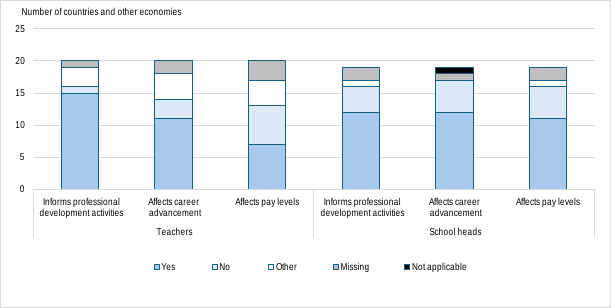
Results from regular teacher appraisals have the most impact on decisions about teachers’ professional development activities. They inform these decisions in three-quarters of countries and economies (15 out of 20). In most of them, they either always result in a professional development plan or they are expected to influence one. In Costa Rica, the Flemish Community of Belgium and Switzerland, the results only lead to a professional development plan for some teachers. In Romania they determine extra opportunities for in-service professional development. The results also affect career advancement in more than half of countries and economies (11 out of 20). They usually have an influence on either promotion decisions, the speed at which a teacher progresses in the career structure or salary scale, or decisions about their contracts (access to contracts or renewal of fixed-term contracts or access to a permanent position). Regular appraisals only have an impact on all three of these aspects in Chile, and on both teachers’ progression and contracts in Romania. The least widespread impact of regular teacher appraisals is on teachers’ pay (in 7 out of 20 of countries and economies). Where they do impact pay levels, it is most frequently through career progression. In Chile, the results affect progression, but also teachers’ base salaries, as well as a pay allowance for good performance (Figure D7.2 and Table D7.3).
The results of regular appraisals have an impact on these three areas of teachers’ professional lives (professional development, career advancement and pay) in other countries, but they are not included in the frameworks related to teachers’ appraisal. This is the case in Czechia and in Japan where the impact varies depending on the decisions of the evaluators. Korea is the only country where the results only have an impact on teachers’ professional development activities (Figure D7.2 and Table D7.3).
Appraisals for completing probation have a similarly widespread impact on decisions about teachers’ professional development activities and career advancement, but less impact on their pay. They affect decisions about teachers’ professional development activities in 8 of the 13 countries and economies using such appraisals and decisions about career advancement in 7. In all of these countries the impact relates to decisions about access to contracts, as would be expected with an appraisal following a probationary period. The impact on professional development activities varies, ranging from always informing their professional development plan in the Slovak Republic and Türkiye to a professional development plan for some teachers only in the Flemish Community and Switzerland. These types of appraisal impact teachers’ pay in four countries and economies. They affect teachers’ base salaries in England (United Kingdom) and Romania, and salary scale progression in Poland and the Slovak Republic (Table D7.3).
In general programmes, at primary and secondary levels
For data, see Table D7.3 and Table D7.6. The data for this figure can be accessed via https://stat.link/58zx6m.
As might be expected, the results of appraisals for promotion affect teachers’ career advancement in almost all the countries and economies using them (nine out of ten), and their pay levels in eight, but they also have an impact on teacher’s professional development activities in five countries. Except in Korea, where the results of these appraisals only affect teachers’ career advancement, the results affect either all three areas of teachers’ professional lives, or both career advancement and pay levels (Table D7.3).
Appraisals for teacher registration have the least impact on teachers compared to other types of appraisals. They affect decisions on teacher’s professional development activities in three out of the eight countries and economies that use them, and career advancement in four, but do not have an impact on teachers’ pay levels of teachers in any of them. In Austria, Bulgaria and Sweden, the results have no impact on any of the three aspects considered here. In all of the four countries where results have an impact on career advancement, they influence decisions on contracts. For example, in Slovenia, teachers who pass the professional examination can be employed for an indefinite period (Table D7.3).
Teachers
As the main consequences of underperformance in appraisals for promotion or for registration are failing to get promotion or registration, this analysis focuses on the consequences of underperformance during regular appraisals or appraisals on completing probation.
The most frequent consequences of underperformance in regular appraisals are further appraisals and the submission or revision of professional development plans. Both of these are used in 10 out of the 20 countries and economies using regular appraisals. Compulsory training, deferred promotion or career advancement, withheld pay rises and dismissal are available in more than one-quarter of countries and economies (between six and eight, depending on the type of consequence). Only France uses transfers to another school or suspension (Table D7.3).
Three-quarters of countries and economies use several of these tools, which can be used in sequence. For example, in Chile, underperforming teachers in the Inicial and Temprano tramos must undergo a new appraisal and follow a compulsory professional improvement plan. Teachers who fail to progress after a second evaluation must be dismissed and cannot be rehired by the same institution or any other similar institution. If they fail to progress in a second evaluation after re-entry into the system, they cannot be hired in any institution governed by the Teacher Career System. Other countries use only one tool, for instance the submission or revision of professional development plans in Germany and Korea and withholding salary increments in the Slovak Republic (Table D7.3).
In all countries and economies using appraisals for completion of probation, teachers who underperform fail to pass probation. In Türkiye, unsuccessful candidates may receive additional training and a further assessment opportunity before a final decision is made, but candidates who remain unsuccessful do not complete the probation process. In half of the countries the consequences might also be dismissal or failing to gain a permanent contact. One-third of countries or fewer might respond by requiring teachers to take further training, defer their promotion or career advancement, or withhold salary increments in these cases (Table D7.3).
School heads
Among the 19 countries and economies with a legal framework for the regular appraisal of school heads, the most common response to underperformance in regular appraisals is the submission or revision of professional development plans (in 11 out of 19). Dismissal is a possibility in nearly half of these (9 out of 19), but may only apply when there are serious reasons to do so (Table D7.6).
For example in Czechia, school heads must be dismissed when they no longer meet some of the requirements to carry out their work (for example integrity or failing to complete the required training programme for school heads), or when organisational changes result in the ending of their post (for example, if their school merges with another). They can also be dismissed for serious violations or failure to comply with the legal obligations arising from their activities, tasks and competences, or following a proposal by the Czech School Inspectorate, or as a result of a final decision of the court in a dispute about the termination of employment or the dismissal of a school head.
In one-third to less than half of countries and economies, underperformance can result in further appraisal (in eight countries or economies) or compulsory training (in seven) aiming at improving their skills and competencies. Other negative consequences can be the deferral of promotion or career advancement or withheld salary increments (in eight countries each). In Czechia and Slovenia underperformance may result in the withdrawal or reduction of a school head’s individual allowance (Table D7.6). Some other consequences are only used in a few countries. Underperformance may result in a transfer to another school in England (United Kingdom) and the Flemish Community of Belgium; failure to receive a permanent contract in England (United Kingdom) and the Flemish Community of Belgium; and suspension in England (United Kingdom) and the Slovak Republic (Table D7.6).
School head appraisal
School head appraisals have historically been less developed and less systematically monitored than teacher appraisals across OECD countries (OECD, 2015[5]). The importance of effective school leadership for teaching quality and student learning is well established (Grissom, Egalite and Lindsay, 2021[2]), yet comparative data on appraisals remain limited. In recent years, a number of countries have nonetheless introduced or consolidated standards-based frameworks that integrate developmental and accountability functions within a single appraisal structure. For example, Portugal has introduced mandatory specialised continuing professional development for school heads (OECD, 2020[6]), while in most states in the United States, both principals’ practice measures and student outcomes are taken into account to produce summative principal ratings (Donaldson et al., 2021[7]). In Portugal, a proposal to connect performance, promotion and pay of school heads through appraisal arrangements have been included in the law in 2023 (OECD, 2020[6]).
School heads are primarily responsible for school management and administration. They typically hold the highest leadership position within a school, such as the headmaster, head teacher or principal, or a middle-level position in a leadership capacity, such as deputy school directors or department heads. Generally, there is no more than one school head per school. Austria, Denmark and Luxembourg are the only countries where there are neither legal frameworks for appraising school heads, nor similar practices (Figure D7.1 and Table D7.1).
Requirements and periodicity
School head appraisals are required by government policy or regulations in 21 of the 30 countries and economies taking part in the survey. Frameworks are usually implemented at the national or central level and hence cover all types of schools, except in Brazil where the regulations only cover appraisals for initial certification as a school head in some schools (there may be other school head appraisals, but these are not regulated). In England (United Kingdom) and Japan, the appraisal regulations are not specific to school heads and are similar for both teachers and school heads. In the Netherlands, there is no regulation on school head appraisals but similar practices exist (Box D7.2). Austria, Denmark and Luxembourg are the only countries where there are neither legal frameworks for appraising school heads, nor similar practices (Figure D7.1. and Table D7.1).
Regular appraisals of school heads are covered by the regulations in 19 countries and economies, while 11 have regulations on appraisals for their initial certification (the appraisal needed to acquire initial certification to be eligible for a school head position). In nearly half the countries and economies (10 out of 21) the frameworks cover both types of appraisal, while in 9 they only cover regular appraisals and they only cover initial certification in two countries (Figure D7.1. and Table D7.1).
Both types of appraisal are mandatory for school heads in nearly all countries and economies, with the exception of Brazil for initial certification and Chile and the Flemish Community of Belgium for regular appraisals. Regular appraisals of school heads take place annually in just over half the countries and economies (10 out of 19), but every four years in Bulgaria and Spain, and every five years in the French Community of Belgium. Periodicity can also vary within countries, especially federal ones such as Germany and Switzerland or according to school head characteristics. In France, school heads should be appraised once in the first three years of their appointment, and then every year (Figure D7.1. and Table D7.5).
The next sections focus on countries and economies with a legal framework for regular appraisal of school heads (19 countries and economies) or for initial certification of school heads (11 countries and economies).
Organisation
In more than half of countries and economies (12 out of 19) with a legal framework for the regular appraisal of school heads, all school heads are appraised, regardless of whether they have a permanent or a fixed-term contract. In other countries and economies, such as France, only school heads with a permanent contract are appraised regularly (the same applies in Bulgaria, Germany and Spain where there are no school heads with fixed-term contracts). Conversely, only school heads with a fixed-term contracts are appraised in Korea, Lithuania and Romania, all countries where school heads do not have permanent contracts (Table D7.5).
The circumstances of regular school head appraisals vary widely across countries. The most widespread approach is for such appraisals to take place in relation to decisions on employment status (in nine countries and economies) while in five they take place at the discretion of the education authority or as a result of a complaint. Appraisal at the discretion of the school board or committee or at the request of the school heads themselves are both considered in four countries and economies (Table D7.5).
The procedures for school head appraisal can be determined by education authorities at various levels of government or by another education body, whether alone or in combination with another body. For both forms of appraisal, this is most commonly the responsibility of the central educational authorities, which determine the procedures for initial certification appraisals in three-quarters of relevant countries and economies (8 out of 11), and for regular appraisals in nearly two-thirds (12 out of 19). However, educational authorities at other levels, school boards or committees, and school organising bodies are also involved in defining procedures in at least one country each. Multiple bodies contribute to determining procedures for appraisals in some countries. Although one level of authority has sole responsibility for determining the procedures for regular school head appraisals in 11 out of 19 countries and economies, two bodies have joint responsibility in Czechia, the Flemish and French Communities of Belgium, the Slovak Republic and Türkiye, and up to six bodies contribute in England (United Kingdom) (Table D7.9, available online).
Appraisals can be led by different types of evaluators, with a combination of actors used in nearly half the countries and economies. Local education authorities are most widely involved in regular school head appraisals. They participate in the regular appraisal of school heads in 9 out of 19 countries and economies. All the other types of evaluators considered, except intermediate agencies, participate in at least one country or economy. Just over half of the countries and economies (10 out of 19) use only one type of evaluator in this form of appraisal, while 6 use two types. For appraisals for initial certification, the responsibility is more evenly spread across the different categories of potential evaluators, and local education authorities are more prevalent across the 11 countries and economies using this type of appraisal (Table D7.9, available online).
Subjects covered and methods
Most countries appraise school heads against one or more reference standards that state clearly what school leaders are expected to know and do. Most commonly, this is a description of the general and professional duties of school heads, used in about two-thirds of countries and economies for regular appraisal (in 13 out of 19) or initial certification of school heads (in 6 out of 11). National or state and/or regional standards for school leadership are the second most commonly used reference document (in 11 countries and economies for regular appraisal and in 7 for initial certification). Although less common, school development plans or school projects, school internal regulations and codes of conduct are also used, most often for regular appraisal of school heads (Table D7.10, available online).
School head appraisals focus on a variety of areas, competencies and responsibilities. The eight different areas of appraisal considered for regular appraisals of school heads are general leadership, pedagogical/instructional leadership, organisation development, school climate, community relations, evaluation and accountability, resource management, and interpersonal skills. These are used in most countries and economies that have regulations on regular appraisal of school heads (in at least 15 out of 19). Six also consider other subjects in their regular appraisals. These include support for students with special educational needs and gifted students (Czechia), and records of in-service training (Korea). The eight areas are also covered for initial certification as school heads in most of the 11 countries with relevant frameworks but evaluation and accountability, resource management, and interpersonal skills are less widely covered in these appraisals (Table D7.6).
Countries and economies use a range of instruments and sources of information to assess school leaders’ performance, singly and in combination. In France, regular appraisals of school heads (at the secondary level) are conducted solely using interviews or dialogue with the evaluator. In contrast, a large variety of instruments are used in England (United Kingdom), including interviews but also school visits, surveys (of teachers, students and/or parents), students’ outcomes, professional development certificates and credentials, portfolios, and self-evaluation. The most common instruments or information sources used for regular appraisals of schools heads are interviews (17 out of 19 countries and economies) and portfolios (10 countries), although either school visits or self-appraisals are also used in more than half of countries and economies (11 out of 19). Interviews are also the most widely used instrument for initial certification appraisals (in 9 out of 11 countries and economies). Countries use up to four different instruments to perform these appraisals, combining school visits, interviews, self-evaluations, portfolios and professional development certificates or credentials. Few countries use other instruments. One example is Korea, where appraisers consult personnel files to verify the appraisee's years of service (Table D7.10, available online).
In three-quarters of countries and economies (15 out of 19) regular appraisals result in a rating, defined as a score on a school head performance scale. Appraisals for initial certification result in ratings in two-thirds of countries (8 out of 11). Most countries and economies have appeal mechanisms for both regular appraisal results (17 out 19) and appraisals for initial certification (8 out of 11) (Table D7.6).
Impact of appraisals on school heads
The results of regular appraisals have an impact on school heads’ professional development activities, salaries and career progression in most countries and economies with available information (see Figure D7.2, for the consequences of underperformance, see Box D7.3). As with teachers, the impact of appraisals on school heads may vary depending on the extent to which appraisals are used for formative and summative purposes (Box D7.4).
Regular appraisals are used for decisions about school heads’ professional development in more than three fifths of the countries and economies (12 out of 19), with the results either always informing professional development plans (in four cases), or expected to do so (in three cases). In five countries and economies they are only reflected in professional development plans for some school heads. For instance, in the Flemish Community of Belgium and Switzerland, this applies to school heads who demonstrated some shortcomings during their appraisal (Figure D7.4 and Table D7.6, available online).
Regular appraisals are used for decisions about career advancement in a similar number of countries and economies (12 out of 19). In five of them, appraisal results influence decisions about contracts (access or renewal of fixed-term contracts or access to permanent position), while in three they affect the speed at which a school head progresses in the career structure or salary scale, and in another three, appraisal results influence decisions about promotion. Regular appraisal results also affect school heads’ pay levels in nearly three fifths of the countries and economies (11 out of 19). Good performance is rewarded with a specific allowance (in five of them) or with a change in the base salary (in three). In Bulgaria and the Slovak Republic, appraisals affect progress through the career structure and/or salary scales and in France, they affect both base salaries and progression Figure D7.3 and Table D7.6, available online).
The results of appraisals for initial certification impact on school heads’ professional development and career advancement in less than half of the relevant countries and economies (4 out of 11). Initial certification as a school head always informs their professional development plans only in Türkiye, whereas they are expected to influence them in Germany and Lithuania, and affect only some school heads’ plans in the French Community of Belgium. Regarding the impact on career advancement, the results of initial certification appraisals affect decisions on promotion in French Community of Belgium, Korea and Spain; and the speed of progression in the career structure in Germany. The results only influence pay levels in Korea, where successful initial certification entitles school heads to a specific allowance, and in Spain, where they affect the base salary. In Spain teachers who attain a school head position receive a fixed additional payment whose amount depends on the size of the school (Table D7.6).
Influence of teacher and school head appraisals on wider decisions
The results of appraisals may impact other activities and decisions about schools beyond those directly related to the teachers and school heads concerned. Information on the impact of the results of appraisals is available for all types of teacher appraisals combined and for all types of school head appraisals combined (Table D7.4).
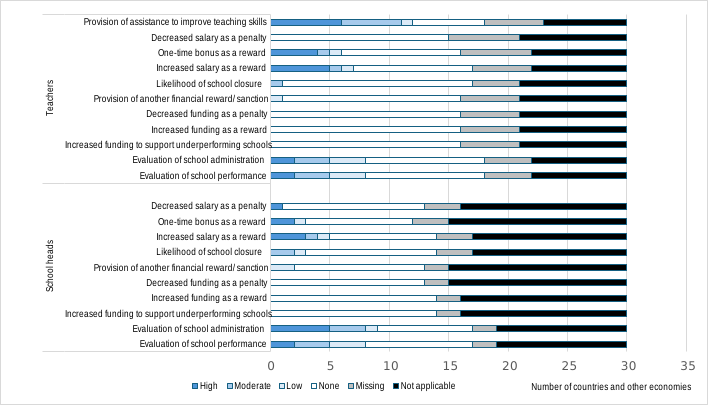
In most countries and economies with available information (10 to 16 out of 15 to 18, depending on the type of decisions considered) teachers’ appraisals do not have an impact on most of the types of decision considered in Table D7.4 and shown in Figure D7.3. These encompass evaluations of the performance and administration of educational institutions, their likelihood of closure, and the remuneration and bonuses received by teachers. Teacher appraisals have no impact on the size of school budgets in any country except the Slovak Republic, where they have a low level of influence on the provision of financial rewards or sanctions to the educational institution.
However, teacher appraisals have a moderate or high level of influence on some domains of decisions in a few countries. As might be expected, teachers’ appraisals have moderate to high level of influence on the provision of assistance to improve teaching skills in 11 countries and economies. They also have a moderate or high level influence on teachers' salaries increase or bonuses in five to six countries, and on the evaluation of school administration and school performance in five countries. Teachers’ appraisals have a high level of influence on evaluations of both school administration and school performance in the Slovak Republic and Türkiye and a moderate level on influence on both these areas in Hungary (Figure D7.3 and Table D7.4).
In general programmes, at primary and secondary levels
For data, see Table D7.4. The data for this figure can be accessed via https://stat.link/58zx6m.
The influence of school head appraisals is similar to those of teachers. They have no influence on school funding in any of the countries, and no influence on the likelihood of school closure or on school heads’ remuneration and bonuses in most countries. Nevertheless, school head appraisals have a high to moderate influence on the evaluation of school administrations in eight countries and on the evaluation of school performance in five. Four countries report that school head appraisals have an influence on increases in salaries as a reward (Figure D7.4 and Table D7.4).
Schools’ influence over appraisals
Individual educational institutions have an influence on teacher and school head appraisals even when there are legal frameworks covering them. The extent of this influence varies considerably across countries and economies. Schools have a moderate to high level of influence or control over teacher appraisals in nearly two-thirds of countries and economies with available information (13 out of 20). Only in the French Community of Belgium, Hungary and Türkiye do schools have no influence on procedures for appraisal.
Similarly, schools have a moderate to high level of influence or control over school head appraisals in nearly two-thirds of countries and economies with available information (10 out of 16). They have no influence on the appraisals of school heads in France, the French Community of Belgium and the Slovak Republic (Table D7.4).
Teacher and school head appraisals (all types of appraisal combined) can have a formative purpose, where the objective of helping them improve and progress in their skills and competencies. For instance, feedback on their performance helps teachers identify how to improve their teaching practice and, with the support of effective school leadership, can create professional learning communities within schools. Appraisals can also have summative purposes, aiming to analyse their performance and their effectiveness in order to inform a variety of employment decisions on areas such as career advancement, salary progression and the allocation of financial rewards or sanctions.
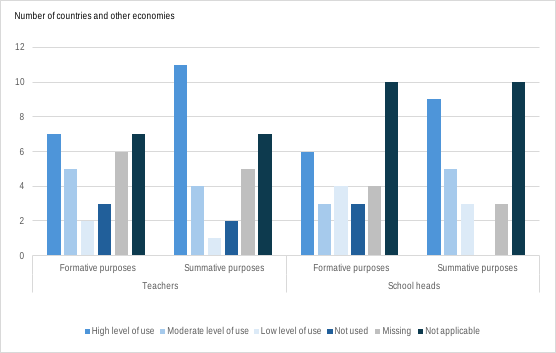
Some 14 countries and economies reported using teacher appraisals for both formative and summative purposes (among the 24 countries with a policy framework coverage for at least one type of appraisal). They might rely solely on appraisal results for these purposes (this is considered as a high level of use), or use them as one of many factors, but with a substantial level of use compared with the others (a moderate level of use) or with limited use compared with the other factors (a low level of use). Overall, teacher appraisals are used at a moderate or high level for formative purposes in 12 countries and for summative purposes in 15 countries (Figure D7.4 and Table D7.4).
In general programmes, at primary and secondary levels
Note: "Formative" refers to the use of appraisals for improvement. "Summative" refers to the use of appraisals to determine whether those being appraised are doing what they are supposed to do.
For data, see Table D7.4. The data for this figure can be accessed via https://stat.link/58zx6m.
Five countries reported a high level of use of teacher appraisals for both formative and summative purposes and three a moderate level for both. In other countries and economies, appraisals are used for summative and formative purposes at different levels. For example, in Korea they have a high level of use for formative purposes but a low level for summative purposes. By contrast, in the Flemish Community of Belgium and Luxembourg, they have a high level of use for summative purposes and a low level for formative purposes. In Luxembourg, the use for summative purposes includes a direct impact on completion of probation. In the Flemish Community of Belgium, the low level of use of teacher appraisals for formative purposes reflects the fact that formal evaluations now only take place in cases of poor performance. In Costa Rica and the French Community of Belgium, teacher appraisals are only used for summative purposes (Figure D7.4 and Table D7.4).
A similar picture emerges for school head appraisals. These are used for both formative and summative purposes in 13 countries and economies (among the 21 countries with a policy framework covering at least one type of appraisal of school heads). In most of them, the levels of use for formative and summative purposes differ. Only Bulgaria, France (at the secondary level), the French Community of Belgium and the Slovak Republic reported a consistently moderate or high level of use for both formative and summative purposes. In Czechia and Türkiye school heads’ appraisals have a high level of use for formative purposes, but a low level for summative purposes. Conversely, in the Flemish Community of Belgium and Spain these appraisals are used to a low level for formative purposes, but a high level for summative purposes. Appraisals are solely used for summative purposes in Korea, Lithuania and Slovenia. More generally school heads appraisals are used at a moderate or high level for formative purposes in 9 countries and for summative purposes in 14 (Figure D7.4 and Table D7.4).
Professional development refers to in-service training that aims to update, develop and broaden the knowledge of teachers and school leaders. This includes any activity that develops an individual’s skills, knowledge, expertise and other characteristics, through personal study and reflection as well as through formal courses.
References/standards refers to documents that provide the basis for appraisal criteria by defining what teachers and school leaders should know and be able to do, the tasks they should perform, and the regulations with which they should comply.
School head appraisals (i.e. evaluations) refer to the external evaluation of individual school leaders to make a judgement about their work and performance using objective criteria. Results of school head evaluations may be used to inform professional development activities, career advancement, and rewards.
Teacher appraisals, also referred to as teacher evaluations, refer to the evaluation of individual teachers to make a judgement about their work and performance using objective criteria. Results of teacher appraisals may be used to inform professional development activities, certification, career advancement and rewards. The term “teachers” covers all professional personnel directly involved in teaching students, including classroom teachers and other teachers who work with students as a whole class in a classroom, in small groups in a resource room, or in one-to-one teaching inside or outside a regular classroom.
This chapter is based on a survey on evaluation and assessment of teachers, school heads and schools that captured qualitative information on school inspections and self-evaluations and on school compliance reporting. Thirty OECD and partner countries and economies contributed to this survey (Austria, Brazil, Bulgaria, Chile, Costa Rica, Czechia, Denmark, England [United Kingdom], Finland, the Flemish and French Communities of Belgium, France, Germany, Hungary, Japan, Korea, Lithuania, Luxembourg, the Netherlands, Norway, Poland, Portugal, Romania, Scotland [United Kingdom], the Slovak Republic, Slovenia, Spain, Sweden, Switzerland and Türkiye).
For more information please see Education at a Glance 2026 Sources, Methodologies and Technical Notes (https://doi.org/10.1787/dcf64a14-en).
Data presented in this chapter are from the OECD-INES 2025 survey on evaluation and assessment of teachers, school heads and schools and refer to the school year 2024/25 (or the school year 2025).
References
[4] Darling-Hammond, L. (2012), “The right start: Creating a Strong Foundation for the Teaching Career”, Phi Delta Kappan, Vol. 94/3, https://doi.org/10.1177/003172171209400303.
[7] Donaldson, M. et al. (2021), “Principal evaluation under the Elementary and Secondary Every Student Act: A comprehensive policy review”, Education Finance and Policy, Vol. 16/2, pp. 347-361, https://doi.org/10.1162/edfp_a_00332.
[2] Grissom, J., A. Egalite and C. Lindsay (2021), How Principals Affect Students and Schools: A Systematic Synthesis of Two Decades of Research, The Wallace Foundation, https://doi.org/10.59656/el-sb1065.001.
[3] OECD (2025), Results from TALIS 2024: The State of Teaching, TALIS, OECD Publishing, Paris, https://doi.org/10.1787/90df6235-en.
[6] OECD (2020), “Education Policy Outlook in Portugal”, OECD Education Policy Perspectives, No. 21, OECD Publishing, Paris, https://doi.org/10.1787/0e254ee5-en.
[5] OECD (2015), Education at a Glance 2015: OECD Indicators, OECD Publishing, Paris, https://doi.org/10.1787/eag-2015-en.
[1] OECD (2013), Synergies for Better Learning: An International Perspective on Evaluation and Assessment, OECD Reviews of Evaluation and Assessment in Education, OECD Publishing, Paris, https://doi.org/10.1787/9789264190658-en.
Data Download
The data for the figures and tables in this chapter, can be downloaded via https://stat.link/58zx6m.
To access further data and/or other education indicators, please visit the OECD Data Explorer: http://data-explorer.oecd.org/s/4s
Data cut-off for the print publication 17 June 2026. Please note that the Data Explorer contains the most recent data.
In general programmes, at primary and secondary levels
Note: Data on the difference in teacher and school head appraisal policy (or regulation) between public and government-dependent private schools are available for consultation online (columns 2 and 9)
1. School head appraisal at upper secondary level is not legislated but widely practised
2. Primary level.
3. Secondary level.
The data for this table can be accessed via https://stat.link/58zx6m.
In general programmes, at primary and secondary levels
Note: Data refer to regular appraisals of teachers. Data on other types of appraisals (for completion of probation, teacher registration, promotion and reward schemes) are available in separate rows for consultation online.
The data for this table can be accessed via https://stat.link/58zx6m.
In general programmes, at primary and secondary levels
Appraisal informs professional development activities
Yes (always): Yes, appraisal results systematically result in a professional development plan; Yes (expected): Yes, appraisal results are expected to influence professional development plans; Yes (for some teachers): Yes, appraisal results are reflected in a professional development plan for some teachers; Yes (for in-service PD): Yes, appraisal results determine extra opportunities for in-service professional development; No: No, appraisal results do not inform teachers' professional development activities; Other: Other.
Appraisal affects career advancement
Yes (promotion): Yes, appraisal results influence decisions about promotion; Yes (progression): Yes, appraisal results influence the speed at which a teacher progresses along the career structure or salary scale; Yes (contracts): Yes, appraisal results influence decisions on access to contracts or renewal of fixed-term contracts or access to a permanent position; No: No, appraisal results do not affect career advancement; Other: Other.
Appraisal affects pay levels
Yes (base salary): Yes, appraisal results affect the base salary; Yes (allowance): Yes, a pay allowance is provided for good performance; Yes (progression): Yes, to the extent that it allows the teacher to progress on the career structure and/or salary scale; No: No, appraisal results do not affect pay levels. Other: Other.
Note: Data refer to regular appraisals of teachers. Data on other types of appraisal (completion of probation, teacher registration, promotion and reward schemes) are available in separate rows for consultation online alongside data on responses to underperformance (Columns 14 to 26).
1. Primary level.
2. Secondary level.
The data for this table can be accessed via https://stat.link/58zx6m.
In general programmes, at primary and secondary levels
Note: "Formative" refers to the use of evaluations for improvement. "Summative" refers to the use of evaluations to determine whether the object of the evaluation is doing what it is supposed to do. Data on the influence of teacher and school head appraisals on the size of school budget (Columns 5 to 8 and 19 to 22) are available for consultation online.
1. Primary level.
2. Secondary level.
The data for this table can be accessed via https://stat.link/58zx6m.
In general programmes, at primary and secondary levels
Note: Data refer to regular appraisals of school heads. Data on appraisals for initial certification as a school head are available in separate rows for consultation online.
1. Primary level.
2. Secondary level.
The data for this table can be accessed via https://stat.link/58zx6m.
In general programmes, at primary and secondary levels
Appraisal informs professional development
Yes (always): Yes, appraisal results systematically result in a professional development plan, Yes (expected): Yes, appraisal results are expected to influence professional development plans; Yes (PD plan): Yes, appraisal results are reflected in a professional development plan for some school heads;
Yes (opportunities): Yes, appraisal results determine extra opportunities for in-service professional development; No: No, appraisal results do not inform school heads' professional development plan and activities; Other: Other.
Appraisal affects career advancement
Yes (promotion): Yes, appraisal results influence decisions about promotion; Yes (speed): Yes, appraisal results influence the speed at which a school head progresses along the career structure or salary scale; Yes (contract): Yes, appraisal results influence decisions on access to contracts or renewal of fixed-term contracts or access to a permanent position; No: No, appraisal results do not affect career advancement; Other: Other.
Appraisal affects pay levels
Base salary: Yes, appraisal results affect the base salary; Allowance: Yes, a pay allowance is provided for good performance; Progression: Yes, to the extent that it allows the school head to progress along the career structure or salary scale; No: No, appraisal results do not affect pay levels; Other: Other.
Note: Data refer to regular appraisals of school heads. Data on appraisals for initial certification as school head are available in separate rows for consultation online alongside data on responses to underperformance (Columns 15 to 25). The data for this table can be accessed via https://stat.link/58zx6m.
1. School head appraisal at upper secondary level is not legislated but widely practised.
2. Primary level.
3. Secondary level.