PIMA-AFOLU covers policies from OECD Members, other EU Member states, G20 countries, and other emerging economies. The 2025 update expanded the coverage of PIMA-AFOLU to include Croatia, Cyprus, Kazakhstan, Malta, the Philippines, Romania, Ukraine, and Viet Nam. As a result, approximately 200 mitigation policies have been added to the database.
Policy Inventory for Mitigation Actions in the Agriculture, Forestry and Other Land Use Sectors
2025 PIMA-AFOLU Update

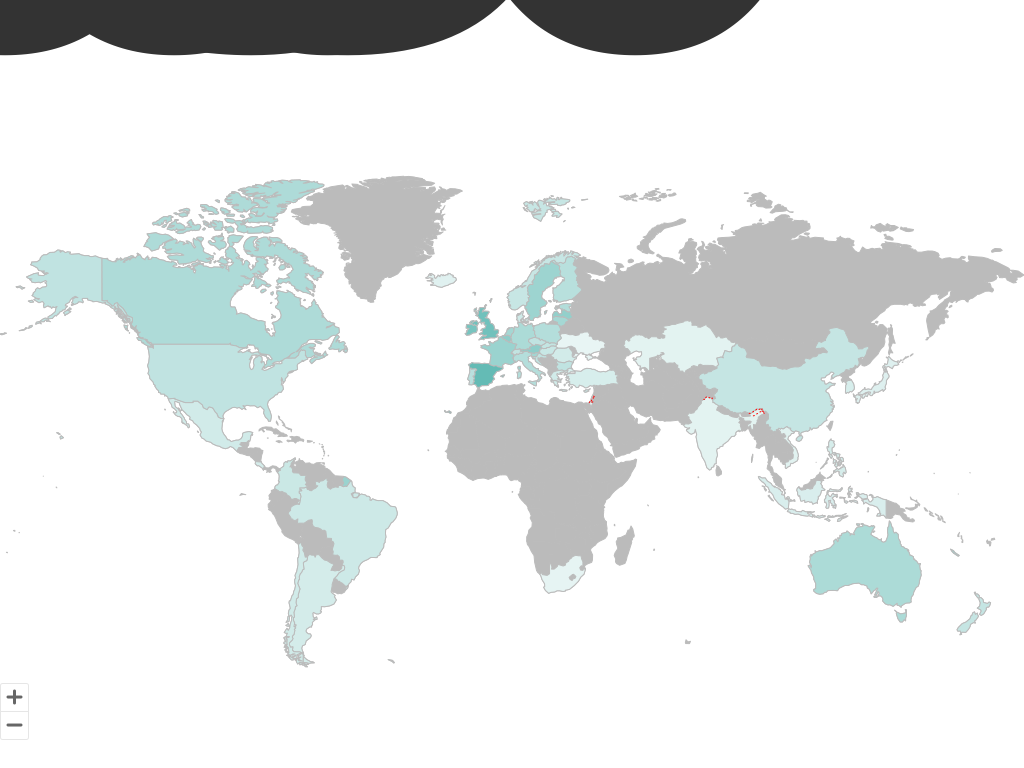
Notes: The number of policies reported in a country does not provide information on their effects on GHG emissions.
The number of policies is based on policies and policy developments in 2024.
Source: PIMA-AFOLU.
Countries are increasingly adopting direct and indirect mitigation policies; most policies included in the database were adopted over the past 20 years. This highlights the growing focus on the environmental effects and potential co-benefits of policies in the AFOLU sectors. However, the large increase in 2023 was primarily due to the adoption of the 2023-27 Common Agricultural Policy (CAP) of the European Union. Previous CAPs also included environmental policies but were not included in PIMA-AFOLU, which was based on ongoing policies when it was created in 2024. Additionally, the number of policies is not indicative of their effectiveness, so policy details and country specific contexts need to be taken into consideration. Additionally, further efforts are needed to evaluate the effectiveness and analyse the depth and breadth of policies.
PIMA-AFOLU distinguishes two levels of policies: overarching policy frameworks (high-level policies) and individual policy instruments. About 21% of policies included in PIMA-AFOLU are high level policies which set out broad policy objectives or are considered “bundled” policies. Examples of high-level policies include climate strategies, and sectoral codes. The remaining policies are individual instruments which target specific measures.
The individual policies are categorised according to the OECD Inclusive Forum of Carbon Mitigation Approaches (IFCMA) instrument typology (OECD, 2024[2]) (Table 2.1). They are grouped into three main categories: i) economic instruments, ii) regulatory instruments, and iii) other instruments.
Economic instruments refer to instruments that incentivise specific actions generating a change in outcomes through direct economic benefit (e.g. a budgetary transfer) or by changing relative prices faced by individual agents (e.g. a tax) (OECD, 2024[3]). These include the three instrument types: subsidies, taxes, and trading systems.
Regulatory instruments refer to a broad range of instruments that drive the adoption of desired processes, technologies, products, or outcomes (Martini, 2023[4]). They may take the form of direct mandates, prohibitions, or restrictions on certain goods or activities, establish maximum or minimum limits on various parameters (e.g. emissions), or require entities to obtain explicit permission or meet specific criteria before engaging in particular activities. Failure to comply typically incurs financial penalties or legal sanctions. These are categorised into performance standards, technology standards and framework regulations policies.
Other instruments include government investment and consumption, information instruments and voluntary agreements. Government investment and consumption instruments encompass the allocation of financial resources by government units towards goods, services, and facilities like infrastructure and R&D, as well as the implementation of policies and rules that shape government expenditure choices and decision-making processes. Information instruments refer to instruments that promote technology choices and behavioural changes through the collection and dissemination of information, raising awareness, and communicating knowledge in order to influence behaviour. Voluntary agreements are agreements between a government authority and one or more private parties to achieve policy objectives or to improve performance beyond compliance with regulatory obligations.
About two-thirds of individual instruments included in PIMA-AFOLU are economic instruments as classified by the typology in Table 2.1. Regulatory and other instruments account for about equal shares, about 16% each, of individual instruments.
Note: Each instrument type consists of several individual policy instruments.
Source: Following IFCMA (OECD, 2024[2]).
A majority of economic instruments (97%) fall under the subsidies instrument type. Few trading systems target AFOLU, despite their increasing number (3% of the economic instruments). The least often used economic instrument type is taxes. Technology and performance standards are respectively 27% and 32% of total reported regulatory instruments, with the remaining 41% classified as framework regulation policies. Government investment and consumption accounts for (41%) of the last category of instruments; information instruments account for 46%, with the remaining 13% classified as voluntary agreements.
Sectors
Policies that target AFOLU sectors can be decomposed by type of targeted sector. The policy inventory has a specific column for “sectors”, the following of which are distinguished:
Agriculture
Forestry
AFOLU (when both sectors are targeted)
Non-AFOLU (when the policy affecting AFOLU has been implemented outside of the sector, e.g. emissions in the energy sector affecting bioenergy producers).
Most policies in the database (approximately 970) focus on the agricultural sector.1 These include policies that support improved management practices such as reducing the application of fertilisers or the use of feed additives to reduce CH4 emissions from livestock. About 170 policies target the forestry sector; these measures include afforestation and forest conservation. Approximately 280 policies have been designed with a specific focus on the AFOLU sector. A few policies (about 70) have been designed outside of the AFOLU sectors (non-AFOLU policies), but can nevertheless affect agriculture or forestry production systems or land use.
Different sectors rely on distinct policy mixes to achieve mitigation objectives. Subsidies remain the most commonly used instrument type for all land-based sectors, representing about 70% of policies in agriculture. Their prevalence is somewhat lower in non-AFOLU sectors, where they account for roughly 40% of policies. While only accounting for 2% of total individual instruments, most trading systems target the AFOLU sector, making up about 8%. These policies often allow both farmers and foresters to generate credits. The forestry sector accounts for the largest proportion of government investment and consumption instruments, which include, for example, research and development (R&D) and afforestation and restoration of state-owned land. Information instruments are proportionately most used by the non-AFOLU sector, accounting for about a quarter of instruments. These policies include environmental certifications and training for businesses.
Subsectors
To capture the diversity of interventions within the AFOLU sectors, the PIMA-AFOLU database further disaggregates policies by subsector. The level of granularity helps to identify which parts of the agricultural and land use sectors are most directly targeted by specific policy measures. The subsectors include livestock (further disaggregated by species), arable land, grassland, forest, wetlands and other sub-sectors. Policies that influence multiple subsectors are tagged accordingly under each relevant subsectors.
More than half of the instruments listed in the policy inventory regulate or provide various incentives for arable land (Figure 2.5). These policies have diverse targets, ranging from changes in land management practices such as fertiliser application to broader landscape adjustments such as agroforestry. Some policies stimulate the removal of land from production altogether.
About 28% of policies target the forest subsector. The focus on tree planting, afforestation, reforestation, and forest management policies is gaining momentum. Countries are not solely addressing forestry-related matters through dedicated forestry ministries, but increasingly integrating these objectives into broader agricultural policies. Notably, several EU countries allocate a portion of their CAP budget to tackle forestry-related issues. This multifaceted approach underscores the importance of sustainable land use practices and the preservation of vital forest ecosystems.
About half of the policies included in PIMA-AFOLU focus on a single subsector (Figure 2.6). These include, for example, measures for improved management of crops (classified under arable land), wetland protection, and forest restoration. Many policies, however, address multiple subsectors simultaneously, e.g. livestock grazing regulations affect both livestock and grassland pastures. Broader interventions such as research programmes or grants and rural development subsidies often target a wide range of producers, foresters and land users.
Environmental domains
Beyond tracking mitigation policies, PIMA-AFOLU can help monitor other environmental goals through the use of domains. When a policy’s primary or secondary objective relates generally to the environment, it receives an associated tag. The domains include: i) soil, ii) water, iii) biodiversity, iv) climate change, v) environment (if the policy target multiple domains), vi) energy, and vii) waste.2
The most commonly assigned domain is environment, which accounts for about 350 instruments, of which 264 are individual instruments. This reflects the multiple and diverse targets of policies, and the large potential to support environmental co-benefits with AFOLU mitigation policies. Biodiversity and climate change each account for about 250 instruments (208 and 186 individual instruments respectively). Relatively few policies target waste and energy.3
Different types of policies may be more commonly used to target specific environmental domains. Overall, economic instruments are the most commonly used in seven of the eight domains. The exception is the waste sector that relies primarily on regulatory instruments, such as restrictions on the use of sewage sludge to fertiliser fields. Policies targeting water also use a relatively large proportion of regulatory instruments (about one-third). These instruments often address water quality by setting pollution limits or restricting activities like livestock grazing or fertiliser application near water bodies. The largest share of other instruments is found amongst policies that specifically target climate change mitigation. Examples include research and development (R&D) initiatives on livestock genetics and feed to reduce CH4 emissions, farm activity and emission reporting requirements, and schemes that generate emission credits for voluntary emission reporting programmes.
Policy objectives are often sector-specific, reflecting differences in the main environmental pressures and policy priorities across sectors. For example, most policies that target soil are agricultural policies; these measures include support for cover crops and restrictions on fertiliser application or tillage. Relative to other sectors, forestry targets a fewer number of environmental domains, indicating that forestry mitigation policies are often more focused on specific objectives rather than more general environmental objectives. Biodiversity is the primary domain of forestry policies, often focusing on forest conservation or restoration.
Policies in the AFOLU sectors can be decomposed by the mechanism of emissions reduction, called mode of mitigation. Some policies can be mapped to the emissions reduction of a particular GHG (“mode of mitigation per GHG type”) and some may stimulate more complex bio-chemical interactions through different land use management measures (“mode of mitigation per land management”) (Figure 2.9). It is possible that a policy targets multiple modes of mitigation; in such cases, multiple tags are allocated.
The mode of mitigation may be a downstream effect of the policy rather than an explicit policy target; for example, water quality regulations that are tagged under water domain may restrict the number of livestock which decreases the production of manure. This may result in decreased manure CH4 and N2O emissions. The allocated modes of emissions are based on possible emission reduction pathways based on the policy target, rather than direct policy targets.
About 20% of policies are associated with N2O emissions through various actions (mainly by regulating the amount, storage, application, or use of inorganic and organic fertilisers); these include policies that target both Soil N2O and or Manure N2O.
CH4 emission reducing policies (policies that control manure and feedstock and number of ruminants, as well as policies that target water efficiency in rice production) are the next most common in the database. About 270 policies aim to reduce this gas (by targeting enteric fermentation, manure methane emissions and improved land management for rice-related policies) (Figure 2.9).
Over 150 policies are associated with the mitigation of CO2 emissions. These policies encourage renewable energy (including bioenergy), building and equipment improvements, and a more efficient use of resources.
When a policy works through land management adjustments, affecting multiple GHGs, it is tagged as a land management mode. Three land use modes are distinguished: i) carbon sequestration; ii) improved land management; and iii) land conservation and ecosystems.
Most policies in the inventory aim to improve land management by enhancing soil quality, crop productivity, or by changing crop types from annual to perennial, including to the forestry sector (841 policies). Many policies also focus on land conservation by preventing land degradation and restoring ecosystems (564 policies). Over 450 policies target carbon sequestration by increasing the amount of carbon stored in plants and soils. These policies can help to reduce emissions and increase resilience to climate change.
Across all sectors, most policies target one or two emission sources or CO2 sequestration pathways (i.e. “modes of mitigation”). However, some sectors such as agriculture and AFOLU more frequently support broader or cross-cutting mitigation approaches. These policies often target multiple GHGs and emission sources, or promote carbon sequestration through different types of land management practices. Relative to other sectors, forestry tends to contribute to mitigation through a smaller number of specific pathways. However, the number of modes of mitigation is not indicative of the mitigation effectiveness.
Although only about 23% of policies target three or more subsectors (Figure 2.6), those that do tend to support a wider range of mitigation methods. For example, policies promoting livestock extensification – by reducing heard sizes and encouraging tree planting on pastures – simultaneously target the livestock, forest, and grassland subsectors. The associated modes of mitigation include enteric CH4, manure CH4, manure N2O, and enhanced carbon sequestration.
Many policies are characterised by quantifiable targets, which serve as benchmarks for their performance evaluation. The formulation of precise and measurable objectives helps to delineate clear pathways to success and to establish robust benchmarks for assessing progress.
Given the multifaceted nature of the AFOLU sector, a spectrum of targets is pertinent, each tailored to address the unique dimensions of agricultural practices, land conservation, and climate action. Targets that are commonly used in the AFOLU policies include area in hectares covered by AFOLU measures, emission reduction objectives, livestock units covered by measures, number of planted trees, and the number of projects or beneficiaries affected (Table 2.2).
Note: targets for emissions reductions in “%” are found in the notes section of PIMA-AFOLU.
Source: OECD (2024[5]).
Preselecting area (ha) helps to understand the extent of policy support aimed at specific management changes, including:
Land management: Area under particular agricultural or forestry management practices.
Reforestation/afforestation: Planting trees on land that has been deforested, aimed at restoring forest ecosystems and enhancing biodiversity. It also includes afforestation efforts.
Protection: Preservation of natural areas and protection from various events including fires and floods.
Restoration: The rehabilitation of degraded land to revive ecological functions and services.
For example, about 9% of policies (when considering the total number of policies) target afforestation activities. However, when considering the area covered by these policies, about 15% of the total targeted area is dedicated to afforestation activities (Figure 2.12).
← 1. While PIMA-AFOLU has the largest coverage of the agricultural sector, this does not indicate its mitigation effectiveness or the potential of a sector relative to forestry, AFOLU or non-AFOLU.
← 2. The domains are adapted from the PINE classification (Chhun et al., 2024[6]).
← 3. While many energy and waste policies target environmental objectives, most of these policies do not directly affect AFOLU emissions through production, and are therefore outside the scope of this database.