SOE boards play a central role in oversight, strategic direction and accountability, and arrangements that support informed and effective decision making underpin their ability to fulfil these responsibilities. This chapter examines SOE board mandates, authority and functions; board committees; composition and diversity; and independence and effectiveness. It also considers the role of boards in the oversight of risk management and internal controls, given their importance in supporting effective governance.
Ownership and Governance of State‑Owned Enterprises 2026

Abstract
Boards of directors are central to the governance of SOEs, as they help shape strategic direction and oversee financial and non-financial performance, while ensuring accountability of management and overall performance. This chapter examines the composition and responsibilities of boards in line with the SOE Guidelines, including mandates, authority and functions, committees, composition and diversity. It also considers board effectiveness, including the role of the Chair and board evaluation practices, as well as oversight of risk management. Based on the key findings:
While boards generally oversee management and play an important role in appointing and dismissing senior executives, their authority to approve corporate strategy differs. Only 43% of jurisdictions grant boards full authority to set and approve corporate strategy, while in almost half, strategic decisions remain subject to formal state shareholder approval, highlighting the involvement of governments in shaping SOE strategic direction.
Board committees are widely used, with audit committees being most formalised. Approximately three‑fourths of jurisdictions require them by law or regulation and often impose specific independence standards. By contrast, nomination, remuneration and risk committees are more commonly governed through corporate governance codes or other soft-law instruments, resulting in greater variation in their mandate, composition and independence requirements. Sustainability committees remain comparatively uncommon and less formalised.
Approaches to board composition, including board size, competencies and diversity, vary considerably across jurisdictions. Board size is most often regulated by law or regulation. Skills and competency criteria are most commonly set out in guidelines, applying in around half of jurisdictions, while approaches to gender diversity are mixed, with 29% reporting no gender or diversity targets in place.
Board independence and evaluation practices are widely established, though they vary in scope and formality. While nearly three‑fourths of jurisdictions have some expectations relating to board independence, only around half (54%) require a minimum number of independent board members, and only 45% prohibit senior political office holders from serving on SOE boards. Board evaluations are also widely used, often through self-evaluation mechanisms, with 71% using evaluation results to inform board nomination processes.
Risk management is broadly recognised but less consistently developed at the portfolio level. Most jurisdictions require or expect SOEs to implement enterprise‑level risk management frameworks and boards are typically responsible for overseeing these arrangements. However, mechanisms for identifying, monitoring and managing risks across the broader SOE portfolio are less systematically established, suggesting that risk oversight often remains focussed on individual enterprises rather than the state’s ownership portfolio as a whole.
5.1.1. Board structures and core functions
Clear mandates and well-defined objectives are essential for SOE boards to effectively carry out their core responsibilities. These include reviewing and guiding corporate strategy, overseeing management, and ensuring alignment with the expectations of the state as shareholder. Understanding how boards fulfil these roles requires first examining how they are structured and the functions they perform across jurisdictions.
Board structure is a core element, with approximately half of the respondents reporting that SOEs operate under a one‑tier board system, in which executive and non-executive directors sit on a single board. Around one‑third use a two‑tier structure, typically including a supervisory board of non-executive members, sometimes including employee representatives, and a separate management board composed of executives. These structural differences can have implications for how oversight responsibilities are organised, including the separation between supervision and management, the role of board committees, and reporting lines for control functions (Figure 5.1).

Note: Sample for Panel A comprises 58 jurisdictions, while sample for Panel B comprises 56 jurisdictions (Chile and France not included). For Panel A, multiple responses were allowed.
Source: OECD (2026[1]), OECD Survey on State Ownership and Corporate Governance.
Despite institutional differences, core functions performed by boards are broadly similar across jurisdictions, suggesting a high degree of functional convergence across governance models. Boards are typically responsible for overseeing performance, appointing senior leadership and determining remuneration. Survey findings indicate that they generally play a strong role in management oversight, with 97% of jurisdictions assigning them responsibility for overseeing executive performance. A large majority also involve boards in appointing or dismissing executive management. A more differentiated picture emerges in relation to remuneration. While boards in 72% of jurisdictions are responsible for determining CEO or executive pay, this is also the area where state influence is most visible – in 81%, remuneration frameworks are subject to government-issued guidelines or limits. This suggests that, while boards retain a role in setting pay, their discretion may be constrained by public sector considerations, such as pay caps, benchmarking frameworks, or broader fiscal and policy objectives (Table 5.1).
Note: The sample comprises 58 jurisdictions. Multiple responses were allowed. Results are drawn from several questionnaire items and provide an overview of the mechanisms reported by respondents. As countries may employ more than one mechanism, the categories overlap and percentages do not sum to 100%.
Source: OECD (2026[1]), OECD Survey on State Ownership and Corporate Governance.
5.1.2. Board autonomy
Boards should have sufficient autonomy and authority to carry out their functions effectively, including in relation to approving the corporate strategy. Across reporting jurisdictions, boards are almost always involved in defining corporate strategy. The difference lies not in whether boards participate in this process, but in where final decision making authority rests.
According to the survey, 43% of jurisdictions indicate that boards have full authority to set and approve corporate strategy. In these systems, governments often define high-level expectations, such as public policy objectives, financial targets or strategic priorities, while boards, together with management, are responsible for translating them into corporate strategies and business plans. Although structured dialogue between the state and the board is common in these cases, formal approval by the shareholder is not required. In practice, boards are still expected to reflect government priorities, which may also be conveyed through informal channels and iterative exchanges. As a result, autonomy in strategy-setting is often exercised within a framework of state stewardship (Table 5.2).
In contrast, a larger share of jurisdictions requires boards to seek formal approval from the state shareholder or ownership entity. In these systems, boards play a central role in developing corporate strategy, but key decisions, such as corporate plans, investment programmes or strategic documents, must be validated by the state. A smaller group of jurisdictions grants boards limited autonomy in defining corporate strategy. In these systems, strategic direction is largely determined by government or ownership entities, with boards playing a more limited role focussed on implementation and oversight.
Note: The sample comprises 58 jurisdictions.
Source: OECD (2026[1]), OECD Survey on State Ownership and Corporate Governance.
Across all models, certain decisions, such as capital structure changes or other major transactions, are typically reserved for shareholder approval. Ultimately, the key distinction lies in whether boards exercise primary authority over strategy, operate under formal state validation, or implement strategies defined by the state. Compared to listed companies, where boards generally have primary responsibility for strategy approval, these findings highlight the more prominent and direct role of the state in shaping SOE strategies.
Beyond formal mandates, board effectiveness also depends on how boards organise their work. A key mechanism is the use of specialised committees to support oversight in core areas such as audit, risk, remuneration and nominations, with sustainability-related committees emerging more recently. Aggregate information is presented in Figure 5.2, while country-level information is presented in Tables 5.3‑5.6.
Based on the survey results, audit committees are the most formalised across jurisdictions, with a majority establishing them through laws or regulations, followed by governance codes or other policy instruments. This high level of formalisation reflects the central role of audit committees in safeguarding financial reporting integrity and reinforcing internal control systems. Correspondingly, independence requirements are typically more stringent than for other committee types, with most imposing them through binding provisions. Moreover, in approximately half of jurisdictions, audit committees must include a majority of independent directors, and in one‑third an independent Chair is required. While these reflect broader trends, in some cases the requirement for independent board members may apply only to certain categories of SOEs such as listed companies (e.g. in Germany) or enterprises meeting specific legal or size thresholds (e.g. in Ukraine).
For other committees, namely nomination, remuneration and risk, frameworks are less prescriptive. They are more often governed by soft law instruments, such as corporate governance codes or comply-or-explain frameworks, with only a minority of jurisdictions imposing binding composition requirements. Independence provisions are also less widespread and more heterogeneous. Where they exist, they typically require a majority of independent members, while independent Chair requirements for non-audit committees are less common (Figure 5.3). Importantly, definitions of independence and board qualification requirements, such as for audit committee members, vary across jurisdictions and within jurisdictions depending on the applicable legal, regulatory or voluntary framework.

Note: Multiple responses were allowed. The figure shows the number of jurisdictions reporting each measure. Where both Law/regulation and a Code/expectation were selected, precedence was given to the former.
Source: OECD (2026[1]), OECD Survey on State Ownership and Corporate Governance.
Sustainability committees (or other committees with responsibility for sustainability-related matters) remain the least formalised among board-level committees. Most jurisdictions report no explicit requirement, and only a limited number regulate them through law or formal guidance. This reflects their relatively recent emergence as a structured board responsibility, with practice in some cases evolving ahead of regulatory frameworks. It should be noted that this survey captured only the presence of a dedicated sustainability committee and did not capture cases where sustainability-related responsibilities may instead be assigned to an existing committee, such as risk or audit.
These patterns broadly align with those observed in listed company governance highlighted in the OECD Corporate Governance Factbook 2025. In both contexts, audit committees represent the most formalised and standardised element of board structures. In listed companies, however, such arrangements are more consistently applied, often approaching universal coverage, while in the SOE context, formalisation remains slightly less uniform in practice (see Box 5.1). For other committees, listed companies also rely heavily on governance codes that go beyond minimum legal requirements. However, listed company frameworks tend to be more standardised, particularly regarding independence and qualification requirements and committee functioning. By contrast, SOE frameworks display more variation, reflecting differences in ownership structures, legal traditions and the role of the state as shareholder.
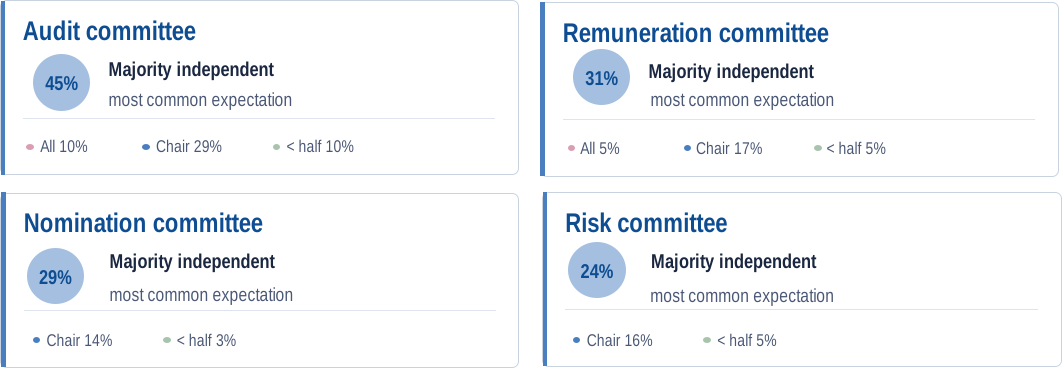
Note: Multiple responses were allowed. Percentages are calculated out of 58 jurisdictions. Detailed breakdown of responses is provided in Tables 5.3‑5.6.
Source: OECD (2026[1]), OECD Survey on State Ownership and Corporate Governance.
Differences are also visible in the organisation of risk oversight. In many listed company frameworks, risk responsibilities are frequently integrated into the audit committee rather than assigned to a standalone risk committee. In the SOE context, while similar arrangements exist, there is greater diversity in how risk oversight is structured. Sustainability-related committees remain an emerging feature in both contexts, with limited formalisation and a stronger role for voluntary adoption or integration of such responsibilities into existing board committees.
The OECD Corporate Governance Factbook 2025, covering 52 jurisdictions, provides a comparative overview of listed company governance practices, highlighting several consistent patterns in the use and regulation of board-level committees.
Audit committees are near-universal and highly standardised. All surveyed jurisdictions require or recommend their establishment, typically combining mandatory status with independence provisions. In several jurisdictions, flexibility exists in how functions are organised (e.g. Finland and Sweden allow the full board to perform audit committee functions; Brazil permits fiscal councils). Audit committees also play a central role in overseeing external audit processes, including recommending auditors and reviewing audit scope.
Independence requirements are most stringent for audit committees. Thirty-one jurisdictions require audit committees to have a majority of independent members, with a further 12 recommending this through codes. Independent chairs are mandated in 33 jurisdictions. In practice, independence requirements for audit committees are more frequently embedded in binding rules than for other committee types.
Nomination and remuneration committees are widely recommended but less frequently mandated. Nomination committees are mandatory in 12 jurisdictions and remuneration committees in 16, while the majority of jurisdictions rely on code‑based recommendations (around 45 jurisdictions). Independence requirements for these committees are most commonly encouraged through codes (22 jurisdictions for nomination and 23 for remuneration), rather than imposed through law.
Risk oversight is increasingly formalised, but not always through standalone committees. Sixty-one per cent of jurisdictions require boards to assume responsibility for risk management, with an additional 31% recommending this role in codes. However, only around 20 jurisdictions require or recommend the establishment of separate risk committees. In most cases (42 jurisdictions), risk oversight is at least partly assigned to the audit committee.
Specialised committees beyond the traditional three remain less formalised but are evolving. Some jurisdictions require or recommend dedicated sustainability committees, while others assign sustainability-related responsibilities to existing committees. Companies are also establishing other specialised committees on a voluntary basis, such as compliance or technology committees, with 13% of S&P 500 companies having a dedicated technology committee in 2024.
Source: OECD (2025[2]), OECD Corporate Governance Factbook 2025, https://doi.org/10.1787/f4f43735-en.
Note: The sample comprises 58 jurisdictions. Multiple responses were allowed. Where both Law/Reg and a Code were selected, precedence was given to the former. In some cases, independence thresholds reflect general practice rather than a formal requirement. *For Ukraine, the requirement applies only to cases where the state owns more than 50% of the shares and the formation of a supervisory board is mandatory.
KEY
Committee mandate and independence requirement
Law/Reg – required by law or regulation
Code – addressed by a code or owner’s expectation
None no requirement; “–” not reported
Independence threshold
■ all members independent
■ majority independent
■ Chair must be independent
■ less than half independent
Source: OECD (2026[1]), OECD Survey on State Ownership and Corporate Governance.
Note: The sample comprises 58 jurisdictions. Multiple responses were allowed. Where both Law/Reg and a Code were selected, precedence was given to the former. In some cases, independence thresholds reflect general practice rather than a formal requirement. *For example, in Ukraine, the requirement applies only to cases where the state owns more than 50% of the shares and the formation of a supervisory board is mandatory. In Azerbaijan, some regulations do not apply to entities under AIH and AZCON.
KEY
Committee mandate and independence requirement
Law/Reg – required by law or regulation
Code – addressed by a code or owner’s expectation
None no requirement; “–” not reported
Independence threshold
■all members independent
■ majority independent
■ Chair must be independent
■ less than half independent
Source: OECD (2026[1]), OECD Survey on State Ownership and Corporate Governance.
Note: The sample comprises 58 jurisdictions. Multiple responses were allowed. Where both Law/Reg and a Code were selected, precedence was given to the former. In some cases, independence thresholds reflect general practice rather than a formal requirement. * For Ukraine, the requirement applies only to cases where the state owns more than 50% of the shares and the formation of supervisory board is mandatory. In some cases where an independence requirement is mandated (by law or code), the specific standard (e.g. majority, chair, or all members independent) is not reported (“–”). This reflects either a qualitative rather than quantitative independence framework (e.g. Korea), a requirement that does not extend to the nomination committee specifically (e.g. Netherlands), or incomplete country reporting subject to further validation.
KEY
Committee mandate and independence requirement
Law/Reg – required by law or regulation
Code – addressed by a code or owner’s expectation
None no requirement; “–” not reported
Independence threshold
■ all members independent
■ majority independent
■ Chair must be independent
■ less than half independent
Source: OECD (2026[1]), OECD Survey on State Ownership and Corporate Governance.
Note: The sample comprises 58 jurisdictions. Multiple responses were allowed. Where both Law/Reg and a Code were selected, precedence was given to the former. In some cases, independence thresholds reflect general practice rather than a formal requirement. * For Brazil, the independence requirement for the risk committee applies only to SOEs classified as National Financial System institutions under CMN Resolution 4557/17 (Art. 45, §5º), which requires that a majority of risk committee members be independent. This requirement does not extend to SOEs outside the financial sector.
KEY
Committee mandate and independence requirement
Law/Reg – required by law or regulation
Code – addressed by a code or owner’s expectation
None no requirement; “–” not reported
Independence threshold
■ all members independent
■ majority independent
■ Chair must be independent
■ less than half independent
Source: OECD (2026[1]), OECD Survey on State Ownership and Corporate Governance.
Board composition shapes who participates in board deliberations and what mix of skills, experience and perspectives is brought to the table. A combination of factors can influence board effectiveness, including board size, skills and competencies, diversity considerations and, in some cases, employee representation, as further elaborated in this section (a breakdown of practices by jurisdiction is elaborated in Table 5.8).
5.3.1. Board size
Board size is one of the most regulated aspects of SOE board composition, reflecting its perceived importance for effective governance. Most jurisdictions establish formal minimum or maximum thresholds, often aligned with general company law frameworks (case studies are presented in Table 5.7).
These thresholds are often developed through company bylaws, founding statutes or ownership decisions, and, in many cases, board composition is tailored to the scale, complexity and sector of the enterprise. Some also include guidance on minimum or maximum size rather than fixed thresholds, encouraging boards to organise their work as needed. Minimum sizes are typically set at around three members to ensure functionality, though observed approaches tend to converge around boards of five to nine members.1 Larger boards remain more prevalent in complex or strategically significant enterprises, reflecting the need to accommodate broader representation requirements, including employee participation, and a wider range of specialised expertise.
5.3.2. Skills and competencies
Ensuring that boards possess an appropriate mix of skills and expertise is widely recognised as a core determinant of board effectiveness, though practices differ. Formal requirements apply in 45% of jurisdictions, while others use non-binding guidance or principles-based approaches. Jurisdictions with detailed legal provisions often combine explicit competency criteria with fit-and-proper assessments and structured nomination procedures. By contrast, more flexible systems tend to rely on governance codes, nomination processes and the role of ownership entities and boards in identifying suitable candidates, often based on board profiles. In such cases, procedural safeguards may substitute for more detailed legal prescription. While this can allow greater flexibility, it may also lead to less consistent implementation across the SOE portfolio (Table 5.8).
5.3.3. Gender and diversity
Approaches to diversity considerations (including with regard to gender, age, geographical, professional and educational background) are more heterogeneous across jurisdictions, reflecting differing policy priorities and regulatory traditions. Among reporting jurisdictions, 43% implement gender diversity quotas and 29% report no specific measures, while 26% rely on voluntary targets. In jurisdictions with requirements, minimum thresholds for the underrepresented gender typically fall within the 30% to 40% range (Table 5.8). These quotas are often accompanied by enforcement mechanisms or disclosure obligations, strengthening their practical effect. This pattern is particularly evident in EU economies, where recent regulatory developments have reinforced convergence around these thresholds (Box 5.2).
The European Union has introduced a common framework to promote gender balance on corporate boards through Directive (EU) 2022/2381 on improving the gender balance among directors of listed companies. The Directive entered into force in December 2022 and was to be transposed by member states by 28 December 2024, with implementation targets to be met by 30 June 2026. Under the Directive, large listed companies are required to ensure that the underrepresented gender accounts for:
at least 40% of non-executive director positions, or
at least 33% of all director positions (including executive and non-executive roles).
The Directive allows member states flexibility in implementation, including the choice between these targets. It also establishes procedural requirements, requiring companies to apply transparent and merit-based selection processes, based on clear and neutral criteria. Where candidates are equally qualified, priority should be given to the underrepresented gender, unless justified otherwise.
In practice, implementation typically combines quantitative targets with procedural and transparency measures. Companies are expected to integrate gender considerations into nomination processes, ensure diverse candidate pools, and disclose information on board composition and progress towards targets. In some jurisdictions, enforcement mechanisms such as sanctions or limits on appointments apply, while in others compliance is supported through reporting obligations and oversight by state ownership entities or regulators.
Source: European Parliament and Council (2022[3]), Directive (EU) 2022/2381 of the European Parliament and of the Council of 23 November 2022 on improving the gender balance among directors of listed companies and related measures, http://data.europa.eu/eli/dir/2022/2381/oj.
Note: Results are drawn from several questionnaire items and provide an overview of the mechanisms reported by respondents. The categories do not sum to 100%.
KEY
■ Requirement
■ Recommendation / voluntary target.
■ Other
Source: OECD (2026[1]), OECD Survey on State Ownership and Corporate Governance.
Other jurisdictions rely on voluntary targets, often set through ownership policies or governance codes, which aim for similar levels of representation but allow greater flexibility in implementation. Progress is commonly supported through transparency measures and comply or explain mechanisms. A number of jurisdictions also promote gender and other forms of diversity (for example representation of underrepresented indigenous, linguistic or religious groups) through general expectations related to board composition and equal opportunity without specifying numerical diversity targets. In these cases, diversity is framed as part of broader governance objectives, including improving board effectiveness and reflecting societal diversity.
5.3.4. Employee representation
Employee representation on boards reflects broader institutional traditions when it comes to labour relations. Employee participation at the board level is considered relevant for strengthening accountability towards employees as stakeholders and improving board decision making by bringing workforce perspectives and operational knowledge into strategic discussions. A majority of jurisdictions indicate that employee representation is not a standard feature of SOE governance. Where it exists, practices vary, with most having only one employee on the board (Table 5.9).
Note: The table includes only those cases where jurisdictions indicated that such requirements apply, with some, including Norway and the Slovak Republic, appearing in multiple categories.
Source: OECD (2026[1]), OECD Survey on State Ownership and Corporate Governance.
In some cases, employee representation is mandated by law, often linked to company size thresholds or co-determination systems, reflecting more institutionalised approaches to stakeholder participation. In others, representation is limited to specific SOEs or sectors, or depends on company statutes rather than general legislation, resulting in more context-specific arrangements. In such cases, participation is typically limited to one or a small number of representatives, which may constrain their influence on board deliberations. Even where broader representation is mandated in principle, it is unclear whether this is always implemented in practice.
5.4.1. Independent directors
Board independence is particularly important for SOEs, given that the state acts as an owner and may influence the SOE through broader policy, regulatory and political interests. Independent board members can help safeguard the board’s autonomy, act as a buffer against undue political interference and support decisions that are taken in the long-term interests of the enterprise and its shareholders. The presence of an appropriate number of independent directors can strengthen board effectiveness by reducing the risk of conflicts of interest and providing objective scrutiny of management and shareholder proposals, while bringing external perspectives and expertise to board deliberations.
Based on the SOE Guidelines, independent board members are understood as individuals who are free of material interests in the enterprise, do not maintain relationships with management, the state or other major shareholders or stakeholders that could compromise their objectivity or impair their ability to exercise independent judgement. It is also considered good practice to exclude persons with marital, family or other personal relationships with the enterprise’s executives or controlling shareholders. While formal criteria provide an important foundation, effective oversight also depends on directors’ ability to exercise objective judgement, provide constructive challenge and resist undue influence.
Definition of independent directors
The scope and definition of independence vary considerably according to national legal context and codes of corporate governance. Among respondents, independence requirements most commonly focus on the absence of ties with the SOE itself and its management. Requirements aimed at avoiding financial or ownership-based conflicts of interest are also common, including being free of material interests in the enterprise and of relationships with other major shareholders. Legal definitions of independence remain primarily centred on company-level and shareholder-related conflicts, while nearly one-third recognise relationships with the state as a relevant independence consideration (Figure 5.4).

Note: The sample comprises 54 jurisdictions (Chile, France, Hungary and the United States not included). Multiple responses were allowed. National definitions include legal and regulatory requirements as well as non-binding corporate governance codes.
Source: OECD (2026[1]), OECD Survey on State Ownership and Corporate Governance.
At the same time, approximately one‑fifth report having alternative approaches to defining board independence. For example, Canada, Japan and Switzerland emphasise conflict-of-interest rules, fiduciary duties and board nomination practices, suggesting that legal definitions are only one of several mechanisms through which independence may be promoted in SOE governance frameworks.
Practices also vary in the breadth of criteria used and in how consistently independence requirements are applied. Some jurisdictions cover five or six of the independence dimensions included in the survey, while others focus more narrowly on relationships with shareholders and management or on selected conflicts of interest. Moreover, even where independence is defined in laws, codes or ownership policies, independent directors may not be required for every category of SOE (Table 5.10).
Note: The sample comprises 54 jurisdictions (Chile, France, Hungary and the United States not included). “Not applicable” indicates that none of the options offered by the questionnaire are covered in the definition of independence of those countries. In some cases, a legal definition exists but does not apply to all categories of SOEs (in Germany, independence is not generally required by the Public Corporate Governance Code (PCGK), though it is addressed in the German Corporate Governance Code (DCGK), which primarily applies to listed companies).
Source: OECD (2026[1]), OECD Survey on State Ownership and Corporate Governance.
Approximately three‑fourths of reporting jurisdictions have either a formal requirement or a recommendation in place, with formal requirements more common (Table 5.11). Even where not legally required, many jurisdictions set relatively high expectations through governance codes, ownership policies or other non-binding instruments. Examples include Australia, Denmark, Finland, Germany and South Africa, as well as particular categories of SOEs in Costa Rica (financial SOEs), Malaysia, the Netherlands and Spain (listed SOEs). However, thresholds vary and may depend on the broader governance framework, the SOE’s legal form and sector of operation, and its charter or other founding instruments (Table 5.12).
Note: The sample comprises 56 jurisdictions (Chile and France not included). The results reflect reported requirements or recommendations in relevant legal and policy frameworks, rather than the actual presence of independent directors on SOE boards. These provisions may apply only to specific categories of SOEs, such as financial institutions, listed SOEs or SOEs of a particular legal form.
KEY
■ A There is a required minimum
■ B There is a recommended minimum
■ C There are both a recommended and required minimum
■ D No recommended or required minimum
Source: OECD (2026[1]), OECD Survey on State Ownership and Corporate Governance.
Note: Explanation of source categories: Company law = general corporate legislation, not SOE‑specific. SOE law = legislation specific to state‑owned enterprises. Securities law = legislation governing listed companies, applicable to SOEs only where listed. Regulation = binding regulation issued by a government body or regulator. Ownership framework/policy = instructions or expectations issued by the state ownership entity. Code = corporate governance code, generally applied on a “comply or explain” basis. Guidelines = non-binding guidance issued by government, a regulator, or an industry body.
Source: OECD (2026[1]), OECD Survey on State Ownership and Corporate Governance.
Tenure limits for independent directors
Board independence is not secured through a single mechanism. Some jurisdictions impose fixed tenure limits for independent directors, while others rely on conflict-of-interest rules, eligibility criteria or assessments of board conduct. Around one‑third report having no formal tenure limits, which may reflect the absence of a formal independence framework, reliance on alternative safeguards, or arrangements determined at the level of individual SOEs (e.g. in Czechia, Portugal and Thailand) (Table 5.13).
Note: The table presents 45 jurisdictions that reported on their tenure limits. In some cases, tenure limits may be extended through reappointment subject to independence safeguards. Reported arrangements reflect general frameworks at the jurisdiction level and may vary across individual SOEs. *To note, in Israel, board members are appointed for a three-year term and may serve no more than two terms. **Costa Rica is listed in both categories, as a nine-year limit applies to financial-sector entities subject to CONASSIF Agreement 4-16, while no tenure limit applies to other SOEs.
Source: OECD (2026[1]), OECD Survey on State Ownership and Corporate Governance.
Where limits are in place, in some cases (e.g. Spain) directors automatically cease to qualify as independent once the maximum tenure is reached. In others, these limits are more flexible. For example, in Indonesia and the United Kingdom, continued service beyond the standard threshold may be permitted where the board or shareholder provides explicit justification. Moreover, while New Zealand does not impose formal term limits on Crown-appointed directors, they are generally expected in practice to serve no more than two or three terms (around six to nine years), with reappointments beyond this period made only where justified by business continuity or other specific needs.
Where limits are in place, in some cases (e.g. Spain) directors automatically cease to qualify as independent once the maximum tenure is reached. In others, these limits are more flexible. For example, in Indonesia and the United Kingdom, continued service beyond the standard threshold may be permitted where the board or shareholder provides explicit justification. Moreover, while New Zealand does not impose formal term limits on Crown-appointed directors, they are generally expected in practice to serve no more than two or three terms (around six to nine years), with reappointments beyond this period made only where justified by business continuity or other specific needs.
5.4.2. Conflicts of interest and political influence
As part of safeguarding independence, governance frameworks include mechanisms to prevent conflicts of interest and limit political interference in board operations. These measures may involve restricting the participation of politicians and other types of public officials on SOE boards, particularly where they are in a position to materially influence decisions, introducing cooling-off periods for former officials, and allowing civil servants to serve only when appointed on merit and subject to standard conflict of interest rules. It is also common practice, however, for state representatives to sit on SOE boards more broadly; where this occurs, it remains important that their appointment be based on merit and relevant competencies, ideally through a competitive or transparent selection process, rather than on affiliation alone.
Additional safeguards, including prohibitions on patronage, political financing and related-party enrichment, enhanced transparency of related-party transactions, and opportunities for minority shareholders to participate in board nominations, can support objective board decision making and the long-term interests of the enterprise and all shareholders (see also Chapter 4 and Chapter 7).
Among countries surveyed, 45% indicate that senior political office holders are not permitted to serve on SOE boards. In other jurisdictions, however, certain categories may be allowed to serve, most commonly secretaries of state or deputy ministers, ministers, elected officials or regulators. Such arrangements can create channels for direct state influence in board decision making and may blur the distinction between the state’s ownership role and the board’s oversight responsibilities (Figure 5.5).
A small number of jurisdictions also report that while senior political office holders may formally be eligible to serve on SOE boards, such cases appear to be rare in practice. For example, in Denmark and Sweden, certain political office holders may not be legally prohibited from serving, but they are generally not appointed. In Canada, the framework also appears to rely less on negative lists and more on broader ethics rules, qualification requirements, conflict-of-interest safeguards and appointment norms.

Note: The sample comprises 58 jurisdictions. Multiple responses were allowed. In Chile, a state representative sits only on the board of ENAMI, the state-owned mining company.
Source: OECD (2026[1]), OECD Survey on State Ownership and Corporate Governance.
Beyond eligibility rules, nearly all jurisdictions report having formal mechanisms to manage potential conflicts of interest within SOE boards. Common safeguards include asset disclosure obligations, recusal requirements and restrictions on participation in decisions where conflicts (potentially) arise. Many also provide for ongoing monitoring through periodic declarations of asset interests, conflict registers or annual reporting. In some cases, these mechanisms are integrated into broader integrity and compliance frameworks, linking board-level safeguards with ethics policies, internal controls and anti-corruption measures. More broadly, mechanisms for safeguarding independence based on the SOE Guidelines and the ACI Guidelines are elaborated in Box 5.3.
Chapter VI of the SOE Guidelines highlights the importance of SOE boards having the authority, competencies and objectivity required to carry out their functions effectively. These provisions are complemented by the OECD Guidelines on Anti-Corruption and Integrity in State‑Owned Enterprises (ACI Guidelines), which offer more detailed guidance on preventing conflicts of interest and limiting undue political influence in boards. Jurisdictions rely on a range of measures to strengthen board independence and effectiveness, including:
Banning the participation of senior political office holders in SOE boards, either through legal restrictions or through governance practices and conflict-of-interest frameworks. Civil servants and other public officials may serve on boards, provided that qualification and conflict-of-interest requirements apply to them.
Introducing board composition requirements including on board qualifications and independence. This includes implementing cooling-off periods for former politicians, public officials or public office holders (to avoid so-called revolving doors).
Separating the roles of Chair and CEO, helping to distinguish oversight responsibilities from executive management.
Clarifying communication channels between the ownership entity, the board and management, while preserving the board’s collective responsibility and independence and reducing undue political interference.
Introducing fiduciary duties applicable to all board members, requiring them to act in the best interests of the enterprise rather than those of the appointing authority, and ensuring they are subject to the same responsibilities and liabilities.
Requiring board members to disclose and manage actual or potential conflicts of interest, including at the time of appointment, with declarations kept up to date throughout their tenure.
Conducting regular board evaluations, including assessments of board effectiveness, composition and skills.
Establishing merit-based nomination processes, supported by transparent selection criteria and, where appropriate, independent assessments of candidates.
The specific combination of measures varies across jurisdictions. However, effective frameworks typically combine formal rules with governance practices that reinforce board autonomy and accountability.
Source: OECD (2024[4]) OECD Guidelines on Corporate Governance of State-Owned Enterprises, https://doi.org/10.1787/18a24f43-en; OECD (2019[5]), Guidelines on Anti-Corruption and Integrity in State-Owned Enterprises, https://doi.org/10.1787/315dab91-en.
5.5.1. Role of the Chair
Beyond formal safeguards such as independence and board composition, board effectiveness depends on how boards operate in practice. This includes leadership arrangements, interaction with significant shareholders and mechanisms to assess board performance. A first important element is the role of the Chair. Based on the SOE Guidelines, the Chair should be independent and separate from the CEO, particularly in SOEs where this separation is important to safeguard the board’s independence from management. The Chair is also responsible for supporting the effective functioning of the board, acting where necessary as the main point of contact with the state ownership entity, and overseeing the proper conduct of board evaluations.
While 37% of those surveyed allow the roles of CEO and Chair to be combined, such practice remains uncommon (reported by 11%). These findings are consistent with the 2024 results, suggesting a continued preference for separating board leadership from executive management. While most prohibit or discourage CEO-Chair duality, responses indicate that separation is not applied uniformly across all SOEs. In some cases, including India and Türkiye, combining the two roles remains common. Others apply more differentiated approaches, such as Korea, where permissibility depends on the type and size of the enterprise. By contrast, several jurisdictions report that even where duality is legally possible, governance codes or ownership expectations favour separation in practice.
Communication between SOEs and ownership entities also sheds light on how board leadership operates in practice. In half of the jurisdictions surveyed, the Chair serves as the primary point of contact with the ownership entity, while in 30% both the Chair and CEO act as key points of contact. This may partly reflect differences in board structure and in how responsibilities are allocated between the two roles (Figure 5.6). These findings are consistent with broader corporate governance trends identified in the OECD Corporate Governance Factbook 2025, which notes that the separation of Chair and CEO roles has increasingly become the predominant governance model across OECD jurisdictions.

Note: The sample comprises 56 jurisdictions (Malaysia and Saudi Arabia not included). Multiple responses were allowed.
Source: OECD (2026[1]), OECD Survey on State Ownership and Corporate Governance.
5.5.2. Board evaluation
Board evaluation is another important element of board effectiveness. The SOE Guidelines provide that boards should, under the Chair’s oversight, regularly carry out a structured evaluation of their performance and efficiency, including whether they possess the appropriate mix of experience, competences and diversity. The most widely used mechanism among those reporting is self-evaluation, while external evaluations, ownership entity assessments and Chair-led evaluations are less common (Figure 5.7). In addition, board evaluation frameworks extend beyond the assessment of the board as a collective body. Beyond the aforementioned evaluation practices, 60% of those surveyed further indicate that the role of the Chair is subject to a dedicated evaluation, while 71% report that board evaluation results influence board nomination processes.

Note: The sample comprises 58 jurisdictions. Multiple responses were allowed.
Source: OECD (2026[1]), OECD Survey on State Ownership and Corporate Governance.
In 2024, 68% of jurisdictions (out of 38) responding to the corresponding question reported evaluating the board as a whole, while 31% reported conducting a specific assessment of the Chair. Regarding the use of evaluation outcomes in nomination processes, 44% (out of 41) reported having formal procedures in place and 32% reported relying on informal practices (OECD, 2024[6]).
Given that board evaluations may combine several elements, jurisdictions were classified according to the design and scope of their evaluation frameworks to assess how these elements interact:
“Advanced” frameworks meet all three criteria considered in the survey: external evaluation, a specific evaluation of the Chair, and the use of evaluation results in board nomination processes.
“Intermediate” frameworks meet at least one, but not all three, of these criteria.
“Basic” frameworks meet none.
This classification is descriptive and does not assess the effectiveness of implementation.
Based on this framework, most jurisdictions fall into an intermediate configuration, i.e. board evaluations are in place but are not yet fully institutionalised or supported by multiple accountability mechanisms. A smaller group (14%) combines external reviews, dedicated evaluations of the Chair and the use of evaluation results in board nomination processes (Figure 5.8). Ireland and the United Kingdom report periodic external reviews, while Kazakhstan uses evaluation outcomes to inform board nomination and renewal decisions.

Note: The sample comprises 58 jurisdictions. Percentages may not sum to 100% due to rounding.
Source: OECD (2026[1]), OECD Survey on State Ownership and Corporate Governance.
5.6.1. Risk management
Risk management is a central element of effective SOE governance, helping enterprises identify, assess and respond to risks that may affect their performance, financial position, public policy objectives and long-term sustainability. Recent OECD work points to broader developments in the evolution of risk management frameworks, which help place the survey findings in a wider governance context (Box 5.4). Building on this, the survey examines risk governance at two complementary levels:
Enterprise‑level risk governance focusses on risks affecting an individual SOE. Boards and management are responsible for identifying, assessing, mitigating and reporting material risks related to the company’s operations, strategy, financial position and external environment.
Portfolio-level risk governance focusses on risks and opportunities arising from state ownership across multiple enterprises. Ownership entities may monitor aggregate exposures, fiscal risks, concentration risks, sustainability-related risks and other vulnerabilities that may not be visible when assessing SOEs individually.
Recent OECD work on corporate governance, state ownership and portfolio risk management highlights several trends in the evolution of risk management and compliance frameworks across SOEs and state ownership entities:
Risk management is becoming a standard governance expectation. Boards are increasingly expected to oversee risk management and internal control systems, while formal risk management frameworks are becoming more common across SOEs.
Enterprise‑level risk management remains more developed than portfolio-level oversight. While many SOEs operate formal risk management systems, mechanisms to identify and monitor risks across the state ownership portfolio remain less widespread.
The scope of risk oversight is expanding. In addition to financial and operational risks, ownership entities increasingly identify sustainability, integrity and corruption-related risks as material areas requiring attention.
Risk management, compliance and integrity frameworks are becoming more integrated. Jurisdictions increasingly combine risk management systems with compliance programmes, ethics frameworks, internal controls and anti-corruption measures.
Risk information is increasingly used to support strategic ownership decisions. More mature frameworks seek not only to identify and monitor risks, but also to inform decisions relating to acquisitions, divestments, portfolio restructuring and long-term ownership strategy.
Source: OECD (2025[2]), OECD Corporate Governance Factbook 2025, https://doi.org/10.1787/f4f43735-en; OECD (2026[7]), Managing Risk Across State‑Owned Enterprises, https://doi.org/10.1787/32334cf7-en.
SOE boards are generally responsible for ensuring that risk management frameworks are established, regularly reviewed and adjusted to reflect changes in the enterprise’s risk profile, strategy and external environment. They help safeguard the effectiveness of internal controls and ensure that policies and procedures remain fit for purpose. Together with the internal audit and internal control systems (discussed in Chapter 4), risk management mechanisms form part of the broader control environment within SOEs. Additional information on risk management in the context of sustainability-related matters is provided in Chapter 6.
Among countries reporting, just over half require SOEs by law, rule or regulation to implement risk management frameworks, while more than a third expect them through governance codes or letters of expectation. Only a few report having no formal requirement or expectation in place (Figure 5.9).

Note: The sample for Panel A comprises 55 jurisdictions (France, Luxembourg and Malaysia not included), while for Panel B the sample comprises 57 jurisdictions (Hungary not included). For Panel A, “state owner” refers to the central ownership agency or other entity exercising the ownership function on behalf of the state; “another government body” refers to institutions such as ministries of finance, treasury departments or sectoral ministries; and “another designated entity” refers to specialised entities, such as state‑owned holding companies, dedicated oversight agencies or other bodies with portfolio-level risk oversight responsibilities.
Source: OECD (2026[1]), OECD Survey on State Ownership and Corporate Governance.
Portfolio-level risk management mechanisms appear less consistently developed than enterprise‑level arrangements. Among the reporting jurisdictions, one‑third have no mechanisms in place to manage risks across the whole SOE portfolio. Where portfolio-level mechanisms exist, they are usually anchored in the state ownership entity. In one‑fifth of jurisdictions, portfolio risks are managed by another government body, while a smaller share assigns this role to a designated entity, such as a holding company or specialised oversight agency.
5.6.2. Compliance frameworks
Compliance requirements, including obligations related to integrity and anti-corruption, are widespread across SOEs. While their scope and sophistication vary, such requirements do not necessarily imply the existence of a dedicated compliance function or programme. As with risk management, the survey examined the prevalence and scope of compliance obligations across jurisdictions. While most jurisdictions require SOEs to comply with applicable laws, regulations and internal policies, fewer require them to implement and evaluate compliance systems, conduct compliance risk assessments or provide regular staff training (Figure 5.10).

Note: The sample comprises 54 jurisdictions (Bulgaria, Chile, France and Hungary not included). Multiple responses were allowed. The question refers to the policies, systems and procedures that SOEs are required to put in place to ensure compliance with applicable laws, regulations and ethical standards, such as codes of conduct, anti-corruption measures, conflict-of-interest policies, whistleblowing mechanisms, internal controls and dedicated compliance functions.
Source: OECD (2026[1]), OECD Survey on State Ownership and Corporate Governance.
References
[3] European Parliament and Council (2022), Directive (EU) 2022/2381 of the European Parliament and of the Council of 23 November 2022 on improving the gender balance among directors of listed companies and related measures, http://data.europa.eu/eli/dir/2022/2381/oj.
[7] OECD (2026), Managing Risk Across State‑Owned Enterprises, OECD Publishing, https://doi.org/10.1787/32334cf7-en.
[1] OECD (2026), “OECD Survey on State Ownership and Corporate Governance”.
[2] OECD (2025), OECD Corporate Governance Factbook 2025, OECD Publishing, Paris, https://doi.org/10.1787/f4f43735-en.
[4] OECD (2024), OECD Guidelines on Corporate Governance of State-Owned Enterprises, OECD Publishing, Paris, https://doi.org/10.1787/18a24f43-en.
[6] OECD (2024), Ownership and Governance of State-Owned Enterprises 2024, OECD Publishing, https://www.oecd.org/content/dam/oecd/en/publications/reports/2024/06/ownership-and-governance-of-state-owned-enterprises-2024_136e9151/395c9956-en.pdf.
[5] OECD (2019), Guidelines on Anti-Corruption and Integrity in State-Owned Enterprises, OECD Publishing, https://doi.org/10.1787/315dab91-en.
[8] OECD (2013), Boards of Directors of State-Owned Enterprises: An Overview of National Practices, OECD Publishing, Paris, https://doi.org/10.1787/9789264200425-en.
← 1. This is also consistent with earlier OECD analysis identifying a similar range as optimal, suggesting an implicit consensus on what constitutes an effective balance between representation and decision making efficiency (OECD, 2013[8]).