Are there lock-in issues for farmers? Only seven countries (21.2%) reported “No lock-in issues have occurred in the agricultural sector”, while most identify lock-in concerns, mainly due to both technical and data ownership issues (15 countries, 45.5%). A few point only to technical problems (one country, 3%) or data ownership rights (one country, 3%), and several selected “Other” (nine countries, 27.3%) (Q2.12.1). Overall, the answers suggest that interoperability and data-governance frictions are already visible in a significant share of countries (Table 3, Q2.9.7). At the same time, the boundary between lock-in and other forms of dependency is not always clear and may not be understood uniformly across countries and contexts. Responses may therefore reflect different interpretations of whether lock-in refers narrowly to technical barriers or more broadly to contractual, data access or provider-dependence issues.
Digital governance in agriculture

Effective data governance increasingly depends on addressing lock-in risks, where users, such as farmers or agribusinesses, become dependent on a single digital service provider due to proprietary systems, lack of interoperability, or contractual limitations. Such dependence can constrain competition, limit innovation, and reduce farmers’ ability to extract value from their data. Data accumulation may further strengthen the position of established providers (Hagiu and Wright, 2023[63]). For example, farmers may not always know who controls data collected through machinery or platforms, how such data may be re-used, or how aggregated information may be shared. This lack of transparency can weaken trust in digital agriculture initiatives. Ensuring that agricultural data can move freely between platforms and systems is therefore critical for a fair, innovative and efficient digital ecosystem.
On the technical side, countries highlight barriers that prevent seamless movement of farm data across tools and services. Reported problems include non-standardised data schemas and formats, incompatible interfaces and closed or undocumented APIs, limited adherence to common equipment protocols, and fragmented cloud environments that inhibit switching. These frictions are most visible when farmers operate several platforms or try to combine data from machines, in-field sensors, and advisory platforms. Some countries describe platforms that accept uploads only in proprietary formats, that machine-generated data are stored on vendor servers without effective bulk export, and that interoperability relies on partner-by-partner connections rather than shared standards.
On the data rights side, several countries emphasise licensing terms and allocation of rights that restrict reuse or sharing of farmer-generated data. Common concerns include broad usage rights to providers, secondary uses with limited transparency, and permissions that require additional consent or fees for export to competing services. Some replies also flag asymmetric information and low awareness of contractual implications among farmers, which can lead to acceptance of restrictive terms at onboarding. Where data access depends on continued service contracts, exit becomes costly and the risk of lock-in rises even if the technical possibility of export exists. Some countries further note uncertainty around responsibility and liability, for example who must ensure data quality or handle error correction after transfer, which can discourage inter-platform movement.
Across the questions on interoperability (Q2.9.2–Q2.9.6), many countries reported having already implemented concrete actions to address interoperability challenges (Figure 4, Table 4). About 17 countries (51.5%) reported the existence of national data standards for agriculture, 17 countries (51.5%) indicated that legal or policy frameworks are in place to promote interoperability, and 17 countries (51.5%) identified dedicated partnerships supporting interoperability efforts. The most common enabler is the use of application programming interfaces (APIs), with 21 countries (63.6%) reporting that APIs are used to connect agricultural data systems. However, a significant share of countries selected “I don’t know,” representing between one-quarter and two-fifths of responses across these questions (eight countries (24.2%) – 13 countries (39.4%)).
Based on Figure 4, countries can be broadly classified into three groups according to the number of interoperability- and portability-related measures declared to be already in place. Group 1 countries, with six or more “Yes” responses out of seven, tend to exhibit relatively comprehensive interoperability ecosystems, combining standards, policy frameworks, partnerships, APIs and portability-related measures. Group 2 countries, with three to five “Yes” responses, appear to be in an intermediate situation, where some enabling components exist but implementation remains uneven across governance, technical and institutional dimensions. Group 3 countries, with two or fewer “Yes” responses, generally show more limited development of interoperability and portability arrangements.
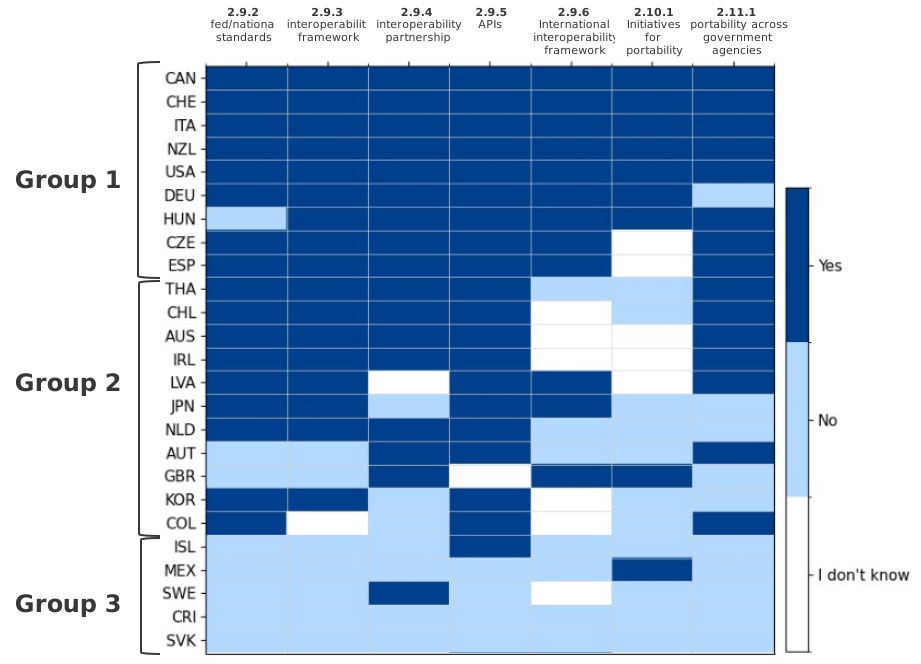
Notes: Countries are classified into three groups based on the number of “Yes” responses across the seven questions: Group 1 (6‑7 “Yes” responses), Group 2 (3‑5), and Group 3 (0‑2). Countries with five or more “I don’t know” responses were excluded from this grouping. See Annex A for the full question wording. Country abbreviations: AUS-Australia; AUT-Austria; CAN-Canada; CHE-Switzerland; CHL-Chile; COL-Colombia; CRI-Costa Rica; CZE-Czechia; DEU-Germany; ESP-Spain; GBR-United Kingdom; HUN-Hungary; IRL-Ireland; ISL-Iceland; ITA-Italy; JPN-Japan; KOR-Korea; LVA-Latvia; MEX-Mexico; NLD-Netherlands; NZL-New Zealand; SVK-Slovak Republic; SWE-Sweden; THA-Thailand; USA-United States.
International data standardisation initiatives are increasingly recognised as important enablers of interoperability, cross-border data exchange, and scalability in digital agriculture. ISOBUS (an ISO standard series: ISO 11783) is an ISO-developed international standard that defines a universal communication protocol for tractors, tractor implements (e.g. seed drills and sprayers), and farm software allowing them to “speak the same language.” While the OECD Tractor Codes are designed to harmonise tractor performance and safety testing, ISOBUS adds cross-brand technical interoperability at the machinery interface level. More broadly, the initiative to establish ISO/TC 347 on data-driven agrifood systems reflects a wider international standardisation effort to improve interoperability beyond machine-to-machine communication, including data and systems integration across agrifood value chains (ISO, 2023[64]). At the same time, the existence of common standards alone may not always ensure fully seamless interoperability in practice. Implementation and adoption can vary across manufacturers and products, and compatibility often depends on which specific functionalities have been adopted. More advanced functions may therefore remain less consistently available than core ones, while manufacturer-specific designs and proprietary operating systems may continue to influence interoperability and data portability outcomes (Sebald et al., 2024[65]).
Some countries have developed their own national IoT standards tailored to farming. Korea, for instance, has a Smart Agriculture Standardisation Forum and a set of KS (Korean Standards) “X series” for smart farm data interfaces (covering greenhouses, environmental sensors, etc.), and the government actively encourages manufacturers to use these standards to ensure interoperability.
Another emerging approach is analytics sharing. Rather than exchanging raw data directly, data remain with their holders or a trusted platform, while only the resulting analytical outputs are shared. This can reduce data transmission and access points, helping to address some privacy and security concerns associated with conventional data sharing (Carballa-Smichowski, 2025[66]).
Among the 33 countries, 10 countries (30.3%) reported that there are initiatives for data portability that allow farmers to move their data between different digital service providers, compared with 11 (33.3%) that report none and 12 (36.4%) that indicate they do not know (Q2.10). This distribution suggests that structured, farmer-facing portability solutions remain major challenges. This is not surprising given that it involves not only technical aspects (formats, APIs, export/import) but also contracts, data ownership and compatibility between providers, all of which have legal and business implications.
An important horizontal framework for data portability in the EU is the European Data Act, which sets common rules for data from connected products and related services, including agricultural machinery and on-farm systems (European Union, 2024[67]). Users of connected machinery and on-farm systems, such as tractors, harvesters, milking robots and irrigation or sensor networks, gain a right to access the product and service data generated in use and to share them with a third-party of their choice. Tech-providers must design products so that data are directly accessible to farmers. Data holders must offer access on fair, reasonable and non-discriminatory terms, while unfair contracts that could prevent data-sharing are prohibited. The Act also facilitates switching between data processing providers and promotes interoperability for data spaces and smart contracts. For the farm sector, these provisions are expected to reduce vendor lock-in, improve portability, and enable secondary uses such as advisory, benchmarking and compliance, while safeguarding personal data within the GDPR framework.
Canada provides another example through the Canadian Agri-Food Data Initiative, an industry-led initiative developed in collaboration with academic and other partners. This initiative aims to strengthen agricultural data capabilities by developing interoperable data frameworks and standards that support cross-platform data sharing, reduce fragmentation, and enable more responsible digital adoption across the agri-food value chain.
When countries are asked about the portability initiatives across different government agencies, positive responses are more frequent: 15 (about 45.5%) report such initiatives, 11 (33.3%) report none, and 7 (21.2%) indicate they do not know (Q2.11.1).
Some EU Member States refer to cross-cutting frameworks such as the European Data Act or national data infrastructure laws and platforms. In Slovenia, a national handbook for opening public-sector data collections guides authorities to make datasets accessible and reusable in structured, commonly used, machine-readable formats, exposed via APIs and standardised interfaces. This supports data transfer across ministries, agencies and public digital service providers, improving interoperability inside the public sector, transparency and service delivery.
Several non-European respondents associate portability with open government data portals and catalogues, such as “Government Data Catalog” (Thailand), or with national interoperability and cloud infrastructures that allow agencies to exchange geospatial, land-use and environmental data via APIs. The response patterns suggest that institutionalised portability across government agencies is more advanced than portability between private digital service providers.
In markets, firms can have incentives to maintain incompatibility to strengthen lock-in and market power (Chen, 2018[68]). Interoperability and portability can counter this by lowering switching costs, enabling the existence of multi-homing, and limiting leading firms’ ability to reduce competition via control over interfaces and data (Jeon, Menicucci and Nasr, 2023[69]). The findings from this paper’s questionnaire and country inputs underscore that these dynamics are not purely theoretical: respondents repeatedly pointed to practical frictions in moving data and maintaining continuity of digital services when changing providers.
As digital agriculture increasingly relies on AI-enabled tools, often delivered through integrated “stacks” that combine machinery, farm management software, cloud infrastructure, and AI models, the locus of lock-in can shift upward from data interoperability and portability to dependence on specific AI ecosystems (Sauvagerd, Mayer and Hartmann, 2024[70]). In practice, farmers and agribusinesses may face not only technical barriers to moving data, but also constraints when AI services are tied to particular platforms, interfaces, or AI model-specific pipelines.
This shift in the locus of lock-in means that interoperability and portability need to be treated as practical enablers of contestability across the full digital “stacks,” not merely as data-access rights of farmers. Data interoperability and portability are necessary conditions for effective switching; however, because AI value is realised through the combination of data, models, compute resources, and complementary services, lock-in can appear as dependence on the broader stack rather than on data alone.