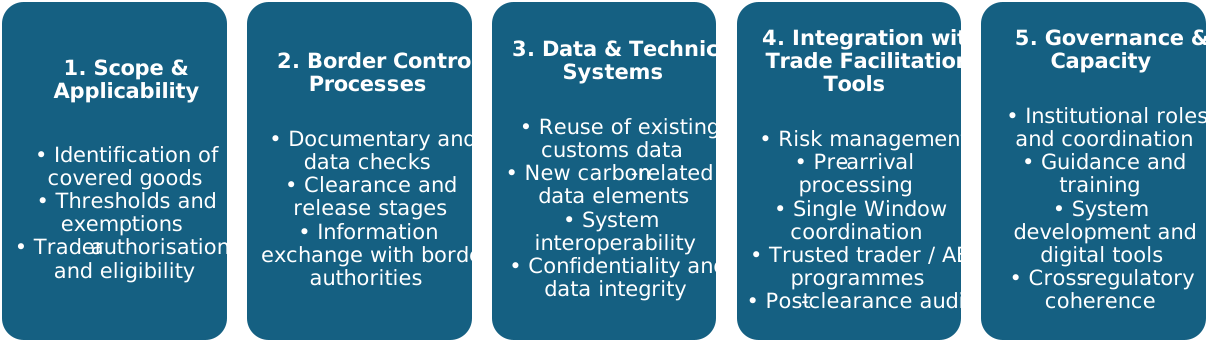
Applying a trade facilitation perspective can help not only to identify potential disruptions and mitigation options, but also to understand implementation readiness and gaps associated with the introduction of carbon-intensity requirements. This is grounded in the elements of technical interoperability identified in this report, including those linked to documentary requirements, data elements and exchange systems, and their relation to procedural steps and institutional roles. This analysis helps to identify where tools used in existing border processes, data infrastructures and coordination mechanisms may already provide a basis for implementation and where additional adjustments, capacity building, training or testing may be required as also highlighted by stakeholders consulted during the preparation of this report.
Figure 5 presents a framework that can be used to assess the readiness of actors involved in the implementation of border-enforced carbon-intensity requirements. The framework translates the trade facilitation perspective developed in this paper into five key implementation dimensions. It can be used by policymakers and authorities to identify implementation gaps, sequencing needs and linkages across actors, procedures, data and systems, and to map how specific carbon-intensity requirements interact with customs processes, border procedures and existing trade facilitation mechanisms. A detailed checklist of areas underpinning this framework is provided in Annex B.