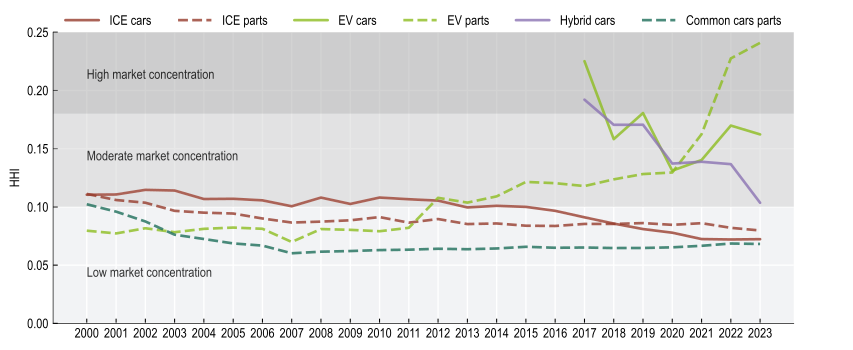
Since 2000, there have been large shifts on the list of the major players of the passenger car market.3 Countries such as Germany, Japan, Canada, France, and Spain, once power houses for internal combustion engine (ICE) cars, have lost market share,4 and emerging car producing countries in Eastern Europe (Czech Republic, Slovakia, and Hungary) and Asia (China) now account for a larger share of global supply (Figure A B.4 Panel A). This reconfiguration has led to a decline in market concentration (Figure 4.2). In 2000, the top 10 car exporters accounted for 88% of total world exports while by 2023 this ratio dropped to 72%.
The market for ICE car parts (e.g. gear boxes, mufflers, engines) and parts common to all cars (e.g. chassis, bumpers, seatbelts, etc.) has consistently shown to have low concentration across exporters (Figure 4.2). Since 2000, the main (top 5) ICE parts producers, apart from Germany, have lost market share (Figure A B.4 Panel D). Canada, United Kingdom, and Austria are no longer in the top 10, replaced by new entrants such as China, Korea, and Poland. Mexico increased its rank from seventh to fifth place. By 2023, the top 10 exporters accounted for only half of total exports, a 12-percentage point drop from 2000. Similarly, the market for parts common to all vehicles saw top producers like Canada, United Kingdom, Spain, and Belgium fall out of the top 10, replaced by China, Poland, Korea, and the Czech Republic (Figure A B.4 Panel F).
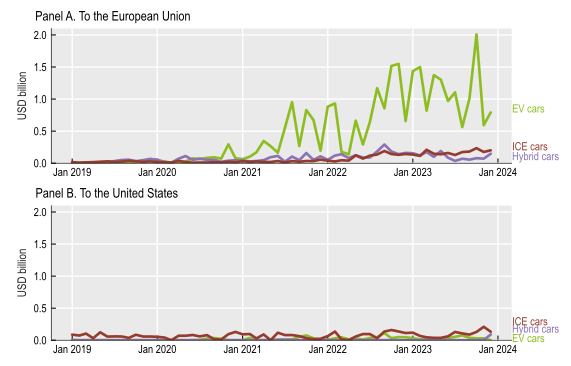
Electric vehicles (EV) and hybrid cars have grown in popularity over the years. Since 2017 (the first year the EV and hybrid categories are distinguished in trade data5), the share of electric cars in total car exports, in value terms, have increased from 1% to 15% and the share of hybrids grew from 5% to 19% (Figure A B.5). Initially, international EV markets were highly concentrated, with the top 5 exporters accounting for 87% of EV cars and 75% of hybrid car exports in 2017. The United States, Germany, the Netherlands, Japan, and France were initially the top EV exporters (Figure A B.4 Panel B) while Japan, Germany, Korea, Belgium, and Türkiye led the field for hybrid car exports (Figure A B.4 Panel C). Over the last five years or so, the concentration of exports in both EV and hybrid markets has fallen to moderate levels, with the export concentration of hybrids falling more sharply and landing just short of the conventional low concentration threshold in 2023 (Figure 4.2). Germany, Slovakia, the United Kingdom, Spain, the Czech Republic, and China along with Hungary, Poland and Italy increased their share of hybrid car exports ranging from 1 (Italy) to 8 (Germany) percentage points between 2017 and 2023. The concentration of EV exports increased in 2022 and remains in the upper limit of a range which is normally considered as moderately concentrated (Figure 4.2), driven by a large shift away from the United States and the Netherlands, whose export market shares dropped from for 39% and 15% to 5% and less than 1% respectively and whose shares were replaced by exports from China (whose market share increased from 1% to 24%) and Germany.6
The concentration of exports of EV car parts as a whole, which cover battery packs and modules7, other EV battery parts, and electric motors, has increased sharply since 2011 (Figure 4.2), driven by China’s growth in the exports of EV components, in particular battery packs and modules. By 2023 China accounted for almost half (46%) of the exports of EV parts which is more than nine times larger than the other two top-3 exporters (Poland (8%) and Hungary (7%).
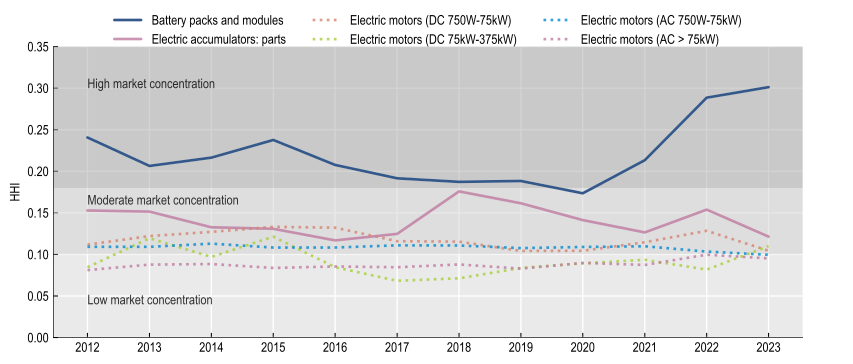
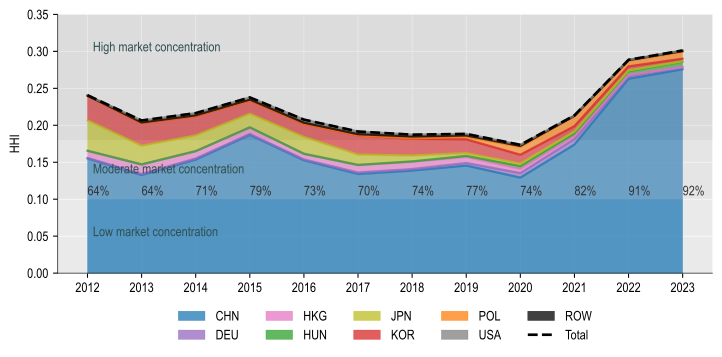
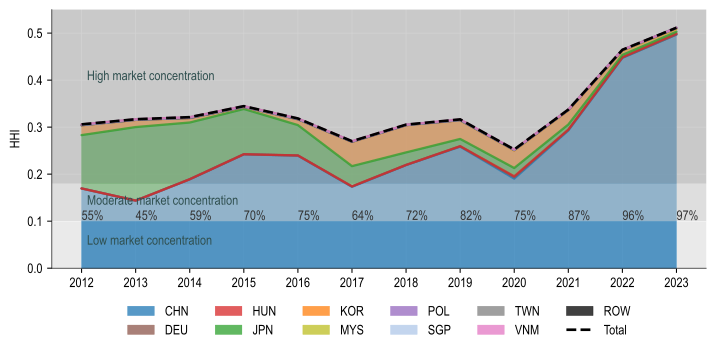
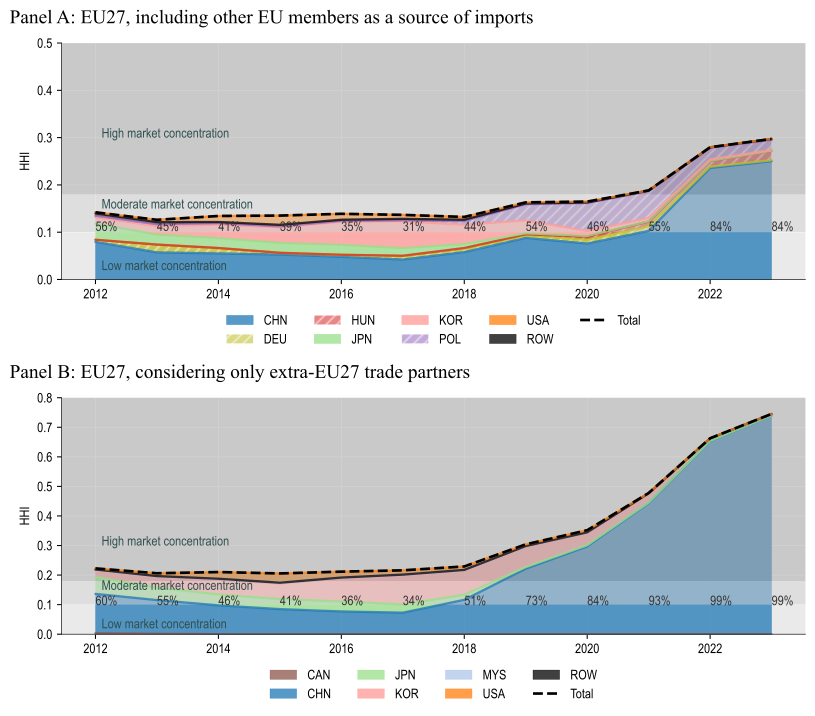
Moreover, the market concentrations of the various EV parts are markedly different when the concentration of each part is considered separately (Figure 4.3). For example, the global supply of other battery parts, i.e. electric accumulator parts, have been moderate over the time frame. While the concentrations of the different types of electric motors, have fluctuated between the low to moderate range over the years and have converged to a low level of market concentration by 2023. On the other hand, the export market of EV battery packs and modules (HS850760 and henceforth referred to as EV batteries), which accounts for the largest share of the EV parts category (82% in 2023), has been highly concentrated over the years and the increase in concentration, particularly over the last three years, has been largely driven by China’s dominance in this industry (Figure 4.4).
A decade ago, Japan, Korea, and China dominated the EV battery industry (Figure 4.4). In total they accounted for 77.8 % of total EV battery exports with China accounting for only 39.4% of total exports and Japan and Korea accounting for roughly 20% each. Over the years new exporters entered the market. Most notably, battery producers in Poland and Hungary have slowly been increasing their market shares over the years. So much so that by 2023, they replace Japan and Korea as the number two and three exporters (respectively). However, despite new entrants, the market concentration of EV batteries climbed steeply starting from 2021 as China increased its market share from 42% in 2021 to 52.5% in 2023 while Poland and Hungary never accounted for more than 18% in total over those years, meaning that China’s share of EV battery exports has been over three times that of the number two exporter over the last few years. Not surprisingly, China has accounted for almost all of the recent increase in concentration of EV battery exports (92% in 2023).