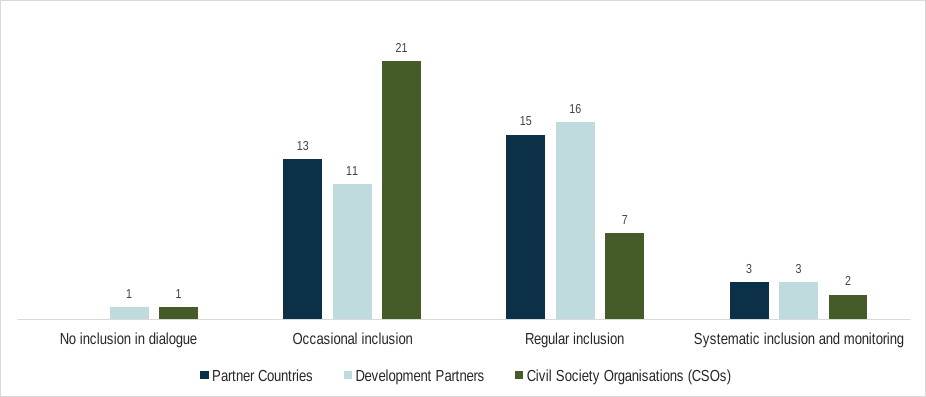
Locally led development (LLD) is closely aligned with the principles and commitments of the Global Partnership for Effective Development Co-operation (GPEDC). As an approach to translate the principle of country ownership into practice, it enables partner countries to define their own priorities, with development partners aligning their support accordingly. By anchoring support in national priorities, systems and leadership, supporting locally led development can enable inclusive dialogue, joint decision-making, and mutual accountability between partner countries and development actors, key conditions for sustainable and legitimate development outcomes.
The GPEDC monitoring is a partner country-led exercise that promotes collective accountability on the effectiveness of development co-operation. While it was not designed to specifically capture locally led approaches, its partner country-led methodology and focus on ownership, results, inclusive partnerships, transparency and accountability generates contextual evidence on the degree to which development partners enable diverse local actors, including national and local authorities, civil society organisations (CSOs) and the private sector to shape the framing, design, delivery, and accountability of development efforts.
This brief complements the OECD’s Guidelines for operationalising locally led development co-operation, aimed at advancing locally led co-operation through light practical guidelines. It draws on the “working definitions” of locally led development and local actors adopted by the OECD (see reader’s guide). The analysis, conducted in November 2025, is based on preliminary findings from the GPEDC’s fourth monitoring round (2023-2026), drawing on data from the 37 partner countries1 that completed data collection as of the end of October 2025.2
This brief provides insights on development partners’ existing practices to promote and enable local actors’ leadership and participation in development co-operation processes. These insights can serve as a basis for peer learning between DAC members and other development partners, helping to identify gaps, learn from good practices, and enhance their own approaches to supporting locally led development. With a fifth GPEDC monitoring round tentatively planned for 2027-28, members have an opportunity not only to benchmark their current performance but also to track progress over time, demonstrating improvements against their ambitions to increase locally led development and reinforce collective accountability.
The GPEDC monitoring generates evidence around four thematic areas: Whole-of-society [approach to development], State and use of country systems, Transparency, Leaving no one behind. This paper organises GPEDC evidence relevant to LLD in line with the thematic areas of the Guidelines for supporting LLD (Table A A.1).