Food systems face the “triple challenge” of ensuring food security and nutrition, providing livelihoods to farmers and others in the food chain, and ensuring environmental sustainability. Solving this puzzle requires co-ordinated and synergic policies. This chapter examines Croatia’s policy objectives for the agriculture and food sector and assesses the path that the sector is taking in terms of productivity growth, greenhouse gas emissions and other agri-environmental trends.
Policies for the Future of Farming and Food in Croatia

Abstract
Croatia’s agricultural policy objectives seek to address economic, social and environmental issues and to foster innovation in the sector. EU policies, plans and strategies provide the main context and orientation, which is complemented by an agro-food strategy defined at the national level.
Croatia has achieved a partially successful path of sustainable productivity growth. In the last decade, total factor productivity growth outperformed that of most peer countries and was a key driver of agricultural output growth.
Productivity gains in the sector have reduced emissions intensity such that output has increased without an associated increase in greenhouse gas (GHG) emissions. A broader examination of agri-environmental indicators shows a mixed picture, with lower-than-average pesticide sales but above average use of synthetic nitrogen and phosphorus fertilisers and a recent increase in ammonia emissions.
6.1.1. Policy objectives
National objectives are formulated in the context of EU policies and strategies
As outlined in Chapter 2, Croatia’s agricultural policies are developed in the context of its European Union membership. Thus, national policy objectives should be in line with the European Union’s Common Agricultural Policy (CAP) and consider the broader policy direction given by EU-level plans and strategies such as the European Green Deal, the Farm to Fork Strategy and the Biodiversity Strategy.
In this context, a first level of policy objectives is provided by the goals agreed on by EU Member States for the 2023-27 reform of the CAP (Figure 6.1). The objectives focus on social, environmental and economic aspects, with knowledge and innovation as a cross-cutting goal for the sector.
Key policy objectives of the 2023-27 Common Agricultural Policy

Source: European Commission, Key policy objectives of the CAP 2023-27, https://agriculture.ec.europa.eu/common-agricultural-policy/cap-overview/cap-2023-27/key-policy-objectives-cap-2023-27_en (accessed February 2024).
At the national level, Croatia adopted in February 2022 the “Agricultural Strategy until 2030”, which sets the framework for interventions in the agro-food sector financed by the 2023-27 CAP and the state, regional and local budgets (see also Section 2.1.4). The Strategy has four strategic objectives related to productivity and competitiveness, environmental sustainability and resilience, innovation, and life in rural areas (Figure 6.2). Like the CAP objectives, they cover economic and social aspects, environmental sustainability, and innovation. The specific interventions foreseen (implemented within the CAP, or as national programmes and measures) involve improved use of public funds for the agro-food sector, promoting a sustainable management of natural resources and climate adaptation and mitigation, developing the domestic market for agro-food products, encouraging entrepreneurship and business development, promoting new growth opportunities, and improving the link between agricultural knowledge and innovation (Ministry of Agriculture, 2022[1]).
Objectives of Croatia’s 2030 Strategy for the agro-food sector
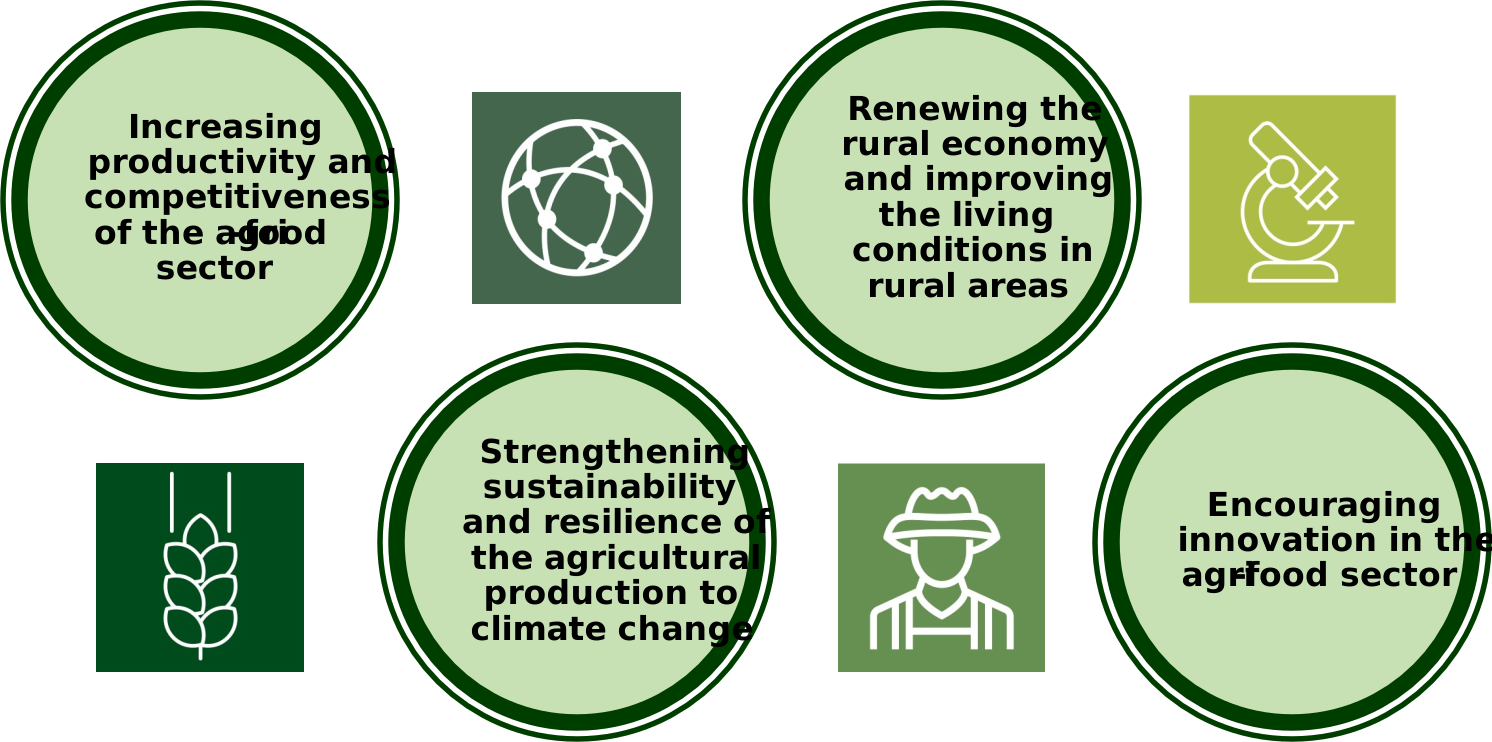
Source: Adapted and translated from Ministry of Agriculture (2022[1]).
Food systems around the world must deliver on a formidable “triple challenge”: ensuring food security and nutrition for all, providing livelihoods to farmers and others in the food chain and promoting rural development, and ensuring environmental sustainability (OECD, 2021[2]). Given the global nature of the triple challenge, it is pertinent to assess the performance of Croatia − beyond its declared policy objectives − with regard to productivity, sustainability and resilience (OECD, 2020[3]). These three dimensions encompass many aspects of the economic, social and environmental goals of the CAP (OECD, 2023[4]) and match the national objectives of the Croatia 2030 Strategy. This section focuses on benchmarking environmentally sustainable productivity performance, analysing the path that the Croatian agricultural sector is taking in terms of productivity growth and main environmental outcomes, in particular GHG emissions. The overall assessment of Croatia is undertaken in the assessment and recommendations presented at the beginning of this report.
Solving the puzzle of the triple challenge requires co-ordinated and synergic policies that generate the innovations needed to meet policy objectives. Innovation not only encompasses technological advances, but also the pathway by which they transform the agricultural production system of a country. Policies need to enhance productivity growth in a way that is environmentally sustainable. This entails achieving high Total Factor Productivity (TFP) growth and, at the same time, ensuring that the gains in efficiency are oriented towards creating a production system that fosters environmental sustainability.
6.2.1. Agricultural productivity growth
Fast productivity growth in the last two decades has been a key driver of output growth
Agricultural total factor productivity (TFP) growth reflects the ability of the sector to use inputs and land more efficiently, thus achieving a higher output per unit of inputs or per hectare of land. In Croatia, productivity has been a primary driver of agricultural output growth. Between 1992 and 2021, Croatia experienced an overall decline in the use of agricultural inputs. TFP increases have mostly compensated a decade-long trend (Figure 6.3).
Evolution of agricultural output, input use and TFP growth, 1992-2021 (Index 1992=1)

Note: TFP growth is calculated as a residual, equal to growth in output minus growth in inputs.
Source: Authors’ calculations based on USDA (2022), International Agricultural Productivity (database).
Figure 6.4 shows the decomposition of agricultural output growth in the three decades1 following Croatia’s independence. The years between 1992 and 2000 are characterised by a significant increase in the use of variable inputs and a reduction of land, labour and capital. This is compatible with the situation of a country at once affected by war – which drove emigration and damaged agricultural land and infrastructure – and with policies having a high use of input subsidies (Section 2.1.1). Despite this reduction in total inputs, agricultural output experienced slight annual growth, driven by an average TFP growth of 1.4%.
Decomposition of Croatia’s agricultural output growth by decade

Note: TFP growth is calculated as a residual, equal to growth in output minus growth in inputs.
Source: Authors’ calculations based on USDA (2022), International Agricultural Productivity (database).
The decade 2001-10 featured strong output growth driven almost exclusively by an average productivity increase of 3.7% per year. Minor recovery of capital investments and an increase in the use of agricultural land compensated minor declines in labour and in the use of variable inputs − a development compatible with the elimination of subsidies to fertilisers by 2000 as part of Croatia’s World Trade Organization accession commitments.
Between 2011 and 2021, output grew at a much more moderate annual rate than in the previous decade: 0.5%, despite still high TFP growth of 2.4%. These outcomes are driven by a strong loss of agricultural labour, reflecting the country’s trend of emigration-driven population loss accelerated by EU accession in 2013 (Section 1.4.3). The use of variable inputs also experienced a strong decline, consistent with the lower fertiliser application and falling pesticide sales detailed in Section 3.2.
An analysis of technical efficiency at the farm level for 2014-16 found that Croatian farms on average had a low level of technical efficiency, which means there was scope for efficiency gains that could have been reflected in the sector´s productivity growth. However, there were important variations associated with farm characteristics. At both ends of the spectrum, both very small and large farms had a higher technical efficiency, while medium-sized farms were the least efficient. Younger farmers were found to be more efficient than older ones, and farms specialising in granivores (e.g. pig and poultry), horticulture, and wine were more efficient than those with other types of production. The farms that were technical efficiency “champions” showed a lower share of income dependence on direct payments (World Bank, 2019[5]).
Croatia outperformed peers in terms of productivity improvements
Despite the deceleration with respect to the previous decade, in 2011-21 Croatia still had the highest rates of productivity growth amongst peer countries (Figure 6.5). The average annual TFP growth of 2.4% was more than twice the average of the OECD (0.85%) and higher than the European Union average of 1.2%.
Agricultural TFP growth in Croatia and selected countries

Source: Authors’ calculations based on USDA (2022), International Agricultural Productivity (database).
6.2.2. Sustainable productivity growth
Agricultural GHG emissions have declined, and productivity improvements compensated the higher GHG intensity of inputs
As shown in Section 3.5, emissions of greenhouse gases (GHG) from agriculture in Croatia have consistently declined since the 1990s, in the context of the structural adjustment of the sector and reduced livestock numbers. The sector is already below the emission reduction target of -16.7% by 2030 (compared with 2005 levels) for sectors not covered by the EU Emissions Trading System.
Given the triple challenge, countries need to find pathways to decouple2 GHG emission growth from output growth. This can occur in two ways: i) by increasing the productivity (TFP) of the whole set of inputs, thus being able to produce more with less inputs; or ii) by reducing the GHG intensity of inputs, or the amount of agricultural GHG emissions per unit of inputs used (the “emission factor”) (Henderson and Lankoski, 2023[6]).
The evolution of agricultural output and GHG emissions in Croatia since 1992 shows that Croatia has achieved absolute decoupling of GHG emission from production (Figure 6.6). There has been positive output growth along with declines (or zero growth, as in 2001-10) in emissions. This has been achieved as a result of significant TFP gains, showing how Croatia has combined productivity and sustainability.
As Figure 6.6 shows, in 2011-21 the absolute reduction in agricultural GHG emissions did not compensate the decline in input use, which resulted in an increase of the emission factor. The robust TFP growth observed during this period compensated for the increases in output and in the emission factor, leading to a decline in GHG emissions that was stronger than in the previous decade.
Decomposition of changes in agricultural GHG emissions in Croatia, 1992-2021

Note: Growth in output (dark green) and in emissions per unit of inputs (light green) contribute positively to the growth in GHG emissions (the diamond marker). Productivity (TFP) improvements (light blue) reduce emissions; thus, they are shown as negative values.
Source: Authors’ calculations based on USDA (2022), International Agricultural Productivity (database); and OECD (2022) Agri-environmental indicators (database).
At the same time, the emission intensity3 of Croatia’s agriculture has decreased over the last three decades, as GHG emissions from agriculture have grown at a slower rate than the sector’s output − or indeed declined. Between 1992 and 2021, Croatia performed better than the EU and OECD averages in terms of emissions intensity reductions (Figure 6.7). The rate of emissions reduction, however, has decelerated in the last decade.
Evolution of changes in agricultural GHG emission intensity in Croatia, the European Union and OECD, 1992–2021

Note: Emission intensity measures the amount of greenhouse gases emitted per unit of output. Lower numbers show greater improvement.
Source: Authors’ calculations based on USDA (2022), International Agricultural Productivity (database) and OECD (2022) Agri-environmental indicators (database).
Other agri-environmental trends show a mixed picture
Pesticide sales had a strong decline following EU accession and remain well below the EU average. However, nutrient use trends show that the input of synthetic nitrogen (N) and phosphorus (P) fertilisers remains above the EU average (Section 3.2.5). Both N and P input per hectare started increasing after reaching their lowest level in 2016, even if they remain below their 2000 level. While the balances of both nutrients have improved over the past decade, they remain above the EU average and, in the case of nitrogen, above the OECD average.
The evolution of ammonia emissions, which mainly originate from the agricultural sector, also deserves attention. While the intensity of ammonia emissions declined after 2009 due primarily to the reduction in animal numbers, this trend stopped in 2013 and reverted to an upward trend after 2016, putting Croatia at risk of not meeting its national target for 2030 (Section 3.2.6).
Croatia’s national policy objectives are formulated in the context of the EU Common Agricultural Policy and the broader social and environmental goals of the European Union. The country also undertook a national process to develop a strategy for the agro-food sector and has used the space available within the CAP to implement additional measures at the national level. Croatia’s agro-food policy objectives cover economic and social aspects, environmental sustainability, and innovation.
Despite the important challenges faced in the last decades and numerous pending tasks, Croatia has managed to develop an agricultural sector that is productive. Total factor productivity has experienced remarkable growth in recent decades, outperforming most peer countries, and has been a key driver of agricultural output growth and the reduction in GHG emissions. At the farm level, there are technical efficiency divergences among different holding types, with mid-sized farms showing the lowest efficiency.
Thanks to productivity gains, Croatia has improved its agricultural output without an associated increase in agricultural GHG emissions, but rather reducing emissions and emission intensity from agriculture. Sales of pesticides have also strongly declined over the last decade. However, trends for other agri-environmental indicators, such as nutrient balances and ammonia emissions, show a mixed picture.
References
[6] Henderson, B. and J. Lankoski (2023), “Integrated approaches for agricultural sustainability and productivity assessments”, OECD Food, Agriculture and Fisheries Papers, No. 204, OECD Publishing, Paris, https://doi.org/10.1787/60cfa586-en.
[1] Ministry of Agriculture (2022), Strategija poljoprivrede do 2030 za transformaciju hrvatskog sela i poljoprivrede - Više od farme (Agriculture strategy until 2030 for the transformation of the Croatian countryside and agriculture - More than a farm), https://poljoprivreda.gov.hr/UserDocsImages/dokumenti/Strategija_poljoprivrede_2020_2030/Strategija_Vi%C5%A1eOdFarme%20(2).pdf (accessed on 6 February 2024).
[4] OECD (2023), Policies for the Future of Farming and Food in the European Union, OECD Agriculture and Food Policy Reviews, OECD Publishing, Paris, https://doi.org/10.1787/32810cf6-en.
[2] OECD (2021), Making Better Policies for Food Systems, OECD Publishing, Paris, https://doi.org/10.1787/ddfba4de-en.
[3] OECD (2020), OECD Agro-Food Productivity-Sustainability-Resilience Policy Framework, https://one.oecd.org/document/TAD/CA/APM/WP(2019)25/FINAL/en/pdf.
[7] OECD (2002), Indicators to Measure Decoupling of Environmental Pressure from Economic Growth, https://www.oecd.org/environment/indicators-modelling-outlooks/1933638.pdf (accessed on 23 February 2024).
[5] World Bank (2019), Sector Diagnostic and Analysis of Public Spending in Agriculture and Rural Development, World Bank, Washington, DC, https://doi.org/10.1596/32304.
← 1. In order to cover all the available data in the analysis, the final “decade” has been expanded to include 2021, while the first one does not include 1991 (no data for Croatia is available for that year).
← 2. Decoupling occurs when the growth rate of an environmental pressure is less than that of its economic driving force over a given period. Absolute decoupling is said to occur when the environmentally relevant variable is stable or decreasing while the economic driving force is growing. Decoupling is said to be relative when the growth rate of the environmentally relevant variable is positive, but less than the growth rate of the economic variable (OECD, 2002[7]).
← 3. “Emission intensity” measures the amount of greenhouse gases emitted (E) per unit of output (Y). It is calculated as the ratio between total GHG emissions generated in agriculture and the value of total agricultural output: EI = E / Y. The growth rate in emission intensity is, therefore, the difference between the growth rates of total emissions and of production. Whenever total GHG emissions grow at a slower rate than output, the emission intensity of output decreases, i.e. its growth rate is negative.