← 1. The Swedish Institute (SI) is a public agency aiming at strengthening, protecting and tracking how Sweden is perceived abroad. It works across many fields – trade, knowledge, culture and development co-operation – to build strong and lasting ties with other countries. The SI’s development co-operation focuses on strengthening individual competencies and organisational capacity, primarily in Eastern Europe and OECD/DAC countries. This is achieved through project funding (especially in Ukraine and Eastern Europe), master’s scholarships for academic excellence, leadership programmes and active alumni networks – collectively contributing to long-term relationships and sustainable societal development.
← 2. Folke Bernadotte Academy (FBA) is Sweden’s government agency for peace, security and development. FBA supports international peace operations and international development co-operation. The agency conducts training, research and method development in order to strengthen peacebuilding and statebuilding in conflict and post-conflict countries. FBA also recruits civilian personnel and expertise for peace operations and election observation missions led by the EU, UN and the Organisation for Security and Co-operation in Europe.
← 3. Swedfund is a state-owned company overseen by the Ministry of Finance (MoF). Swedfund´s operations are financed by reflows from the portfolio and through funding from the development co-operation budget, for which the Swedish Ministry for Foreign Affairs is responsible. As Sweden’s development finance institution, Swedfund´s mission is to fight poverty through sustainable investments in developing countries. The MoF has one representative on Swedfund’s board. This individual serves in a personal capacity and does not formally represent the Swedish state. Swedfund does not have the mandate to align with bilateral, regional or thematic development co-operation strategies. Its financial goal is for the company’s financial results to be positive on average over five years.
← 4. The 13 bilateral strategies include Bangladesh, Colombia, Cuba, Democratic Republic of Congo, Ethiopia, Guatemala, Kenya, Rwanda, Somalia, Sudan, Uganda, Ukraine, and Zambia. The 14 country windows in regional strategies include: Albania, Armenia, Belarus, Bosnia and Herzegovina, Georgia, Jordan, Kosovo, Lebanon, Moldova, North Macedonia, West Bank and Gaza Strip (referred to as Palestine in Sida’s regional strategy), Serbia, Syria, and Türkiye. The 11 thematic strategies refer to Sida and cover civil society; democracy support through political party support; gender equality; health and sexual and reproductive health and rights (SRHR); human rights, democracy and the rule of law; humanitarian aid; innovation, partnership and capacity development; migration; peace, security and stabilisation; research; and sustainable growth, green transition and education. The six regional strategies include: Africa; Eastern Europe, Western Balkans and Türkiye; Middle East and North Africa; SRHR Africa; the Syrian crisis (covering Jordan, Lebanon and Syria); and Latin America.
← 5. Agencies submit reports on strategies every year by March 15th and make proposals for future strategies. The MFA is responsible for drafting strategies ahead of a consultation process with all ministries. The adoption of a strategy, co-ordinated by the Prime Minister’s office, requires agreement from the four parties in the coalition agreement. Once the strategy is adopted, agencies adopt operational plans.
← 6. Due to data lags, the 2023 Index captures allocations recorded in 2021, the most recent year for which there is confirmed data.
← 7. Similarly, feedback from Kenya indicates that support to decentralisation has been the backbone for agricultural support to counties and has been used by several donors.
← 8. In addition to strengthening the framework for SRHR, the 2022-2026 SRHR strategy focuses on increasing access to SRHR interventions, strengthening knowledge of SRHR, and changing social norms and strengthened accountability, with a special focus on the most deprived areas and the most vulnerable groups, including LGBTQI people.
← 9. The allocation amounted to SEK 300 million in 2024 and SEK 800 million in 2025.
← 10. This is composed of 42% who answered “bad idea” and 31% who answered “neither good nor bad”.
← 11. Phase-outs in 2024 were from Burkina Faso, Mali, South Sudan and Cambodia; in 2025 from Afghanistan, Iraq and Yemen); and in 2026 from Liberia, Mozambique, Tanzania, Zimbabwe, Myanmar and Bolivia.
← 12. Standalone bilateral strategies are dedicated strategies, as opposed to country widows of regional strategies. These are Bangladesh, Colombia, Cuba, Democratic Republic of the Congo (DRC), Ethiopia, Guatemala, Kenya, Rwanda, Somalia, Sudan, Uganda, Ukraine and Zambia.
← 13. Country programmable aid (CPA) is the portion of aid that donors programme at country or regional level. CPA for bilateral donors is defined through exclusions, by subtracting from total gross bilateral ODA all activities that are inherently unpredictable by nature (humanitarian aid and debt relief); or entail no cross-border flows (administrative costs, imputed student costs and scholarships, promotion of development awareness, costs related to research and refugees in donor countries, core funding to NGOs, ODA equity investments, and aid which is not allocable by country).
← 14. The calculation includes bilateral ODA to LDCs, regional bilateral ODA marked with LDC code 1 (exact expenditure to LDCs) and imputed multilateral flows, i.e. making allowance for contributions through multilateral organisations, calculated using the geographical distribution of multilateral disbursements for the year of reference.
← 15. Similarly, the share of bilateral ODA going to LDCs has slightly decreased from 31% in 2019 to 30% in 2024.
← 16. Cambodia, Burkina Faso, Mali and South Sudan in 2024; Afghanistan and Yemen in 2025; Liberia, Mozambique, Myanmar and Tanzania in 2026.
← 17. The 25 bilateral strategies include country windows of regional strategies. The eight LDCs include: Bangladesh, DRC, Ethiopia, Rwanda, Somalia, Sudan, Uganda and Zambia.
← 18. Eastern Europe (Armenia, Belarus, Georgia, Moldova); Western Balkans (Albania, Bosnia and Herzegovina, Kosovo, North Macedonia, Serbia); and Türkiye.
← 19. These are Afghanistan, Iraq, Lebanon and Uzbekistan.
← 20. The DAC Gender equality policy marker is a statistical instrument to record activities with gender equality as a policy objective. Activities are classified as "principal" when gender equality is the main objective, "significant" when gender equality is an important but secondary objective, or "not targeted". The basis used is the allocable bilateral ODA screened against the gender marker. Bilateral allocable covers bilateral ODA with the following modalities: sector budget support (A02), core support to NGOs (B01), specific funds managed by international organisation (B03), pooled funding (B04), projects (C01), donor country personnel (D01), other technical assistance (D02) and scholarships (E01).
← 21. This is Sida’s largest guarantee. It has a term of 22 years and expands the IDB’s lending scope by approximately USD 460 million in the areas of sustainable and resilient landscapes, sustainable forestry and conservation, and bioeconomy in the Amazon region.
← 22. The guarantee, called the Innovative Finance Facility for Climate in Asia and the Pacific (IF-CAP), enables the bank to lend up to USD 900 million.
← 23. In collaboration with the World Bank and the Government of Kenya, counties and local communities have made significant contributions to Kenya’s decentralised climate finance architecture. Through support for institutional capacity in counties, 45 of Kenya’s 47 counties have adopted climate change laws and have also carried out climate risk assessments (PCRAs) in which local communities have participated through local climate change committees to identify and assess climate change risks and prioritise investments in climate action. To date, 29 705 Kenyans have participated and 1 380 climate change committees have been formed.
← 24. In 2024, Swedfund received a capital infusion of SEK 1.76 billion, of which SEK 460 million was earmarked for climate investments and 300 million for Ukraine. In 2025, an additional SEK 1.8 billion was provided, of which SEK 600 million was earmarked for climate investments and 500 million for Ukraine. In 2025, Swedfund received an updated Owner Directive, including a broader geographical mandate to allow investments in upper middle-income countries focused on the green and digital transition, effective reduction of emissions and mobilisation of capital.
← 25. Commitments during this period went down by 43%.
← 26. From USD 259 million to USD 196 million. Sweden’s capital subscriptions on an encashment basis (type of finance 311) to the Green Climate Fund were 1.6 billion SEK in 2022, 1.2 billion SEK in 2023 and 1.5 billion SEK in 2024. They reflect earlier capital subscriptions on a deposit basis and are not included in disbursements to avoid double counting. In 2025, Sweden’s capital subscription to the Green Climate Fund on a deposit basis (type of finance 310) were 8 billion SEK (0 SEK between 2022 and 2024) - preliminary data.
← 27. Figures on Sweden's climate-related development finance reported to the OECD DAC and those reported through national communications and other international reporting channels (e.g. the EU and UNFCCC) are not directly comparable. Differences arise from variations in reporting methodologies, measurement approaches, coverage, and the treatment of multilateral contributions
← 28. In that period, 26.7% of total bilateral allocable ODA (USD 471.9 million) focused on climate change overall (the DAC average was 35.4%).
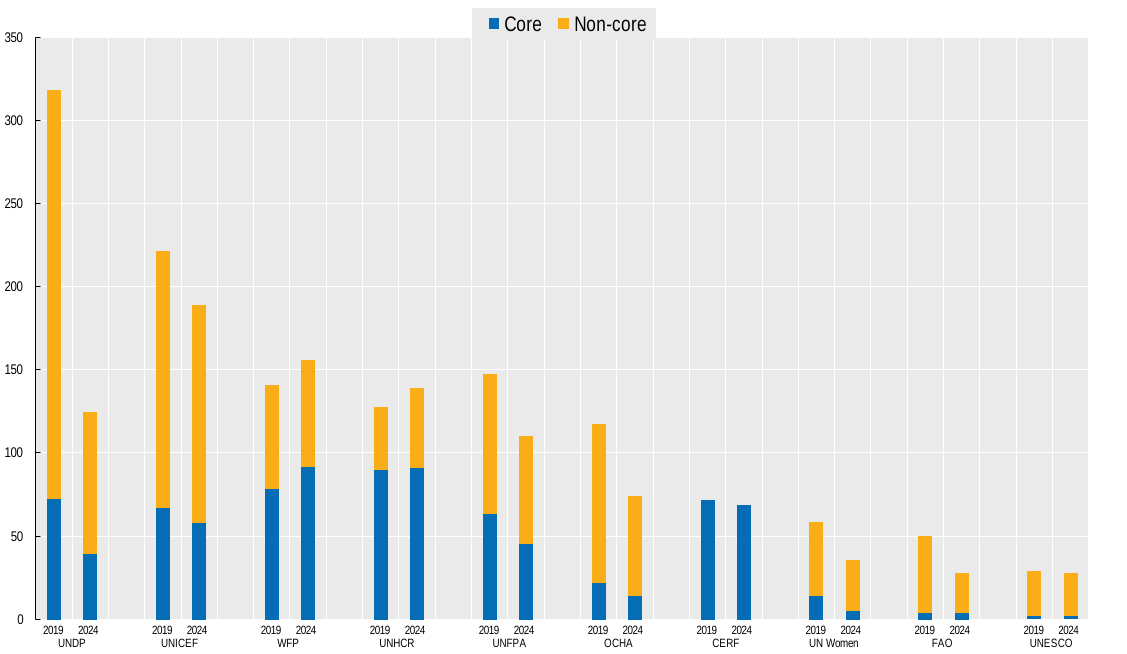
← 29. On 20 December 2024, the Swedish Government decided to end core support to the United Nations Relief and Works Agency for Palestine Refugees in the Near East (UNRWA), which had amounted to USD 400 million in 2024. Funding to the United Nations Office for the Coordination of Humanitarian Affairs (OCHA) Central Emergency Response Fund (CERF), which funded UNRWA through the country-based pooled fund, also decreased significantly in 2025, although it was expected to increase again in 2026. Instead of funding UNRWA, Sweden increased support to the humanitarian crisis in the Gaza Strip and the region through other humanitarian partners.
← 30. The remaining 1% was accounted for by the Civil Contingencies Agency, mainly through seconded staff for mine action and equipment for energy infrastructure, primarily in Ukraine.
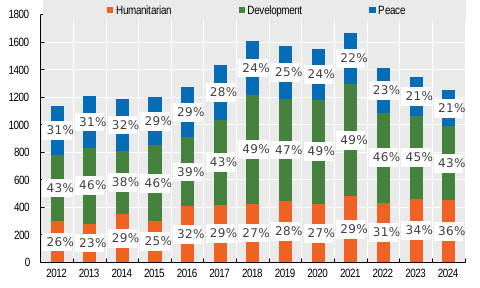
← 31. Protracted crises are defined as contexts that have had UN-co-ordinated country response plans or regional response plans for at least five consecutive years, excluding COVID-19 response plans. The 91% in 2024 compares to 29% in 2014 (Development Initiatives, 2024[36]).
← 32. In Somalia, an estimated 70% of conflicts are linked to the scarcity of natural resources, underscoring the need for sustained investments in resilience, climate change adaptation, and early warning systems.
← 33. These investments typically fall outside of the humanitarian assistance envelope and are more effectively embedded within longer-term programming for livelihoods, access to basic services, and social protection.
← 34. In the OECD’s fragility framework, ODA to peace-related sectors are tracked using the following CRS codes: 15110 (Public sector policy and administrative management), 15111 (Public finance management (PFM), 15112 (Decentralisation and support to subnational government), 15113 (Anti-corruption organisations and institutions), 15130 (Legal and judicial development), 15150 (Democratic participation and civil society), 15152 (Legislatures and political parties), 15153 (Media and free flow of information), 15160 (Human rights), 15170 (Women's equality organisations and institutions), 15180 (Ending violence against women and girls), 15190 (Facilitation of orderly, safe, regular and responsible migration and mobility), 15210 (Security system management and reform), 15220 (Civilian peace-building, conflict prevention and resolution), 15230, (Participation in international peacekeeping operations) 15240 (Reintegration and SALW control), 15250 (Removal of land mines and explosive remnants of war), 15261 (Child soldiers (prevention and demobilisation).
← 35. The strategy documents set out the planned allocation with SEK 50 million for 2024 and SEK 350 million for 2025. An estimated SEK 800 million will be allocated for 2026 and 2027 annually, and an estimated SEK 900 million annually for 2028.
← 37. Criterion 2 of the Criteria for assessing the ODA eligibility of activities in the field of migration indicates that “Development co-operation programmes can be part of a broader policy dialogue with the beneficiary country, including in the field of migration. Development funds might e.g. make the developing country more willing to co-operate in the return and readmission of rejected asylum seekers and irregular migrants. However, if the delivery of funds within an activity is subject to specific conditions on migration outcomes, the funds are not reportable as ODA unless it can be demonstrated that the conditions imposed primarily contribute to the promotion of the economic development and welfare of developing countries, and not primarily to the donor's domestic migration concerns.” See the annex of this document for the rules and clarifications for reporting migration-related activities as ODA (OECD, 2026[104]).
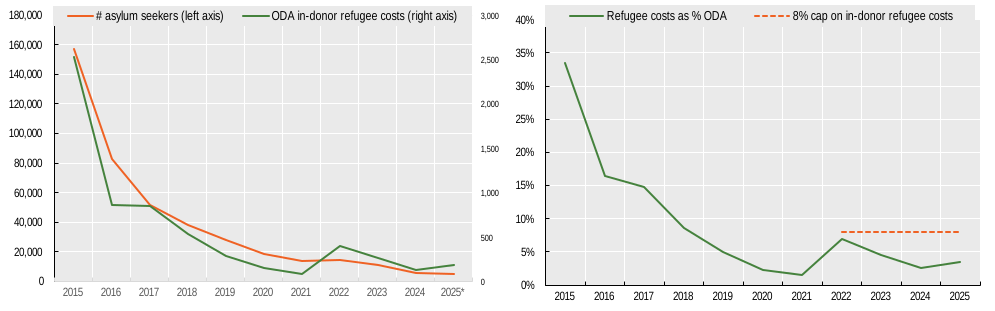
← 39. In 2024, the number of first asylum applicants decreased by 24%, to reach around 6 800. The majority of applicants came from Syria (900), Uzbekistan (400) and Afghanistan (400). The largest increase since 2023 concerned nationals of Nigeria (25) and the largest decrease was in nationals of Uzbekistan (300). Of the 9 690 decisions taken in 2024, 34% were positive (OECD, 2025[44]).
← 40. Changes in methodology were verified by the OECD/DAC for eligibility to ensure that they were in line with the following rules: alignment with the 12-month rule (i.e. only temporary and not permanent sustenance or integration costs are included) and with specific exclusions (e.g. support to asylum seekers whose application has been rejected on a final instance).
← 41. In 2025, Sweden’s ODA reporting in this area covered costs for an average of 1 700 former asylum seekers (people granted asylum), 800 people in need of protection who are family members of former asylum seekers, and 500 quota refugees. See the dataset DAC members’ methodologies for reporting in-donor refugee costs in ODA in the OECD’s Data Explorer (OECD, 2026[45]).
← 43. When measured against population size, Czechia continues to host the highest share (34.5 displaced persons per 1 000 inhabitants), followed by Estonia (29.5), Poland (27.1) and the Slovak Republic (26.6). Ireland (21.3), Latvia (16.6), Lithuania (15.9), Norway (14.8), Germany (14.6), and Finland (12.8) also rank among the highest in per capita terms. The absolute number reflects the estimated number of individuals who have fled Ukraine since 24 February 2022, have been granted temporary protection, international protection, or other forms of stay linked to their protection needs or situation in their country of origin, and who are currently present in each respective host country (OECD, 2025[44]).
← 44. Note that Sweden’s Strategy for Multilateral Development Cooperation and Humanitarian Assistance is included in this number because Sida assists Government Offices with its expertise in board meetings, organisational assessments, follow-up, and feedback of information and experiences to the Government Offices and foreign missions, advocacy and follow-up at country level, participation in consultations, as well as disbursement of core support and execution of certain control measures related to these. It is also one of the agencies called upon to help increase Swedish representation in multilateral organizations (MFA, 2024[72]).
← 45. The 2010 ordinance grounded the agency’s mandate in Agenda 2030 and the Policy for Global Development (PGU), with explicit references to a rights-based approach, gender equality, climate and environmental sustainability, and conflict sensitivity (Government of Sweden, 2010[49]).
← 46. In this review, government assignments are understood as strategies, letters of appropriation and specific assignments.
← 47. By 2019, Sweden had reduced the number of its partner countries to 35 from 44 at the time of the previous (2013) peer review (OECD, 2019[30]).
← 49. The operational strategy underscores common principles for a good administrative culture: democracy, objectivity, rule of law, respect, free formation of opinion, efficacy and service (Sida, 2024[47]).
← 50. Employee surveys also indicate strong trust at line manager level and high collegial support. These issues are addressed through joint management-union mechanisms.
← 51. The administrative appropriation is primarily intended to cover Sida's internal costs, i.e. personnel, premises, IT, security, consultants and other services. It is also used to pay Sida's share of the costs for the embassies where Sida is present, and for allowances for Sida's posted staff and their accompanying people. Sida’s operating costs are somewhat broader, as certain administrative expenses can be charged to earmarked aid appropriations or external funding sources such as EU grants; however, the vast majority of these costs continue to be covered by the administrative appropriation, accounting for just over 93% in 2025.
← 52. A 2022 survey found that DAC countries spent an average of 5.7% of net ODA on administrative costs in 2019, with wide variation. The survey highlighted the need to clarify the ODA-eligibility of costs to improve the quality of reporting and comparability across members. Since then, the reporting directives have been amended to provide further guidance on what should and should not be reported as administrative costs. Based on based on internal, unpublished OECD analysis.
← 53. Sida’s staff turnover has remained relatively stable overall, with recruitment exceeding separations in 2024 and 2025, following a temporary spike in exits in 2023. This suggests a return to net staffing growth alongside the organisational transformation.
← 54. Sida will track external indicators under its new results framework using 30 standardised results areas aligned with the 7 government priorities. Each area includes one to three development indicators from reliable external sources to capture broader contextual changes over time, supporting more evidence-based reporting. The indicator set is being finalised and will include sufficient historical data to establish a baseline and analyse trends.
← 55. Sweden has invested substantially in development research over the years, although this has decreased both in volume and share since 2019-2020, accounting for USD 75 million or 3.6% of Sweden’s bilateral ODA in 2023-24, compared to USD 128 million or 4.8% in 2019-20 (OECD, 2026[35]). This share comes out of sector allocable ODA. ODA for research includes the following CRS purpose codes: Educational research (11182); Medical research (12182); Research for prevention and control of NCDs (12382); Energy research (23182); Agricultural research (31182); Forestry research (31282); Fishery research (31382); Technological research and development (32182); Environmental research (41082); and Research/scientific institutions (43082).
← 56. This includes funding to Swedish development research via the Swedish Research Council (Vetenskapsrådet) that was cancelled in 2023 and is being phased out.
← 57. The reform agenda emphasises stronger central steering and clearer strategic prioritisation. It does not indicate that country strategies are expected to decrease as a share of overall development assistance. In addition, several thematic strategies are increasingly allocating resources to a set of prioritised countries, including those where Sweden has country strategies (while seeking complementarities). See pages 27-28 of the reform strategy (MFA, 2023[7]).
← 58. The phasing out of Myanmar was decided in September 2025 and was not linked to the December 2025 political decision for the other five.
← 59. Top 10 recipients in 2024 include three countries to be phased out in 2025 and 2026: Afghanistan (2nd), Mozambique (4th) and Tanzania (8th).
← 60. According to Sida’s 2026 Annual Report, “One example where Sida has already taken action is the Water and Energy for Food (WE4F) in the Middle East and North Africa, where Sida has provided additional funding to mitigate the consequences of USAID's withdrawal and enable a structured phase-out and a possible transition to a new phase of the initiative with a different approach” (Sida, 2026[53]).
← 61. Joint articulation and communication of exits shape their legitimacy and future relations. Sweden’s exit from South Africa in 2013 illustrates that exits decided unilaterally by donors risk reinforcing power asymmetries, even when relationships have historically been strong. The evaluation recommends that exit plans be jointly articulated and sequenced (Tjønneland et al., 2008[67]), which does not appear to be the case for any of the six bilateral strategies being phased out. In Viet Nam, Forsberg shows that Sweden’s exit was perceived as more legitimate because it was framed as part of a normalisation of bilateral relations, rather than a withdrawal of solidarity, and because communication accompanied institutional transition (Forsberg, 2010[103]).
← 62. For example, the 2020 Kenya country strategy indicates that “Sida will lay the foundation for broader and more self-sustaining relations between the countries. Conditions for domestic resource mobilisation and international trade and investment will continue to be strengthened, as will partnerships that can continue without development cooperation funding, such as partnerships with the private sector and national institutions. Measures to promote institution-building, capacity development, and exchanges of experiences will continue to increase and deepen cooperation” (MFA, 2020[99]).
← 63. Sweden decided in 2020 to withdraw from education support in Cambodia, with activities phased out in the following years and bilateral development co-operation ending fully in 2024.
← 64. In 2024 following Sweden’s exit, USAID picked up some of the support to local organisations given their localisation agenda.
← 65. The current commitment framework does not allow Sida to commit more than 50% of its current annual allocation in the following year.
← 66. The renewed Somalia strategy has an overall reduced amount of approximately SEK 200 million per year (USD 20.8 million) and a smaller set of priorities centred on institutions, jobs and resilience, with migration policy explicitly folded into the partnership. The bilateral strategy states: “Opportunities for collaboration with activities within the Strategy for Sweden’s global development cooperation on migration, returns and voluntary repatriation 2024-2028 will be harnessed” (MFA, 2026[69]).
← 67. The volume of ODA channelled through recipient governments is measured according to DAC-CRS channel code 12xxx. in 2023-24, 83% of Sweden’s ODA channelled through recipient governments was provided by Sida (Swedfund and the Civil Contingencies Agency accounted for 9% and 8% respectively). For Sida, using a 2023-24 annual average, 51% (USD 25.4 million) of aid channelled via recipient governments was project-type funding, 29% (USD 14.2 million) was sector budget support, and 20% (USD 10 million) was basket and pooled funding.
← 68. In 2023-24, countries that received direct support from the Swedish National Audit Officeincluded Armenia, Kosovo, Liberia, Moldova and Zimbabwe.
← 69. This marked the last years when Sweden provided general budget support to Mozambique (2015) and Tanzania (2016) for the implementation of their national strategies.
← 70. In 2026, the volume of Swedish climate aid allocated to the Green Climate Fund and Global Environment Facility was larger than the implied shortfall from non-allocation of funding to the Adaptation Fund and LDCF in 2025. Sweden is also one of the largest contributors to the Energy Community Secretariat for Ukraine.
← 71. In 2024, just over half of Sweden’s earmarked multilateral ODA was channelled through the United Nations, down from 69% in 2019.
← 72. As a government agency, Sida’s annual accounts and internal controls are audited every year. The National Audit Office also conducts thematic and operational audits of Sida’s aid management. In contrast, its remit over government ministries is more limited: when auditing the MFA, it either audits the MFA and Sida jointly or audits how the MFA governs and reports on Sida.
← 73. The MFA has seven permanent or semi-permanent structures for dialogue with civil society.
← 74. The Global Call for proposals was handled in several stages, with the Swedish CSOs and large international CSO handled first. A call for small grants was undertaken in March 2025, resulting in 98 applications, 55 of which were agreed for support. An additional call for proposals was undertaken in September 2025, with a focus on Ukraine civil society through Swedish organisations, and a new call for small grants in February 2026, resulting in 48 applications, is currently being assessed. Direct support to local CSOs is still being assessed from the Global Call for proposals in 2024.
← 75. CSO partners also included six policy and method development organisations in 2024.
← 76. Sida’s 2025 annual report states that: “Sida has opened up applications for grants of a maximum of SEK 1 million and SEK 5 million respectively from Swedish organisations (in line with government guidance)…” (Sida, 2026[54]).
← 77. This is according to Sida’s 2025 annual report, but allocations were cut in 2026 in a revised budget and could give some cause for concern.
← 78. In this case, 110 proposals were received for just one election-related award worth SEK 21 million, or around USD 2 million.
← 79. The new 2026-2028 Somalia bilateral strategy, for example, states that in its somewhat shorter timeframe for implementation, Sida should focus on these particular challenges and, for example, prioritise co-operation partners that have good capability and capacity to transition and adapt their activities if necessary...” (MFA, 2026[69]).
← 80. According to Sida’s figures, the average share of direct funding to local actors by Sida's humanitarian central operational partners rose steadily from 13.2% in 2021 to 19.7% in 2024. In 2024, Sida also provided direct funding to two local actors for the first time via pilot initiatives in Myanmar and Ukraine, totalling SEK 7 million. In 2025, one more contribution was added in the Democratic Republic of Congo and the total amount increased to SEK 13 million. Combined with MFA funding, the amount of Swedish humanitarian funding that was channelled to LNAs indirectly or directly in 2025 amounted to 11%.
← 81. As a Sida partner, Islamic Relief Sweden operated mainly in protracted humanitarian crises in Afghanistan, Ethiopia, Pakistan, the West Bank and Gaza Strip (referred to as Palestine in Sida’s documents), Somalia, South Sudan, Sudan, Syria, and Yemen, , delivering life‑saving assistance in some of the most fragile and hard‑to‑reach contexts worldwide. See the statement by Islamic Relief (in Swedish) (Islamic Relief Sweden, n.d.[106]).
← 82. The strategy indicates that “the prospects for enhanced synergies between international development cooperation, trade promotion and trade policy are particularly good with respect to green and digital transition, and for sustainable infrastructure projects. Swedish businesses can contribute to higher productivity, sustainable economic development and increased trade and employment in low and middle income countries. This in turn creates ways out of poverty” (MFA, 2023[81]).
← 83. The strategy states that “prospects for Swedish businesses to compete in international public procurements should be improved”, notably through sustainability criteria and life-cycle cost analysis (MFA, 2023[81]).
← 84. Other tasks include: (1) co-operation with Team Sweden in Ukraine; (2) measures that have been taken in multilateral procurement to increase the impact of sustainability criteria and life-cycle perspectives; (3) private investments; (4) ensuring that total socio-economic costs are taken into account in the agency's decisions on support for digitalisation and digital infrastructure; and (4) Made with Sweden promotion and communication concept.
← 85. From SEK 14 billion in 2019 (USD 1.48 billion) to SEK 30 billion in 2025 (USD 3.05 billion).
← 86. A centralised framework to connect private sector investment projects with a large array of financial and non-financial support – including the European Commission’s budget, the European Investment Bank (EIB), DFIs, development agencies, governments and export credit agencies.
← 87. PSI takes into account support to private companies through loans, equity, guarantees or reimbursable grants.
← 88. EKN did the risk calculation for Sida’s early loan portfolio guarantees.
← 89. NIR is a member-based non-profit organisation. Its current members consist of nine of Sweden’s largest exporting companies, as well as the Swedish Export Credit Corporation (SEK) and Swedish bank SEB. NIR has been operating for 60 years in the nexus between aid and trade and interacting with a multitude of stakeholders ranging from governments, agencies, academia and NGOs, as well as businesses in Sweden and in partner countries.
← 90. These were Ethiopia, Kenya, Liberia, Mozambique, Rwanda, Tanzania, Uganda, Ukraine, Zambia and Zimbabwe. In 2025, Swedfund also had active loans in Bangladesh, the Democratic Republic of the Congo and Somalia.
← 92. The Project Accelerator (PA) is an instrument created in 2016 to finance feasibility studies and capacity support for facilitating investments in renewable energy and green infrastructure sectors. The PA’s technical feasibility studies and local capacity building in the public sector aim to accelerate critical infrastructure projects in healthcare, digitalisation, circular solutions, green energy and sustainable transport.
← 93. Business Sweden is jointly owned by the Swedish state and the Swedish business sector, with representation by the MFA and the Swedish Foreign Trade Association on the Board of Directors.
← 94. In 2024, Business Sweden was given a mandate to “improve the conditions for Swedish businesses to contribute to the objectives for development cooperation and to a green and digital transformation in low- and middle-income countries”, for which SEK 65 million was allocated from the aid budget.
← 95. The trade and development assignments of Business Sweden have three purposes: development co-operation, climate and digital transition, as well as trade promotion.
← 96. This instrument was piloted in 2021, and was scaled-up after the adoption of the reform agenda. Sida has also piloted a new instrument.
← 97. It currently runs in 14 countries and supports 15 projects, primarily in Sub-Saharan Africa, and in sectors such as transport and energy.
← 98. Since the launch of UTS in September 2025, 15 UTS have been provided.
← 99. Bombardier, a Swedish-based supplier, was involved in the project for signalling equipment.
← 100. The Sustainability Impact Accelerator develops partners’ capacities to align infrastructure projects with the human rights-based framework in IFC’s Performance Standards. The standards clarify responsibilities of state actors and project owners in infrastructure projects to protect and respect the rights of affected people and communities and protect the environment and cultural heritage. Cross-cutting perspectives such as climate change, environmental protection, gender, conflict and rule of law are addressed throughout the standards.
← 101. In some cases, Business Sweden requires interested companies to pay fees as a way to ensure “skin in the game” and actual interest in engaging in the project.
← 102. When working with ODA, Business Sweden has an exclusion list. For instance, it does not support infrastructure projects with high CO2 emissions such as airports. In some instances, Business Sweden uses development indicators such as local jobs, increased access sustainable infrastructure, reduced carbon emissions. The review team has not been able to access project documents due to confidentiality reasons.
← 103. However, both Business Sweden and EKN operate under strict sustainability frameworks, and EKN can only support certain gas‑related projects under OECD rules and Swedish climate commitments.
← 104. The Strategic Programme Office consists of Business Sweden, Sida, Swedfund, EKN, SEK and the Ministry for Foreign Affairs. It is in charge of monthly reviews of Team Sweden project applications and decides jointly on “on go/no-go” for projects.
← 105. For instance, the 2025 appropriation letter asks Sida to report on “How cooperation with the Swedish resource base, including Swedish companies, has been developed with the aim of exploiting Swedish added value in the implementation of development assistance.”
← 106. The National Board of Trade Sweden supports public institutions in partner countries to strengthen their capacity to analyse, develop and implement trade policies and regulatory frameworks. This includes co-operation related to WTO-linked work and trade agreements and, for EU candidate countries, support for EU integration. Co-operation is primarily implemented through peer-to-peer engagement between public institutions. The Trade Academy Trade Policy programme focuses on capacity development – strengthening civil servants at trade policy institutions in these countries so that they can contribute to institutional change.
← 107. As an example, smallholder farmers currently supported as part of agricultural development projects may not be able to afford Swedish agricultural equipment.
← 108. Countries covered by the recommendation are least developed countries (LDCs), heavily indebted poor countries (HIPCs), other low-income countries and IDA-only countries and territories. The recommendation only applies to specific sectors, and excludes scholarships and free-standing technical co-operation, among others.
← 109. Contract awards data are used to monitor whether aid that is reported as de jure untied in the Creditor Reporting System (CRS), is also untied in practice.
← 110. The instrument consists of an EKN guarantee, a loan from SEK, and grant funding intended to reduce borrowing costs for buyers of Swedish goods and services. In 2025, EKN was able to issue grant decisions for up to SEK 1.23 billion. The instrument is administered by EKN together with SEK, Sida and other Team Sweden partners. The regulation entered into force on August 1, 2025, marking the start of a five-year pilot. Conditions: This instrument requires a Swedish export component. The project must take place in a country where EKN can provide guarantees, primarily low- and middle-income countries. It should promote social and economic development and comply with OECD rules for tied aid, with at least a 35% subsidy. The aid funds can only be used to repay the export credit – instalments, interest, and credit-related costs – and the transaction must be arranged by a private financial institution, such as a bank. As a first priority, the aid component is intended to cover the interest portion.
← 111. For instance, a Project Accelerator feasibility study undertaken in partnership with the African Development Bank for a wastewater management project in South Sudan includes the South Sudan Urban Sanitation Department and the Juba Urban Authority. Key criteria for the PA include local impact, whether the project is a strategic priority for the country (local or national development plan or similar), the robustness of the local project owner (capacity to follow through) and identification of potential financiers.
← 112. This means that the project is prioritized within Team Sweden as a strategic opportunity and/or a Swedish company has expressed a direct interest in being a supplier to a possible future procurement of a technical solution.
← 113. For several years, Business Sweden has been tasked with supporting companies in deals financed by multilateral development organisations such as the UN, the World Bank, the African Development Bank and the European Bank for Reconstruction and Development. The activities were initiated within Business Promotion Activities (within Business Sweden), but most were transferred to Trade and Development activities (within Business Sweden) in 2024. Business Sweden has a dialogue with several of these organisations, at central and local level, to highlight the importance of applying sustainability criteria and life cycle perspectives in procurement.
← 114. Established in April 2022 at the request of the European Commission and the Ministry of Energy of Ukraine, the Ukraine Energy Support Fund is managed by the Energy Community Secretariat.