This chapter presents the latest evidence on the critical role of competition in public procurement systems. Competition is widely recognized as a powerful mechanism for achieving value for money in public spending. Research consistently demonstrates that competitive procurement procedures can lead to significantly lower costs. However, many countries face persistent challenges that undermine competition, including a high rate of use of non-competitive procedures and a prevalence of single-bid procedures. Understanding the underlying causes of these issues is crucial for identifying opportunities to strengthen procurement systems and maximize their effectiveness.
Maximising the Benefits of Effective Competition in Public Procurement in Slovenia

Abstract
Public procurement is a key pillar of strategic governance and plays a pivotal role in the efficient allocation of resources, driving economic growth, and delivering public services to citizens. The main goal of public procurement is to purchase goods, works, and services to ensure the best public service-delivery to citizens. To achieve this goal, public buyers shall ensure value for money when conducting procurement processes, either by selecting the lowest-priced offer or by considering price and non-price factors such as quality or environmental considerations.
Public procurement has therefore the potential to greatly influence the markets, as it accounts for a large share of public expenditure, approximately 12.9% of GDP and 27.8% of government expenditure in OECD member countries in 2021. This is even more true in Slovenia, with 13.7% of GDP and 27.6% of government expenditure. (OECD, 2023[1]) Public procurement impacts many areas of public service delivery in OECD countries, and is key in many sectors (see Figure 1.1).
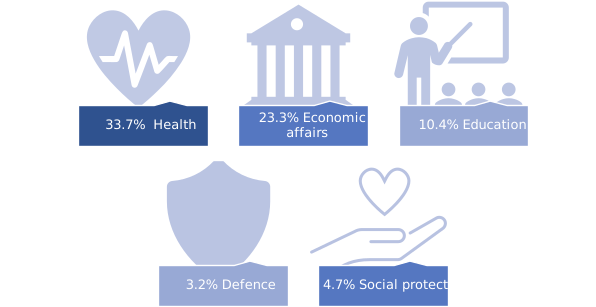
Source: (OECD, 2023[1])
Given the importance of procurement spending, as a main rule to ensure value for money, public buyers rely on competitive bidding processes, with the goal of ensuring optimal participation from the private sector. Competition creates a market environment that fosters innovation and diffusion of new technologies and makes businesses more productive and competitive both domestically and when competing overseas. Competition brings many benefits to the procurement system, including trust from both the economic operators and the civil society (see Figure 1.2). (OECD, 2019[2])
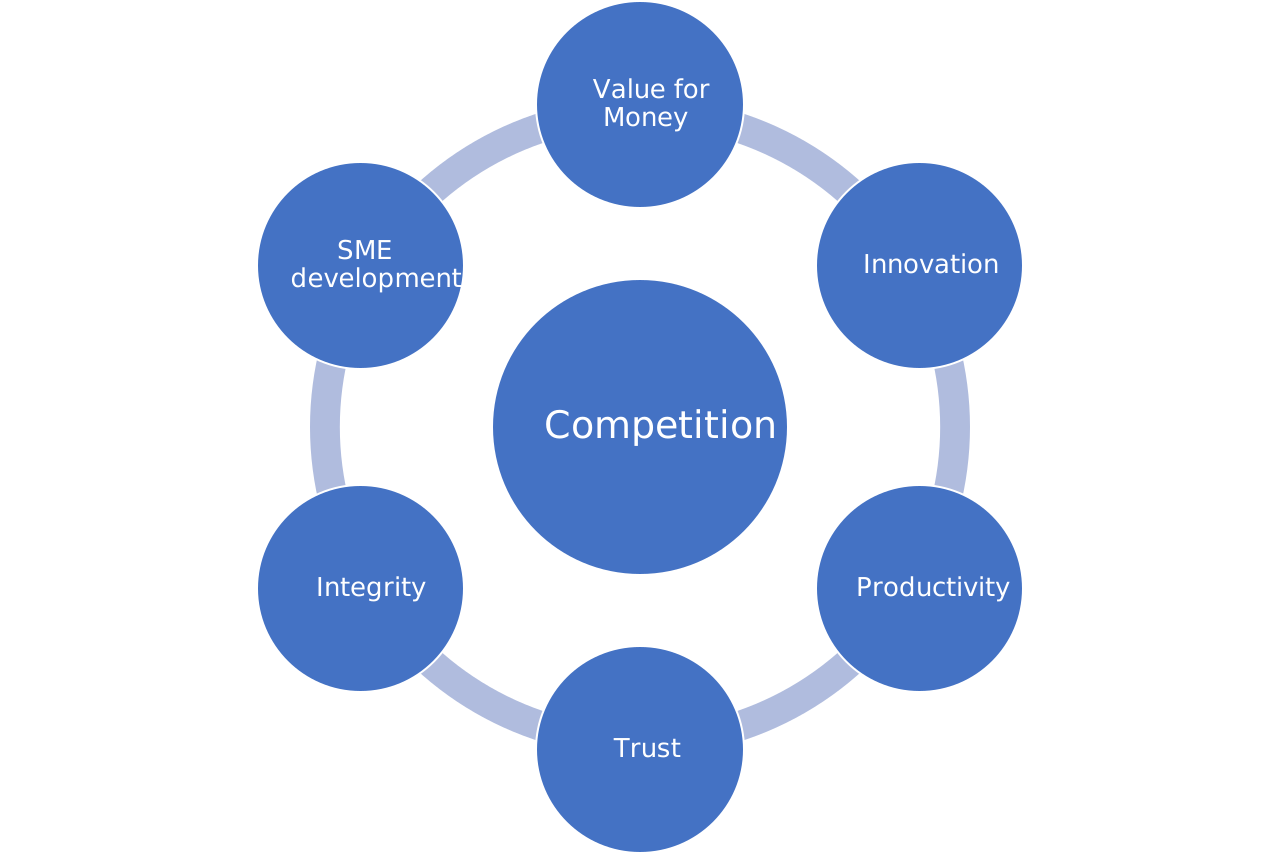
Source: (OECD, 2019[2])
The level of competition is usually guaranteed by the degree of access to public procurement opportunities. As such, one of the principles in the Recommendation of the OECD Council on Public Procurement is the principle of access, which highlights the importance of a sound competition in public procurement and encourages Adherents to the Recommendation to encourage intense competition in public procurement (see Box 1.1).
The OECD Recommendation on Public Procurement recommends that Adherents facilitate access to procurement opportunities for potential competitors of all sizes. To this end, Adherents should:
i) Have in place coherent and stable institutional, legal and regulatory frameworks, which are essential to increase participation in doing business with the public sector and are key starting points to assure sustainable and efficient public procurement systems. These frameworks should be as clear and simple as possible, avoid including requirements which duplicate or conflict with other legislation or regulation, and treat bidders, including foreign suppliers, in a fair, transparent, and equitable manner.
ii) Deliver clear and integrated tender documentation, standardised where possible and proportionate to the need, to ensure that: 1) specific tender opportunities are designed so as to encourage broad participation from potential competitors, including new entrants and small and medium enterprises and 2) the extent and complexity of information required in tender documentation and the time allotted for suppliers to respond is proportionate to the size and complexity of the procurement, taking into account any exigent circumstances such as emergency procurement.
iii) Use competitive tendering and limit the use of exceptions and single-source procurement.
Source: (OECD, 2015[3])
However, non-competitive procedures and distortions to competition are still recurring issues in many OECD countries’ public procurement systems. The use of non-competitive procedures (usually without prior publication, or general visibility) should normally be used only exceptionally and only in duly justified cases as they undermine the efficiency of public procurement, but the rate of their use is still quite high in some countries. (OECD, 2015[3]) Recent data show some improvement on the use of less transparent procedures in Slovenia. As per the European Single Market Scoreboard, Slovenia was amongst the countries with the highest shares of negotiated procedures without prior publication, but managed to decrease to 11% in 2022, from 19% in 2021 and 26% in 2020. (European Commission, 2023[4])
Other risks that hinder competition include complex public procurement rules and the use of non-standardised bidding documents, which impede broad participation from potential competitors, including new entrants and SMEs, as well as obstacles such as regulatory burden, financial constraints, lack of technical expertise, collusive practices and request for bribes, faced by the private sector for participating in public procurement processes. (OECD, 2015[3])
In addition to non-competitive procedures, a low number of bids in open competitive procedures is also a major concern in Slovenia. Indeed, low prices and/or better products are desirable for public buyers because they usually result in resources either being saved or freed up for use on other goods and services. As such, single bidding, where only one bidder submits a bid in a procurement process, tends to lower value for money by increasing prices, for example by 9.6% in a 2009-2014 EU-wide dataset of contracts (Fazekas, 2022[5]).
The resurgence of single-bid procedures is also an endemic issue in several European Union (EU) countries. As such, the European Court of Auditors has assessed the level of competition for public procurements in the EU’s single market over the period of 10 years up to 2021 and found that the level of competition has decreased significantly, with a lack of awareness that competition is a prerequisite for value for money. The report also highlighted that EU member states have not made systematic use of data available to identify the root causes of limited competition and took only scattered actions to reduce obstacles to competition in public procurement. The report describes an increasing trend in market concentration across all industrial and services sectors over the period examined, coinciding with similar global trends according to OECD. A specific recommendation from the report is to deepen the analysis concerning root causes behind low competition and to put forward measures to overcome key obstacles to competition and promote best practice. (European Court of Auditors, 2023[6]).
On the other hand, OECD countries started to pay attention to the issue of competition and single-bidding in public procurement. For instance, the National Audit Office of the United Kingdom recently issued a report on lessons learned regarding competition in public procurement, which emphasizes the importance of healthy competition in public procurement and provides several recommendations to public buyers to enhance it. (National Audit Office of the UK, 2023[7]) The OECD is also assisting some of its member countries, such as Hungary, in identifying the root causes of low competition in public procurement.
Slovenia is among the EU countries with the highest rate of single-bid procedures according to the European Union’s Single Market Scoreboard, with 44% in 2021, but this issue is common among most EU countries (see Figure 1.3). The rate is calculated based on the notices published on the European Union’s Tenders Electronic Daily portal.
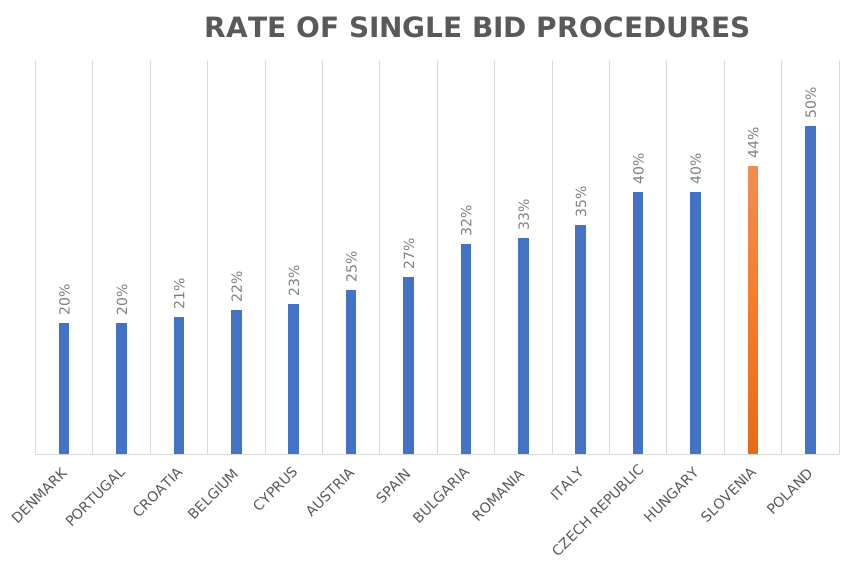
Source: (European Commission, 2021[8])
In the EU Council Recommendation on Slovenia's 2019 National Programme, the Council stated that there are weaknesses regarding competition and transparency in public procurement in Slovenia, as indicated notably by the high ratio of contracts arranged through negotiated procedures. The Council also noted weak safeguards against collusion and corruption, especially in local procurement processes. As such the Council recommended for Slovenia to take action to improve competition, professionalisation and independent oversight in public procurement. (Council of the European Union, 2019[9])To address these systemic issues in the public procurement system, the Government of Slovenia has made several commitments in its Recovery and Resilience Plan (RRP), adopted by the Council of the European Union on May 31st, 2022 (see Box 1.2). (Council of the European Union, 2022[10])
The RRP contains several measures in “Reform Component C: Creating systemic conditions for investment growth” that aim to increase public and private investment by simplifying procedures in the area of construction and spatial planning and by reforming the public procurement system. Six of these measures are closely related to improvements in the public procurement system in Slovenia:
Among the measures envisaged by the RRP is the decrease of negotiated procedures without prior publication to 14% of the total number of procedures. Slovenia already fulfilled this measure in 2022 with a decrease to 11%, however single-bidding remains among the highest in EU member countries. As such, this Report aims at analysing the root causes behind the low competition and prevalence of the high level of single-bid procedures in Slovenia, the sectors that are most affected, and it provides key recommendations to tackle this issue. In addition, the Report is assessing the potential impact of recent public procurement reforms on competition, as foreseen in measure 177 of the RRP.
References
[10] Council of the European Union (2022), Annex to the Council Implementing Decision on the approval of the assessment of the recovery and resilience plan for Slovenia, https://data.consilium.europa.eu/doc/document/ST-8390-2022-INIT/en/pdf (accessed on 30 January 2024).
[9] Council of the European Union (2019), Council Recommendation on the 2019 National Reform Programme of Slovenia and delivering a Council opinion on the 2019 Stability Programme of Slovenia, https://eur-lex.europa.eu/legal-content/EN/TXT/?uri=CELEX%3A52019DC0524 (accessed on 30 January 2024).
[4] European Commission (2023), 2023 Country Report - Slovenia, https://economy-finance.ec.europa.eu/system/files/2023-05/SI_SWD_2023_624_en.pdf (accessed on 25 January 2024).
[8] European Commission (2021), Access to public procurement, Single Market Scoreboard, https://single-market-scoreboard.ec.europa.eu/business-framework-conditions/public-procurement_en (accessed on 20 July 2023).
[6] European Court of Auditors (2023), Public procurement in the EU: Less competition for contracts awarded for works, goods and services in the 10 years up to 2021.
[5] Fazekas, M. (2022), Single bidding and non-competitive tendering procedures in EU co-funded projects, Publications Office of the European Union, https://doi.org/10.2776/751156.
[7] National Audit Office of the UK (2023), Lessons learned: competition in public procurement, https://www.nao.org.uk/wp-content/uploads/2023/07/lessons-learned-competition-in-public-procurement.pdf.
[1] OECD (2023), Government at a Glance 2023, OECD Publishing, Paris, https://doi.org/10.1787/3d5c5d31-en.
[2] OECD (2019), Enhancing the Use of Competitive Tendering in Costa Rica’s Public Procurement System.
[3] OECD (2015), OECD RECOMMENDATION OF THE COUNCIL ON PUBLIC PROCUREMENT - Directorate for Public Governance and Territorial Development, https://www.oecd.org/gov/public-procurement/OECD-Recommendation-on-Public-Procurement.pdf (accessed on 1 February 2023).