This annex describes a template for presenting the technical information about Luxembourg’s HSPA indicators during the implementation of the framework. Section C.1. outlines the current plans for the structure of technical information in Luxembourg’s indicator sheets, while section C.2. outlines international practises for doing this.
Health System Performance Assessment Framework for Luxembourg

Indicator technical information forms a vital component of the HSPA by clearly defining each indicator and ensuring methodological soundness and transparency. The technical information for Luxembourg’s HSPA draws on international best practices from other HSPA frameworks and adapts them to Luxembourg’s national context. The technical information serves as an indicator “passport”, setting out key information such as identification, rationale, calculation methods, and data sources. By systematically documenting methodologies, the technical information supports accurate interpretation of results and builds confidence in the robustness of the HSPA process.
Figure A C.1. presents the proposed structure and content of Luxembourg’s indicator technical information, developed jointly by Luxembourg’s PMT and the OECD. For each indicator, 20 information fields would be provided. This section additionally explains how these elements are applied within Luxembourg’s HSPA framework.
Source: Developing the HSPA framework for Luxembourg project.
During the HSPA indicator selection process, defining the different types of data sources required further clarification due to the complex structure of data flows among HSPA stakeholders in Luxembourg. As indicated in Figure A C.1. , the HSPA indicator custodian is the organisation responsible for providing a given indicator for the purposes of the HSPA in Luxembourg. These organisations were determined during bilateral consultations with the relevant stakeholders during the indicator selection process, as described in Figure 3.1. It is important to clarify that the indicator custodians are not necessarily the same organisations that produce or disseminate the underlying data; rather, they have been specifically assigned responsibility for supplying the indicator within the context of the HSPA in Luxembourg.
For the purposes of the HSPA in Luxembourg, the indicator source refers to the organisation that publishes or disseminates the original indicator and serves as the reference source for its use within the HSPA framework. In some cases, this organisation may also be responsible for defining or producing the indicator; however, this is not necessarily always the case. In addition, the role of the data custodian was defined to distinguish responsibility for the underlying data. The data custodian refers to the organisation responsible for managing the dataset or datasets used to derive the indicator. This includes responsibilities related to data stewardship, maintenance, and access, and the data custodian may differ from both the indicator source and the HSPA indicator custodian, reflecting the complex data governance arrangements within the HSPA framework.
Finally, the data source for the HSPA refers to the specific survey or dataset used to generate the indicator. This field records the original name of the dataset as used by the data-holding organisation (for example, a registry of professionals or the joint OECD/WHO/Eurostat questionnaire JQNMHS).
For the Self-perceived Health indicator (see Figure A C.2. ), data was originally collected through the EU-SILC survey. The survey data are managed and processed by STATEC, which acts as the data custodian for the underlying dataset. The indicator is then compiled and disseminated at European Level by EUROSTAT, which acts as the indicator source for the HSPA framework in Luxemburg. Within the HSPA framework in Luxembourg, ObSanté acts as the HSPA indicator custodian and is responsible for providing the indicator for HSPA reporting.
1. EU statistics on income and living conditions.
Source: Developing the HSPA framework for Luxembourg project.
At the HLAB meeting in November 2025, the PMT and the OECD team presented HLAB members with an overview of international practices for documenting technical information on HSPA indicators. Countries typically compile this technical information during the implementation phase. It is designed to remain relatively stable over time, as the underlying methodologies change infrequently.
The technical information serves four main purposes:
Standardise indicator definitions and measurement approaches
Ensure transparency, enabling users to understand data sources and calculation methods
Guide analysis and reporting, supporting results that are interpretable and credible
Support cross-country comparability
Countries adopt different approaches to documenting technical information for HSPA indicators. They vary in the types of elements included, the level of detail provided, and the structure and presentation of the information. Some countries integrate technical information alongside the indicator results, while others present it separately. Unlike results, which are updated regularly, technical information is updated only when necessary, for example following methodological revisions or the identification of new limitations.
To compare international practices in presenting technical information across HSPAs and related frameworks, the analysis reviewed four HSPAs and one additional example used in Luxembourg: Belgium’s HSPA (Belgian Healthcare Knowledge Centre, 2024[1]), Ireland (AMC, 2021[2]), Canada (CIHI, 2025[3]) and Italy (Ministero della Salute, 2019[4]); and Luxembourg’s ObSanté indicators (ObSanté, 2025[5]).
The table below summarises the elements included in the technical information sections across these countries. These findings highlight the variation in selected elements and supported the reflection process caried out by the PMT on which components may be most relevant for inclusion in their respective HSPAs.
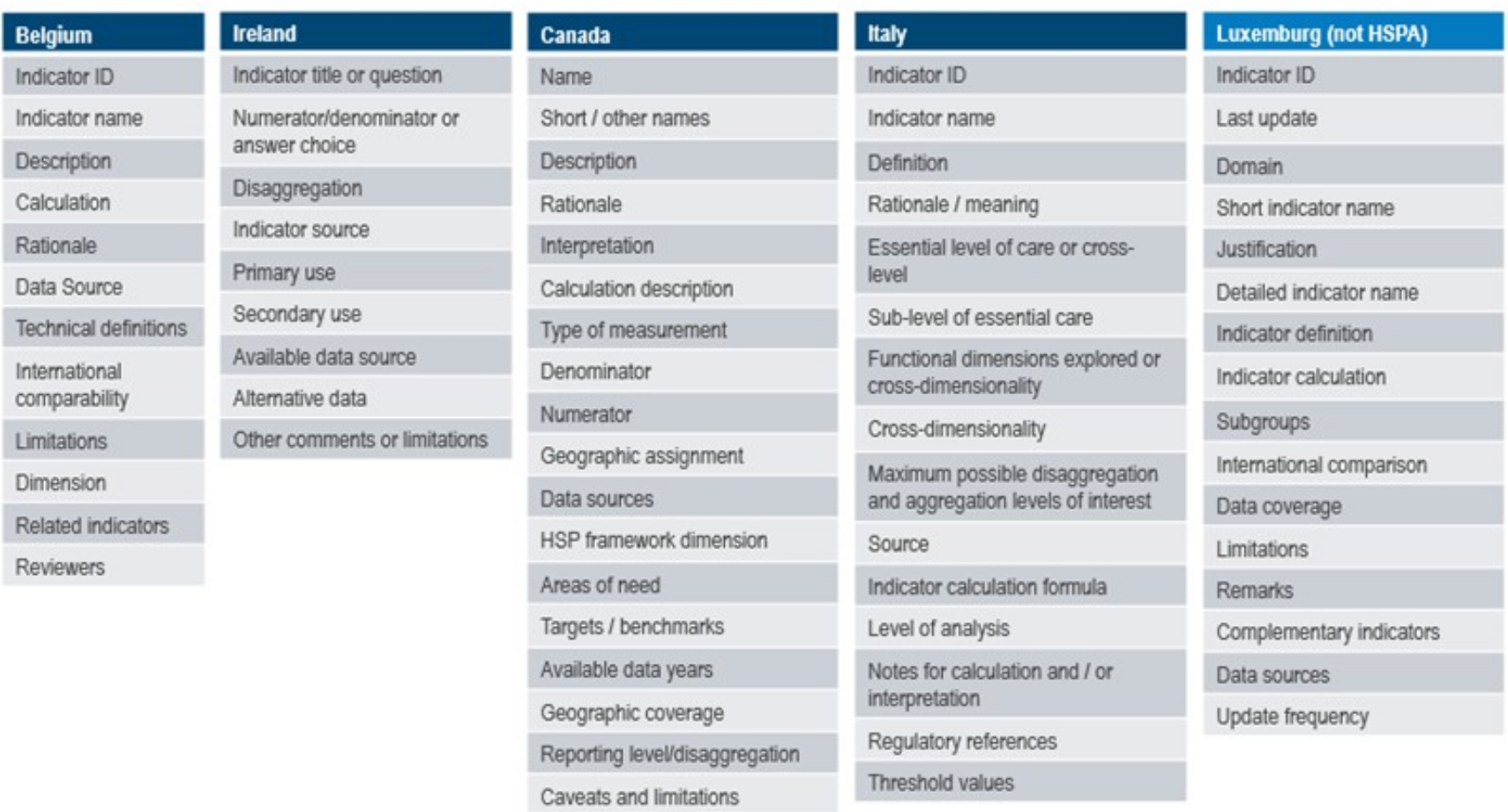
Note: The indicators developed by Luxembourg are not part of an HSPA framework and were used to explore different formats for presenting technical information. This refers to the health indicators developed by the Observatoire national de la santé (National Health Observatory).
Source: Authors based on the Belgian Healthcare Knowledge Centre (2024[1]), Academic Medical Centre of the University of Amsterdam (2021[2]), Canadian Institute for Health Information (CIHI, 2025[3]), Ministero della Salute Italy (2019[4]); and ObSanté Luxembourg (2025[5]).
Although the specific elements differ across HSPA frameworks, most organise their technical information around a similar set of categories. In practice, the technical sections of nearly all HSPAs cover the following core areas:
Identifying information: This typically includes a unique indicator ID, the official indicator name and a brief description.
Background and context: This section commonly outlines the rationale for inclusion, links to related domains or indicators, and considerations for international comparability.
Indicator calculation: Describes how the indicator is constructed. This includes the calculation method, measurement type, data sources, available breakdowns and the frequency of updates.
Quality statement: Assesses the robustness of the indicator. This section usually documents data limitations and provides additional notes to support interpretation and assess reliability.
Countries also differ in how they present technical information for HSPA indicators. In practice, each country adopts a format that reflects its institutional needs and aligns with the overall design of its HSPA platform. Belgium and Luxembourg provide a separate technical document for each indicator, typically in PDF format, with technical details presented in a structured table (Belgian Healthcare Knowledge Centre, 2024[1]; ObSanté, 2025[5]). Italy, by contrast, consolidates the technical information for all indicators into a single PDF document containing all technical sheets (Ministero della Salute, 2019[4]).
Canada also presents technical information at the indicator level, but uses individual web pages rather than downloadable files (CIHI, 2025[3]). In addition, Canada integrates key indicator results directly into the technical tables. Belgium presents results separately from the technical information, although both appear within the same document (Belgian Healthcare Knowledge Centre, 2024[1]).
Ireland adopts a different approach, compiling technical information for all indicators across domains in a single Excel file (AMC, 2021[2]). This file is published separately from the online interactive platform used to present indicator results.
References
[2] AMC (2021), Methodological report: The development of the Irish Health System Performace Assessment Framework and its relation to the Health Information System, Academic Medical Centre of the University of Amsterdam, https://assets.gov.ie/static/documents/methodological-report.pdf.
[1] Belgian Healthcare Knowledge Centre (2024), For a healthy Belgium, https://doi.org/10.57598/R376C.
[3] CIHI (2025), Health system performance measurement, Canadian Institute for Health Information, https://www.cihi.ca/en/access-data-and-reports/health-system-performance-measurement.
[4] Ministero della Salute (2019), Schede tecniche degli indicatori NSG.
[5] ObSanté (2025), Indicateurs, Observatoire national de la santé, https://obs.gouvernement.lu/fr/indicateurs-sante.html?utm_source.