On average across OECD countries, government expenditure per student is similar in primary education (USD 12 051) and lower secondary education (USD 13 402), with greater differences between countries than between education levels.
There are striking disparities across countries in annual spending per student by governments at primary and lower secondary level: from under USD 3 000 in Mexico and Peru to over USD 25 000 in Luxembourg, highlighting significant differences in national income levels and capacity to invest in education.
Although richer countries like Luxembourg have the highest government spending per primary and lower secondary student, their spending as a share of GDP tends to fall below the OECD average. In contrast, OECD and partner countries with lower GDP such as Costa Rica and South Africa dedicate a higher share of national income to primary and lower secondary education.
Education at a Glance 2025

Context
In all OECD and partner countries, education at the primary and lower secondary levels is compulsory (see Chapter B2). As a result, policies, funding mechanisms and institutional arrangements frequently apply to both levels as a unified stage of education. In many OECD countries, primary and lower secondary education are provided within the same structure, often referred to as basic education, reinforcing this integrated approach.
Moreover, lower secondary education (ISCED 2) is still largely offered as a general programme for all students in most countries, without a formal division between general and vocational tracks. Since programme orientation becomes more relevant and widespread at the upper secondary level (ISCED 3), issues related to this differentiation are addressed separately in Chapter C4.
This chapter focuses on how education systems build on early childhood education to establish strong foundations in primary and lower secondary schooling. It examines how funding patterns are changing over time and how resources are allocated between the two levels.
In equivalent USD converted using PPPs, based on full-time equivalent students, direct expenditure on educational institutions

1. Year of reference differs from 2022.
2. Primary includes pre-primary and lower secondary education.
3. Lower secondary education covers only general programmes.
4. Primary includes lower secondary education.
5. Total expenditure on educational institutions includes payments by households outside educational institutions.
For data, see Table C3.1. For a link to download the data, see Tables and Notes section.
Other findings
Most countries have increased expenditure per student in recent years, often due to falling enrolments while increasing the level of investment in education. The sharpest increases between 2015 and 2022 were in Bulgaria (67%) and Korea (63%), while Latvia, Mexico and the Republic of Türkiye reported declines in expenditure per student.
On average across OECD countries, spending per lower secondary student is slightly higher in public schools than in private ones, but this varies by country. For example, private schools in Denmark, Greece, Poland and Türkiye significantly outspend public schools, while the differences are minimal in the Netherlands and the Slovak Republic, where the private educational institutions are exclusively or largely government dependent.
In most OECD and partner countries, annual government expenditure per full-time equivalent student is relatively similar at primary and lower secondary level. Governments spend on average USD 12 051 per student at primary level, compared to about USD 13 402 at lower secondary level across OECD countries (Figure C3.1). The largest variation is not between levels but between countries. For example, in Mexico and Peru, governments spend less than USD 3 000 per student at both levels. This contrasts sharply with Luxembourg, where expenditure reaches USD 25 482 per primary student and USD 30 498 per student at the lower secondary level – ten times the amount in the countries with the lowest expenditure per student.
Only a small number of countries exhibit significant differences in government spending per student between primary and lower secondary education (Figure C3.1). Czechia and Finland are the countries with the greatest differences in absolute terms even though primary and lower secondary education is organised within a single-structure system in nine-year basic school. In primary education, instruction is more class-teacher oriented, especially in lower grades, and more subject-teacher oriented in lower secondary education. Although teacher salaries are not significantly higher in lower secondary education compared to primary education, longer student instruction time (see Chapter D4), lower ratio of students to teaching staff (see Chapter D2), and higher teacher salary cost (see Chapter D4) in lower secondary education than in primary education partly explains the higher cost at lower secondary level.
The largest relative difference is observed in Romania where the government spends USD 3 629 per student at primary level per year, but over twice as much (USD 7 941) at lower secondary level (Figure C3.1). As with Czechia and Finland, teachers’ salaries and class sizes are similar between primary and lower secondary education, but the longer instruction time for students in lower secondary education (1 001 hours per year) compared to primary education (720 hours per year) partly explains the higher cost at lower secondary education level (see Chapter D4).
Government expenditure on primary and lower secondary educational institutions as a percentage of GDP
Expenditure per student in primary and lower secondary education is highest in Luxembourg and Switzerland (Figure C3.1), but these two countries also have among the highest GDP per capita across OECD countries. When looking at government education expenditure as a percentage of GDP, the order of countries changes drastically (Figure C3.1 and Figure C3.2). In particular, Luxembourg falls from the highest to below the OECD average. Meanwhile, some OECD and partner countries with lower GDP invest a large share of their income in education at primary and lower secondary level. For example, Brazil, Costa Rica and South Africa all move from being in the bottom ten when considering expenditure per student, to the top ten when considering expenditure as a share of GDP.
Differences in government expenditure on primary and lower secondary educational institutions as a percentage of GDP highlight differences in public investment in foundational education, which can have long-term implications for educational quality, equity and outcomes. Iceland dedicates the highest share among OECD and partner countries, spending 3.2% of its GDP on this sector. In contrast, government expenditure on primary and lower secondary in Hungary, Romania and Türkiye represents just over 1.0% of GDP, well below the OECD average of 2.2%. Some countries with a high GDP such as Germany, Italy and Japan also fall below the OECD average, indicating that higher national income does not necessarily correlate with higher spending on education (Figure C3.2).
On average across OECD countries, government expenditure on primary education amounts to 1.3% of GPD, compared to 0.9% of GDP on lower secondary education. This is strongly influenced by two factors: the length of primary and lower secondary programmes, and the size of the population of children at each level. Countries with a classic wide-based age pyramid and a longer duration of primary education will naturally spend more on primary education relative to GDP. For example, South Africa has a relatively young population and primary education lasts seven years, longer than in most OECD and partner countries. This partly explains why the government in South Africa spends 2.4% of GDP on primary education and only 0.8% on lower secondary education (Figure C3.2).
In contrast, primary education lasts only four years in Austria, Bulgaria, Croatia, Germany, Hungary, Lithuania, Poland, the Slovak Republic and Türkiye, and governments in many of these countries spend less on primary education than on lower secondary education. For example, in Germany, government expenditure on primary education represents 0.7% of GDP, compared to 1.2% for lower secondary education. This is also because Germany has the longest duration of lower secondary education across OECD countries (Figure C3.2).
The length of programmes and the population dynamics are not the only drivers of government investment in primary and lower secondary education. For example, in Romania, primary education lasts five years and lower secondary education lasts four years, but despite the longer duration of primary education, the government invests much more in lower secondary than in primary education. Romania stands out as the country with the lowest percentage of government expenditure on primary education as a percentage of GDP, at 0.4% compared to the OECD average of 1.3% (Figure C3.2).
In per cent, expenditure on educational institutions

1. Year of reference differs from 2022.
2. Includes pre-primary education.
3. Lower secondary education covers only general programmes.
For data, see Table C3.1. For a link to download the data, see Tables and Notes section.
Expenditure per student, by type of institution
Expenditure per student can vary considerably depending on the type of institution. Public schools are typically funded and regulated by government authorities. Private schools, defined as being under the control of a private entity regardless of their funding sources, fall into two categories. Government-dependent private institutions, which receive more than half of their funding from public sources, and independent private institutions, which typically rely on private funding such as tuition fees and donations and, in some cases, public subsidies.
Figure C3.3 portrays the overall differences in total expenditure per student between public and private lower secondary institutions, without distinguishing between independent and government-dependent private schools. On average across OECD countries, expenditure per student in public lower secondary institutions (USD 14 806 per student) is slightly higher than in private institutions (USD 13 986 per student). This may reflect the fact that public schools typically offer more stable employment and centrally negotiated salary scales. This often results in higher average teacher salaries and more generous benefits compared to private schools, especially independent ones that may hire younger or less experienced staff.
In countries where private provision is mostly or exclusively government dependent – such as the Netherlands and the Slovak Republic – the differences in spending per student between public and private institutions at lower secondary level are minimal. In contrast, in systems where private education is largely independent, such as in Luxembourg, there can be much larger differences in spending per student between the private and public sector (Figure C3.3).
While most countries follow a similar pattern to the OECD average, there are some notable exceptions. For example, in Denmark, expenditure per student in public institutions is USD 16 409 while it reaches USD 27 828 in private ones. In Denmark, boarding schools are considered government-dependent private and are a common choice in the transition between levels of education. Similar differences in favour of lower secondary private institutions can be found in Greece, Poland and Türkiye (Figure C3.3).
In equivalent USD converted using PPPs, based on full-time equivalent students, direct expenditure on educational institutions

1. Lower secondary education covers only general programmes.
2. Year of reference differs from 2022.
For data, see Table C3.1. For a link to download the data, see Tables and Notes section.
Trends in expenditure on primary and lower secondary education
Between 2015 and 2022, most OECD and partner countries experienced an increase in expenditure per student in primary and lower secondary educational institutions (Figure C3.4). These changes reflect a combination of shifts in expenditure on education and demographic trends affecting student enrolment. While most countries increased their investment per student, the scale of these changes varied widely, depending on national economic conditions, demographic trends and policy priorities. Some countries faced shrinking student populations and were able to boost expenditure per student by investing further in their education budgets, whereas others needed to substantially increase total expenditure to keep pace with growing enrolment and maintain quality standards. Increased spending per student does not necessarily translate to better quality of education as it may reflect factors like the greater cost of operating small schools in rural areas.
Bulgaria recorded the largest increase in expenditure per student across reporting countries (67%) and the largest drop in student numbers (-12%) between 2015 and 2022. A similar pattern was observed in Korea, where spending per student rose by 63% while enrolment declined by 7%. Estonia managed to boost spending per student by 38% despite a 15% increase in student numbers, requiring a total expenditure increase of 60% over the period. Czechia and Lithuania followed similar trends, with spending per student increasing, while enrolment also grew. Finally, Türkiye (-10%) and Latvia (-14%) reported notable reductions in expenditure per student, influenced by declining spending (in constant prices) and rising enrolment (Figure C3.4).
In per cent, based on full-time equivalent students, constant prices (2020=100)

1. Includes payments by households outside educational institutions.
2. Primary includes pre-primary education.
3. Lower secondary education covers only general programmes.
For data, see Table C3.3. For a link to download the data, see Tables and Notes section.
For the definitions of direct government expenditure on educational institutions, and direct private expenditure on educational institutions, refer to Chapter C1.
For the definition of public and private educational institutions, refer to Chapter C2.
For an overview of the methodology, see Chapter C1. For more detailed information, please refer to the OECD Handbook for Internationally Comparative Education Statistics (OECD, 2018[1]). For country-specific notes, see Education at a Glance 2025 Sources, Methodologies and Technical Notes (https://doi.org/10.1787/fcfaf2d1-en).
Adult education can be offered at the primary and secondary levels, and as such, the data may include related expenditure for adult learners as well as for students with special educational needs.
For the data sources used in this Chapter, refer to Chapter C1. For additional details, see Education at a Glance 2025 Sources, Methodologies and Technical Notes).
References
[1] OECD (2018), OECD Handbook for Internationally Comparative Education Statistics 2018: Concepts, Standards, Definitions and Classifications, OECD Publishing, Paris, https://doi.org/10.1787/9789264304444-en.
To download the data for the figures and tables in this chapter, click StatLink above.
To access further data and/or other education indicators, please visit the OECD Data Explorer: https://data-explorer.oecd.org/.
Data cut-off for the print publication 13 June 2025. Please note that the Data Explorer contains the most recent data.
Table C3.1. Expenditure on primary and lower secondary educational institutions (2022)
Note: Columns showing data on expenditure per student as a percentage of GDP per capita and on expenditure on educational institutions as a percentage of GDP are available for consultation on line.
1. Primary includes pre-primary and lower secondary education.
2. Total expenditure on educational institutions includes payments by households outside educational institutions.
3. Lower secondary education covers only general programmes.
4. Data include government transfers and payments to households (scholarship and loans) and to other non-educational private entities.
5. Year of reference 2021.
Table C3.2. Distribution of expenditure on primary and lower secondary educational institutions, by source of funds (2022)
1. Primary includes pre-primary and lower secondary education.
2. Total expenditure on educational institutions includes payments by households outside educational institutions.
3. Lower secondary education covers only general programmes.
4. Data include government transfers and payments to households (scholarship and loans) and to other non-educational private entities.
5. Year of reference 2021.
Table C3.3. Change in expenditure on primary and lower secondary education (2015 to 2022)
Note: Columns showing the data used to calculate changes between 2015 and 2022 are available for consultation on line.
1. Primary includes pre-primary and lower secondary education.
2. Total expenditure on educational institutions for 2022 includes payments by households outside educational institutions.
3. Lower secondary education covers only general programmes.
4. Data include government transfers and payments to households (scholarship and loans) and to other non-educational private entities.
a – category not applicable; b – break in series; d – contains data from another column; m – missing data; x – contained in another column (indicated in brackets). For further control codes, see the Reader’s Guide.
For further methodological information, see Education at a Glance 2025: Sources, Methodologies and Technical Notes (https://doi.org/10.1787/fcfaf2d1-en)].
Direct expenditure within educational institutions, by level of education

Note: For notes on this table and a link to download the data, see Tables and Notes section above.
Final source (after transfers), in per cent, direct expenditure within educational institutions, by level of education
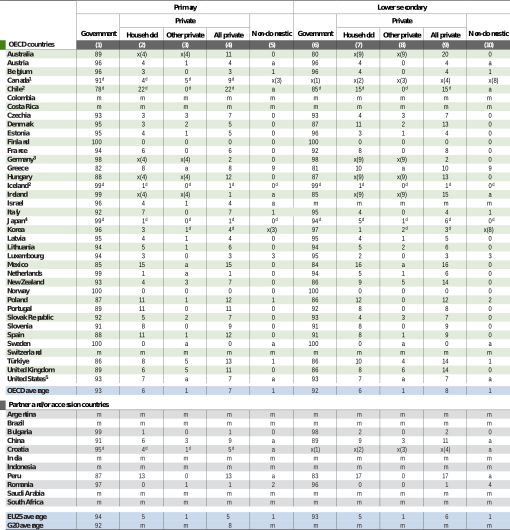
Note: For notes on this table and a link to download the data, see Tables and Notes section above.
Direct expenditure within educational institutions, constant prices (2020=100)

Note: For notes on this table and a link to download the data, see Tables and Notes section above.