Portugal is one of the most wildfire-prone countries in Europe. Large fires in sparsely inhabited areas account for most of the burned area, showing how socio‑economic change, land abandonment, and degraded forests have heightened wildfire risk. Industrial and service-sector growth has reduced dependence on land-based activities, driving migration from rural areas to cities and shrinking the rural population from 60% in the 1960s to just 5% today (AGIF, 2020[1]). Inheritance structures and demographic change have fragmented private forest ownership – 93% of forests are privately owned, divided into 6.5 million holdings averaging 0.57 ha – making land management difficult (Schmithüsen and Hirsch, 2010[2]) (Fernandes and Simões, 2024[3]). Low agricultural and timber profitability, combined with policies favouring large-scale operations, further discourage active use of these parcels (Hatcher, Straka and Greene, 2013[4]). As agricultural and forest lands are abandoned, unmanaged, fire-prone vegetation dominates the landscape, while poor forest health and invasive species add to vulnerability (OECD, 2023[5]). Finally, climate change further exacerbates this risk by driving extreme weather that fuels fire spread and intensity (OECD, 2023[6]) (Figure 1).
Towards an integrated rural fire management framework in Portugal

Average annual area burned (ha) and average annual number of fires over 2006-2024
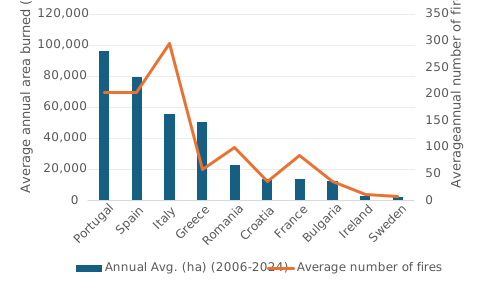
Note: The data presented in this figure account only for fires with a burned area exceeding 30 hectares, and thus exclude the numerous smaller fires successfully contained through effective suppression operations.
Source: Author’s own, based on European Forest Fire Information System (EFFIS) Estimates for European Union, under the Copernicus Emergency Management Service (European Commission, JRC, 2025).
In 2017, Portugal experienced its deadliest wildfires in recent years. Over the course of the year, more than 100 people lost their lives, thousands were injured or displaced, and vast areas of forest and agricultural land were destroyed (AGIF, 2020[1]). The unprecedented severity of the 2017 fires was driven by a combination of factors. First, extreme weather conditions, including prolonged drought, record-breaking heatwaves, and strong winds contributed to fire intensity and spread. In addition, a high amount of dead vegetation resulting from decades of land abandonment and insufficient forest management fuelled the fires. Finally, there were underlying structural vulnerabilities stemming from the country’s fire prevention and emergency response systems (OECD, 2023[6]).
In the aftermath of the devastating 2017 fires, Portugal faced a pivotal moment in its approach to wildfire management, leading to a paradigm shift toward proactive and risk-based fire management. The pre-2017 wildfire management system was characterised by a lack of co-ordination and dialogue among key stakeholders, an unclear distribution of roles and responsibilities, the underinvestment in wildfire prevention, and a general lack of awareness of existing levels of risk (Independent Technical Commission, 2018[7]) (Independent Technical Commission, 2018[8]) (AGIF, 2020[1]). To address these gaps, Portugal embarked on a reform path, guided by the objective to reduce severe fire risks, and enhance resilience. This reform led to the establishment of the Integrated Rural Fire Management System (IRFMS) (Presidency of the Council of Ministers, 2019[9]) and the elaboration of a 2020–2030 Integrated Rural Fire Management Strategy, which emphasise the greater integration of prevention, emergency response and recovery efforts across all levels and actors.
The 2024 and 2025 fires demonstrate that significant challenges remain in pursuing the paradigm shift set through the introduction of the IRFMS. While Portugal has experienced a slight decline in fire ignitions and average annual area burned since 2017, the country faces growing exposure to severe wildfires (Figure 2). The 2024 fires caused the third-largest burned area since 2014 (AGIF, 2025[10]). The summer of 2025 again saw exceptionally large fires, with burned area exceeding that of 2017. Climate projections indicate an increase in high-to-extreme wildfire risk days, making intense and frequent fires more likely (OECD, 2023[5]) (Ross, Gannon and Steinberg, 2020[11]).
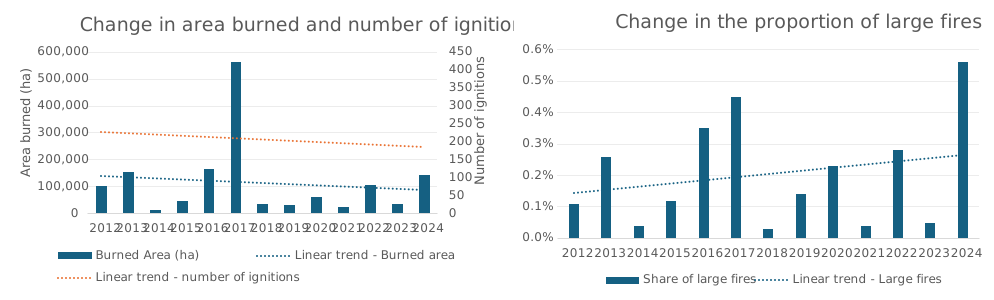
Source: Author’s own, based on ICNF total and regional statistics (2001-2023) and (AGIF, 2025[10]).
To support Portugal in furthering the implementation of its ambitious reform programme, the country engaged in a Technical Support Instrument (TSI) project funded by the European Commission’s Secretariat-General for Structural Reform Support (SG REFORM) to address the persistent challenges in wildfire management and strengthening the implementation of the reforms adopted after 2017. This report presents the project’s key findings and recommendations.