This chapter lays out proposed objectives for a digital transformation strategy, considerations on scope and timeline and linkages to other Irish and European strategies and initiatives. The first section outlines the objectives, emphasising the need to establish a clear vision and defining the desired future state. The objectives identified in Ireland’s strategy for the digital transformation for public procurement will ultimately need to be defined by the Irish government and may differ from those outlined here. However, the number of objectives and how they are expressed is less important than capturing the underlying priorities. The second section proposes a scope for the strategy, including the stages of the procurement cycle and the entities involved. The final section explores the potential linkages and relationships to other Irish and European strategies and initiatives, highlighting how a digital transformation strategy could integrate with broader frameworks.
The Way Forward for Digital Public Procurement in Ireland

Abstract
2.1.1. Establishing a clear vision and ambition for digital transformation
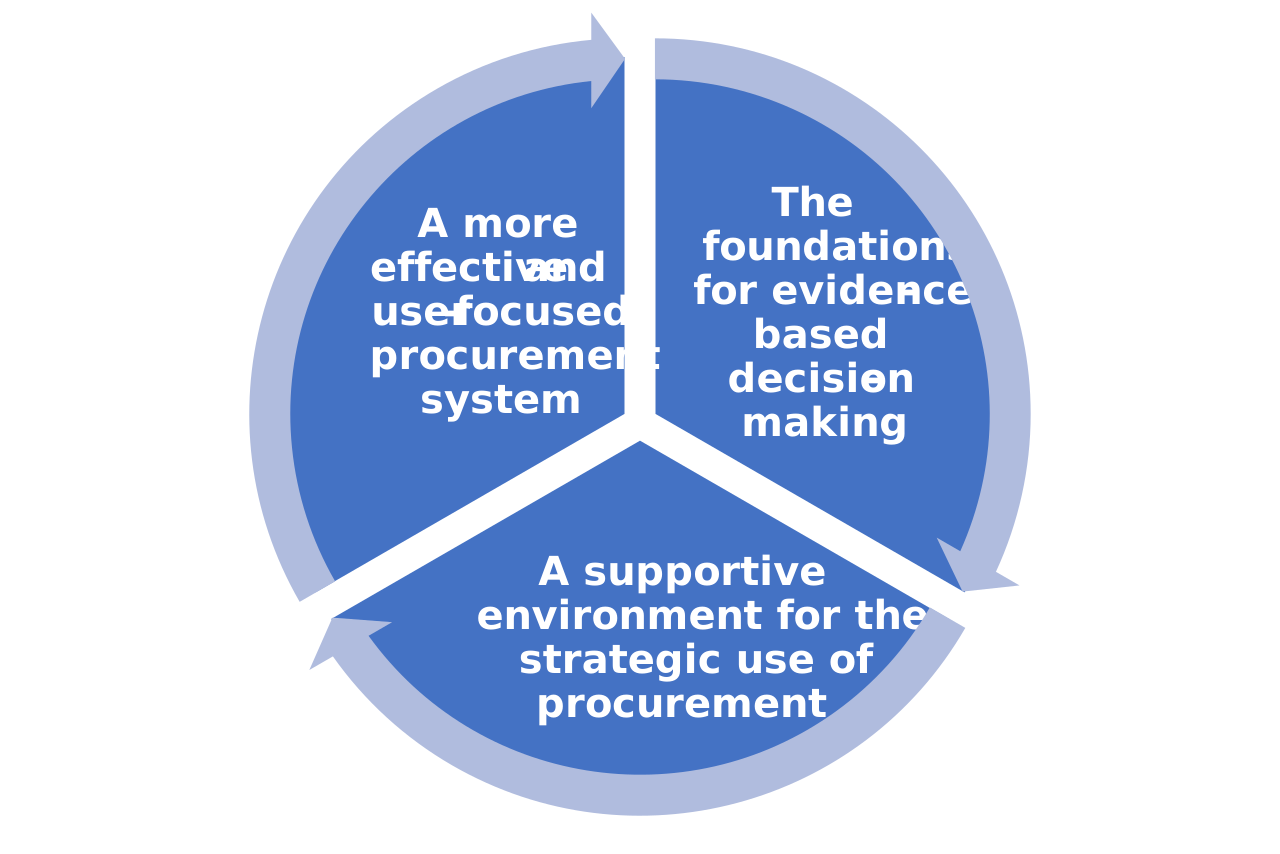
Successful digital transformation in public procurement will require establishing a clear vision and direction shared by all stakeholders. The strategy’s objectives should serve as guiding principles for its development and implementation. Aligned with the broader goals and strategies of the Irish government, ambitious objectives can provide a compelling vision to mobilise stakeholders around a common goal. However, as too many objectives can dilute the strategy’s focus and impact, the objectives should remain focused on key principles and should serve Ireland’s broader goals for the public procurement system.
The objectives outlined in this Guidance Paper aim to capture the goals and ambitions for digital transformation expressed by Irish stakeholders, support the government’s public procurement policy objectives, and align with trends and good practices in digital procurement across OECD countries.
Source: Authors’ elaboration
These objectives are interdependent and reinforcing: a more effective public procurement system and better data can help to lay the groundwork to pursue strategic objectives and data-driven insights can inform strategic procurement initiatives and underlie an evidence-based approach to improving public procurement practices. For example, leveraging emerging technology can enhance operational efficiency while also enabling the seamless integration of sustainability criteria and innovative solutions into procurement processes.
Objective 1: A more effective and user-centric public procurement system
An effective and user-centric public procurement system is critical to the delivery of public services. It can achieve greater value for money by, for example, driving the use of central arrangements or increasing the attractiveness of the public sector as a customer. The digital transformation strategy should aim to enhance the procurement system through the redesign of processes to take advantage of digital tools and platforms and increased data availability. It should seek to improve existing digital platforms such as eTenders and introduce new tools to simplify procurement procedures and reduce duplication.
The strategy should aim to complete the digitalisation of the procurement cycle by introducing new tools and improving the user-friendliness of existing platforms. Digital should be an enabler of efficient public procurement for users rather than a barrier. For the private sector, the strategy should seek to improve competition by positioning the public sector as a buyer of choice. This involves increasing transparency, standardising processes, supporting improvements in the quality of documentation, and improving the implementation of the once-only principle. For the public sector, this should include automating repetitive tasks and reducing duplication across platforms. This could include enhancing or extending eTenders features such as eCatalogues and eEvaluation or introducing tools to support procurement planning.
The strategy should also ensure the coordinated use of emerging technologies. Technologies like AI have the potential to improve efficiency and effectiveness by automating data entry and document review and enhancing data analytics capabilities. Irish stakeholders expressed interest in applying these technologies to public procurement but lacked the resources or guidance to do so with confidence. By providing coordinated support in deploying these technologies and connecting to broader Irish and European strategies, the strategy can help all stakeholders benefit from these opportunities and avoid common pitfalls.
Objective 2: A supportive environment for the strategic use of procurement
Procurement is increasingly used as a strategic tool to promote economic and sustainability goals. In Ireland, this includes, for example, a new Green Public Procurement (GPP) Strategy and Action Plan. Published in April 2024, the GPP Strategy and Action Plan established ambitious targets and commits to annual reporting. The digital transformation strategy should create a supportive environment for this strategic use of procurement, leveraging data and digital tools to make it easier to implement and measure the use of procurement to pursue a range of policy tools. This includes streamlining processes and introducing tools to make it easier for contracting authorities to incorporate sustainability into their procurement practices, facilitating the procurement of innovation and implementing agile procurement processes to swiftly adopt new technologies and solutions, and supporting SME’s access to procurement opportunities.
Tracking the use of strategic procurement and its effectiveness can also help guide its use to where it is most impactful. The strategy should enhance the government’s ability to measure and evaluate strategic procurement through robust data collection and analysis mechanisms. This could include, for example, the ability to calculate the carbon footprints of procurements. Box 2.1 provides an example from Lithuania of the use of digital tools to support strategic procurement.
In 2021, Lithuania’s government set out to achieve 100% green public procurement by 2023. In 2020, only 5% of the country’s public procurement spending by value used green criteria. To achieve this ambitious goal, the Lithuanian government created an action plan, set up a helpdesk and an extensive monitoring system. By December 2023, green procurement uptake across Lithuanian public institutions increased to 94% by value and 93% by total procedures.
The Lithuanian Public Procurement Office (LPPO) launched a public procurement scoreboard, an IT tool that collects and presents green public procurement data. This tool helps to filter and visualise data about the uptake of green public procurement (GPP) in terms of value and percentage of procedures, but also the specifications, criteria and clauses used for green public procurements.
The tool creates healthy competition between buyers and helps them cross-reference the green technical specifications of goods and services they are planning to buy with past procurements. It also allows the government to monitor GPP uptake by institutions and direct support to sectors and institutions that are lagging behind. The LPPO is currently exploring new opportunities to apply their technology, for example to integrate life cycle costing (LCC) methodologies in the routine procedures of the e-procurement platform.
Objective 3: Provide the foundations for enhanced evidence-based decision-making
The strategy should lay down robust foundations for evidence-based decision-making in public procurement. By giving public buyers the tools to leverage data that is collected and managed in a robust and consistent manner, digital transformation can allow them to make informed decisions based on reliable evidence. With the appropriate analytical tools, data can be used to track individual procurements, guide the development of procurement strategies, and provide inputs for procurement policymaking. Central to this objective is the effective collection, management, and use of data to inform all stages of the procurement cycle, and the digital transformation strategy will need to be closely linked to the data pillar of ’Ireland’s planned public procurement strategy.
By emphasising transparency through increased data accessibility, the strategy can foster trust in procurement processes by ensuring that stakeholders have access to accurate and comprehensive information. Accessible data can give the private sector enhanced visibility into market opportunities, improving access and fostering competition. For example, AusTender, the Australian Government’s procurement information platform, provides a searchable database of entities’ annual procurement plans to draw the market’s early attention to potential opportunities (Department of Finance, 2024[4]). The data produced by digital procurement tools and platforms can also be a valuable resource for auditors and competition authorities and can increase transparency and accountability in procurement processes and in government spending. For example, Ireland’s Competition and Consumer Protection Commission is actively building its data analysis capabilities and seeking opportunities to increase its access to and use of procurement data (Competition and Consumer Protection Commission, 2023[5]).
2.1.2. The desired future state of digital public procurement in Ireland
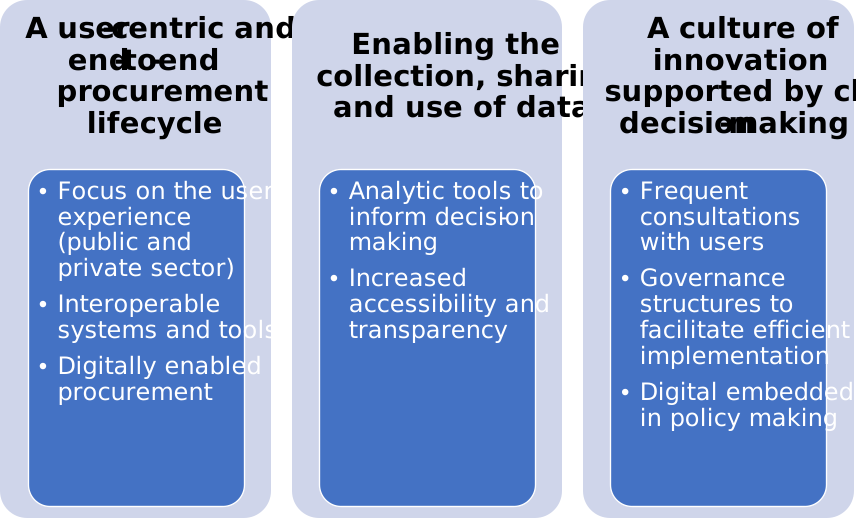
Describing a high-level future state for digital public procurement can help to orient the strategy and link the strategy objectives to more concrete initiatives. The future state should be ambitious but must consider Ireland’s current position and institutional arrangements. The proposed future state described here is based around three pillars; however, the number of pillars is less important than the constituent initiatives and goals.
Source: Authors’ elaboration
A user-centric and end-to-end procurement lifecycle
A more efficient, user-friendly procurement system would allow contracting authority staff to focus on the strategic aspects of procurement, where they could be equipped with tools for planning procurements, the development of tender documentation, and monitoring and measurement. For potential suppliers, it could include a strong implementation of the once-only principle with, for example, a streamlined process and integration with national databases for widely used certifications and licenses (such as tax clearance certificates). Platforms and tools should be built to meet user needs, allowing businesses of all sizes to find out about opportunities more easily, to prepare and submit bids, and to understand the outcomes of procurement procedures.
Interoperability across the procurement cycle is fundamental to the future state of digital public procurement. A digital procurement ecosystem made up of different interoperable platforms and tools would provide more flexibility for contracting authorities and CPBs and align with Ireland's institutional landscape. This entails implementing platforms and tools that are interoperable across sectors, facilitated by technologies like APIs and RPA, which ensure smooth transitions between phases of the procurement process. For example, interoperability between eTenders and supplygov.ie could facilitate the posting of award notices from mini-competitions and draw downs. Interoperability can also help public buyers track and monitor procurements in real time as they move through the lifecycle.
Development and implementation should be focused on users to meet the needs of Ireland’s diverse public procurement stakeholders. Tools and platforms should be simple to use and appropriate to their purpose and, where possible, consistent across contracting authorities and CPBs. This could include the development of flexible tools and platforms for public buyers, including enhancements to functions like evaluation and contract management, or the implementation of mobile applications. Box 2.2 provides examples from Finland of different digital tools implemented by Hansel, Finland’s CPB, to support contracting authorities. Introducing new digital tools in every stage of procurement will require support for smaller contracting authorities without dedicated procurement functions, such as intuitive interfaces and workflows that are not dependent on complex user manuals or extensive training and experience.
Hansel Ltd. is Finland’s CPB for central and local governments. Hansel offers a range of digital tools across different platforms to support contracting authorities:
Hansel maintains Hilma, Finland’s national portal for public procurement notices.
Hansel directly provides online tendering services such as framework agreements, DPS and below-threshold procurement, through Hansel.fi.
Hansel has contracted with Cloudia, a provider of digital procurement tools, to supply procurement lifecycle services for contracting authorities.
Hansel also works with the Finnish Government Shared Services Centre on Handi, the ordering invoicing platform for central government.
Examples of the digital tools provided by Hansel include:
Planning in Cloudia
Cloudia Planning is a centralised tool to streamline and manage contracting authorities’ procurement processes by scheduling tasks, assigning responsibilities, and tracking costs and timelines. It enhances transparency, efficiency, and stakeholder participation, enabling planners to create procurement strategies, assess staffing needs, and monitor progress. By standardising documents and providing real-time performance comparisons, Cloudia Planning helps contracting authorities adjust procurement plans as needed, ensuring that buying needs are controlled and procurement expectations are realistic.
Below threshold procurement
Hansel’s small-scale procurement tendering tool is designed to facilitate and simplify the tendering process for procurements below the EUR 60,000 threshold, allowing users to easily send invitations to tender to economic operators. It ensures transparency and equal treatment while offering support, templates, and a streamlined process for both contracting authorities and suppliers.
Contract management in Cloudia
Cloudia's contract management service is a centralised cloud solution that streamlines the contract lifecycle, providing visibility and control over contract details, statuses, and responsible parties. It enhances efficiency by improving access to contract information, supporting timely purchasing decisions, and preventing mistakes like paying for expired contracts or missing renewals. The service includes templates, electronic signatures, and integration with other processes.
Source: (Hansel, 2023[6]), information provided by Hansel
Enabling the collection, sharing and use of data
The future state should prioritise the collection and use of data to guide individual procurements and procurement policymaking. The digital transformation strategy should be closely integrated with Ireland’s public procurement strategy and leverage existing Irish data governance structures and initiatives, such as the Data Governance Board and the Unique Business Identifier. For example, moving over time towards mandatory eInvoicing (with appropriate support for contracting authorities and economic operators) would improve data availability and quality. Investment in tools and platforms that enable data collection and sharing would also lay the foundations for integration with the European Commission’s European Public Procurement Data Space if Ireland chooses to pursue participation.
Data should be used to support evidence-informed decision-making. CPBs, contracting authorities, the private sector and other stakeholders could be equipped with data analysis capabilities, including the use of AI and machine learning, to enable predictive insights. This can include monitoring and identifying efficiency gaps in the procurement process and generating evidence of impacts on policy objectives (World Bank, 2022[7]).
Better data can also enhance transparency. Public procurement data can support oversight bodies and made publicly available to contribute to the transparency and accountability of procurement processes and government spending. This could, for example, include making more procurement data available through Ireland’s open data portal or using the functionality of the new eTenders platform to improve access to procurement data and seeking to make historical procurement data publicly available on a consolidated basis.
Interoperability between public procurement platforms and tools and with other government platforms (e.g. financial management systems) would enhance data quality and availability. An approach centring interoperability and common data standards would better align with Ireland’s institutional landscape and data governance systems than building a single overarching data platform. This would require putting in place tools and technology to allow for the validation and exchange of data between the platforms and tools of OGP, sectoral CPBs, contracting authorities and other public sector bodies. This would help to ensure that data are collected once and reused across various platforms, reducing redundancy and errors and promoting adherence to the ‘once only’ principle. An advanced example of this integration is Korea’s KONEPS platform, which integrates data from almost 200 external platforms or tools (see Box 2.3).
KONEPS (Korea ON-line E-Procurement System) is the Korean Public Procurement Service’s (PPS) comprehensive online platform for the management of public procurement, including bidding, contract-signing, and payment.
KONEPS is linked with 191 external platforms or tools to share and retrieve information, allowing for greater efficiency and the broader use of procurement data. This has included the elimination of paper submission of documents such as business registration certificates and tax payment certificates, which are now accessed directly from government databases. It also includes Korea’s Bid Rigging Indicator Analysis System (BRIAS), which examines data elements including bidding price, the number of participants, and the competition method, and applies a formula that generates a potential bid-rigging score. If the score is above a certain threshold, this suggests the need to collect more information on the procurement.
The Next-generation KONEPS Project, launched in June 2024, willy unify four additional data systems and integrate 25 other procurement platforms to KONEPS. The Next-generation KONEPS project will allow contracting authorities to receive product recommendations based on their needs and purchase history and receive data-based planning support.
Source: Information provided by Public Procurement Service
A culture of innovation supported by clear decision-making structures
Culture and governance are critical to the success and continued evolution of digital transformation. This includes fostering a culture of continuous improvement and adaptation to meet changing needs.
Creating opportunities for collaboration and knowledge sharing can help drive innovation and a shared sense of ownership across the public procurement system. Through a concerted effort to embrace innovation, the Irish public procurement system can be agile and responsive to emerging trends and challenges. User engagement and an agile approach should be the basis for the design and implementation of emerging technologies. Users should be engaged on an ongoing basis to identify insights for iterating the design of services and simplify underlying processes. Lessons can be learned from existing practices: the development and maintenance of the supplygov.ie platform, for example, has been supported by frequent consultations with users, which has helped to ensure that contracting authorities and economic operators want and are willing to use the implemented solutions.
It also includes governance structures that facilitate a consistent approach and ongoing collaboration across the lead institutions. Clear decision-making structures made up of senior representatives of key organisations can facilitate efficient implementation of digital transformation initiatives and ongoing alignment with strategic objectives. At the same time, mechanisms for collaboration at the working level can help overcome silos and ensure that the ecosystem of digital platforms and tools is developing in a coherent way.
This should include a consistent and coordinated approach to the application of emerging technologies such as AI, focused on strategy objectives such as improving the user experience and reducing the administrative burden for contracting authorities and suppliers. This could include a framework for decision-making on how and when to develop, pilot, and deploy these emerging technologies in public procurement, embedded in broader Irish government frameworks, such as the Guidelines for Use of AI in the Public Service (Department of Public Expenditure, NDP Delivery and Reform, 2024[8]).
2.2.1. Entities covered by the strategy
To align with the current legal and policy framework, the digital transformation strategy should apply to all Irish contracting authorities, including the OGP, the four sectoral CPBs, individual Departments, Offices, commercial and non-commercial State bodies, and private entities which are subsidised 50% or more by a public body when awarding contracts for goods, services and works. This would also contribute to achieving the strategy’s objectives: a consistent set of digital tools and approaches will increase efficiency and help to achieve a consistent approach to strategic procurement and the collection and use of procurement data. The benefits of interoperability and data analysis, such as increased efficiency and insights into spending patterns, scale with the coverage of the stages of the procurement process and participating public entities. A wider implementation means that more contracting authorities and economic operators benefit from interoperability and standardisation and decision-makers benefit from data that covers more of the public sector and the supplier market.
While it will maximise the potential benefits, this wide scope will also bring challenges. The strategy will need to address differing capacities and needs across contracting authorities, as well as different legal requirements under EU Directive 2014/24 on Public Procurement, EU Directive 2014/25 on Procurement by Entities Operating in the Water, Energy, Transport and Postal Services Sectors, and EU Directive 2009/81 on the Award of Contracts relating to Defence and Security. These challenges can be addressed by focusing on the user experience and demonstrating success before scaling up. Identifying pilots and the early adopters who are ready to move them forward would provide opportunities to test and learn while mitigating the risk of imposing solutions on contracting authorities with limited capacity (see Chapter 4). Ongoing engagement with commercial semi-state bodies and the Department of Defence can help to ensure their unique needs are met (see Chapter 3).
2.2.2. Timeline
The timeline covered by the strategy should be long enough to provide stable, ongoing guidance but be sensitive to the rapidly changing digital procurement environment. This suggests a longer-term, phased strategy that is periodically reviewed and re-assessed. The longer the timeframe, the greater the need to monitor the landscape and consider periodic reviews to recalibrate if necessary. While the pace of technological change necessitates adaptability, a number of countries have found success in integrating shorter-term priorities within a broader, long-term framework. For example, Slovenia and Czechia have adopted eight-year digital transformation plans, while France initially developed a five-year digital transformation plan but recognised the need to extend it to better accommodate evolving needs.
Consideration should be given to aligning with the current contract for eTenders, the national e-procurement platform. As the central e-procurement platform for Ireland, the strategy will, at least initially, need to build around eTenders. The current eTenders contract runs until 2029, with three potential extensions of up to 12 months each. The strategy would also benefit from aligning its timeline with related government strategies, such as Connecting Government 2030 and Better Public Service: Public Transformation 2030. This would allow future versions of the public procurement digital transformation strategy to inform and reflect future government-wide digital and transformation strategies.
Assuming the digital transformation strategy is launched in 2025, a 6-year term would balance the need for stability with the need for agility. A substantive review at the halfway point in 2028 would allow for a reassessment of the digital procurement landscape and would align with the end of the initial term of the current eTenders contract.
National and European laws and strategies play a pivotal role in shaping public procurement and data governance. It is important to identify areas for complementarity, alignment and reinforcement between the digital transformation of public procurement and other policy areas, including identifying current measures and mechanisms that can link the strategy and projects with other government strategies (OECD, 2021[9]).
The strategy for the digital transformation of public procurement should ensure alignment with broader Irish and European strategies and plans. Alignment would allow the digital transformation of public procurement to support government priorities as well as leverage initiatives and actions being implemented under other strategies.
2.3.1. Leveraging Irish strategies and initiatives
Ongoing digital government efforts in Ireland offer opportunities for public procurement to leverage policies and actions intended to increase the capacity of public sector institutions and to coordinate the adoption of digital tools. While public procurement has not figured prominently in Irish digital government strategies and plans, there are opportunities for the digital transformation of public procurement to draw on the governance structures and resources they could potentially offer. The OECD Recommendation on Digital Government Strategies advises governments to identify the complementarity, alignment and mutual reinforcement between digital strategies and other relevant sector strategies and to integrate digital strategies in overall public administration reforms (OECD, 2014[10]). This can be challenging as there is sometimes limited interaction or coordination in the development of strategies.
Annex A provides an overview of relevant strategies and plans, their linkages to public procurement, and individual initiatives or actions that could be leveraged to support the strategy for the digital transformation of public procurement. It identifies governance and coordination structures, such as the AI and Emerging Tech Network, common government-wide standards, such as the design principles developed under the Public Service Transformation Strategy, and resourcing opportunities, such as the Public Service Innovation Fund and the capacity and capability building being developed under the Public Service Open Data Strategy. Box 2.4 provides an example of the kind of public sector pilots that could potentially be applied to the public procurement system.
In 2018, Ireland’s tax authority, the Revenue Commissioners, initiated a pilot project to use AI-based Natural Language Processing (NLP) technologies to deliver improved customer service, reduce costs and increase efficiencies.
This resulted in the implementation of a Virtual Digital Agent or voicebot focused on a subset of inquiries from taxpayers relating to tax clearance (confirmation that a person or business’ tax affairs are in order). A high proportion of these calls are reasonably repetitive, and the knowledge required to provide suitable responses and positive experiences for customers is well understood.
A suite of integrated technologies was used to convert customer speech to text, understand the text using NLP so that a response could be formulated, and then convert this response back to speech so the customer could hear the answer.
Up to 50% of calls were handled from start to finish by the voicebot and only 10% of calls were transferred due to a failure to understand. The project was considered a success, and the Revenue Commissioners are deploying this technology in future service offerings.
2.3.2. Leveraging European strategies and initiatives
From the legal framework to the publication of tender opportunities on TED, public procurement in Ireland is deeply embedded in the European context. Ireland can benefit from increased international co-operation by sharing skills, knowledge and experiences to enable increased integration and data sharing (OECD, n.d.[12]).The strategy for the digital transformation of public procurement should make full use of European initiatives such as eForms, the European Single Procurement Document (ESPD), and eCertis, and Ireland should consider participation in the Public Procurement Data Space (see Box 2.5). Through OGP, Ireland should continue its active role in shaping the development and implementation of these instruments.
eForms
eForms are an EU legislative open standard for publishing public procurement data. Well-implemented eForms should increase the ability of businesses and other organisations to find procurement notices, reduce the administrative burden for contracting authorities, increase the ability of governments to make data-driven decisions about public spending, and make public procurement more transparent.
The European Single Procurement Document (ESPD)
The ESPD is a single self-declaration form of businesses’ financial status, abilities and suitability for a public procurement procedure. It is used as preliminary evidence of compliance with the requirements of exclusion criteria (e.g., criminal convictions) and selection; generally, only the winning economic operator has to present the full set of underlying documentation.
eCertis
eCertis helps businesses identify criteria and evidence requested in procurement procedures across the EU and supports public buyers with the evaluation of bids received from various Member States. Economic operators wishing to participate in a public procurement procedure or contracting authorities evaluating bids received from other Member States can use eCertis to help understand what evidence is requested or provided by the other party.
The Public Procurement Data Space
The Public Procurement Data Space (PPDS) will connect European public procurement databases, including TED data and national procurement datasets in an EU-level platform for public procurement data. It is expected to improve data quality, availability and completeness.
Source: (OECD, 2024[13])
References
[5] Competition and Consumer Protection Commission (2023), Competition and Consumer Protection Commission Statement of Strategy 2024-2026, https://www.ccpc.ie/business/wp-content/uploads/sites/3/2023/11/2024.11.13-100707-CCPC-Strategy-Statement-FINAL-WEB.pdf.
[4] Department of Finance (2024), Commonwealth Procurement Rules, https://www.finance.gov.au/sites/default/files/2024-06/Commonwealth_Procurement_Rules-1-July-2024.pdf.
[11] Department of Public Expenditure, NDP Delivery and Reform (2024), Artificial Intelligence (AI), https://www.gov.ie/en/publication/629ce-artificial-intelligence-ai/ (accessed on 27 June 2024).
[8] Department of Public Expenditure, NDP Delivery and Reform (2024), Interim Guidelines for Use of AI in the Public Service, https://assets.gov.ie/280459/73ce75af-0015-46af-a9f6-b54f0a3c4fd0.pdf.
[6] Hansel (2023), Annual Report 2023, https://annualreport2023.hansel.fi/.
[3] OECD (2024), “Lithuania”, in Harnessing Public Procurement for the Green Transition: Good Practices in OECD Countries, OECD Publishing, Paris, https://doi.org/10.1787/a5bf1c5e-en.
[13] OECD (2024), The Digital Transformation of Public Procurement in Ireland: A Report on the Current State, OECD Public Governance Reviews, OECD Publishing, Paris, https://doi.org/10.1787/87912457-en.
[9] OECD (2021), The E-Leaders Handbook on the Governance of Digital Government, OECD Digital Government Studies, OECD Publishing, Paris, https://doi.org/10.1787/ac7f2531-en.
[10] OECD (2014), Recommendation of the Council on Digital Government Strategies, https://legalinstruments.oecd.org/en/instruments/OECD-LEGAL-0406.
[12] OECD (n.d.), Principle 8: Strengthen international co-operation with other governments, https://www.oecd.org/governance/digital-government/toolkit/principle8/ (accessed on 22 April 2024).
[2] Open Contracting Partnership (2023), How Lithuania fast-tracked green procurement, https://www.open-contracting.org/2023/12/06/how-lithuania-fast-tracked-green-procurement/ (accessed on 17 July 2024).
[1] Open Contracting Partnership (2022), Going 100% green in Lithuania, https://www.open-contracting.org/2022/10/17/going-100-green-in-lithuania/ (accessed on 17 July 2024).
[7] World Bank (2022), Using Data Analytics in Public Procurement: Operational Options and a Guiding Framework, http://hdl.handle.net/10986/37467.