Conscious of the structural nature of Portugal’s productivity challenges, the country has implemented a comprehensive set of pro‑productivity policies over the past decade, with a strong focus on the regulatory environment, innovation and diffusion, firms’ financial conditions and workforce skills. This chapter maps productivity-related policy measures implemented between 2015 and 2025, documenting their breadth, evolution, and cross-country comparison, and assessing how well they address key productivity drivers. While these measures have contributed to improvements in overall policy settings, evidence points to scope for further strengthening their effectiveness and efficiency. Moreover, further analytical insights are needed to better understand policy complementarities and potential unintended effects of support measures, in order to improve coordination and prioritisation across policy areas and sectors. This highlights the need for a more systematic approach to productivity policymaking going forward.
Strengthening Pro‑Productivity Institutions and Policymaking in Portugal

Abstract
The objective of the stocktaking is to establish a structured overview of the policy effort that can inform further integrated productivity analysis (see Box 2.1 for the sources of the measures included in the stocktaking). The stocktaking does not seek to assess the impact of productivity measures on productivity, nor to formulate policy recommendations. It draws on an OECD analytical framework that has previously been applied to identify areas for further analysis by pro-productivity institutions (André and Gal, 2024[1]; OECD, 2025[2]). The framework covers a variety of structural productivity drivers and corresponding policy areas, drawing on evidence from both firm-level and macroeconomic studies. While macroeconomic policies also affect productivity, both by influencing the cyclical state of the economy in the short term and through interactions with productivity drivers, such as investment and factor allocation, over the medium to long term, they are not among the policies discussed in the framework and in this chapter.
The framework groups productivity‑enhancing policies into two main categories according to the potential effects of these policies on productivity:
Incentives, which encourage firms to undertake actions that raise productivity or help shift resources from less productive to more productive firms. Incentives can be non-financial, for instance through increased competitive pressures that stimulate the creative-destruction process, or financial, for instance when set through tax incentives or financial support conditional on certain firm actions.
Capabilities, which enable firms to become more productive and enable resources to be reallocated. Capabilities can address labour inputs by strengthening the availability and mobility of skilled labour; capital inputs by enabling business investment and providing high-quality infrastructure; or facilitate the efficient combination of production factors through knowledge creation and diffusion within and across national boundaries, thereby enhancing multifactor productivity (MFP).
The stocktaking is based on the analysis of 160 policy measures identified from laws, decree-laws, ordinances and resolutions by the Council of Ministers, regulations, and policy strategies for the period 2015-2025. The identification of measures is based on the monitoring outputs of Portuguese expert institutions, notably the policy measures gathered in the Competitiveness Sheets of the Ministry of Economy (DGE, 2026[3]). Complementary information has been gathered from AD&C, which is the agency responsible for managing European funds in Portugal (AD&C, 2026[4]).
The stocktaking has limitations. Measures are not mutually exclusive, so some may be omitted. Key areas – pre-primary to upper-secondary education, foundational research, infrastructure, and openness to foreign investment – are not systematically covered. Priority areas are identified by measure counts, which may not reflect the scope or ambition of reforms.
The tracking of progress in relevant policy areas further draws on insights from work on productivity and competitiveness, notably the OECD Economic Surveys for Portugal (OECD, 2021[5]; OECD, 2023[6]; OECD, 2026[7]), the OECD Foundations for Growth and Competitiveness Database, which incorporates a broad range of indicators (OECD, 2026[8]), and outputs from Portuguese institutions and academia.
The mapping of policy measures indicates that, over the last decade, Portugal has addressed most policy areas included in the OECD analytical framework to some extent, using both incentive- and capability-oriented measures. While the comprehensive approach reflects Portugal’s efforts to boost productivity across its multifaceted drivers, the emphasis placed on different policy areas has shifted over time:
Incentives: Portugal has used non-financial and financial incentives targeting firm-level productivity improvements and the reallocation of resources (Figure 2.1, Panel A):
The regulatory environment was strengthened by putting in place several waves of pro-competition measures in many industries, removing barriers to firm entry and exit, and easing the overall administrative burden on business. This is consistent with the need to address some of the structural barriers identified in Chapter 1.
Another consistent focus has been on stimulating innovation and technology diffusion through fiscal incentives. Except for the national R&D tax credit instrument, these measures were mostly linked to EU programmes, including the structural funds and the Recovery and Resilience Plan following the pandemic, so that the timing of these measures tended to coincide with the respective programming periods.
Various other measures have set incentives for reallocation through different policy channels, notably by changing corporate taxation for business investment, different labour market reforms affecting employment regimes and wage-setting institutions, including the introduction of a minimum wage and complementary measures to mitigate potentially detrimental effects on unit labour costs, and environmental policy-related regulations and pricing.
Capabilities: a broad set of policy measures and reforms has been put in place to address capital and labour inputs, and, to a lesser extent, knowledge creation and diffusion (Figure 2.1, Panel B):
Following the Portuguese financial crisis, a cluster of measures was introduced to strengthen firms’ capitalisation and access to external financing, and improve framework conditions for business investment.
The COVID-19 pandemic marked a shift in capability-related measures. In the post-pandemic recovery phase, capital-related measures increasingly targeted framework conditions for green investment and infrastructure across transport, digital connectivity, and energy dimensions.
On the labour capability side, adult skills and lifelong learning gained increasing priority following the pandemic, with various measures taken to strengthen the adult education system and labour mobility in different dimensions that matter for efficient job-worker matching.
National measures have also supported knowledge creation and diffusion, complementing EU initiatives that shape European research cooperation and framework conditions for international knowledge transfer through trade and investment.
Additional measures have aimed to strengthen links between higher education institutions, research centres, and firms, with support directed towards technology transfer and talent mobility, and to raise firms’ absorptive capacity for technology adoption.

Note: Overall, 160 measures have been mapped based on the sources specified in Box 2.1. A. The groupings shown in this figure further summarise different policy areas differentiated in the OECD analytical framework. Measures labelled under Regulatory Environment group all pro-competition measures, including reforms of product market regulation, barriers affecting the openness to international and services trade, anti-trust regimes, as well as reforms of entry and exit regimes. Fiscal incentives for innovation and diffusion are in line with the dimensions included in the analytical framework. The category “Other incentives affecting reallocation” includes hiring and dismissal costs, corporate tax measures related to capital allocation, and environmental policy-related regulation and carbon pricing. B. The figure does not include measures related to the education system and foundational skills, residential mobility, and internationalisation of domestic firms through FDI and GVC integration, while a sub-set of infrastructure measures is included.
Source: OECD elaborations.
The measures are discussed below in light of improvements in policy settings over time and in international comparison, which help draw some implications for potential further improvements in pro-productivity policymaking and analysis going forward.
Regulatory reforms have aimed at improving competition and firm dynamics
Competition and firm entry
Measures to improve the regulatory environment formed a key area of incentive-oriented policies in the last decade. Reform packages were initiated during the recovery periods from the 2009–2013 recession as well as the recession caused by the COVID-19 pandemic. These measures were relevant in stimulating firm performance by restoring competitive forces and economic dynamism through increased firm entry and exit. In the post-financial crisis period, a comprehensive set of measures was put in place to strengthen competition through reforms of product market regulation and increased trade openness, and to reform entry and exit regimes. The Simplex programme, originally launched in 2006, has served as an umbrella for various waves of measures related to licensing, digitalisation of public services and the reduction of administrative burden on business, including by setting up a one-stop electronic portal for company creation, licensing and certification as well as streamlining procedures for investment permits. Following the pandemic, many measures linked further improvements of the regulatory environment to the reform milestones of the Recovery and Resilience Plan (RRP, 2021–2026). Reforms from 2022 to 2024 focused on eliminating redundant permits in the areas of environmental and urban planning and industrial licensing as well as on increasing competition-friendliness in regulated services and professions.
The comprehensive reforms of the regulatory environment have reduced administrative requirements and improved communication towards firms, which in 2023 placed Portugal in the upper half of the OECD distribution of the respective PMR indicators (Figure 2.2). While the indicator for entry barriers in services remains relatively high, recent measures reforming the legal regimes for entry into regulated professions are not yet reflected in the data for 2023. Overall, the reforms have contributed to a more supportive environment for entrepreneurs in Portugal, even though regulatory barriers in some sectors, notably professional services and retail distribution, still limit competition and firm growth (OECD, 2026[7]).
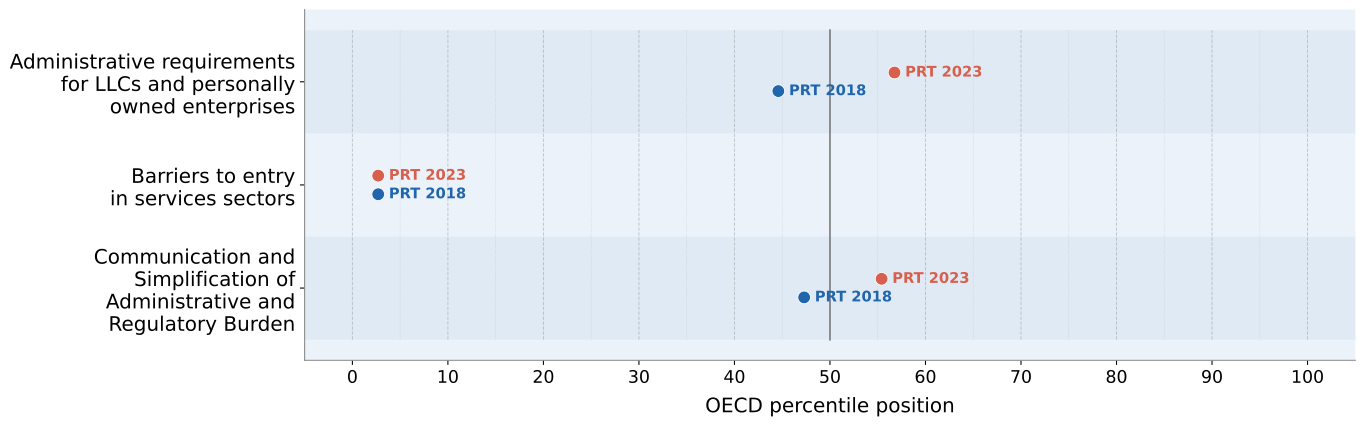
Note: The figure presents Portugal’s position relative to the distribution of all available OECD countries in the latest available year.
Source: OECD calculations based on OECD Product Market Regulation (PMR) Indicators gathered in the OECD Foundations for Growth and Competitiveness Database.
Despite the notable improvements of pro-competition product market regulation, policy evaluations offer limited insights on the extent to which the measures described above have helped boost productivity. Some evidence from reforms initiated more than one decade ago suggests overall positive effects of upstream PMR reforms on productivity in downstream industries (Correia and Fontoura Gouveia, 2017[9]). Moreover, an evaluation of reforms to facilitate business registration during the 2000s found increases in firm entry and aggregate productivity (Félix and Maggi, 2021[10]). These findings are consistent with research and evidence across OECD countries on the benefits of easing product market regulation (Zona Mattioli and Borowiecki, 2025[11]; Andrews and Égert, 2026[12]; Andrews et al., 2025[13]). However, evidence for Portugal could be updated to assess the effectiveness of the policy packages taken over the last decade.
Trade openness
Further relevant measures taken under the Simplex initiative focused on removing administrative trade barriers, including by modernising customs procedures and streamlining goods clearance. These measures have been accompanied by improvements in indicators related to trade-related formalities, although performance gaps relative to other OECD countries remain in the areas of automation and procedures. At the same time, policy settings for services trade have further improved, placing Portugal in a relatively competitive position with regard to barriers to competition, regulatory transparency and administrative requirements (Figure 2.3).
For a small open economy like Portugal, international openness represents a particularly important dimension of pro-productivity policymaking. A recent evaluation coordinated by PLANAPP finds that different forms of global engagement by Portuguese firms, including exporting, importing, sourcing practices and participation in global value chains, help explain productivity differentials, highlighting the importance of further strengthening the regulatory environment for trade (PLANAPP, 2025[14]).
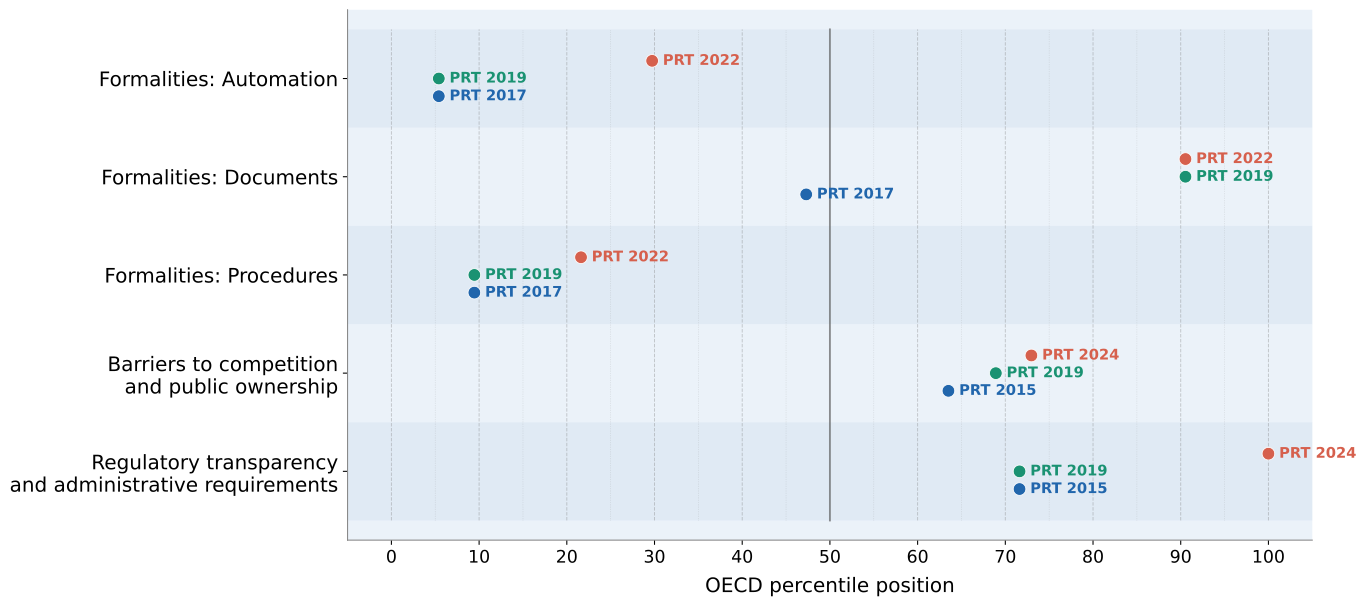
Note: The figure presents Portugal’s position relative to the distribution of all available OECD countries in the latest available year.
Source: OECD calculations based on OECD Trade Facilitation Indicators (Formalities) and the Service Trade Restrictiveness Indicators gathered in the OECD Foundations for Growth and Competitiveness Database.
Restructuring and insolvency regimes
Concerns about capital misallocation and the prevalence of zombie firms weighing on productivity following the financial crises of 2009-2013 motivated efforts to overhaul restructuring and insolvency regimes, partly under the umbrella of the CAPITALIZAR programme which represented a broader initiative to strengthen firm financial access (see more details in the section on finance below). Relevant measures included restricting the revitalisation process to non-insolvent companies with genuine recovery potential, introducing a new debt-to-equity conversion regime, increasing the agility and attractiveness of out-of-court restructuring, creating a business recovery mediator statute, and introducing an early-warning mechanism. Zombie firms and allocative efficiency also became a renewed policy priority following the unprecedented emergency support granted to firms during the COVID-19 pandemic. Portugal transposed EU rules on preventive restructuring into national law, introducing measures to facilitate faster restructuring and debt forgiveness. Insolvency proceedings were further simplified, streamlining the verification of liabilities and the ranking of creditors to allow for more agile processing.
These measures have led to significant relative improvements of restructuring and insolvency regimes over time and in OECD comparison, reflected in the OECD Insolvency Indicators for prevention and streamlining, restructuring tools, and treatment of failed entrepreneurs (Figure 2.4). There is evidence that pre-pandemic institutional reforms aimed at improving the efficiency of insolvency frameworks reduced the prevalence of zombie firms and economy-wide distortions in business dynamism and reallocation – primarily through facilitated recovery rather than firm exit (Nieto-Carrillo, Carreira and Teixeira, 2022[15]). The 2023 OECD Economic Survey confirmed strong implementation progress of insolvency reforms while pointing to further areas for improvement, including the use of out-of-court procedures (OECD, 2023[6]).
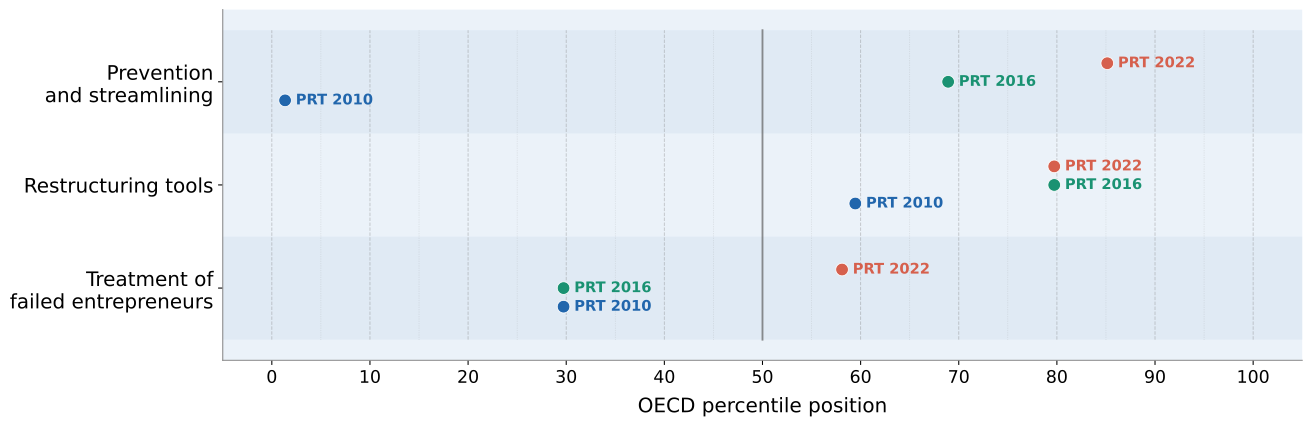
Note: The figure presents Portugal’s position relative to the distribution of all available OECD countries in the latest available year.
Source: OECD calculations based on OECD Insolvency Indicators gathered in the OECD Foundations for Growth and Competitiveness Database.
Support to strengthen business investment in innovation and technology adoption has expanded
Over the last decade, Portugal has gradually expanded existing fiscal support and introduced new measures for business investment in research and development (R&D) and technology adoption, using both tax incentives and direct support backed by national and EU funds. The various measures form a comprehensive, yet complex, ecosystem of support instruments for business innovation and diffusion. Public R&D support through tax incentives and direct funding is among the highest across OECD countries relative to GDP (Figure 2.5).
As a percentage of GDP

Note: See OECD (2023[16]) for a detailed discussion of design features.
Source: OECD R&D Tax Incentives Database, https://oe.cd/rdtax, November 2025.
To support business R&D, the longstanding R&D tax incentive scheme SIFIDE II has been modified several times, gradually increasing its generosity and broadening its scope by extending the loss carry-forward period, increasing the deduction rate for R&D activities associated with eco-design, and stepping up support for loss-making small and young firms. Portugal is among the OECD countries in which targeting and generosity of R&D incentives depend on firm size and age characteristics (OECD, 2023[16]). Another long-standing tax incentive scheme (RFAI) is more relevant for technology adoption as it allows firms to deduct a share of eligible investment expenditures – including expenditure on machinery, equipment, technology, digitalisation and certain intangible assets – from their corporate income tax liability. The RFAI scheme was also progressively broadened over time, including through more favourable treatment for SMEs and firms investing in disadvantaged regions.
Further measures providing fiscal support for innovation and diffusion draw on EU structural and investment funds under the respective competitiveness operational programmes (formerly COMPETE 2020 and later COMPETE 2030) of Portugal 2020 (2014–2020) and Portugal 2030 (2021–2027), as well as the Mobilising Agendas for Business Innovation in the Recovery and Resilience Plan (2021–2026). These measures are structured along a progression from incentives for early research to market uptake. At the initial stage, support concentrates on research capacity, skills and infrastructure. In a second stage, when firms develop and test new products or processes, business research and innovation programmes provide grants combining Portugal 2030 resources, Recovery and Resilience Plan funding, and national co-financing. Closer to the market, instruments become more targeted towards scaling and deployment in priority areas such as digital and clean technologies, including the Strategic Technologies for Europe Platform (STEP). Across different stages, support for innovation and adoption may be complemented by public and private national financing and the indirect support provided by the tax incentive schemes described above. In line with the high number of measures taken, fiscal incentives and financial support for business innovation and technology diffusion have strongly increased over the past decade (Box 2.2).
Portugal has moved into the upper half of the OECD in terms of business R&D (BERD) financed by government and is close to the top in terms of implied R&D tax subsidy rate, mostly reflecting the support provided through SIFIDE II. While business R&D and the share of R&D personnel have also improved over the same period, they have grown more slowly than public support and remain in the lower half of OECD countries. Indicators of technology diffusion and adoption, including the share of businesses purchasing cloud services and business use of AI, have also increased over time – with further potential improvements since 2023/2024 that are not yet reflected in the data (Figure 2.6). However, the OECD Economic Survey notes that the take-up of relevant digital technologies in SMEs continues to lag behind both at the national level relative to larger firms and in comparisons with small firms in other OECD countries (OECD, 2026[7]).
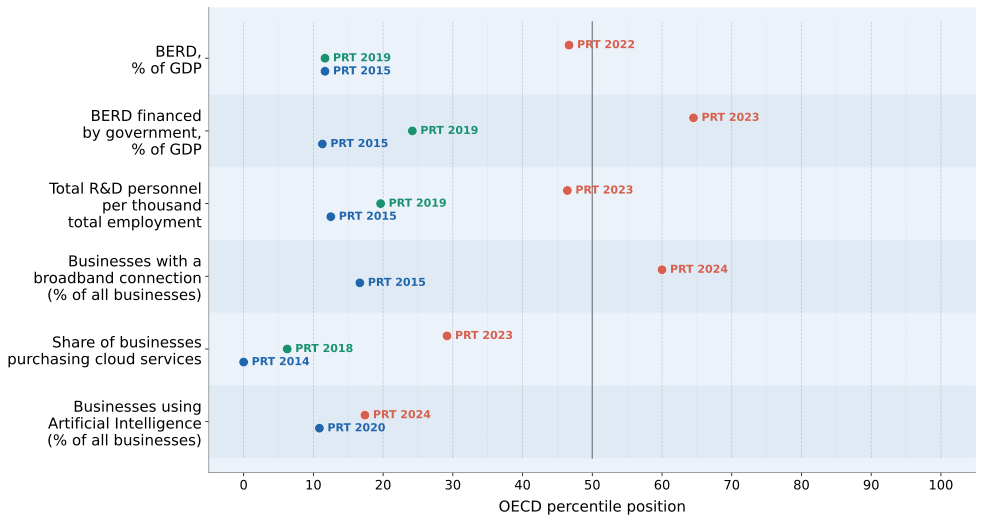
Note: The figure presents Portugal’s position relative to the distribution of all available OECD countries in the latest available year.
Source: OECD calculations based on OECD Main Science and Technology Indicators (MSTI) and OECD ICT Access and Usage by Businesses Database, gathered in the OECD Foundations for Growth and Competitiveness Database.
There are potential signs of efficiency challenges of the innovation and diffusion support system as well as unintended consequences of firm-size dependent incentive policies. Business investment in relevant areas has not kept up with the increasing generosity of support. Together with the persistent productivity dispersion across firms documented in Chapter 1, this points to remaining weaknesses in the mechanisms through which R&D and innovation support contribute to the diffusion, commercialisation and market uptake of innovation. Potential explanations are persistent structural challenges related to complementary workforce and managerial skills – areas in which Portugal has room for further improvement despite various policy actions, as discussed in the capability section below. Moreover, another concern regarding the design and targeting of different tax credits for business investment is the potential creation of pervasive incentives for firms to stay small, which may hamper aggregate business dynamism and productivity growth. The OECD Economic Survey 2026 concludes that incentives for R&D and business investment should be evaluated in terms of their design, considering targeting, thresholds, and the use of complementary direct support to further incentivise basic research (OECD, 2026[7]).
Relevant policy evaluations also show mixed results regarding the effects of support policies on productivity. While evaluations point to overall positive effects of fiscal incentives and financial support on R&D inputs – notably R&D investment and employment – across different support instruments (Basto, Martins and Nogueira, 2021[17]; Teixeira, Teixeira and Santos, 2023[18]), evidence varies across instruments regarding the firm-level productivity effects of innovation support. For SIFIDE II, a significant causal productivity effect concentrated in large firms has been identified, while no significant effect is found for support provided through earlier EU-backed instruments such as SI I&DT QREN (Bernard, Lila and Silva, 2023[19]; Teixeira, Teixeira and Santos, 2023[18]).
So far, evaluations provide limited insights into the complementarities between fiscal support for innovation and technology adoption with other policy areas, notably policies to strengthen the adult education system and digital skills. Such interactions warrant further attention, given that research published by Portuguese institutions has pointed to the importance of digital skills for harnessing broad-based gains from transformative technologies (Osório de Barros and Asensio Menchero, 2024[20]; Osório de Barros, 2021[21]) and to workforce skill composition as a determinant of ICT adoption (Silva and Amador, 2023[22]). Evidence could further be strengthened on the trade-offs that size-dependent support policies may create for other productivity drivers, notably firm growth. While Oliveira and Fonte-Santa (2023[23]) study the determinants of firm growth in Portugal, including the role of support instruments, they do not investigate the extent to which size thresholds in eligibility and generosity may impede incentives to scale up.
Improving firms’ financial conditions has been a strong focus of capability-oriented policies
Improving the firm capabilities for business investment and capital accumulation has been a key area of policymaking over the last decade. Measures were aimed at improving firms’ access to external finance, strengthening corporate capitalisation and enhancing the investment environment. These priorities reflect the legacy of the global financial crisis and the euro area sovereign debt crisis, which led to a system‑wide increase in non‑performing loans and tighter credit conditions for Portuguese firms (Marques, Martinho and Silva, 2020[24]). In 2015, equity, quasi-equity, debt and guarantee funds were established to improve access to finance for firms at various stages of development. A broad set of measures was initiated between 2016 and 2018 under the umbrella of the CAPITALIZAR programme, ranging from simplifying the investment environment and reviewing the tax regime to providing credit lines and facilitating restructuring (see incentives for capital reallocation above). Efforts to improve financing conditions continued thereafter, including through the establishment of the Portuguese Development Bank (Banco Português de Fomento, BPF) with a mandate to correct market failures in business financing, promote modernisation of the private capital stock, and support exports.
Following the COVID-19 pandemic, further measures were taken to create better framework conditions for business investment, significantly supported by the RRP. Measures to further broaden the range of available funding sources and financing instruments, improving access to credit through guarantee mechanisms, and strengthening the equity base of non-financial companies showed continuity with the pre-pandemic period. At the same time, measures put stronger emphasis on improving the framework conditions for green investment – in line with the priorities of the RRP – including through investment support in sectors considered strategic for the green transition and financial guarantees for energy transition investments across the economy.
The comprehensive packages of measures implemented over the last decade were followed by notable improvements in business access to external financing and capitalisation (Box 2.3).
Non-performing loan ratios fell from among the highest in the OECD in 2015 to a fraction of that level by 2024, while credit conditions for SMEs have markedly improved, with the interest rate spread between loans to SMEs and large firms placing Portugal above the OECD median in 2022. Access to financial institutions is high relative to other OECD countries, consistent with the broad range of measures taken since 2015 to diversify firms' access to different financing sources and promote development finance. However, indicators of financial market access and depth also indicate that market-based financing, for instance by raising equity or issuing bonds, may still pose a challenge for Portuguese companies, pointing to further room for improvement to strengthen the domestic financial system (Figure 2.7).
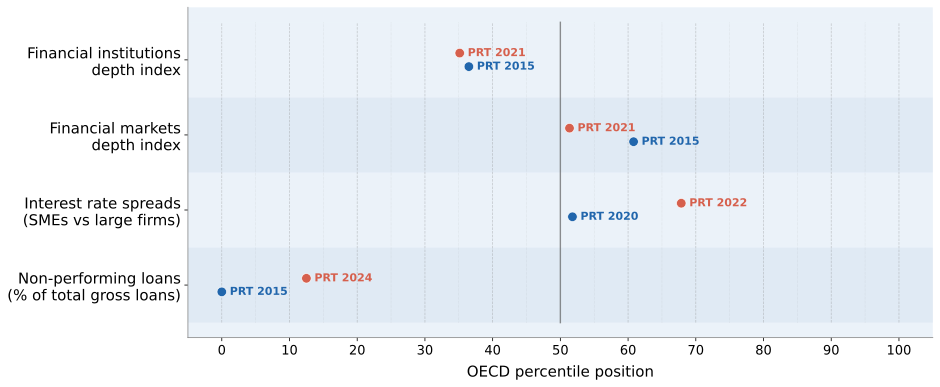
Note: The figure presents Portugal’s position relative to the distribution of all available OECD countries in the latest available year.
Source: OECD calculations based on indicators from the IMF Financial Development Index, OECD Scoreboard on Financing SMEs and Entrepreneurs, World Bank Global Financial Development Database, gathered in the OECD Foundations for Growth and Competitiveness Database.
Despite the notable improvements in firms’ capitalisation and the reduction of legacy barriers in access to external financing, the level of business investment has remained relatively weak in OECD comparison (OECD, 2026[8]). The proportion of firms undertaking investment remains below the EU average and reported financial constraints above. This is despite a larger share of Portuguese firms benefitting from public support for investment – particularly in the form of grants and subsidies (EIB, 2025[25]). Investment in innovative business models and intangible assets also faces limitations by the relatively low and stagnant level of venture capital investment in OECD comparison (Figure 2.8), which points to potential interactions with the challenges in technology diffusion and adoption discussed above.
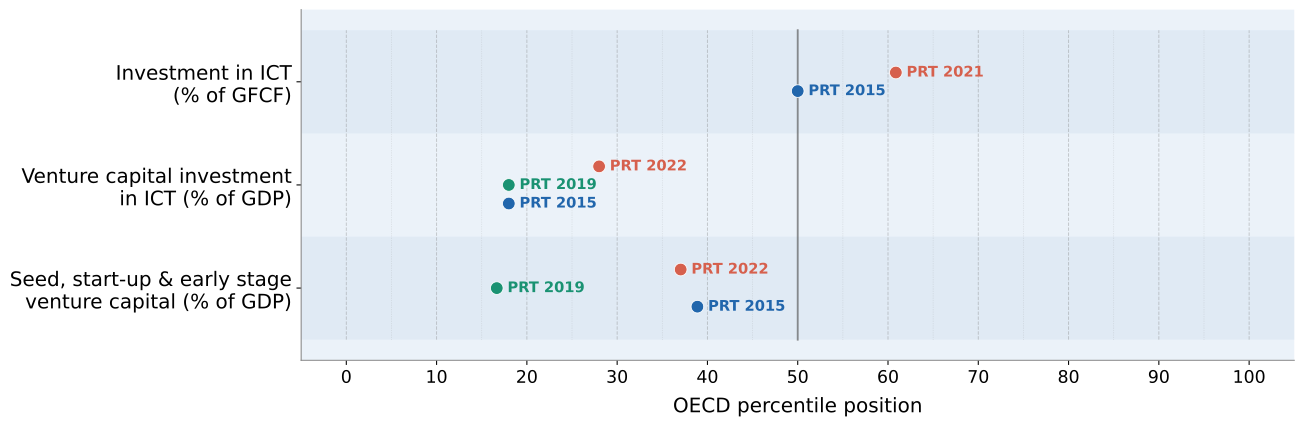
Note: The figure presents Portugal’s position relative to the distribution of all available OECD countries in the latest available year.
Source: OECD calculations based on indicators from the OECD National Accounts and OECD Entrepreneurship Financing Database, gathered in the OECD Foundations for Growth and Competitiveness Database.
While the importance of increasing business investment to boost productivity in Portugal is broadly recognised, there is relatively little recent evidence on the nexus between firms’ financial conditions, business investment and productivity. OECD work points to potential complementarities between business investment with other policy areas and firm characteristics (Dlugosch et al., 2025[26]; André and Gal, 2024[1]), including firm size and managerial skills – areas in which Portugal faces challenges relative to other OECD countries. Better understanding policies that may interact with the relationship between access to finance and business investment will be important to design more effective policy packages to stimulate business investment in the future.
Efforts to strengthen the adult education system and labour mobility have gained momentum following the COVID-19 pandemic
Policies aimed at increasing workforce skills and labour mobility for efficient job-worker matching were established throughout the last decade, but policy efforts significantly accelerated in the recovery period from the COVID-19 pandemic, backed by the RRP component on Qualifications and Skills.
Lifelong learning and workforce skills
The Qualifica Programme, which established a nationwide network of qualification centres in 2016 that provide education and training offers as well as recognition, validation and certification of skills processes, was expanded in 2022 with specialised adult qualification centres. Further programmes have been put in place targeting the qualification and requalification of workers in industrial SMEs and offering financial support to employers hiring unemployed persons with mandatory professional training for hired workers. Other measures have addressed specific skills required by the digital and green transitions, including the INCoDe.2030 initiative, launched in 2017, covering inclusion, education, qualification, specialisation and research – with the objective of positioning Portugal among the leading European countries in digital skills by 2030. A free online platform was launched in 2022 to allow citizens to diagnose and improve their digital competences. Additional measures under the RRP support education and training pathways and aim to increase higher education participation in science, technology, engineering, arts and mathematics. A programme supporting reskilling and upskilling for the green transition was launched in 2023 under Portugal 2030, offering professional training and requalification to workers in energy transition sectors. In the area of managerial practices and skills, some measures under the RRP cover these dimensions, but overall, relatively few dedicated actions were identified (Box 2.4).
The share of tertiary-educated adults in non-formal job-related training was in the upper half of the OECD distribution in 2022, the share of students in vocational training has increased continuously, as have active labour market policies per unemployed person (Figure 2.9). The 2026 OECD Economic Survey stresses progress in strengthening workforce skills and alignment between education and labour market needs. However, challenges remain, including relatively low foundational skills among adults (as indicated by PIAAC data), particularly driven by older cohorts, a high degree of field-of-study mismatch, and deficits in management skills and practices (OECD, 2026[7]; OECD, 2023[6]; OECD, 2021[5]). Accordingly, recent OECD estimates suggest that closing the skill gap with the upper half of the OECD could drive major labour productivity improvements (Andrews, Égert and de la Maisonneuve, 2025[27]; OECD, 2026[8]).
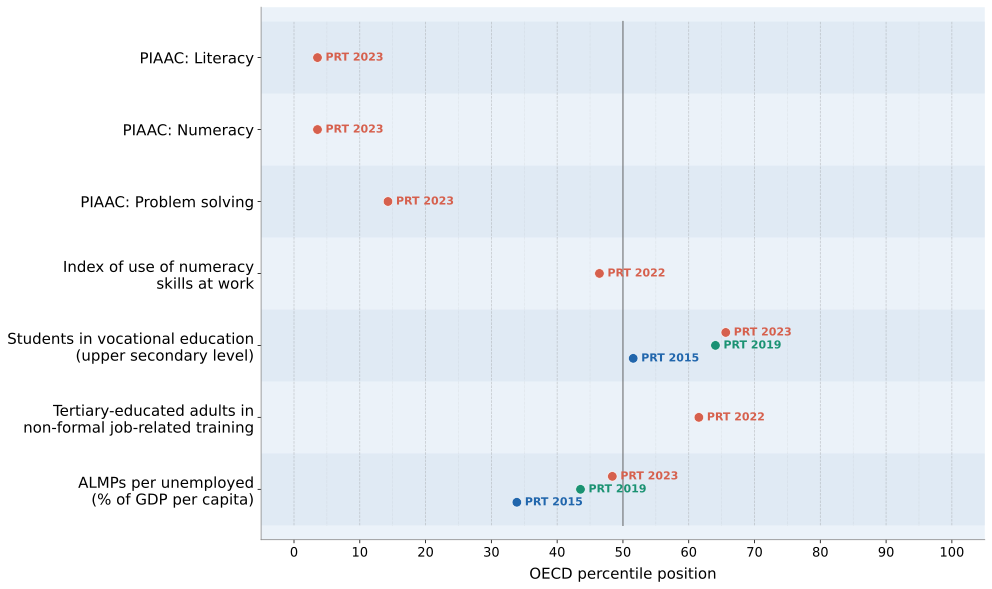
Note: The figure presents Portugal’s position relative to the distribution of all available OECD countries in the latest available year.
Source: OECD calculations based on indicators from the OECD Programme for the International Assessment of Adult Competencies (PIAAC), OECD Education at a Glance, OECD Survey of Adult Skills, and OECD Employment and Labour Market Statistics, gathered in the OECD Foundations for Growth and Competitiveness Database.
The 2026 OECD Economic Survey points to important policy challenges that remain in relation to the adult education system and skill-related outcomes. These include a relatively low participation in lifelong learning, particularly among low-skilled individuals, older workers, the unemployed and inactive workers. Potential factors for low uptake include the lack of suitable training options, limited support from employers and Public Employment Services, and incompatible work schedules. The Survey highlights that Portugal should further strengthen vocational education and work-based training, access to information on career pathways, the alignment of training offer with labour market needs, quality standards for lifelong learning, and targeted training in digital and foundational skills for low-qualified and older adults (OECD, 2026[7]). Moreover, the stocktaking indicates further room to strengthen policies to address a lack of management qualifications and skills which remain a major challenge in Portugal, particularly in small enterprises (OECD, 2026[7]). This may pose a particular challenge for firm-level productivity performance as a lack of good managerial practices and skills are understood to have a potentially detrimental effect on other firm-level productivity drivers including organisational efficiency and the ability to unlock employee potential (André and Gal, 2024[1]).
There is also scope to further strengthen the evidence on the productivity-related outcomes of workforce training programmes and their interactions with other productivity drivers and policy areas. The benefits of increasing workforce skills and qualifications on productivity are well documented in Portugal (Simões and Fonte Santa, 2023[28]; Cima et al., 2022[29]). However, most existing evaluation studies of the adult education system either do not assess productivity as a performance metric or focus on older instruments that pre-date the policies described above. Notably, an evaluation of the FIG programme – which provided grants to firms to cover employee training costs – analysed applications submitted between 2007 and 2011 and found positive effects on firm productivity, as well as on other productivity drivers such as exports (Martins, 2023[30]), suggesting potential synergies across policy areas that could be further explored.
Labour mobility and job-worker matching
Portugal has also introduced a range of measures that could facilitate the productive matching of workers to jobs and labour mobility. These span the dimensions of skill recognition and matching, domestic geographical and residential mobility, as well as the attraction of international talent.
Measures to strengthen skill recognition and meet skill demand include the RVCC system under the Qualifica Programme which supports the recognition, validation, and certification of competences acquired through non-formal and informal learning. Moreover, an automated job-matching system was introduced to improve the quality of matches between worker profiles and employer needs while reducing unemployment durations. Several measures were taken in relation to domestic geographical and residential mobility, the latter closely linked to the housing market. This included the creation of a tenant and landlord counter, which aims to streamline rental injunction procedures to encourage the placement of properties on the rental market. To attract international talent, measures were taken to simplify professional qualification recognition procedures and to provide a streamlined pathway for highly qualified non-EU professionals to access jobs created by Portuguese companies operating in the global market.
Despite the measures taken, persistent challenges remain in the dimensions of efficient job-worker matching and labour mobility, related to geographical and occupational labour mobility and the matching between qualifications and job requirements. The OECD Economic Survey highlights the issue of tight housing markets for the geographical mobility of the workforce (OECD, 2026[7]). Moreover, the Bank of Portugal and a recent PLANAPP report have examined educational and skill mismatches in the Portuguese labour market. The Bank of Portugal found that underqualification has declined over time in line with workforce cohort effects (Pimenta and Pereira, 2019[31]). However, the PLANAPP report finds evidence of heterogeneous overeducation across different sectors of the Portuguese economy, as well as wage penalties that may be associated with productivity challenges (PLANAPP, 2026[32]).
Portugal aims to further strengthen pro-productivity policies across a variety of policy areas, as planned government measures indicate. Many measures show a thematic continuity with past reforms, while also reflecting some reprioritisation in response to challenges in current policy settings discussed in the stocktaking of past measures above. On the incentive side, improving the business environment remains the centrepiece of planned reforms, while on the capabilities side a broad-based agenda aims to strengthen workforce skills and labour mobility. Notable shifts are visible in a more selective and targeted stance on fiscal support and a narrower approach to strengthening business investment with a greater focus on innovative business models and intangible assets (Box 2.5).
The Major Options Law for 2025 to 2029 (Grandes Opções, GO) provides an indication of how the government plans to strengthen productivity growth in the coming years (Assembly of the Republic of Portugal, 2025[33]). The GO is the constitutionally-mandated planning instrument that translates the government programme for economic, social, environmental, and territorial policy into specific measures, and links them to funding from different sources. While the budget law decides on specific measures on an annual basis, applying the OECD analytical framework, introduced in the previous section, to the 288 planned measures in the Major Options Law provides a useful overview of medium-term priorities and government commitments.
Planned measures to strengthen the business environment include improving regulatory procedures, increasing competition in different network sectors, and strengthening entry and exit regimes, including by further simplifying rules for business creation and registration, eliminating sectoral entry barriers, and enhancing efficiency and speed of the judiciary system. Further incentive-oriented measures target taxation affecting private investment. The GO foresees gradually lowering the corporate income tax, with preferential treatment for SMEs, building on past measures to limit the taxation of reinvested profits and reflecting OECD advice to lower corporate income taxes (OECD, 2026[7]).
On the capabilities side, measures to strengthen labour quality include reforming the public vocational training model to better align education with labour market needs, improving quality control, funding-outcome links and certification for middle management in training, and reinforcing digital and green skills, including by launching a Digital Skills Pact. Labour mobility is to be addressed through several channels, including facilitated skill recognition and certification, better public transport access, and improved housing affordability and accessibility. These ambitions are consistent with the assessed potential productivity boost from closing Portugal's skill gap and improving labour allocation, and reflect recommendations on skills and mobility outlined in the OECD Economic Survey 2026 (OECD, 2026[7]).
Shifts in priorities are evident for fiscal incentives and financial support for innovation, which receive notably less emphasis. On the capabilities side, measures to strengthen firm capitalisation and access to finance are more focused on targeting high-risk investment for innovative business models and intangible assets, notably by strengthening the venture capital ecosystem. The envisaged elimination of scattered and inefficient tax incentives while optimising the design of effective ones, and the gradual reduction of corporate income taxes mirror recent OECD advice. Conversely, infrastructure-related measures – spanning transport, digital, energy and water dimensions – are a key focus of the GO, in line with the OECD assessment that past underinvestment needs to be addressed (OECD, 2026[7]).
Productivity-related ambitions set out in the Major Options Law also underline the importance of strengthening productivity analysis and expert guidance to develop evidence-based pro-productivity policies. The Major Options Law includes ambitious and multi-dimensional reform commitments, notably in the area of business dynamism by systematically removing barriers to market entry and firm growth, that would benefit from analytical support to develop an actionable and cross-cutting policy agenda. Moreover, planned pro-productivity measures are supposed to be connected to further analytical insights into strengths and weaknesses of existing policy settings. Notably, the GO foresees reviews of business environment settings, including in the areas of rules applicable to business creation and registration, insolvency regimes in relation to European best practices, the role and powers of professional associations, and the efficiency of administrative and tax justice. The call for further reviews of current policy settings, which require additional analytical insights, also extends to fiscal incentives for innovation and diffusion and to the effectiveness of the allocation and implementation of European funds that often back business support policies.
Overall, the stocktaking shows that Portugal has pursued a broad and sustained set of pro‑productivity policies over the past decade, addressing many of the key drivers identified in the OECD analytical framework. Reforms have combined incentive and capability‑oriented measures and have evolved over time in response to changing economic conditions, including the legacy of the financial crisis, the COVID‑19 pandemic, and the green and digital transitions.
At the same time, the dispersion of measures across policy areas, instruments and programming periods highlights the challenges of ensuring coherence, prioritisation, and the effective exploitation of complementarities. While many policies target well-identified bottlenecks, links between diagnosis, policy design, implementation and monitoring remain uneven. In some policy areas, numerous measures have been taken but the impact on productivity is unclear, due to inconclusive evidence and a lack of recent evaluations, or is found to be heterogenous across different affected sectors and firms. For instance, evidence is limited regarding the effects of more recent reforms aimed at improving the regulatory environment for competition and entry. For fiscal support for R&D and technology adoption, only a few instruments have been found to positively affect productivity while the impact is heterogenous or insignificant for others.
Moreover, there is a need for more evidence on whether some measures intended to target certain productivity drivers have unintended consequences on other drivers, highlighting the need to consider trade-offs in policy prioritisation and design. In particular, firm-size-dependent eligibility criteria and generosity of the numerous incentives for business investment may discourage firms from expanding, reinforcing weak firm growth and persistent small average firm size.
The stocktaking also points to performance gaps that may reflect insufficient consideration of complementarities between different policy areas. For instance, despite improvements, remaining deficits in workforce skills and managerial practices represent an important bottleneck across the Portuguese economy, especially in small firms, that likely interact with other productivity drivers. This may partly explain the limited effectiveness of support policies for innovation and technology adoption, as well as the low responsiveness of business investment to improved access to external financing and stronger firm capitalisation.
More evidence on the outcomes of policies taken over the last decade, complementarities of different policy areas, as well as potential trade-offs due to unintended consequences is needed to better align and prioritise efforts to strengthen pro-productivity policies going forward. These observations suggest that the main challenge is not a lack of policy effort, but the absence of an institutional mechanism to synthesise evidence across policy domains, identify priorities and actions, and support follow‑up over time. Addressing this gap would help strengthen the effectiveness of pro‑productivity policies and improve the alignment of reforms with long‑term productivity objectives.
Table 2.1 summarises the main messages emerging from the stocktaking.
References
[4] AD&C (2026), Projects co-financed by the EU, https://www.adcoesao.pt/quem-somos/projetos/.
[1] André, C. and P. Gal (2024), “Reviving productivity growth: A review of policies”, OECD Economics Department Working Papers, No. 1822, OECD Publishing, Paris, https://doi.org/10.1787/61244acd-en.
[12] Andrews, D. and B. Égert (2026), “Regulation and growth reloaded: Lessons from 25 years of retail trade and professional services reforms”, OECD Economics Department Working Papers, No. 1860, OECD Publishing, Paris, https://doi.org/10.1787/4326cd65-en.
[13] Andrews, D. et al. (2025), “Regulation and Growth: Lessons from nearly 50 years of product market reforms”, OECD Economics Department Working Papers, No. 1835, OECD Publishing, Paris, https://doi.org/10.1787/3b3285df-en.
[27] Andrews, D., B. Égert and C. de la Maisonneuve (2025), “Adult skills and productivity: New evidence from PIAAC 2023”, OECD Economics Department Working Papers, No. 1834, OECD Publishing, Paris, https://doi.org/10.1787/12ac6e8c-en.
[33] Assembly of the Republic of Portugal (2025), Lei n.º 73-B/2025, de 31 de dezembro [Law No. 73-B/2025 of 31 December approving the Major Planning Options for 2025-2029], Diário da República, https://diariodarepublica.pt/dr/detalhe/lei/73-b-2025-993315589.
[17] Basto, R., A. Martins and G. Nogueira (2021), “The Impact of R&D tax incentives in Portugal”, GEE Papers, https://www.gee.gov.pt/RePEc/WorkingPapers/GEE_PAPERS_158.pdf.
[19] Bernard, A., R. Lila and J. Silva (2023), “Employment versus Efficiency: Which Firms Should R&D Tax Credits Target?”, GEE Papers, https://www.gee.gov.pt/RePEc/WorkingPapers/GEE_PAPERS_176.pdf.
[29] Cima, J. et al. (2022), “Workforce skills and firm productivity”, Bank of Portugal Working Papers, https://www.bportugal.pt/en/paper/workforce-skills-and-firm-productivity.
[9] Correia, H. and A. Fontoura Gouveia (2017), “Is deregulation of product and labour markets promoting employment and productivity? A difference-in-differences approach”, BMEP, Vol. 9, https://www.gee.gov.pt/pt/documentos/estudos-e-seminarios/artigos/1469-analise-12-17/file.
[3] DGE (2026), “Competitiveness Sheets”, https://gee.gov.pt/pt/estudos-e-seminarios/competitividade.
[26] Dlugosch, D. et al. (2025), “Understanding the weakness in business investment: A cross-country analysis”, OECD Economics Department Working Papers, No. 1836, OECD Publishing, Paris, https://doi.org/10.1787/89bd437d-en.
[25] EIB (2025), “EIB Investment Survey 2025: Portugal overview”, European Investment Bank, https://www.eib.org/files/publications/20250218-091225-econ-eibis-2025-portugal-en.pdf.
[10] Félix, S. and C. Maggi (2021), “What is the Impact of Increased Business Competition?”, CPP Papers Number 16, https://conselhoprodutividade.com/wp-content/uploads/2021/02/numero-16-what-is-the-impact-of-increased-business-competition-2.pdf.
[24] Marques, C., R. Martinho and R. Silva (2020), “Non-performing loans and bank lending: Evidence for Portugal”, Bank of Portugal Working Papers, https://www.bportugal.pt/sites/default/files/anexos/papers/re202003_en_0.pdf.
[30] Martins, P. (2023), “Employee Training and Firm Performance: Quasi-experimental evidence from the European Social Fund”, GEE Papers, https://www.gee.gov.pt//RePEc/WorkingPapers/GEE_PAPERS_152.pdf.
[15] Nieto-Carrillo, E., C. Carreira and P. Teixeira (2022), “Giving zombie firms a second chance: An assessment of the reform of the Portuguese insolvency framework”, Economic Analysis and Policy, Vol. 76, pp. 156-181, https://doi.org/10.1016/j.eap.2022.08.003.
[8] OECD (2026), Foundations for Growth and Competitiveness 2026, OECD Publishing, Paris, https://doi.org/10.1787/40a7532f-en.
[7] OECD (2026), OECD Economic Surveys: Portugal 2026, OECD Publishing, Paris, https://doi.org/10.1787/025b3445-en.
[2] OECD (2025), Strengthening Productivity Analysis for Policymaking in Thailand, OECD Publishing, Paris, https://doi.org/10.1787/0b8d13ac-en.
[16] OECD (2023), Evaluating the effects of the R&D tax credit in Iceland, OECD Publishing, Paris, https://www.oecd.org/content/dam/oecd/en/topics/policy-sub-issues/structural-reforms/country-policy-support/oecd-iceland-tax-credit-evaluation-2023.pdf.
[6] OECD (2023), OECD Economic Surveys: Portugal 2023, OECD Publishing, Paris, https://doi.org/10.1787/2b8ee40a-en.
[5] OECD (2021), OECD Economic Surveys: Portugal 2021, OECD Publishing, Paris, https://doi.org/10.1787/13b842d6-en.
[23] Oliveira, R. and S. Fonte-Santa (2023), “Scale-ups in Portugal: Improving Policy Design by Understanding High-growth in SMEs”, GPEARI Articles, https://www.gpeari.gov.pt/documents/35086/330536/Artigo+01-2023-SCALE-UPS+IN+PORTUGAL.pdf/77342c00-899c-463b-007d-a7a67e5b7cf9?t=1681390949180.
[21] Osório de Barros, G. (2021), “Digitalisation, Skills and Cybersecurity in Portugal – Critical Factors in a Digital Economy driven by Covid-19”, GEE Economic Themes, https://www.gee.gov.pt/pt/estudos-e-seminarios/estudos-de-temas-economicos-category/31552-te-89-digitalisation-skills-and-cybersecurity-in-portugal-critical-factors-in-a-digital-economy-driven-by-covid-19.
[20] Osório de Barros, G. and M. Asensio Menchero (2024), “Qualificações Digitais em Portugal [Digital qualifications in Portugal]”, Estudos de Temas Económicos [Studies of Economic Themes], https://www.gee.gov.pt/pt/?option=com_fileman&view=file&routed=1&name=TE%20125%20-%20Qualificac%CC%A7o%CC%83es%20Digitais%20em%20Portugal.pdf&folder=estudos-e-seminarios%2Ftemas-economicos&container=fileman-files.
[31] Pimenta, A. and M. Pereira (2019), “Aggregate educational mismatches in the Portuguese labour market”, https://www.bportugal.pt/sites/default/files/anexos/papers/re201903_e.pdf.
[32] PLANAPP (2026), “Desajuste educacional no mercado de trabalho [Educational mismatch in the labour market]”, PLANAPP Analysis Notes, Vol. 15, https://www.planapp.gov.pt/wp-content/uploads/2026/04/PLANAPP-NotaAnalise-DesajusteEducacional.pdf.
[14] PLANAPP (2025), As empresas no comércio internacional: Análise da produtividade entre 2010 e 2021 em Portugal [Companies in international trade: Analysis of productivity between 2010 and 2021 in Portugal], NIPE-EEG, Universidade do Minho / PLANAPP Study N.13, https://planapp.gov.pt/wp-content/uploads/2025/08/PLANAPP-Estudo-ProdutividadeEmpresas.pdf.
[22] Silva, C. and J. Amador (2023), “A view on ICT and digitalization in Portuguese firms”, Bank of Portugal Working Papers, https://www.bportugal.pt/en/paper/view-ict-and-digitalization-portuguese-firms.
[28] Simões, M. and S. Fonte Santa (2023), “How does the increase of employee’s qualifications relate to productivity? – An empirical assessment using firm-level data”, GPEARI Articles, https://www.gpeari.gov.pt/documents/35086/330536/Artigo+07-2023-How+does+the+increase+of+employees+qualifications+relate+to+productivity.pdf/f776ebf6-e9c3-5d91-181e-130e930e5908?t=1701272240237.
[18] Teixeira, I., A. Teixeira and L. Santos (2023), “R&D subsidies and Portuguese firms’ performance: A longitudinal firm level study”, GEE Papers, https://www.gee.gov.pt/RePEc/WorkingPapers/GEE_PAPERS_173.pdf.
[11] Zona Mattioli, A. and M. Borowiecki (2025), “Product market regulation and services productivity in the European Union”, OECD Economics Department Working Papers, No. 1850, OECD Publishing, Paris, https://doi.org/10.1787/672ea722-en.