Portugal’s economy has transformed markedly over the past four decades. Real GDP has more than doubled, alongside a shift towards a more diversified, services and export‑oriented economy integrated into global markets. However, there is room for further advances. While long-term productivity growth has been relatively weak, there are signs of improvement over the last decade. This chapter provides an overview of productivity trends at the aggregate, regional, sectoral and firm level in Portugal. It presents some of the persistent challenges related to within-firm improvements, business dynamics and resource allocation, and reviews evidence on key determinants of productivity growth. It highlights the importance to take action to address these challenges and sustain recent productivity improvements.
Strengthening Pro‑Productivity Institutions and Policymaking in Portugal

Abstract
The Portuguese economy has undergone a significant transformation over the past four decades. Its structure has shifted from a less open model, with a sizeable agricultural sector and concentration in lower value-added manufacturing, towards a more diversified, services-oriented and export-driven economy. This transformation has been supported by strong integration into European and global markets, as reflected in a sizable stock of foreign direct investment and strong export performance over the last two decades (OECD, 2026[1]; OECD, 2025[2]).
Between 2013 and 2025, average annual real GDP growth reached 2% (compound annual growth rate), outpacing that of other OECD‑EU22 countries (Figure 1.1, Panel A). This expansion marks a significant recovery from the contraction following the global financial crisis and the euro area sovereign debt crisis, during which output declined by about 2.3% per year, reversing much of the expansion recorded in the 2000–2008 period, driven by rapid fixed capital investment (Kara, Marques-Ibanez and Ongena, 2015[3]). Part of the strong growth recorded since 2013 reflects a cyclical rebound, including the closing of a large and persistent negative output gap that peaked at -7% in 2013 and did not fully close until 2018. Beyond cyclical effects, GDP growth was driven to a large extent by labour productivity, reflecting capital deepening and multifactor productivity growth (Figure 1.1, Panel B). Accordingly, growth since 2013 has become increasingly underpinned by stronger multifactor productivity growth (MFP) (Figure 1.1, Panel C), signalling a shift towards a more sustainable growth model.
Economic growth remained resilient following the COVID-19 pandemic despite adverse external conditions, including the energy price shock linked to Russia's war of aggression against Ukraine and the increase in global interest rates to tame post-pandemic inflation. Public investment, particularly in support of climate and digital-related areas, and reforms associated with Portugal's Recovery and Resilience Plan have supported this performance, although their full effects on productivity are yet to materialise (OECD, 2026[1]). Portugal has also pursued further reforms of the public administration aimed at strengthening coordination, strategic capacity and the use of evidence-based policymaking, reinforcing the institutional foundations for productivity-enhancing policies.

Note: B. Data refer to 2024 or latest available year. Labour productivity is defined as real output per worker. The OECD aggregate is the unweighted average of 33 countries. C. It shows all OECD countries with available data. MFP (hours based, current prices).
Source: A: OECD Economic Outlook Database. B: OECD Economic Survey of Portugal 2026 (2026[1]). C: OECD calculations based on OECD Productivity Database (2025).
Considering Portugal’s economic performance over a longer horizon, the country has closed about half of its labour productivity gap with the OECD average since 2000 (Figure 1.2). However, a gap of about 50% remains with the average of the upper half of OECD countries, largely explained by lower MFP, and, to a lesser extent, weaker capital intensity linked to subdued investment, especially in the business sector (OECD, 2026[4]; Dlugosch et al., 2025[5]). As a result, GDP per capita remains about 40% below the average of the upper half of the OECD (OECD, 2026[4]). Sustaining recent productivity improvements will therefore be essential to raise living standards and strengthen competitiveness, including by addressing persistent disparities in productivity performance across regions and sectors.
GDP per hour worked in current PPPs relative to the OECD average

Source: OECD Productivity Database (2025).
Regional disparities are a structural feature of the Portuguese economy and an important dimension of its productivity performance. Economic activity tends to be concentrated in coastal metropolitan regions, with the Lisbon metropolitan area playing a dominant role. In 2023, Lisbon was the only region in Portugal with a GDP per capita above the EU average, while – apart from Algarve, Madeira and Alentejo – it was below 75% in all other regions (European Commission, 2025[6]).
Lisbon concentrates a large share of high‑value‑added services, innovative firms and foreign direct investment, benefiting from strong agglomeration effects and international connectivity. Demographic trends reinforce these patterns: population ageing and out‑migration have been particularly pronounced in regions such as Centro and Alentejo, reducing labour supply and weakening long‑term growth potential (OECD, 2023[7]).
Regional disparities are closely intertwined with sectoral and firm‑level dynamics (examined in greater detail below). They reflect both the geographical concentration of sectors with different productivity levels and differences in the performance of the same sectors across regions. At the firm level, more productive firms and innovative activities tend to cluster in already productive regions, reinforcing spatial concentration. Conversely, lagging regions are characterised by a higher prevalence of small, low‑productivity firms and weaker diffusion of technologies and skills. Firm‑level indicators compiled by the Bank of Portugal show marked regional differences in profitability, financial structure and business performance, highlighting heterogeneity not only across firms but also across territories (Bank of Portugal, 2024[8]). While disparities remain large, regional productivity has shown some convergence since the mid-2010s, due to strong labour productivity growth outside metropolitan areas and weaker productivity growth in Lisbon and to a lesser extent in the Porto metropolitan area (Figure 1.3). This is in part the result of policies and investment targeting less developed regions (OECD, 2023[7]), and some over-concentration effects in Lisbon, due in part to increasing housing prices (OECD, 2026[1]) and a slow-down in services which dominate Lisbon’s economy (Bank of Portugal, 2025[9]).
Labour productivity per employee, index 1995=100

Note: Data are deflated by the GDP deflator and correspond to NUTS3 regions. The other continental regions are an unweighted average excluding the Metropolitan area of Porto and Grande Lisboa.
Source: Statistics Portugal (2026), National Accounts.
Sectoral differences in productivity growth also exist. Strong gains in labour productivity have been recorded in some market services, particularly financial, insurance and business, as well as in manufacturing. By contrast, productivity growth has been weak or stagnant in several large service sectors, including wholesale and retail trade, transport and accommodation and food services, which together accounted for around 40% of value added in the Portuguese economy in 2024. Similarly to many OECD countries, productivity growth in construction has also lagged behind most other sectors (Figure 1.4, Panel A). This heterogeneity has important macroeconomic implications. Weak productivity growth in labour-intensive services can contribute to rising unit labour costs, upward pressure on prices, and subdued real wage growth (OECD, 2026[1]). Given the size of these sectors, their performance weighs on aggregate outcomes and reinforces the macroeconomic relevance of productivity‑enhancing structural reforms.
A decomposition of aggregate labour productivity into sectoral composition effects and within-industry performance shows that the latter has made a negative contribution over the last decade (Figure 1.4, Panel B). This means that aggregate labour productivity growth and, all else equal, the cumulative gain in GDP per capita could have been significantly stronger if productivity within industries had remained unchanged, as gains from the reallocation of activity towards more productive industries were partly offset by declining within-industry productivity. This pattern – uncommon in magnitude across OECD countries – points to firm level inefficiencies within many industries, including insufficient catch‑up in performance or reallocation away from low‑productivity firms, as further analysed in the following section. Recent evidence from the Centre for Planning and Evaluation of Public Policies (PLANAPP) in the Ministry of the Presidency, which conducted a decomposition with a different methodology across more granular sub‑sectors over the 2008–2022 period, provides complementary insights on the role of sectoral productivity developments for aggregate performance. The study finds contractionary efficiency gains in many industries, meaning that more efficient use of labour inputs has often been accompanied by a decline in industry size, as measured by the share of value added in the economy. This indicates that improvements in sectoral performance have not always translated into stronger aggregate productivity (PLANAPP, 2025[10]).

Note: A. Labour productivity measured as GVA per hour worked. B. Shift–share decomposition based on GVA-based labour productivity.
Source: OECD National Accounts database and OECD calculations.
Structural challenges faced by individual firms are a key source of weak long-term productivity growth in Portugal. Even though productivity in firms in the middle and at the bottom of the productivity distributions has not significantly lagged behind top performers over the last decade, a wide and persistent performance gap remains (OECD, 2026[11]). This performance gap between frontier and laggard firms reflects a broader pattern documented across OECD countries, where a slowdown in the diffusion of technologies, knowledge and best practices has prevented catch-up (OECD, 2025[12]; Berlingieri et al., 2020[13]).
Part of the observed productivity dispersion within industries in Portugal can be attributed to the size and age structure of the firm population, which includes a relatively high share of small and young firms, and large productivity gaps across size and age groups (OECD, 2026[1]; OECD, 2026[11]; OECD, 2025[14]). However, as shown in Figure 1.5, dispersion has also remained persistently higher than in peer countries among larger firms across sectors. Analysis by Portuguese expert institutions and the OECD suggests that the dispersion is related to heterogeneity in innovation capacity, the adoption of digital technologies and investment in intangible assets (Cincera et al., 2020[15]), managerial practices and workforce skills (Criscuolo, Gal and Freund, 2024[16]), limited integration into international value chains and export markets (PLANAPP, 2025[17]), and the presence of multinational enterprises (Soares and Serrano, 2025[18]). Moreover, productivity differentials within firm-size classes point to distortions in the process of creative destruction, including in business dynamism – encompassing firm entry, growth and exit – and the reallocation of resources (OECD, 2026[11]), as further discussed below.
Labour productivity of 10th-decile firms relative to 5th-decile firms with at least 20 employees
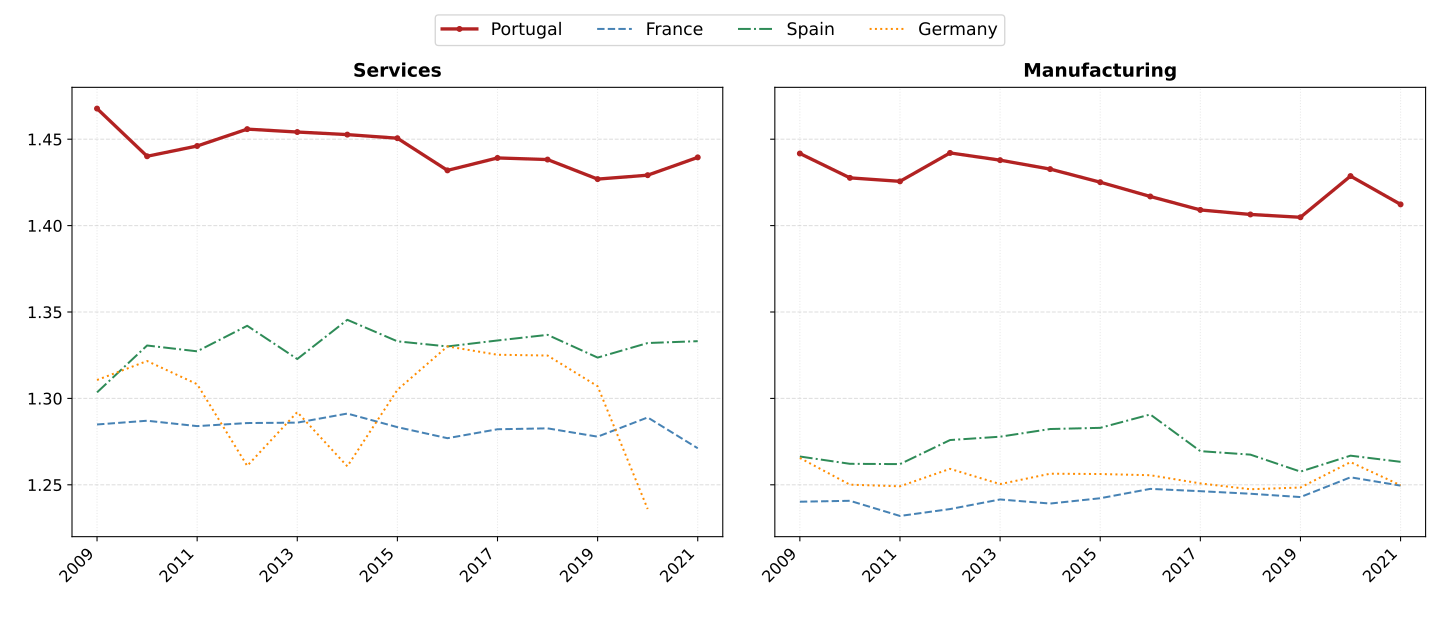
Note: Dispersion of value added-based labour productivity across firms with 20 or more employees, measured as the ratio between the median log labour productivity of firms in the top decile and that of firms in the fifth decile. The manufacturing panel refers to the Manufacturing sector. The services panel is a simple average of seven sub-sectors: Accommodation & food, Administrative & support, Information & communication, Professional & scientific, Real estate, Transportation & storage, and Wholesale & retail trade. For Germany, the services series ends in 2020, and the Accommodation & food sub-sector is missing in 2012–2014 and 2020, so the average for those years is taken over the six remaining sub-sectors.
Source: OECD calculations based on the 10th CompNET vintage (IWH-COMPNET, 2025[19]).
In Portugal, as in many other OECD countries, business dynamism has declined over time which has led to lower contributions of firm entry and exit to aggregate productivity growth (OECD, 2025[20]). Even though new firm entry is still relatively high compared to other OECD countries, young firms in Portugal are less productive and post-entry growth is weaker (OECD, 2025[20]). Evidence published by Portuguese institutions, the OECD, and academia shows that the factors constraining firm entry and growth are multifaceted. While reductions in regulatory barriers and increasing entrepreneurial human capital have supported firm entry rates (Félix and Maggi, 2021[21]; Queiró, 2021[22]), workforce skills, managerial practices and lack of international exposure through foreign trade and investment pose challenges for many firms to scale up (PLANAPP, 2025[17]; Oliveira and Fonte-Santa, 2023[23]; Criscuolo, Gal and Freund, 2024[16]). Following the Portuguese financial crisis, the exit of unproductive firms with poor financial performance – often referred to as zombie firms – contributed strongly to aggregate productivity growth relative to other OECD countries (OECD, 2025[20]; OECD, 2026[11]), with evidence pointing to the crucial role of insolvency and restructuring regimes in shaping firm recovery and exit outcomes (Carreira, Teixeira and Nieto-Carrillo, 2023[24]). However, the contribution of exit to productivity growth has also declined over the last decade, converging towards levels observed in peer countries (OECD, 2025[20]).
Challenges also remain in relation to the reallocation of resources from less to more productive firms. While allocative efficiency explains a relatively high share of aggregate productivity relative to other OECD countries – meaning that more productive firms are also larger in terms of their employment share in the economy – this is mostly due to the size composition of the Portuguese firm population in which many small firms with low productivity struggle to scale up. Allocative efficiency appears weaker when excluding small firms and has stagnated over time (OECD, 2026[11]). Research published by the Portuguese Ministries of Finance and Economy as well as the Bank of Portugal has provided explanations for reallocation challenges. Alves (2017[25]) points to different drivers of aggregate resource misallocation in Portugal, including insufficient market orientation of R&D investment, attraction of labour and skilled workers in non-tradable sectors paying high wages despite low productivity, low competitive pressures and innovation in these sectors, and factors related to business dynamism, including barriers to firm growth and the survival of financially non-viable and overly indebted firms. Further work conducted by the Bank of Portugal also highlights the role of financial channels for both labour and capital allocation, as a large share of outstanding credit is directed to low-productivity firms while credit shocks have affected employment dynamics (Azevedo, Mateus and Pina, 2021[26]; Acabbi and Panetti, 2019[27]).
Overall, the evidence from both international comparisons and country-specific analysis produced by Portuguese institutions suggests that the country’s aggregate productivity performance is constrained by structural firm-level challenges including high within-industry dispersion, weakening business dynamism, and allocative efficiency that is mostly attributed to small firm size. To address these challenges and sustain recent improvements in productivity growth, multi-dimensional policy approaches are required that target drivers of diffusion mechanisms, firm growth, and resource reallocation, including further strengthening competition, improving skills and managerial capabilities, enhancing the efficiency of capital allocation, and further reducing barriers to firm entry, growth, and exit. Given the strong complementarities across these areas, identifying binding bottlenecks and prioritising reforms is analytically complex and requires an integrated perspective. This underscores the importance of identifying complementarities and synergies across policy measures, as highlighted in Chapter 2. It also calls for institutional arrangements capable of integrating evidence across policy domains, produce coherent productivity analysis, assess complementarities and trade‑offs across policy areas, and support evidence‑based policymaking over time, an issue examined in Chapter 3.
References
[27] Acabbi, E. and E. Panetti (2019), “The Financial Channels of Labor Rigidities: Evidence from Portugal”, Bank of Portugal Working Papers, https://www.bportugal.pt/en/paper/financial-channels-labor-rigidities-evidence-portugal.
[25] Alves, R. (2017), “Portugal: a Paradox in Productivity”, GEE Papers, https://www.gee.gov.pt/RePEc/WorkingPapers/GEE_PAPERS_70.pdf.
[26] Azevedo, N., M. Mateus and Á. Pina (2021), “Bank credit allocation and productivity: stylised facts for Portugal”, Studies in Economics and Finance, Vol. 39/4, pp. 644-674, https://doi.org/10.1108/sef-08-2020-0312.
[9] Bank of Portugal (2025), Economic Bulletin March 2025, https://www.bportugal.pt/sites/default/files/documents/2025-04/be_mar25_e.pdf.
[8] Bank of Portugal (2024), Indicadores económicos e financeiros das empresas por região [Economic and financial indicators for companies by region], https://bpstat.bportugal.pt/dominios/178/.
[13] Berlingieri, G. et al. (2020), “Laggard firms, technology diffusion and its structural and policy determinants”, OECD Science, Technology and Industry Policy Papers, No. 86, OECD Publishing, Paris, https://doi.org/10.1787/281bd7a9-en.
[24] Carreira, C., P. Teixeira and E. Nieto-Carrillo (2023), Recovery and exit of zombie firms in Portugal: A remake, Universität St.Gallen, Schweizerisches Institut für Aussenwirtschaft und Angewandte Wirtschaftsforschung (SIAW-HSG), https://ux-tauri.unisg.ch/RePEc/usg/auswrt/AW_73-01__09_Carreira_etal.pdf.
[15] Cincera, M. et al. (2020), “Intangible investments and productivity performance”, GEE Papers, https://www.gee.gov.pt/RePEc/WorkingPapers/GEE_PAPERS_145.pdf.
[16] Criscuolo, C., P. Gal and L. Freund (2024), “Human capital at work: Five facts about the role of skills for firm productivity, growth, and wage inequality”, OECD Productivity Working Papers, No. 36, OECD Publishing, Paris, https://doi.org/10.1787/486c0289-en.
[5] Dlugosch, D. et al. (2025), “Understanding the weakness in business investment: A cross-country analysis”, OECD Economics Department Working Papers, No. 1836, OECD Publishing, Paris, https://doi.org/10.1787/89bd437d-en.
[6] European Commission (2025), Commission Staff Working Document: 2025 Country Report - Portugal, SWD(2025) 222 final, https://economy-finance.ec.europa.eu/document/download/52166ac9-de1e-4009-8921-39eb6f9673fc_en?filename=PT_CR_SWD_2025_222_1_EN_autre_document_travail_service_part1_v3.pdf.
[21] Félix, S. and C. Maggi (2021), “What is the Impact of Increased Business Competition?”, CPP Papers Number 16, https://conselhoprodutividade.com/wp-content/uploads/2021/02/numero-16-what-is-the-impact-of-increased-business-competition-2.pdf.
[19] IWH-COMPNET (2025), The CompNet 10th Vintage Dataset, IWH-COMPNET, https://www.iwh-halle.de/en/compnet/data/10th-vintage.
[3] Kara, A., D. Marques-Ibanez and S. Ongena (2015), “Securitization and Lending Standards: Evidence from the European Wholesale Loan Market”, International Finance Discussion Papers, Vol. 2015.0/1141, pp. 1-33, https://doi.org/10.17016/ifdp.2015.1141.
[4] OECD (2026), Foundations for Growth and Competitiveness 2026, OECD Publishing, Paris, https://doi.org/10.1787/40a7532f-en.
[1] OECD (2026), OECD Economic Surveys: Portugal 2026, OECD Publishing, Paris, https://doi.org/10.1787/025b3445-en.
[11] OECD (2026), “Portugal: Insights on productivity based on microdata”, https://www.oecd.org/content/dam/oecd/en/publications/reports/2026/02/oecd-insights-on-productivity-country-notes_e66278d6/portugal_b70d8b12/dda72c49-en.pdf.
[2] OECD (2025), “FDI stocks”, https://www.oecd.org/en/data/indicators/fdi-stocks.html.
[14] OECD (2025), OECD Compendium of Productivity Indicators 2025, OECD Publishing, Paris, https://doi.org/10.1787/b024d9e1-en.
[20] OECD (2025), “Portugal: Business Dynamics”, https://www.oecd.org/content/dam/oecd/en/publications/reports/2025/06/oecd-insights-on-productivity-and-business-dynamics-country-notes_2e4ed11c/portugal_a6c38b72/a85524e0-en.pdf.
[12] OECD (2025), The Global Forum on Productivity at 10: Past and Future Perspectives on Reviving Productivity Growth, OECD Publishing, Paris, https://doi.org/10.1787/ca7295d9-en.
[7] OECD (2023), OECD Regional Outlook 2023: The Longstanding Geography of Inequalities, OECD Publishing, Paris, https://doi.org/10.1787/92cd40a0-en.
[23] Oliveira, R. and S. Fonte-Santa (2023), “Scale-ups in Portugal: Improving Policy Design by Understanding High-growth in SMEs”, GPEARI Articles, https://www.gpeari.gov.pt/documents/35086/330536/Artigo+01-2023-SCALE-UPS+IN+PORTUGAL.pdf/77342c00-899c-463b-007d-a7a67e5b7cf9?t=1681390949180.
[17] PLANAPP (2025), As empresas no comércio internacional: Análise da produtividade entre 2010 e 2021 em Portugal [Companies in international trade: Analysis of productivity between 2010 and 2021 in Portugal], NIPE-EEG, Universidade do Minho / PLANAPP Study N.13, https://planapp.gov.pt/wp-content/uploads/2025/08/PLANAPP-Estudo-ProdutividadeEmpresas.pdf.
[10] PLANAPP (2025), “Dinâmica da produtividade do trabalho em Portugal Efeito de produtividade setorial vs. alteração da composição setorial [Trends in labour productivity in Portugal: Sectoral productivity effects versus changes in sectoral composition]”, PLANAPP Analysis Notes, Vol. 13, https://www.planapp.gov.pt/wp-content/uploads/2025/08/PLANAPP-DinamicaProdutividadeTrabalhoPT.pdf.
[22] Queiró, F. (2021), “Entrepreneurial Human Capital and Firm Dynamics”, The Review of Economic Studies, Vol. 89/4, pp. 2061-2100, https://doi.org/10.1093/restud/rdab070.
[18] Soares, A. and T. Serrano (2025), “Some stylized facts on multinational firms in Portugal”, Bank of Portugal Working Papers, https://www.bportugal.pt/en/paper/some-stylized-facts-multinational-firms-portugal.