Chapter 3 presents the main strands of strategic public procurement: green public procurement, socially responsible public procurement and innovation procurement. The challenges and current practices of each type of strategic public procurement are discussed based on the survey results, which shed light on the barriers suppliers and public buyers face when practising strategic public procurement in Estonia.
Strategic Public Procurement and Professionalisation Initiatives in Estonia
Diagnostic Report

Abstract
Estonia has collected more experience with GPP compared with other types of strategic public procurement, and contracting authorities appear to have comparatively less concerns from a legal point of view about introducing green criteria in their tenders. About half of contracting authorities surveyed report having carried out GPP at least once. This is aligned with the fact that GPP criteria for four product categories are mandatory. Despite growing experience with GPP criteria, contracting authorities face specific challenges in implementation.
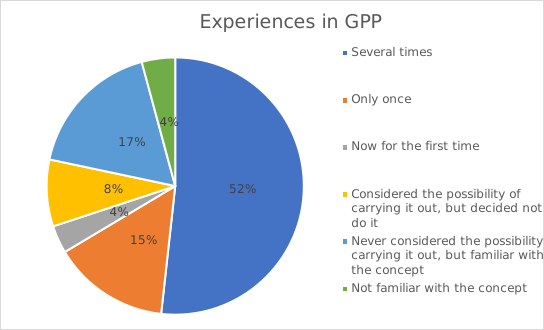
Source: Survey of contracting authorities, OECD (2024)
Namely, the survey of contracting authorities reveals which are the most common challenges that practitioners experience with GPP. The main challenge is the potential (or perception) of increase in acquisition price. Like institutional leaders, practitioners are concerned with potential price increases as a result of GPP. Other concerns are related to lack of adequate capability (i.e. insufficient support in terms of guidelines, tools and training) and limited market readiness by suppliers to participate in GPP tenders.

Source: Survey of contracting authorities, OECD (2024)
As outlined in the assessment of enabling conditions for strategic public procurement, a key obstacle is the fact that state budgets are planned yearly, and therefore do not provide decision-makers with sufficient confidence in making more long-term, investment-based decisions. This appears to be a long-standing budgeting practice in the Estonian context that would require changes that go beyond the sphere of public procurement.
Surveyed practitioners provide additional explanations regarding obstacles to GPP implementation. Namely, some consider that the lack of an organisational strategy including a clear rationale for using green criteria poses a challenge. Procurement officials may not always be in the position to judge the appropriateness of GPP criteria and lack competences to assess environmental impacts. Lack of time is a challenge, as GPP may involve more time to plan a sound procurement process. Some practitioners are also concerned about the increased complexity of contract monitoring if green criteria are included.
It is important to highlight that there may be differences between the type of contracting authorities regarding the implementation of GPP. Smaller, local authorities usually have greater difficulties in implementing GPP, as they may have less personnel dedicated to procurement and have challenges in keeping up with evolving regulations. Even though local authorities do not depend on the tightening state budget, they are also faced with limited resources. Among larger authorities, it is possible to differentiate among those that conduct their own procurement (in full or partially) and those which use the services of the State Shared Service Centre and hence do not conduct any procurement.
3.1.1. Life-cycle costing
Another aspect that is closely linked to green public procurement practices is life-cycle costing (LCC). Life cycle costing consists of assessing all the costs that occur over the life cycle of goods, services or works, including operations, maintenance or disposal costs. Certain methodologies also consider the costs of external environmental effects, such as CO2 emissions. LCC in public procurement can be used either in the planning phase to compare different solutions in terms of cost drivers, or during the evaluation phase as a criterion to select the most cost-effective solution. LCC (even without considering externalities) contributes to sustainability given that it promotes the choice of resource-efficient solutions.
Stakeholders in Estonia consider that it is difficult to implement LCC. Additionally, there is a lack of uniform tools across EU countries that could serve as an example. At the same time, the short-term implementation of budgets is a further constraint to finance goods, services or works that have higher initial acquisition prices but are less costly over their life cycle. However, promoting greater use of LCC not only as part of the evaluation of tenders, but also in the preparatory stage of the procurement can support a shift towards more environmentally friendly products and services. Indeed, green solutions often correlate with lower operating costs during their lifecycle (Rüdenauer et al., 2007[1])).
While introducing LCC in the tender evaluation can be a complex task, which requires to overcome several barriers even if tools are available (OECD, 2022[2])), Estonian authorities could focus on enhancing public buyer’s knowledge about life-cycle costs, and encouraging them to test simple calculation of alternative solutions in the preparatory stages of the procurement. A second step could be to build up dedicated capacity for developing LCC calculations in the construction and infrastructure sector through a network of LCC experts. In Norway, similar initiatives have been implemented (see Box 3.1).
Since 2017, Norwegian law mandates public building owners and developers to assess Life Cycle Costs when conducting a procurement procedure for public works. Contracting authorities have taken various approaches to implement these provisions. Møre and Romsdal county municipality has focused on developing internal capacity through dedicated municipal staff with skills related to LCC to tackle this challenge.
The municipality has a population of 265.000. Its main responsibilities in the public works context include the operation of 22 high schools with about 10.000 students, maintenance of 3200 km of roads, operation of all public transport both on land and by sea, and dental care for the elderly andchildren.
To implement mandatory LCC requirements Møre and Romsdal county municipality hired a dedicated economic advisor with skills in financial and LCC calculations in the building sector. To further increase capacity, the economic advisor benefited from participation in Norway’s LCC Forum. This is a national-led effort to enhance capacity around LCC. Specifically, the forum holds courses and tutorials during the year, and it is a member-based forum where the members participate with their skills to help others. LCC forum has a board consisting of members from both public and private companies from all parts of the building process.
Based on the knowledge gathered through the LCC Forum and its skilled employees, the municipality is equipped to make decisions about works procurement based on LCC calculations and comparing of alternative building designs in the preparatory stages of the procurement. In fact, the LCC Forum has established that a large part of the LCC costs of a building is decided early in the planning process. Between 30-50% of the LCC costs are decided when choosing a plot of land to build on. The reason for this is that the plot of land will affect how high to build, whether it is necessary to build underground or into the landscape. These elements have a strong impact on the construction costs and operation costs. The plot of land will also affect how effective the design of the building is to reduce the square meters needed for corridors, technical rooms etc. A common takeaway is that: “the cheapest square meter to build is the one you do not build”. The remaining 50-70% of LCC are defined after the sketches are finished and 70-80% of LCC is decided before starting the detailing of the building project.
Source: Information provided by Møre and Romsdal county municipality (presentation by Line Thorvik Thule, LCC Closing Conference Budapest, November 2023)
Socially responsible public procurement is considerably less implemented according to the survey of public procurement practitioners with only 14% of respondents having carried it out several times, and 13% only once (Figure 3.3). This data is consistent with findings from discussions with stakeholders and with Estonia’s own monitoring of SRPP. In fact, SRPP can address a number of social objectives and can be integrated in various types of procurements. In addition, specific tools in the legal framework can be used specifically for social goals (e.g. reserved contracts).
As highlighted in the assessment of enabling conditions, Estonia lacks focus regarding the social objectives that can be prioritised through SRPP. Lack of awareness starts with the policymaking, where public procurement has only recently started being considered as a tool to address various social policy challenges. Nevertheless, some contracting authorities have been active in integrating social considerations in their tenders, particularly to ensure that labour standards are applied consistently throughout the supply chain. Specific issues of non-compliance with labour laws have been highlighted by the Labour Inspectorate, particularly in construction and cleaning contracts.
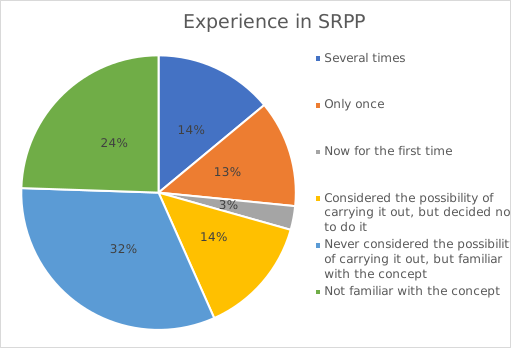
Source: Survey of contracting authorities, OECD (2024)
In the survey, contracting authorities report facing several challenges related to SRPP (see Figure 3.4).

Source: Survey of contracting authorities, OECD (2024)
The greatest challenge is the lack of adequate capability in the form of guidelines, supporting tools and training. As noted in other parts of this report, SRPP is a relatively new policy in Estonia and hence less capacity building has been conducted. At the same time, another major challenge with SRPP concerns the lack of legal clarity. Legal questions may concern several aspects related to SRPP.
Stakeholders have highlighted one specific legal challenge related to SRPP during consultations meetings. Namely, contracting authorities that have been interested in implementing SRPP have faced restrictions regarding data protection. For instance, requesting data from suppliers about certain characteristics of employees (e.g. gender, socio-economic status) to monitor certain SRPP-related interventions would contravene data protection law, as per GDPR requirements. Hence, contracting authorities are unsure about how to implement SRPP without contravening privacy and data protection obligations. In terms of practical experience, the State Shared Service Centre (RTK) has introduced social criteria related to accessibility in approximately 10% of its tenders. The RTK has also attempted to introduce social criteria for services contracts, in particular by providing extra points to bids that include persons with special needs. In this instance, however, questions about the need to collect sensitive data were raised. Beyond this specific challenge, SSSC also experiences lack of awareness about SRPP among its customers. The customers are often reluctant to integrate additional SRPP-related criteria, and the decision is ultimately left to them. The prevailing understanding is that providing extra credit points for social aspects would amount to unfair competition.
Other concrete challenges faced by contracting authorities in the social domain is regarding ensuring compliance with labour rights. Findings from the Labour Inspectorate suggests that issues occur frequently in contracts related to construction or cleaning services. However, even in this area, there are limited instruments for contracting authorities to act if lack of compliance is detected. Indeed, given how contract are structured, contracting authorities do not have the right to end the contract nor to impose sanctions if such problems are detected. The contracting authority only has the right to terminate the contract if criminal offences are detected. Similarly, excluding companies where such problems have been identified in the past is challenging. In some instances, it is necessary for the issue to re-surface before being able to effectively exclude the supplier.
Recently, sample award criteria including criteria related to socially responsible public procurement have been prepared by the Ministry of Finance. Such efforts could be taken forward to help contracting authorities better grasp the concepts of SRPP, by defining social priorities that can be supported by SRPP, as well as compiling social criteria into a catalogue that is easily accessible to contracting authorities.
Practices related to innovation procurement are carried out least frequently in Estonia, as per the results of the survey of contracting authorities. Only 7% of contracting authorities have carried it out several times, and 6% have only once. At the same time, innovation procurement may not be applicable for the majority of standard procurements. Instead, it brings value in situations, where the contracting authority needs to meet a particular need through innovation, either because the solution does not exist yet (in which case it would be most often referred to as R&D procurement such as pre-commercial procurement), or whenever the solution is available on the market but not widespread (referred to as public procurement of innovative solutions or PPI).
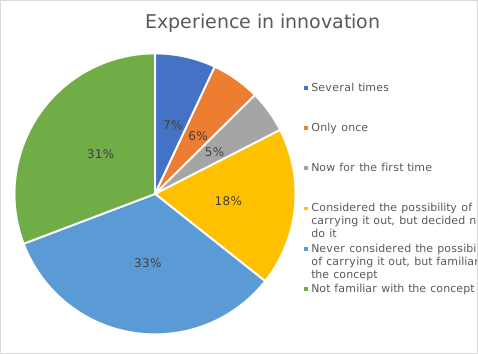
Source: Survey of contracting authorities, OECD (2024)
In terms of challenges, procurement officials report the lack of adequate capability as their main challenge with innovation procurement. This result resonates well with the fact that Estonia does not have a comprehensive training programme on innovation procurement. A second important challenge is the lack of time to prepare the procedure. Stakeholder consultations confirmed the lack of time as a difficulty in implementing innovation procurement. This can be the case when contracting authorities make use of the RTK for their procurements. If the preparation phase is not allotted sufficient time, the RTK may not be in a position to consider the option of innovation procurement, even though it may be the best instrument in particular circumstances. Lack of legal clarity also affects stakeholders. The survey does not provide further details to which legal question emerge regarding innovation procurement, but it is likely that procurement practitioners do not feel confident to use some of the advanced procurement procedures often used in the context of innovation procurement (e.g. competitive dialogue, competitive procedure with negotiation, innovation partnership etc.) (see Figure 3.6).

Source: Survey of contracting authorities, OECD (2024)
While there is a consensus that Estonian contracting authorities do not lack interest for innovation procurement, some barriers may also lie in accessing funding for innovation procurement. Namely, the regular state budget is overall tight and may be difficult to use for innovation procurement purposes given the riskier nature of this type of procurement. Reputational risks are considered high if the state budget is used but no innovation results come out at the end of the procurement process. In the case of EU funds, challenges are perceived to be at the level of audits.
Nonetheless, according to the 2024 European Commission report on benchmarking of national policy frameworks for innovation procurement, Estonia ranks second with a total score of 52,43%, with highlights such as innovation procurement being embedded in the “Estonian Research and Development, Innovation and Entrepreneurship Strategy 2021-2035, several horizontal policies recognising the importance of innovation procurement, spending targets (volume and expenditure) for innovation procurement, and a robust monitoring system. In addition, one of the key highlights of the report concerns financial incentives, which are aimed to tackle the issue of financial constraints. Estonia has indeed set up national financial incentive called InnoFond (Public Sector Innovation Capacity Programme). InnoFond aims to support innovation procurements in which solutions are sought to alleviate the development needs stated in Estonian long-term strategy "Estonia 2035", and which use new knowledge and technologies. The InnoFond encourages public procurers to apply for financial support for innovation procurements and supports the search for innovative solutions, development of solutions and testing in real life. In addition, the Public Sector Innovation Capacity Programme, run by the State Office, provides financial incentives for innovation procurements that are implemented with EU financing (e.g. RRF, ESIF, Horizon Europe, EIB financing).
Estonia has been funding its innovation capacity including through innovation procurement since 2015, when the Ministry of Economic Affairs tasked Enterprise Estonia to implement an about EUR 10 million scheme to support the policy “the public sector as a smart customer”. The scheme was co-financed with EU Structural Funds. The bulk of funding was dedicated to providing co-financing for Estonian procurement officials to conduct procurement of innovation. Co-funding for procurers could reach up to 50%, with 75% going towards to actual solution and the rest funding support activities. A small part of the funding was
In addition to the financial support, contracting authorities can also benefit from the expertise of the Estonian Business and Innovation Agency for innovation procurement. Indeed, since November 2024, the Agency has been appointed as a voluntary centralised purchasing body for public procurement supporting innovation. This new role may tackle capacities issues previously identified for contracting authorities, and increase the uptake of innovation procurement (Government of Estonia, 2024[3]). Beyond the support provided by Estonian Business and Innovation Agency, a pool of innovation procurement experts could be created in order to support innovation procurement processes on an ad-hoc basis.
References
[3] Government of Estonia (2024), Designation of a voluntary central purchasing body in public procurement supporting innovation, https://www.riigiteataja.ee/akt/303122024003 (accessed on 20 January 2025).
[2] OECD (2022), Life-Cycle Costing in Public Procurement in Hungary: Stocktaking of Good Practices, OECD Public Governance Reviews, OECD Publishing, Paris, https://doi.org/10.1787/8d90f627-en.
[1] Rüdenauer, I. et al. (2007), “Costs and Benefits of Green Public Procurement in Europe”, General Recommendations. Freiburg: report on behalf of DG Environment (http://ec. europa. eu/environment/gpp/pdf/eu\_recommendations. pdf, accessed December 1, 2008), Vol. 49/0.