People understand policy issues through values, experiences and narratives that shape how they interpret information. This chapter explores how public communication can support broader and more constructive ways of discussing contested issues. It provides practical guidance on developing frames of reference that move debate beyond simplistic “us versus them” dynamics, make trade-offs easier to understand and connect evidence to people’s lived experiences. It also examines how governments can work transparently with independent and trusted voices to foster more informed, open and constructive democratic debate.
Public Communication Handbook to Bridge Divides and Shape Better Policy
Voices that Resonate

Abstract
Supporting shared frames of reference as entry-points for constructive public debate involves:
Making complex issues easier to discuss without oversimplifying them. Provide enough nuance to reflect different concerns, trade-offs and perspectives, while keeping issues accessible and relatable.
Moving beyond “us versus them” framings. Focus communication on shared challenges, practical consequences and common concerns, while recognising that legitimate disagreement will remain.
Connecting communication to people's values and lived experiences. Ground evidence in real-world experiences and draw on values that resonate across different groups, without requiring agreement on solutions.
Recognising how different groups experience policy issues differently. Make distributional impacts, competing priorities and trade-offs visible rather than treating the public as a homogeneous audience.
Supporting constructive public debate also requires going beyond institutional communication:
Collaborate with independent and credible voices. Public debate is shaped by many actors. Institutions can support broader frames of reference by engaging credibly and transparently with stakeholders, intermediaries and communities, while respecting their independence.
Avoid positioning as the sole “owner” of the shared frames of reference. The value of broader framing lies in providing a common foundation for discussion that is open to interpretation by different actors and not associated only with the government.
Invest in relationships over time. Supporting constructive debate is an ongoing effort that relies on sustained engagement, mutual trust and opportunities for different voices to contribute to public discussion at key moments in the policy cycle.
People make sense of policy issues through frames of reference that help organise facts, experiences, values and assumptions into meaning. On contested issues, narrow or adversarial framings can make disagreement appear irreconcilable by oversimplifying problems, reinforcing “us versus them” dynamics, or presenting trade-offs as zero-sum choices. Broader, shared frames of reference can do the opposite: give different groups a way into the same debate, make legitimate concerns visible and create space for more constructive discussion. This is why it is important that institutions adopt these frames and support their use in public debate.
Societies are characterised by a plurality of views, where moderate majorities and, to some extent, more fringe perspectives coexist. In this context, it is useful to have a common entry point for debate, allowing diverse groups to engage with the same issue and interpret new information from a shared frame of reference. This frame of reference does not require agreement across differences, nor does it need to appeal to everyone.
As noted in the pillar on “Joining up policy and communication”, support for constructive debate is needed at the early stages, before positions harden and decisions are made. At this point, public institutions can use their communication to help ensure that different preferences, concerns and trade-offs are aired, understood and deliberated in constructive rather than adversarial terms. This can improve the conditions for identifying where workable compromises may exist and where policy development may need to adjust.
This role for institutions exists separately and in parallel to political communication, as noted above. Elected officials and political parties will naturally advocate for their own positions, as they should in a democracy. However, the role of public communication by institutions is different: to take actions that help support broader and shared frames of reference in public discourse, as well as to clarify evidence, explain problems and possible solutions to inform public debate without influencing its direction. This is an important distinction as sixty-five percent of senior government communicators surveyed by the OECD in 2025 agree or strongly agree that “the politicisation of public communication is compromising institutions’ work to build trust with citizens” (OECD, 2026[1]).
Supporting shared frames of reference for public debate is necessarily a collaborative, bottom-up effort: framings that enter mainstream discourse need to be repeated and reused by many diverse voices over time. Institutions operating in contexts of low trust therefore need to earn the support of actors who can contribute to broader frames for debate, by engaging with them transparently, responsibly and with full respect for their autonomy.
For shared frames of reference to gain traction in pluralistic societies, they need to be shaped and communicated by a range of voices rather than by government alone. No single actor can credibly speak to all parts of society, especially where trust is uneven. Public debate is more likely to broaden when evidence, concerns and trade-offs are interpreted and expressed by actors that different groups recognise as credible: civil society organisations, community leaders, professional groups, frontline workers, content creators, and some news media. These actors can play an active role in testing and refining how issues are framed upstream and then use these frames to engage with different audiences and contexts in their own words.
Building relationships with diverse external stakeholders requires sustained engagement, openness to different perspectives, and an acceptance that shared frames of reference will evolve as they are taken up by others. Collaboration with other actors should therefore be transparent, voluntary and non-controlling and should not seek to manage public opinion. It should not involve hidden direction, scripted advocacy or the use of third parties as proxies for government positions. When institutions seek to own a given frame of reference or make it closely associated with official messaging, it is no longer a shared one. They risk limiting its reach, particularly among audiences that are not politically aligned with the incumbent government or are sceptical of public authority.
In low‑trust environments, visible government ownership can reinforce distance rather than support engagement. With institutions acting as a convenor and facilitator, by sharing evidence, creating spaces for dialogue and helping others to interpret and communicate in their own words, they can make shared frames of reference more legitimate and broadly grounded, rather than messages imposed from above.
In sum, this chapter does not suggest that governments should create official counter-narratives, seek to manage public opinion, or use third parties as proxies to promote a government position. Rather, it focuses on how public institutions can make use of shared frames of references created with and used by a wide spectrum of voices to support informed, transparent and constructive debate by clarifying evidence, recognising legitimate concerns and explaining trade-offs.
This toolbox illustrates how to:
Broaden the frames of reference on a given issue, so that they are rooted in common values and with enough nuance to support constructive debate.
Work transparently with a broad range of independent and credible voices to shape and support shared frames of reference that enrich public debate.
When adversarial frames come to dominate public debate on a live policy issue (i.e. where policy change is being considered), public communicators can help broaden the range of perspectives available to citizens. They can use their understanding of public opinion, dominant narratives and underlying values to identify broader and more constructive ways of framing a policy problem. The objective is not to resolve disagreement but to help ensure that the way the issue is discussed and understood is not constrained by narrow, irreconcilable interpretations.
By broadening the lens through which an issue is understood, institutions can help different perspectives engage with the same evidence, concerns and trade-offs, while leaving space for legitimate disagreement about the best way forward. In their non-political role as providers of public information and facilitators of public dialogue, public communicators can apply the guidance below to shape their communication and to offer useful frames for stakeholders to weigh in on the issue constructively and help mitigate division.
The approaches below draw on communication research and practice to identify practical ways of broadening the frames of reference through which contested issues are understood and debated.
Balance clarity with complexity: how to make policy issues easier to understand without reducing them to simplistic or adversarial interpretations.
Move beyond "us versus them" framings: how to broaden discussion beyond competing camps by highlighting shared concerns, overlapping identities and common interests.
Connect to values that resonate across differences: how to anchor communication in widely held values and lived experiences so that different groups can engage with the same issue from a shared starting point, while retaining legitimate differences in perspective.
4.1.1. Making complex issues easier to understand without oversimplifying them
The considerations below highlight how communicators, in or outside government, can make complex policy issues accessible and engaging without oversimplifying them, reinforcing elements of division, or triggering defensiveness.
Balance simplicity with nuance
Supporting broader and more widely shared frames of reference requires striking a careful balance between clarity and complexity. Counterintuitively, simplifying issues too much can be just as damaging as overcomplicating them, as it can strip away context, reinforce binaries, and make information easier to distort (Mudde, 2004[2]; Seiger et al., 2025[3]). It can also create a false sense of understanding, discouraging people from recognising what they do not know or reconsidering their views (Fernbach et al., 2013[4]). To provide meaningful entry points into public debate, framings should include enough nuance to reflect the key considerations, trade-offs, and perspectives involved, without becoming overly technical or difficult to engage with.
Anchor communication in lived experience rather than abstract concepts
Information on a policy issue is less likely to resonate when it is overly abstract or disconnected from people's everyday experiences. Translating abstract concepts into concrete realities helps people understand what is at stake and why it matters. This means assuming little prior knowledge, explaining issues in everyday terms, and illustrating evidence through practical examples and relatable experiences. References to familiar situations, tangible consequences, or shared challenges can help make complex policy issues easier to understand and discuss.
Plain language works best, especially when dealing with complex or contested issues. Language that connects policy questions to everyday concerns, such as fairness, security, opportunity or quality of life, is more likely to resonate across different groups. Adding context and concrete references can also help reduce misunderstandings and make both messages and framings more resilient to oversimplification or distortion.
Adversarial framings often gain traction because they tap into frustration with real problems and channel it towards blame. More constructive framings acknowledge these challenges without centring blame. Rather than dwelling on failure, they focus attention on the underlying issue, demonstrate understanding of trade-offs, and identify possible paths forward. This does not mean downplaying problems or avoiding difficult choices. Rather, it means discussing them in ways that recognise people's concerns while helping them engage with realistic options and consequences grounded in lived experience (Climate Outreach, 2025[5]).
Account for how people interpret facts differently
Once people internalise certain narratives or frames of reference, it affects which facts they notice and how they interpret them. People tend to pay attention to information that fits their existing beliefs and values, which means the same facts can support different conclusions (Reuters Institute, 2023[6]; UNESCO, 2023[7]). Recognising this helps explain why simplicity and just providing the facts are not enough. Effective communication accounts for these differences in interpretation and can guide understanding without triggering defensiveness or reinforcing “us versus them” thinking.
Example:
“We need to ensure the security of our communities when managing migration” → deficit framing, emphasises security is a problem
“Well‑managed migration helps our economy grow and keeps our communities safe when people who have the right to be here work, pay taxes, and take part in community life.” → focuses on the desirable outcome of migration in relatable terms
4.1.2. Focusing the debate on shared challenges rather than opposing camps
Public debate on contested policy issues is often shaped by adversarial frames that pit groups against one another. These "us versus them" dynamics can appeal strongly to group identities and offer simple, emotionally compelling explanations for complex issues. At the same time, they can present differing positions as fundamentally incompatible, harden group boundaries, and make constructive debate more difficult.1
In response, communication should focus on what helps people stay in the same conversation: emphasising shared identities, common challenges, and collective aspirations, while acknowledging legitimate concerns without stereotyping. In highly contested settings, the objective may become simply to keep dialogue open and lower tension (Mouffe, 2000[8]). The following approaches can help anchor discussion in shared concerns and goals rather than group conflict.
Framing issues around shared challenges and outcomes
Public debate is more likely to remain open and constructive when communication shows how different priorities connect, rather than treating them as competing choices. Linking concerns that are often portrayed as being in tension, such as environmental protection and economic resilience, or migration and social cohesion, can help people see how progress in one area may support objectives in another. By drawing attention to shared challenges, common interests and potential mutual benefits, this approach can reduce zero-sum thinking and create more space for dialogue, compromise and collective problem-solving.
The table below illustrates practical ways of discussing contested issues that move beyond oppositional “us versus them” framings and instead emphasise shared challenges, mutual recognition and collective outcomes.
Consider distributional impacts and acknowledge trade-offs
Contested policy issues often involve unevenly distributed costs and benefits, which shape how different groups understand a problem and evaluate potential responses (Causa, Hermansen and Ruiz, 2016[10]). Disagreement frequently stems not only from differences in objectives, but also from how trade-offs are experienced across sectors, regions or social groups, and whether these are perceived as fair. Understanding these distributional effects is therefore essential for broadening the frames through which an issue is discussed.
Rather than treating the public as a homogeneous audience, institutions can identify how different groups experience a problem, whether through direct costs, longer-term uncertainty, competing priorities or perceived risks. Bringing these different perspectives into public discussion can help make trade-offs more visible and legitimate concerns easier to recognise. This includes clearly explaining who is affected, acknowledging unequal impacts, and demonstrating how different considerations have been weighed in policy development. Doing so can help shift debate away from simplified or adversarial interpretations towards a more grounded discussion of practical consequences and competing priorities.
Draw on real people's experiences to make issues relatable across differences
Real-life experiences can help people relate abstract issues to their own lives and better understand how they affect others. They can make complex issues more concrete and favour empathy. Effective storytelling draws audiences to identify with other people and situations, dwell on a problem, and overcome preconceptions. In the context of contested issues, these stories can help keep debate anchored in lived realities and shared concerns rather than abstract positions or identity-based divisions. This could include:
Explaining systems, not sides: showing how problems affect (or will affect) everyday life for audiences, rather than singling out groups or assigning blame.
Grounding stories in familiar situations and practical consequences (as per the guidance above).
Showing where solutions can lead. Real-life stories are most constructive when they help people imagine how change could improve conditions over time. Research shows that solution‑oriented framings support engagement more effectively than ones focused mainly on crisis or conflict (Winett and Niederdeppe, 2022[11]).
Avoiding “characters” that map onto social divides. While storytelling often relies on real people, it should avoid figures that audiences easily read as “us” or “them”, which can activate adverse reactions tied to group identity (Yanchenko, 2022[12]).
Using stories to complement evidence. Strong stories support data by connecting it to lived experience. Stories help people process complexity, but credibility depends on being grounded in facts and policy reality.
As highlighted in Section 4.2 on “Engaging independent voices to contribute to constructive debate”, shared frames of reference can be concretised with stories from a wide range of voices across society. Working transparently with intermediaries and stakeholders helps ensure that different groups can contribute their own perspectives and experiences to public debate in their own words. These lenses can acknowledge differences without turning them into fixed oppositions, while highlighting shared values, concerns and challenges. When grounded in context and audience insight, they can create space for engagement even where views diverge.
4.1.3. Connecting to people’s values effectively and constructively
The third element in broadening frames of reference for public debate is recognising is recognising the role of values in shaping how people understand and engage with issues. People interpret policy information through values and emotional drivers as much as through facts. Messages can feel credible or threatening depending on whether they connect to what audiences care about (Metropolitan Group, 2025[13]; Dennison, 2021[14]).
Start from what matters to people, not just the facts
Values‑based communication increases receptiveness by linking policy options to what audiences find morally or socially meaningful (Dennison, 2023[15]; Dennison, 2021[14]). When framings or messages resonate with people’s value frameworks, they can foster trust and recognition. When they do not, they may provoke resistance, even when the evidence is strong. Emotions are central to this process, feelings such as fear, loss, pride or belonging shape how people engage with contested policy issues through their own experience (Green and Brock, 2000[16]).
In highly contested contexts, widen the “shared starting point”
Values-based communication can also be useful in highly contested contexts. While polarising content can heighten identity-protective reasoning, focusing on widely held values, such as dignity, fairness, security or family wellbeing, can provide common reference points that can resonate across opposing viewpoints and provide an entry-point for framing problems and solutions (Metropolitan Group, 2025[13]).
Use multiple values to broaden engagement without requiring agreement
Because publics hold different and often overlapping value priorities, frames of reference are broader and more robust when they connect to multiple values rather than relying on a single moral appeal. Practical work by the Metropolitan Group (2025[13]) and Climate Outreach (2025[5]) suggests that anchoring framings and messages in values such as responsibility, stability, cohesion or fairness can broaden engagement (see Figure 4.1 for additional common values). This helps people with different starting points recognise concerns that matter to them, without requiring agreement on solutions.
Apply audience segmentation by values and attitudes to identify what brings different people into the same debate
To put these insights into practice, communicators increasingly use value‑based segmentation, clustering audiences by beliefs and motivations rather than demographics (see previous section) (Badullovich, 2022[17]; Seiger et al., 2025[3]). These insights can help identify which values are most salient for different audiences and inform communication that creates broader entry points into public debate, especially for those segments that are more likely drawn to adversarial frames.
The following figure presents nine broad value categories that recur across research and practice. Understanding which of these values are most relevant to a particular policy issue, and which resonate with different audiences, can help communicators frame issues in ways that are meaningful and accessible to a wider range of people.
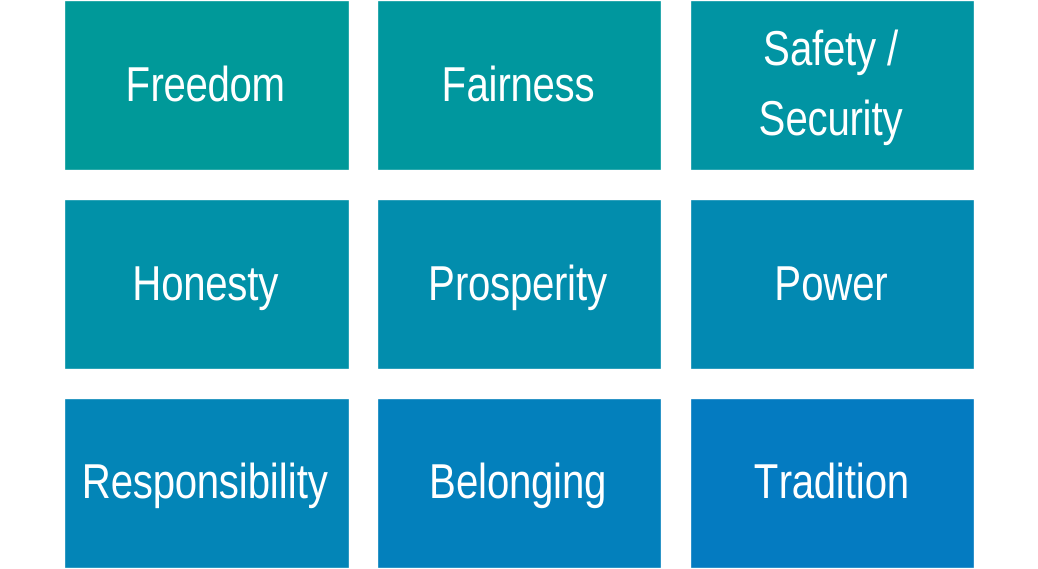
Source: Author’s work based on (Metropolitan Group, 2025[13]; Scharfbillig et al., 2021[18]).
1. Who are the broader framings meant for?
The framing on the policy issue is grounded in evidence about how different groups understand the issue, including their values, concerns, lived experiences and motivations.
It doesn’t assume that audiences share the institution’s knowledge or framing of the problem.
It is tested with relevant audiences, including groups that may be sceptical, less visible or harder to reach.
2. Is the framing for debate constructive?
The frame of reference highlights shared or cross-cutting goals and avoids presenting the problem as a conflict. It focuses on strengths, opportunities and constructive solutions, rather than only on flaws or risks.
The frame offers a positive and credible vision of the future that different groups can recognise themselves in. It leaves room for people to express concerns, weigh trade-offs and see how their perspectives could shape decisions.
The framing treats disagreement as legitimate and avoid moral superiority, blame or dismissive language.
The frame portrays opposing views or groups constructively, using face-saving approaches that keep dialogue open.
3. Does the broader frame of reference make complexity understandable?
The framing introduces enough complexity to challenge simplistic or adversarial framings, while keeping the communication accessible.
It provides context so people can understand how issues connect, why trade-offs exist.
It pairs numbers and evidence with real-life accounts, so they are relatable rather than abstract.
4. Is the language accessible and respectful?
The language is plain, relatable and free of jargon, loaded words.
The framing avoids labels, stereotypes and subtle forms of othering.
The tone invites reflection through empathy, respect and curiosity, and avoids triggering defensiveness.
4.1.4. From concept to implementation: test, learn and adapt
The guidance above helps institutions design their communication to support constructive debate on live policy questions without advancing specific solutions. The same principles can also be adapted to the context of communicating policy decisions on contested issues once they are adopted and being implemented, so to favour greater understanding, compliance and explain the implications for citizens.
Regardless of the stage of the policy process, communicators must test and refine how they apply shared frames of reference to their communication. Understanding how different audiences interpret and respond to initial frames and messages can help ensure they support the goals of broadening engagement, supporting understanding of trade-offs, and fostering more constructive debate.
A range of methods can reveal whether the broader framing and supporting messages resonate broadly, risk unintended reactions, or need refinement. Pre‑testing helps identify where it can potentially backfire, which is especially important for sensitive or contested topics. Testing can include the following methods (see Section 3.2 on “Understanding framings, narratives and their evolution” for relevant methods to apply here):
Direct stakeholder testing and co-creation: narrative workshops that allow relevant groups’ representatives to co‑create and refine shared language and storylines.
Surveys: assess agreement, relevance, and likelihood to share.
Informant interviews or focus groups: surface contextual insights not visible through quantitative data alone.
Refinement and experimental methods: include A/B testing to compare framing variants, and testing different framing and message components to understand what people engage with and what they dismiss.
Together, these methods help ensure that a framing is understandable, credible and robust across different audiences and contexts.
Public debate on contested issues is shaped by many voices beyond government, such as journalists, commentators, civil society organisations, community leaders, frontline professionals and content creators. Their experience, credibility and relationship with the public is essential to help broaden how issues are understood and discussed, rather than reinforce framings that deepen division.
As part of supporting shared frames of reference for constructive debate, public institutions should look beyond their own channels. They can work transparently and collaboratively with independent actors to help them bring different perspectives to how they themselves communicate on the issues. Institutions can share evidence and context, facilitate access to expertise and create opportunities for dialogue. Such collaboration should involve actors with different viewpoints, including those who may challenge government positions.
This approach can help independent actors engage with contested issues in ways that foster informed and constructive exchange rather than reinforcing adversarial or polarising frames. Institutions may draw on the same broader frames of reference in their own public communication, while respecting the distinction between impartial public communication and political advocacy.
Collaboration should take place on an equal footing, respectfully of other actors’ autonomy and the authenticity that makes them connect with their audiences. Rather than asking independent actors to adopt or amplify institutional messages, public communicators can bring them into the process of identifying shared frames of reference that these actors can also support.
Co-operation between institutions and third parties in the context of supporting constructive debate should never involve hidden direction, scripted advocacy or the use of third parties as proxies for government positions. Whatever the depth and extent of the collaboration, independent actors should remain free to interpret the issue, raise concerns and communicate in their own words.
Transparency and mutual respect are essential to ensuring that broader frames of reference remain genuinely shared and reliable for different perspectives, rather than being tarnished as biased or politicised.
4.2.1. How to collaborate responsibly and effectively with diverse voices
The approaches described in this section rely on different forms of partnership, ranging from light-touch relationship management to more structured collaboration. In practice, what matters is for institutions to establish reliable channels with key independent voices to share context, evidence and perspectives, and to create opportunities for shared frames of reference on a contested policy issue to be interpreted, discussed and communicated by different actors in ways that fit their audiences.
Such engagement is already commonplace as government communication teams routinely brief and consult with media and other stakeholders. In the context of supporting broader frames of reference for public debate, these relationships should be transparent and proportionate, with clear safeguards to preserve partners' independence and avoid any perception that government is seeking to direct or constrain their voice.
The following elements set out which actors to consider engaging, how to select partners proportionately to the risks at stake, and how to sustain these relationships without undermining independence or authenticity.
Who to involve: Types of independent voices to consider
Collaboration should reflect the fact that different groups in society trust different voices, access information through different channels, and engage with issues from different perspectives. Public institutions can consider engaging independent actors who can help bring additional lived experience and perspectives into public debate that mirror those found across society, for example:
News media and journalists with different political leanings, including outlets that reach audiences who are sceptical of official messaging (see Box 4.1 for an example in New Zealand).
Content creators and influencers (vloggers, podcasters, social media personalities), who can discuss issues in formats and language that resonate in digital and algorithm-driven environments. (see Box 4.1 for new approaches in the United Kingdom)
Civil society organisations and community leaders, who can bring local perspectives, concerns and experiences into public debate.
Frontline public servants (nurses, police, teachers, etc.) who are in direct contact with citizens and service users and can contribute practical insights from their experience.
Businesses, associations and other societal actors, who can contribute sectoral perspectives and help connect policy issues to everyday realities (see Box 4.1 for the model adopted in France).
While it is desirable for elected officials to adopt broader and more constructive frames in their own communication about a contested issue, they are often not the most appropriate actors for this type of collaboration (Baugh, 2026[19]). They are commonly associated with particular political camps and may not command broad public trust.
How to choose who to collaborate with: Considerations on risks, ethics and criteria
Independent actors should be selected based on the contribution they can make to constructive debate, particularly their ability to bring relevant expertise, lived experience, perspectives or connect audiences that may not otherwise engage with institutional communication. This includes especially actors who are influential with audiences exposed to adversarial framings, provided they are willing to participate transparently and in good faith.
Choosing which actors to collaborate with requires due diligence as well as transparency. Selection should weigh prospective value to public debate against reputational, operational and ethical risks, and set proportionate safeguards from the outset (Zerfass et al., 2024[20]). The French Government Information Service, for example, has developed a charter to govern its partnerships activities that corresponds to a low-risk approach (Box 4.1).
Working with independent actors inevitably entails that any actor can be critical of government and also contribute constructively to public debate on policy. The greater risk may come from engaging only with those voices that won’t challenge institutions, thereby leaving large information spaces to be shaped by unreliable or adversarial frames that stymie debate.
Collaborations may be more or less informal and voluntary (i.e. unpaid, as in this context payment would compromise the independence of the partner). Independent actors should have their own reasons for engaging, whether because the issue relates to their mission, expertise, community, advocacy priorities or audience interests. Participation should never depend on an expectation of endorsement, amplification or alignment with government positions. For many, there should be a clear stake in being part of shaping policy.
In practice, governments should define the ethical parameters for collaboration from the outset, including the public interest purpose of the initiative, the neutrality of messaging, and alignment with relevant public goals. These safeguards can help collaboration scale reach and credibility while reducing risks of politicisation, influence or perceptions that government is seeking to control independent voices.
With these considerations in mind, communicators can conduct a mapping exercise to identify relevant voices and intermediaries connected to the contested policy issue at hand, drawing on similar methods to those described in Section 3.2 on “Understanding framings, narratives and their evolution”. Once a list of potential partners has been identified, the following criteria can help guide engagement:
Audience reach: the actor should genuinely connect with audiences that may not engage with official channels, rather than simply having a large following. Taken together, the mix of partners should reflect different communities, experiences and perspectives across the issue.
Credibility and values alignment: the collaboration should be compatible with clearly defined public-interest objectives and able to withstand public scrutiny. Consider the partner’s track record, incentives, and willingness to engage responsibly, avoid misinformation, and contribute to constructive debate.
Authentic voice and relevance: the issue should be one on which the partner has a credible connection, interest or track record of engagement. They should be able to discuss it in ways that are authentic to their audiences and consistent with their usual voice and format.
How to build and sustain relationships with independent actors
Relationship-building should be considered an integral part of a collaborative and horizontal effort to support more constructive public debate from the very start. Independent voices are more likely to collaborate and to stay engaged when they are brought into discussions early and when engagement is designed around mutual value and respect. Good practice for building and sustaining relationships includes:
Start early (upstream): involve prospective partners while the narrative is still being developed and tested, so they can shape language, framings, and guardrails. A sense of joint ownership can go a long way towards building strong relationships.
Co-create, don’t just brief: use workshops/sounding boards to test what lands, identify unintended interpretations, and agree a shared entry point that different viewpoints can use.
Agree roles and boundaries: negotiate clear roles (e.g. who convenes, who tests, who communicates) and align expectations about what will and will not be asked of partners; set eventual “red lines” upfront (e.g. on accuracy, confidentiality, or disclosure).
Make mutual benefit explicit: define what partners can gain and offer support and access (e.g. timely briefings; access to subject‑matter experts; opportunities to put questions to decision makers; clear, up‑to‑date evidence and explainer materials; and advance notice of policy milestones).
Protect authenticity: focus on shared outcomes and offer facts, but refrain from trying to script or control what partners say. The value of the collaboration rests in providing a shared entry-point that partners can make their own, using their own voice, formats and community reference points.
Sustain participation: maintain a cadence of check-ins, shared learning on what resonates, updates on policymaking, so engagement continues beyond a single moment. Use predictable “hooks” to mobilise partners, such as policy milestones, high‑attention moments, or local events where trusted intermediaries can amplify the narrative.
Start early (upstream): involve prospective partners early in discussions about the issue and analysis of the barriers to debate, so they can help identify concerns, test language and framings, and surface potential risks or blind spots. Early engagement can help build trust and mutual understanding.
Co-create, don’t just brief: use workshops, roundtables or sounding boards to test what resonates, identify unintended interpretations, and explore ways different perspectives can engage constructively with the issue.
Agree boundaries: establish clear expectations about accuracy, confidentiality, disclosure and independence.
Make mutual value explicit: clarify what partners may gain from participating, such as access to timely information, subject-matter expertise, opportunities to raise questions with decision makers, clear evidence and explanatory materials, or advance notice of policy developments.
Protect independence and authenticity: provide evidence, context and opportunities for engagement, but avoid directing, scripting or attempting to control how partners discuss an issue. The value of engagement rests in allowing different actors to contribute perspectives in ways that are credible to their own audiences.
Sustain engagement over time: maintain regular opportunities for exchange, learning and feedback. Sharing updates, lessons learned and emerging evidence can help relationships extend beyond a single policy moment. Engagement may be particularly valuable around major policy milestones, periods of heightened public attention, or events where independent actors are already facilitating discussion.
Partnerships team and charter in France
France’s Government Information Service uses an intermediated communication model that leverages trusted actors to deliver public‑interest messages rather than relying solely on government‑to‑citizen channels. Having formalised its Partnership with the State programme with an official charter in 2025, the government works with businesses, associations, professional federations, media outlets, and civil‑society organisations that relay messages and adapt them into formats suited to their audiences.
This approach expands reach, boosts credibility through co‑signing with recognised organisations, and reduces public expenditure on paid amplification since participation is voluntary on a pro-bono basis. It also encourages creativity and community ownership, as partners reshape messages in ways that feel familiar and relevant to their networks. Over 230 partners were mobilised during the COVID-19 pandemic and many more have been brought on board since this experience, making intermediated communication a core tool of French public outreach and enabling wider reach of audiences at both national and local levels.
The charter sets out four core principles: a public‑interest purpose, neutrality of messaging, alignment with social and sustainability standards, and systematic monitoring and evaluation. Its strength lies in providing legal parameters and ethical safeguards while enabling broad participation, helping scale reach and credibility without financial transactions or risks of politicisation.
Relationship-building between the Government of New Zealand and the media on security
New Zealand’s Department of Prime Minister and Cabinet (DPMC) has established both formal protocols and ongoing working relationships with senior newsroom leaders to support clear communication on national security issues. Engagement with the Media Freedom Committee (MFC), a forum bringing together leaders from major news organisations, provides a recognised channel for dialogue between government agencies and the media on issues affecting information access and reporting.
A key foundation of the approach is the Terrorist and National Security Event Media Protocols, which set out shared expectations during terrorism-related or national security events. They emphasise a dual imperative: authorities can minimise risks to life and property while informing the public to the maximum extent possible, and media organisations can act responsibly and co-operatively during the event. Having these expectations agreed in advance provides clarity under pressure and supports rapid, consistent communication when public safety is at stake.
The relationship is maintained outside of crises through regular (e.g. bi-yearly) briefings where relevant agencies share background context on a “not for reporting” basis. These sessions help build mutual understanding of processes, constraints and terminology before an incident occurs, and reduce the risk of misunderstanding when time is limited and information is evolving.
In urgent situations, this established channel can be used to rapidly share updates or request time-limited sensitivity around details that could increase risk if published immediately (for example, during cyber incidents involving sensitive personal data). This enables co-ordination without seeking to direct editorial decisions and supports a shared focus on harm minimisation while maintaining timely public information. This approach complements formal access regimes (including Official Information Act processes). Where releases require redactions or limited scope, providing additional context through established channels can reduce misinterpretation while respecting legal constraints.
The UK Government Communications’ New Media Unit for citizen-centred communication
The United Kingdom’s Government Communications established the New Media Unit (NMU) to respond to challenges in the current information environment, where some citizens engage less with traditional government communication channels. These channels are sometimes seen as distant or less connected to everyday experiences. The NMU aims to address this by adapting how government listens to, understands, and communicates with the public.
Its approach shifts from a top-down model to an audience-first framework, using citizen insights to shape communication. It also places emphasis on who delivers messages, prioritising individuals with relevant lived experience, such as service users, healthcare workers, teachers, and community representatives, rather than relying primarily on institutional or political voices.
The NMU also collaborates with digital content creators who are familiar with online platforms and have established relationships with their audiences. These creators contribute to presenting information in formats that align with how people consume content in digital spaces.
By combining locally relevant storytelling with a broader range of messengers, the NMU aims to reach audiences that may be less engaged with traditional communications. Early evaluations indicate higher engagement and improved understanding compared to more conventional approaches.
Sources: Case study provided by the Government Information Service to the OECD Secretariat, 2025; Interview with the New Zealand’s Department of Prime Minister and Cabinet, 2026; Case study provided by UK Government Communication to the OECD Secretariat, 2026.
4.2.2. Sustaining the conversation over time: planning, measuring, and revising
Supporting shared frames of reference on a contested issue is a long-term endeavour. It can take years for these frames to permeate in public debate and they will need to be reinforced over time against other dominant frames that can narrow debate and fuel division. To do so, institutions must plan for both long-term and short-term goals:
Focus on foreseeable salient moments, such as key announcements, new initiatives, and events, as hooks to plan main efforts around. Different stages of the policy cycle call for a different roles and approach to communicating on a policy issue (see first toolbox).
Invest in supporting shared frames and communicating during “normal times”, especially with targeted communities, at the local level, with audiences that are less focused on the news cycle.
Prepare for different adverse scenarios that can affect public debate or distort it (e.g. crises or information manipulation).
Apply shared frames of reference on the contested policy issue in public communications:
Use the frames to communicate messages and information about the policy problem via institutional channels. Ensure cross- and local government alignment.
Assess if and when use of the shared frames at the political level would help or hinder success (e.g. if risk of distancing independent partners)
Pre-bunk and debunk false claims.
Measure if shared frames are permeating into the debate and supporting constructive engagement across differences. Revise your approach based on learnings.
Dos
Work with a diverse range of independent voices, perspectives and communities, including those beyond your institution's usual networks.
Listen to intermediaries' views, concerns and experiences, and involve them in identifying shared frames of reference that can support constructive debate.
Support independent actors in contributing their own perspectives, expertise and lived experience in ways that are authentic to their audiences.
Aim for representation of different experiences and viewpoints and engage both grassroots and established actors.
Be transparent about the nature, purpose and boundaries of any collaboration.
Protect the independence and autonomy of participating actors, including their ability to disagree with government positions.
Don’ts
Don't seek agreement or consensus; constructive public debate often requires acknowledging disagreements and trade-offs.
Don't treat collaboration as a tool for persuasion, advocacy or mobilisation behind a government position.
Don't think in terms of one-off transactions; invest in relationships and ongoing dialogue.
Don't use third parties as proxies for official positions, or attempt to script, direct or control what independent actors say.
Don't think of partners as an extension of institutional channels.
Don't claim ownership of broader frames of reference or expect independent actors to endorse them; their value lies in allowing different voices to engage with the issue in their own terms.
References
[17] Badullovich, N. (2022), “From influencing to engagement: a framing model for climate communication in polarised settings”, Environmental Politics, Vol. 32/2, pp. 207-226, https://doi.org/10.1080/09644016.2022.2052648.
[19] Baugh, S. (2026), Winning Strategies, Pt 2: Borrow Trust, https://simonbaugh.substack.com/p/winning-strategies-pt-2-borrow-trust.
[10] Causa, O., M. Hermansen and N. Ruiz (2016), “The Distributional Impact of Structural Reforms”, OECD Economics Department Working Papers, No. 1342, OECD Publishing, Paris, https://doi.org/10.1787/5jln041nkpwc-en.
[5] Climate Outreach (2025), BTC 2025 Communications 2025 Communications Toolkit: Quick‑Start Guide – How to Talk About Different Issues, Including Net Zero and Climate Adaptation, Climate Outreach, https://climateoutreach.org/btc/2025/toolkit/.
[15] Dennison, J. (2023), “Emotions: functions and significance for attitudes, behaviour, and communication”, Migration Studies, Vol. 12/1, pp. 1-20, https://doi.org/10.1093/migration/mnad018.
[14] Dennison, J. (2021), “Narratives: A review of concepts, determinants, effects, and uses in migration research”, Comparative Migration Studies, Vol. 9/1, https://doi.org/10.1186/s40878-021-00259-9.
[9] Doornbosch, L., M. van Vuuren and M. de Jong (2024), “Moving beyond us-versus-them polarization towards constructive conversations”, Democratization, Vol. 32/1, pp. 96-122, https://doi.org/10.1080/13510347.2024.2401127.
[4] Fernbach, P. et al. (2013), “Political extremism is supported by an illusion of understanding.”, Psychological Science, Vol. 24/6, pp. 939–946.
[16] Green, M. and T. Brock (2000), “The role of transportation in the persuasiveness of public narratives.”, Journal of Personality and Social Psychology, Vol. 79/5, pp. 701-721, https://doi.org/10.1037/0022-3514.79.5.701.
[13] Metropolitan Group (2025), Mapping the Global Democracy Narrative Landscape: Research Findings and Applications, https://www.metgroup.com/wp-content/uploads/2025/06/JUNE-2025-Mapping-the-Global-Democracy-Narrative-Landscape-DECK-Metropolitan-Group.pdf.
[8] Mouffe, C. (2000), The Democratic Paradox, Verso, London, https://monoskop.org/images/4/41/Mouffe_Chantal_The_Democratic_Paradox_2000.pdf.
[2] Mudde, C. (2004), “The Populist Zeitgeist”, Government and Opposition, Vol. 39/4, pp. 541-563, https://doi.org/10.1111/j.1477-7053.2004.00135.x.
[1] OECD (2026), Reforming Government Communication for the Age of Algorithms, OECD Public Governance Reviews, OECD Publishing, Paris, https://doi.org/10.1787/adef6a50-en.
[6] Reuters Institute (2023), Digital News Report 2023, https://www.digitalnewsreport.org/survey/2023/.
[18] Scharfbillig, M. et al. (2021), Values & Identities - a policymaker’s guide, Office of the European Union, Luxembourg, https://knowledge4policy.ec.europa.eu/projects-activities/values-identities-policymakers-guide_en.
[3] Seiger, F. et al. (2025), Navigating migration narratives - Research insights and strategies for effective communication, Publications Office of the European Union, https://doi.org/10.2760/7999210.
[21] Tajfel, H. et al. (1971), “Social categorization and intergroup behaviour”, European Journal of Social Psychology, Vol. 1/2, pp. 149–178.
[7] UNESCO (2023), Guidelines for the governance of digital platforms: safeguarding freedom of expression and access to information through a multi-stakeholder approach, https://unesdoc.unesco.org/ark:/48223/pf0000387339.
[11] Winett, L. and J. Niederdeppe (2022), Storytelling for Social Change: A Message Brief, https://evidenceforaction.org/sites/default/files/2022-01/Messaging-Brief-Jan22.pdf.
[12] Yanchenko, K. (2022), “Stories about “Us” and “Them”: An Experimental Inquiry into the Relative Appeal of Populist Narratives”, International Journal of Public Opinion Research, Vol. 34/1, https://doi.org/10.1093/ijpor/edac004.
[20] Zerfass, A. et al. (2024), “Ethical Challenges of Digital Communication: A Comparative Study of Public Relations Practitioners in 52 Countries”, International Journal of Communication, Vol. 18, pp. 1-23, https://ijoc.org/index.php/ijoc/article/view/20636.
← 1. To address these dynamics, it is first important to understand why “us versus them” frames are so appealing and persistent in public debate. Groups form easily; even arbitrary distinctions can produce in‑group bias and out‑group hostility (Tajfel et al., 1971[21]). Adversarial narratives often portray opposing views, and those who hold them, as immoral or harmful, exaggerating or distorting what “the other side” actually believes (Doornbosch, van Vuuren and de Jong, 2024[9]). These effects are stronger when messages invoke crisis, threat, or grievance, because anger and anxiety can reduce critical engagement and increase susceptibility to persuasive or manipulative tactics (Seiger et al., 2025[3]). This mindset can also trigger “motivated reasoning”, the dynamic whereby people seek information that confirms prior beliefs (Seiger et al., 2025[3]; Metropolitan Group, 2025[13]).