In addition to promoting the MNE Guidelines and handling specific instances, NCPs around the world increasingly take action to promote policy coherence for RBC by building linkages with relevant policy communities. Over recent years, they have notably engaged with trade and investment officials to raise awareness and capacity, inform policy design, and overall support alignment and harmonisation. MENA+T Programme NCPs contribute to this trend. Building on their institutional arrangements, they have started playing a role in the promotion of policy coherence, seeking to integrate RBC considerations in trade and investment policymaking and negotiations. Some challenges, however, impede countries in the MENA+T region to fully leverage trade and investment policies and agreements to encourage RBC.
Promoting Responsible Business Conduct through Trade and Investment in the Middle East, North Africa and Türkiye

Abstract
NCPs have two main responsibilities: (i) promoting the awareness and uptake of the MNE Guidelines and (ii) contributing to the resolution of issues arising in relation to their implementation in their capacity as non-judicial grievance mechanisms. In addition, NCPs may also provide support to efforts by their governments to develop, implement and foster coherence of policies to promote RBC. In light of the increasing number of policy measures relevant to RBC, NCPs have a key role to play to enhance alignment and harmonisation. As experts in the field with in-depth knowledge of the MNE Guidelines and the related Due Diligence Guidance, they can train and build the capacity of public officials on the various aspects of RBC, the different OECD RBC instruments, and the relevance of integrating RBC considerations in their work areas. Most importantly, they can act as counsellor to the different ministries and government entities seeking to mainstream RBC in their respective laws, regulations, policies, and initiatives, and provide advice on their design, revision, and/or implementation.
Following the 2023 update of the MNE Guidelines, the Implementation Procedures acknowledge the role that NCPs may play with respect to policy coherence, taking into account their capacities and priorities.1 The OECD Recommendation on the Role of Government in Promoting RBC [OECD/LEGAL/0486] also contains several guiding principles on this role. On a general note, it recommends that governments periodically assess the adequacy of their NCPs’ institutional arrangements and the human and financial resources available to them, with a view to enabling them to play an important role in promoting policy coherence for RBC [OECD/LEGAL/0486, para. II(3)]. More specifically, it recommends that governments support NCPs in fostering policy coherence, notably by informing government entities of their statements and reports related to specific instances relevant to their policies and programmes [OECD/LEGAL/0486].2 In the same vein, it also encourages governments to take into account the good faith engagement of companies in the context of NCP specific instances when reviewing eligibility for government support and services, such as trade advocacy, economic diplomacy, or other benefits [OECD/LEGAL/0486, para. III(5)].
Over recent years, a growing number of NCPs have taken action to promote policy coherence for RBC at a general level. For instance, various NCPs have assisted their governments in the development of domestic legislation relevant for RBC or participated in the work related to the development of such legislation at the regional level. Some NCPs have also contributed to the formulation and the implementation of National Action Plans on Business and Human Rights or RBC (NAPs) (OECD, 2023, p. 17[101]; 2019, pp. 25-26[102]; 2023, pp. 46-47[103]). In 2024, 35% of NCPs (i.e. 18 out of 52) reported that their countries had adopted (4) or were developing (14) NAPs and in 78% of the countries in which a NAP was in place or under development the NCPs had been involved (OECD, 2024, p. 2[104]; OECD, 2025[105]). The NCPs’ role in informing government policies on RBC was recognised by ministers and representatives from 50 adherent countries, and the European Union, in the Declaration on Promoting and Enabling Responsible Business Conduct in the Global Economy [OECD/LEGAL/0489] adopted at the 2023 OECD Ministerial Meeting on RBC.
These actions in favour of policy coherence for RBC are often facilitated by NCPs’ institutional arrangements. A number of NCPs across the global network are set up as inter-governmental platforms comprised of representatives from various ministries and government entities. This promotes collaboration and synergies between different entities with competences relevant to RBC. In 2025, nearly half (25 out of 52) of the NCPs reported being established either as an inter-agency NCP or a multipartite NCP involving different government entities.3 More generally, 81% of NCPs included more than one government entity in their structure in 2025 (OECD, 2026 (forthcoming)[106]).
Furthermore, NCPs are engaging more and more with specific policy communities and government entities with a view to mainstreaming RBC in policy areas that can influence business conduct. In 2025, 75% of NCPs (i.e. 39 out of 52) reported following and/or providing input, or being consulted, on policy and regulatory developments relevant to promote RBC.4 Trade and investment are among these relevant areas, with NCPs gradually taking action to engage with trade and investment officials. Since 2023, a significant percentage of NCPs has reported having promoted the MNE Guidelines with their trade and investment promotion agencies. Around half of NCPs has also indicated having informed trade and investment officials of their relevant statements and reports, and approximately a fourth of them of companies’ engagement in specific instances (see Figure 5.1).
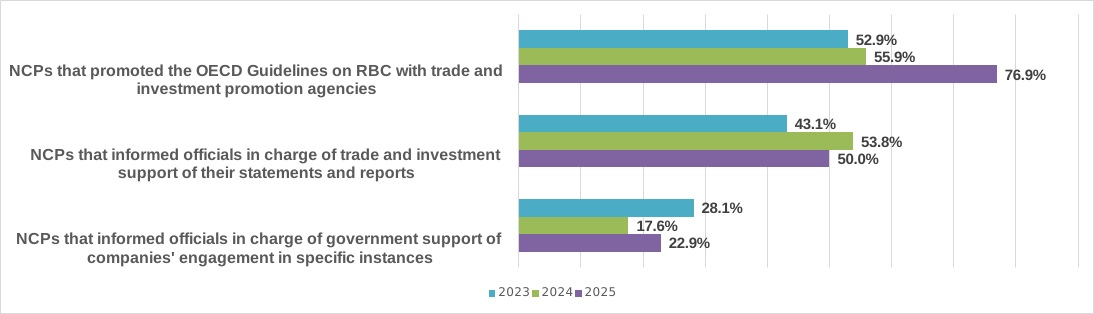
Note: NCPs that informed officials in charge of government support of companies’ engagement in specific instances excludes NCPs that have not yet received a specific instance (i.e. 19 out of 51 NCPs had not received a specific instance by 2023 and are excluded, 18/52 in 2024, and 15/52 in 2025).
Source: Based on the answers by 51 NCPs to the 2023 NCP Annual Questionnaire and by 52 NCPs to the 2024 and 2025 NCP Annual Questionnaires.
Beyond information sharing and awareness raising, NCPs across the world also increasingly seek to build coherence between trade and investment and RBC by building lasting linkages with trade and investment officials, developing co‑ordination activities, or participating in trade and investment policymaking or negotiations (see Figure 5.2).
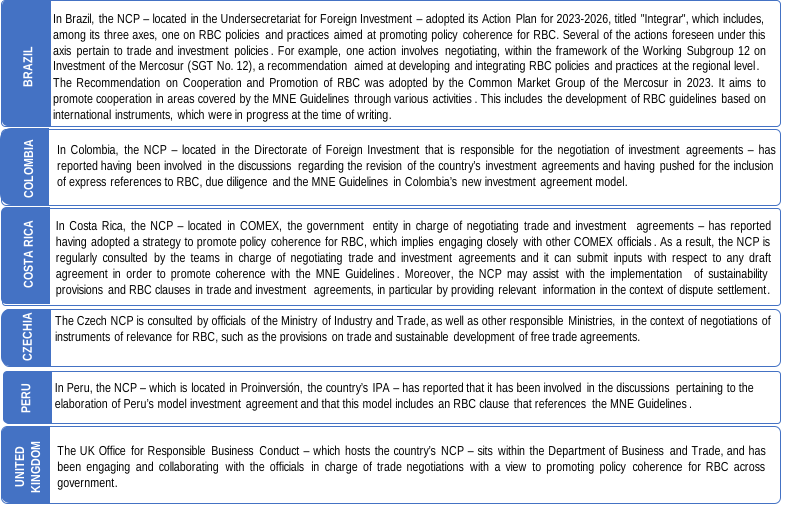
Sources: OECD (2024[8]), Promoting responsible business conduct in trade and investment: Latin America and the Caribbean, OECD Business and Finance Policy Papers, p. 34, No. 61, Paris, https://doi.org/10.1787/672fbe56-en; (2019[107]), Annual Report on the OECD Guidelines for Multinational Enterprises 2018, https://www.oecd.org/content/dam/oecd/en/networks/national-contact-points/2018-Annual-Report-MNE-Guidelines-EN.pdf; (2023[108]), OECD Guidelines for Multinational Enterprises National Contact Point Peer Reviews: Czechia, https://doi.org/10.1787/3f1c6f2e-en; Government of the United Kingdom (2019[109]), 2019 Annual Report on the United Kingdom’s National Contact Point for the OECD Guidelines for Multinational Enterprises, https://www.gov.uk/government/publications/united-kingdoms-national-contact-point-2019-annual-report/annual-report-on-the-united-kingdoms-national-contact-point-for-the-oecd-guidelines-for-multinational-enterprises.
Some NCPs have gone even further with initiatives aiming to link access to, or continuity of, government support and services in the field of trade and investment to the observance of RBC principles and standards. An example is that of the Canadian NCP, which is entitled by its Specific Instance Procedures to recommend withdrawal of current and future trade support to Canadian companies that do not participate in the NCP process or that do not engage in good faith or constructively in such processes (Government of Canada, 2022[110]).5 Similarly, the German NCP informs government entities in charge of trade and investment support of the conclusion of specific instances, and the constructive participation of companies in the process is taken into account when granting such support or allowing participation in trade missions (Government of Germany, 2024, pp. 2, 13[111]).
The five NCPs of the MENA region and Türkiye, which are part of the MENA+T Programme, are well placed to enhance policy coherence for RBC through the mainstreaming of RBC considerations in trade and investment policies and agreements. Provided that they can function autonomously and guarantee impartiality in the fulfilment of their mandate, their location constitutes an advantage in this regard, as they are all located within government entities that have competencies related to trade or investment (see Figure 5.3). The NCP of Egypt is part of the entity in charge of the negotiations of investment agreements, as well as trade and investment promotion and facilitation policies. Jordan’s NCP is hosted by the entity responsible for investment agreements negotiations and investment promotion and facilitation policies. Morocco’s NCP is located within the entity responsible for both export and investment promotion. Tunisia’s NCP belongs to the entity responsible for investment agreement negotiations, while Türkiye’s NCP is housed in the entity providing investment incentives.
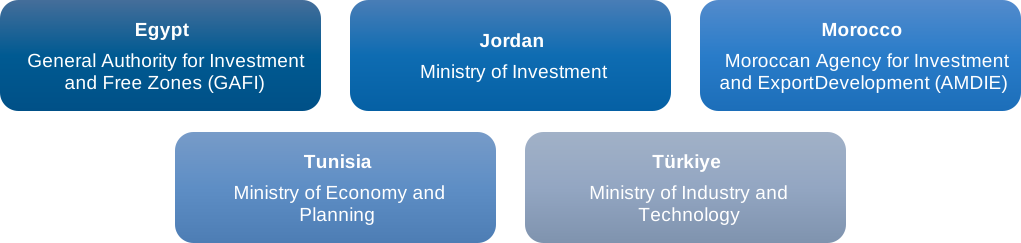
Note: Egypt’s NCP is housed within the GAFI, which is affiliated with the Ministry of Investment and Foreign Trade. Morocco’s NCP is located in AMDIE under the administrative supervision of the Ministry of Investment, Convergence, and Evaluation of Public Policies.
Source: Based on publicly available information and answers to the 2025 NCP Annual Questionnaire by MENA+T Programme Countries.
The institutional arrangements of certain MENA+T Programme NCPs also represent an opportunity for the promotion of policy coherence for RBC. Three out of the five NCPs in the region have an inter-agency set-up (Morocco) or a government advisory body (Egypt and Jordan) involving representatives of several ministries and government entities. In addition, Tunisia’s 2023 draft rules of procedure seek to bring together representatives of different government entities, as well as businesses and trade unions, in a tripartite NCP structure. As for Türkiye, it has indicated its intention to create an advisory body that would include government representatives (see Table 5.1 and Annex C for more details). Such arrangements are useful to ensure that NCPs have access to the required expertise to fulfil their mandate, as well as to support their role in enhancing alignment and harmonisation among actions taken across government to promote and enable RBC (OECD, 2022[112]). By facilitating NCPs’ engagement and co‑ordination with officials from ministries and government entities that have competences in policy areas relevant to RBC, government advisory bodies can support the mainstreaming of RBC principles and standards in relevant government policies and initiatives, including in the field of trade and investment.
Stakeholder advisory bodies can likewise support policy coherence for RBC by helping NCPs become aware of opportunities related to the integration of RBC in other policy areas, as well as inconsistencies in laws and policies that create barriers to the implementation of RBC principles and standards. Most of the MENA+T Programme NCPs have stakeholder advisory bodies that involve representatives from businesses (Egypt, Jordan and Morocco) or trade unions (Egypt and Morocco). Türkiye has indicated its intention to create a multistakeholder advisory body (see Table 5.1 and Annex C for more details).
Notes:
1. NCP institutional arrangements refer to the structuring and operations of an NCP, including how they engage with or incorporate stakeholder participation. There are different models of institutional arrangements:
(i) “single agency”: the NCP is composed of one official in a single ministry, or by a group of officials belonging to the same service in the same ministry, where only the NCP and its hosting entity have voting rights.
(ii) “inter-agency”: the NCP is composed of a group of representatives from several ministries or government agencies, usually with a Secretariat located in one of these ministries, composed of one or more officials, where various government entities have voting rights.
(iii) “multipartite”: the NCP is composed of a group of government officials and stakeholder representatives, usually with a Secretariat located in one of the government agencies represented in the NCP, where the NCP, other government entities, and stakeholders have voting rights.
(iv) “expert-based”: the NCP is composed of experts who are appointed by, but external to, the government and have voting rights.
(v) “hybrid NCPs”: composed of elements derived from different models listed here.
2. Egypt’s NCP advisory body (the National Committee) is comprised of both government and stakeholders’ representatives, including businesses and trade unions, with a civil society organisation yet to be identified.
3. Created in 2025, Jordan’s NCP advisory body (the National Team) is comprised of both government and business representatives, with representatives from trade unions, civil society, and academia being considered for inclusion.
4. Morocco’s NCP consists of government representatives and its advisory body includes stakeholders’ representatives from business and trade unions.
5. According to its 2023 draft rules of procedure, the Tunisian NCP would have a tripartite structure bringing together representatives of the government, businesses, and trade unions. However, these institutional arrangements are yet to be put in place.
6. Türkiye is in the process of restructuring its NCP to incorporate an advisory body gathering government and stakeholder representatives.
Source: Based on publicly available information and information shared by MENA+T Programme Countries.
The NCPs of the region are, in general, aware of their role regarding the promotion of policy coherence for RBC and the possibility to advance responsible business practices through trade and investment. During the survey on RBC, trade, and investment conducted by the OECD Secretariat with officials from the five MENA+T Programme NCPs in the context of the preparation of this report, all seven respondents indicated that both export and investment promotion and facilitation activities are “very” or “extremely useful” to encourage RBC. They also agreed that their country could make greater use of support services provided to exporters and investors to incentivise them to observe RBC principles and standards.
Based on their institutional arrangements and this awareness, MENA+T Programme NCPs have undertaken initial actions that have contributed to some degree to reinforce policy coherence between RBC, trade and investment. In recent years, all of them have either engaged and co‑operated with, shared relevant information among, or been consulted by, trade and investment officials in different ways, thereby supporting the promotion of RBC through trade and investment (see Figure 5.4).
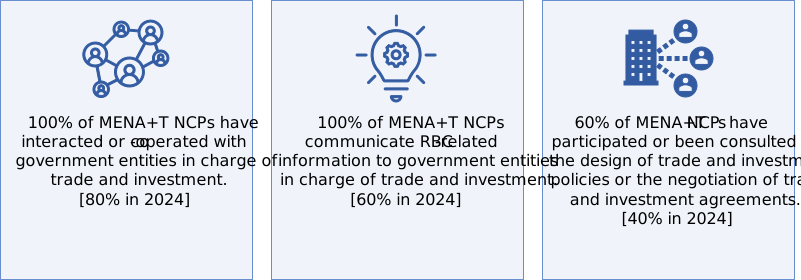
Source: Based on the responses to the 2024 and 2025 NCP Annual Questionnaires and information shared by MENA+T Programme Countries.
The five NCPs of the region have interacted or co‑operated with officials responsible for trade and investment support, including trade missions. For instance, according to information provided by the Government of Morocco, in 2023, its NCP provided training on the MNE Guidelines, due diligence and the NCP for AMDIE staff involved in investor outreach, export promotion, and investment projects’ management. AMDIE also organised in 2024 - 2025 a regional roadshow aimed at strengthening local exports and investment ecosystems, notably through the promotion of RBC among relevant officials, including those of the Regional Centres for Investment.
All MENA+T Programme NCPs have also shared statements, data and other insights with relevant trade and investment officials. According to information shared by MENA+T Programme Countries, the Egyptian, Moroccan and Tunisian NCPs have promoted the MNE Guidelines among officials in charge of trade and investment promotion. In 2024, Tunisia’s NCP presented the MNE Guidelines to companies, investors, and government representatives during investment workshops aimed at driving growth, investment, and competitiveness in the textile and apparel sector. The Moroccan NCP regularly informs officials responsible for reviewing eligibility for government support and services, including in the field of trade and investment, of companies engaged in specific instances. Jordan’s NCP also provides briefings and short policy notes on RBC trends and implications to relevant trade and investment officials.6
Moreover, almost all MENA+T Programme NCPs have been involved in trade and investment negotiations or policymaking, with a view to integrating RBC considerations in agreements or policies (see Figure 5.5).

Sources: EU (2022[113]), https://ec.europa.eu/commission/presscorner/detail/en/ip_22_6136; OECD (2023[114]), National Contact Point Peer Reviews: Morocco 2023, https://doi.org/10.1787/1e29eba3-en; and based on analysis of the responses to the 2023, 2024 and 2025 NCP Annual Questionnaires and information shared by the five countries part of the MENA+T Programme.
These initial efforts by MENA+T Programme NCPs lay the ground for future action to further promote policy coherence between trade and investment and RBC. Taking into account their capacities and priorities, the NCPs of the region could seek to play a more active role in supporting the mainstreaming of RBC in trade and investment policies and agreements. In the context of the survey on RBC, trade and investment mentioned above, six out of the seven respondents recognised that their country’s NCP could further support the promotion of RBC through trade and investment. They indicated that this could be done by enhancing RBC awareness among relevant government entities, increasing financial and/or human resources for the NCP, and enhancing inter-institutional co‑operation and co‑ordination. They, however, mentioned facing several challenges, the lack of technical capacity of relevant government entities and the lack of awareness of RBC among these entities being the two main ones, followed by insufficient financial and human resources for the NCP.
The challenges that MENA+T Programme NCPs reported facing in playing a greater role in the promotion of RBC through trade and investment and, more broadly, to support policy coherence for RBC have been underlined in the context of recent peer reviews. The peer reviews of the Moroccan and Turkish NCPs concluded that both NCPs could play a more significant role in the promotion of policy coherence for RBC. In particular, Morocco’s peer review found that there were opportunities to further promote the NCP across government, given interest from other government entities for increased co‑ordination, and recommended that the NCP enhance its contribution to policy coherence by strengthening co‑ordination across the government (OECD, 2023, p. 8[114]). Türkiye’s peer review highlighted that this role could be enhanced if the NCP continues to build relations with other government entities to facilitate co‑ordination, to engage in exchanges on RBC-related matters, and to support the development and coherence of policies that promote RBC (OECD, 2024, pp. 42-43[115]).
← 1. According to section D of the Procedures part of the 2023 version of the MNE Guidelines, “[i]n furthering the effectiveness of the Guidelines, NCPs may, where appropriate and in co-ordination with relevant government agencies, support efforts by their government to develop, implement, and foster coherence of policies aimed at promoting RBC.” The Commentary on the Procedures for NCPs specifies in its paragraph 55 that “the support provided by or requested from the NCP should take into account their capacities and priorities” (OECD, 2023[152]).
← 2. The MNE Guidelines also underline, in the Commentaries on the Implementation Procedures, that “where appropriate, the NCP may inform relevant government agencies of the good faith engagement, or absence thereof, of the parties, and should communicate in a transparent manner with the parties about intended or actual steps in this regard” (OECD (2023[152]), para. 44).
← 3. Compiled by the OECD Secretariat based on the answers by 52 NCPs to the 2025 NCP Annual Questionnaire.
← 4. Compiled by the OECD Secretariat based on the answers by 52 NCPs to the 2025 NCP Annual Questionnaire.
← 5. See Government of Canada (2022[128]), Specific Instance Procedures, para. 9.5: “If Canadian companies do not participate in the NCP process, or if the NCP determines that they do not engage in good faith or constructively in the course of or follow-up to the review process, the NCP can recommend the withdrawal of all Trade Commissioner Service support and that Export Development Canada and the Canadian Commercial Corporation also withdraw future support.”
← 6. Responses of the Government of Jordan to the 2024 and 2025 NCP Annual Questionnaires.