MENA+T Programme Countries have also started to use their trade and investment agreements as levers to encourage RBC. The analysis of around 500 trade and investment agreements signed by MENA+T Programme Countries between 1990 and 2025 shows that provisions related to the areas covered by the MNE Guidelines are increasingly being integrated. Clauses aimed to encourage companies to adopt responsible business practices are emerging more timidly, but with features specific to the region. This progressive inclusion can contribute to enable RBC by reinforcing relevant legal, regulatory, and policy frameworks, supporting international collaboration, and promoting RBC with businesses.
Promoting Responsible Business Conduct through Trade and Investment in the Middle East, North Africa and Türkiye

Abstract
The integration in trade and investment agreements of sustainability provisions – those addressing issues in areas covered by the MNE Guidelines such as human rights, labour rights, environmental protection and anti-corruption – has evolved progressively over the past three decades in the MENA+T region, reflecting global trends (Gaukrodger, 2021[23]). An analysis of approximately 500 trade and investment agreements signed by MENA+T Programme Countries between 1990 and 20251 shows that 33% include such provisions and indicates a recent shift towards a more systematic integration. The majority of agreements concluded over the last 14 years include some form of sustainability provision, with varying rates across policy areas (see Figure 4.1).
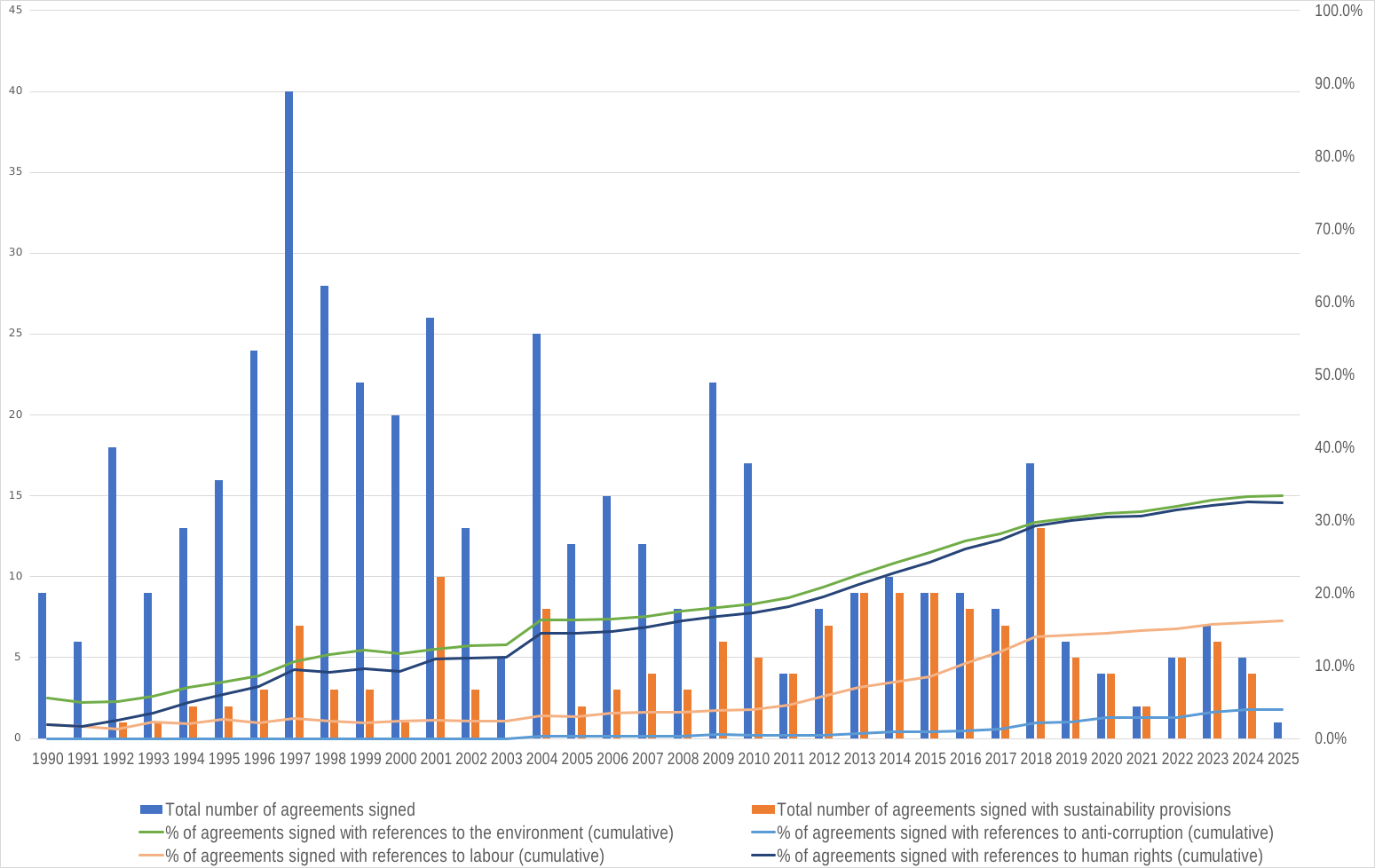
Source: Based on OECD analysis of the content of the trade and investment agreements concluded by the five countries part of the MENA+T Programme between 1990 and 2025.
Provisions related to the protection of the environment have experienced the most important growth. Present in less than 3% of the agreements concluded in 1990, their inclusion has increased by nearly ten‑fold to appear in around 30% of agreements signed by MENA+T Programme Countries between 1990 and 2025. Provisions regarding the promotion of human rights have had a similar upward trajectory. The inclusion of labour-related provisions has shown a more gradual rise. Integrated in around 1% of agreements in the early 1990s, these provisions remained relatively uncommon until the 2010s, and they appeared only in around 15% of agreements by 2024. The less common sustainability provisions are those related to anti-corruption. They first appeared in 2004 and their integration over the subsequent two decades has been limited. As of 2025, anti-corruption clauses were present in less than 4% of agreements signed by MENA+T Programme Countries.
Certain agreements concluded by MENA+T Programme Countries include rather detailed sustainability provisions. For instance, three agreements contain a specific chapter on trade and sustainable development (TSD Chapter) with multiple sustainability provisions. One example is the TSD Chapter of the 2012 Korea-Türkiye FTA, which contains various sustainability provisions related notably to labour rights and environmental protection (see Box 4.1).2 Three other trade agreements include standalone chapters dedicated to labour and/or environmental matters.3
The FTA concluded by Korea and Türkiye in 2012 integrates RBC considerations in various locations. In the preamble, the signatories declare their intention to strengthen the development and enforcement of labour and environmental laws and policies, guarantee basic workers’ rights, and promote sustainable development. The main text then includes a full chapter dedicated to trade and sustainable development (TSD Chapter), with various sustainability provisions.
Through the sustainability provisions included in the TSD Chapter of the Korea-Türkiye FTA, the signatories undertake to (i) protect their right to regulate in labour and environmental matters; (ii) implement and enforce high levels of labour and environmental protection and (iii) co‑operate in these areas.

Source: (2012[86]), Framework Agreement Establishing a Free Trade Area between the Republic of Korea and the Republic of Türkiye, Chapter 5, https://www.trade.gov.tr/free-trade-agreements/republic-of-korea.
The progressive integration of sustainability provisions in the trade and investment agreements concluded by MENA+T Programme Countries can contribute to promote and enable RBC in the region in several manners.
These provisions can help buttress the development and implementation of domestic laws, regulations, and policies in areas covered by the MNE Guidelines, thereby underpinning the consolidation of enabling environments for RBC. For instance, sustainability provisions related to women’s rights included in the 1993 Common Market for Eastern and Southern Africa (COMESA) Treaty4 have supported the development of national gender policies in member states and are now guiding the elaboration of a regional strategy on women’s economic empowerment (COMESA, 2020[87]; COMESA, 2024[88]). The COMESA Treaty also includes provisions through which the signatories commit to integrating environmental considerations in all their policies and to promote co‑ordinated environmental management through shared regulations, data exchange, and joint impact assessments.5 The 2018 European Free Trade Association (EFTA)-Türkiye FTA is another example of how sustainability provisions can support the implementation of legal and policy frameworks in areas relevant for RBC. The FTA establishes a Joint Committee composed of senior officials from each party that convene biennially to monitor the implementation of the agreement, including its TSD Chapter. During the Joint Committee’s first meeting in August 2023, each party raised concerns regarding the protection of labour rights and the environment, requiring signatories to respond to these concerns. By creating this institutional mechanism to monitor each signatory’s implementation of the commitments set out in the TSD Chapter, the FTA promotes government action relevant for RBC (see Box 4.2).
The Modernised FTA between the European Free Trade Association (EFTA) and Türkiye, in force since 2021, contains a chapter dedicated to trade and sustainable development (TSD Chapter). Under this Chapter, the signatories reaffirm their commitment to relevant multilateral environmental and labour agreements. They commit to maintain high levels of environmental and labour protection and recognise each signatory’s right to regulate in these fields. The FTA also establishes a Joint Committee in charge of supervising and reviewing biennially the implementation of the agreement, including the TSD Chapter. During the first Joint Committee Meeting held in 2023, the parties discussed, among others, the implementation of the TSD Chapter commitments and raised several points in this regard:
The EFTA states asked questions to Türkiye on the protection of the environment, with a focus on the implementation of the Paris Agreement, as well as wastewater pollution, and recycling practices. They also enquired about several labour rights matters, including: freedom of association (in light of ongoing cases under the ILO supervisory system); actions taken to address repression of strikes and harassment or arbitrary arrest of trade union leaders; efforts to combat child labour, particularly in the agriculture and garment sectors; and measures regarding the gender pay gap. Türkiye provided written responses in advance of the Joint Committee Meeting, which laid the ground for a follow-up discussion. During this subsequent exchange, the EFTA states urged Türkiye, among others, to co‑operate with the ILO on freedom of association cases and to provide more detailed information on related measures. According to the Government of Türkiye, additional written information was provided to the EFTA states detailing measures to strengthen gender equality and protect union rights through constitutional provisions and labour laws.
Türkiye, in turn, directed questions to the EFTA states and, in particular, to Iceland and Switzerland in relation to their approaches to the gender pay gap and with respect to Switzerland’s implementation of the ILO Convention No. 98 on the Right to Organise and Collective Bargaining. Türkiye also sought clarification from Liechtenstein on the legal recognition of the right to strike and the prohibition of anti‑union discrimination in the country. The respective EFTA delegations provided information during the Joint Committee Meeting and all parties agreed to continue the exchanges in writing.
Sources: (2018[89]), Modernised Free Trade Agreement between EFTA States and Türkiye, https://www.efta.int/trade-relations/free-trade-network/turkiye; EFTA (2023[90]), The EFTA States and Türkiye hold their first Joint Committee Meeting under the modernised Free Trade Agreement, https://www.efta.int/media-resources/news/efta-states-and-turkiye-hold-their-first-joint-committee-meeting-under.
Another type of sustainability provisions that can contribute to reinforcing the development and implementation of legal and policy frameworks in areas relevant for RBC are those designed to preserve the right to regulate, as they allow the signatories to adopt, modify or enforce laws, regulations or policies in these fields without legal risks. In other regions, this type of sustainability provisions has, for instance, allowed states to successfully avoid legal liability in investor-state dispute settlement cases brought by investors as a result of governmental measures taken to protect the environment (OECD, 2024, pp. 31-32[8]). In most trade and investment agreements signed by MENA+T Programme Countries such provisions take the form of “general exceptions” allowing signatories to justify adopting measures that would otherwise be contrary to the agreement. These exceptions usually cover areas such as the protection of the environment and human health, often through direct references to Article XX of the GATT or similar language and generally remain broad in scope. Some agreements, however, include more detailed provisions specifically aimed at preserving the right to regulate in areas covered by the MNE Guidelines. For example, in the 2024 Egypt-Saudi Arabia BIT, the signatories recognise each other’s right to take appropriate measures to prevent and combat corruption in accordance with their national legislation and the international agreements to which they are a party.6 The BIT also recognises the right for each signatory to determine its own policies to set appropriate levels of protection for the environment, public health, labour rights, and to adopt or amend legal and policy frameworks accordingly.7 The Revised COMESA Investment Agreement is another example with a targeted provision designed to mitigate legal risks if the parties exercise their right to regulate. It provides that regulatory measures adopted by signatories, or decisions by their judicial bodies, aimed to protect or promote legitimate public welfare objectives, such as public health, safety, or environmental protection, shall not be considered an expropriation or measures equivalent to an expropriation.8
The inclusion of sustainability provisions in MENA+T Programme Countries’ trade and investment agreements can also support the strengthening of intergovernmental collaboration in matters relevant for RBC. This type of sustainability provision has enabled countries in other regions to create forums to co‑operate on RBC-related matters within the supervisory mechanisms overseeing the implementation of agreements, thereby supporting the development of policies that underpin RBC (OECD, 2024, pp. 32-33[8]). In the MENA+T region, the 1993 COMESA Treaty dedicates a full chapter to co‑operation between the signatories on environmental issues.9 The agreement creates a technical committee on “Natural Resources and Environment”, composed of representatives of each member state, responsible for preparing and prioritising a programme on the management of natural resources and the environment, monitoring the implementation of co‑operation programmes in this area and providing recommendations on the implementation of the agreement’s relevant provisions.10 It also encourages collective action by the signatories to conserve biodiversity and manage cross-border ecosystems with a view to ensuring long-term ecological sustainability and the protection of human health across the region. Another example is the 2012 Korea-Türkiye FTA, through which the signatories commit to collaborate in various areas covered by the MNE Guidelines, and in particular to exchange information and collaborate on CSR and accountability, including on the effective implementation of international agreed guidelines (see Box 4.1).
Finally, sustainability provisions can also play a role in relation to access to remedy, notably by creating new mechanisms that allow the filing of public submissions on matters related to areas covered by the MNE Guidelines with dedicated bodies. In other regions, citizens and civil society organisations have used these mechanisms to present public submissions regarding labour or environmental matters, which have contributed to the resolution of RBC-related issues (OECD, 2021, pp. 99-100[91]; 2024, pp. 33-34[8]). Sustainability provisions can also contribute to enhance the effectiveness of existing remedy mechanisms. For instance, the 2009 Canada-Jordan FTA includes provisions aimed at ensuring the availability of effective mechanisms to resolve claims related to the enforcement of domestic environmental laws. In its Side Agreement on the Environment, the signatories commit to guaranteeing that environmental law violations can be addressed before judicial, quasi-judicial or administrative proceedings ((n.a.), 2009[92]). The agreement also requires that the signatories ensure that any person with a legally recognised interest under environmental laws has appropriate access to these proceedings to seek enforcement and remedies in case of violations.11
RBC clauses – through which signatories commit to encourage businesses to observe internationally recognised RBC principles and standards – remain rather limited in trade and investment agreements signed by MENA+T Programme Countries. They appeared for the first time with the Canada-Jordan FTA signed in 2009. This RBC clause is included in the Side Agreement on the Environment and encourages the adoption of voluntary best practices of CSR by businesses to strengthen coherence between economic and environmental objectives.12 Since then, 11 other publicly available13 investment agreements signed by MENA+T Programme Countries have incorporated RBC clauses, including two agreements concluded in 2024 (see Annex B).14 Of these 11 investment agreements with an RBC clause, five are BITs signed by Morocco, three by Türkiye, one by Egypt, and two are regional African investment agreements to which some MENA+T Programme Countries are parties.
The RBC clauses included to date in the MENA+T Programme Countries’ trade and investment agreements vary significantly in scope and specificity. Some are broad and general in nature. For instance, the RBC clause of the 2022 Türkiye‑Uruguay BIT (not yet in force) contains a general commitment by the signatories to encourage companies operating in their territory to voluntarily incorporate internationally recognised standards of CSR in their practices and internal policies.15 Other provisions integrate detailed requirements for investors related to RBC, such as the 2022 Comoros-Morocco BIT, which replicates the RBC clause included in the 2019 Moroccan Model BIT,16 and the Revised COMESA Investment Agreement (see Figure 4.3).

Sources: (2022[93]), Comoros-Morocco BIT, Article 20.3, https://munganyo.km/decrees/531; (2019[94]), Moroccan Model BIT, https://investmentpolicy.unctad.org/international-investment-agreements/treaty-files/5895/download; (2017[95]), Revised COMESA Investment Agreement, https://www.comesa.int/wp-content/uploads/2020/10/English-Revised-Investment-agreement-for-the-CCIA-28.09.17-FINAL-after-Adoption-for-signing.pdf.
All the RBC clauses in MENA+T Programme Countries’ trade and investment agreements reflect a shared commitment by the signatories to encourage companies to integrate internationally recognised RBC principles and standards in their internal policies and practices. While doing so, they refer to at least one of the areas of the MNE Guidelines. All agreements with RBC clauses refer to the environment, around 90% refer to labour, over 80% make reference to anti-corruption, and 75% mention human rights (see Figure 4.4). Overall, 75% of the agreements with RBC clauses cover all four areas of the MNE Guidelines. The 2023 Cabo Verde‑Morocco BIT, for example, provides that investors shall strive to voluntarily adopt in their internal policies internationally recognised CSR standards, specifying that these cover areas such as labour, the environment, human rights, community relations and anti-corruption.17

Source: Based on OECD analysis of the content of the trade and investment agreements concluded by MENA+T Programme Countries.
Despite often referring generally to internationally recognised standards in the field of RBC in their wording, only a few RBC clauses included in MENA+T Programme Countries’ agreements actually identify the specific RBC principles and standards that companies should observe. One example is the 2022 Comoros-Morocco BIT, which expressly refers to the MNE Guidelines and the ILO Tripartite Declaration of Principles Concerning Multinational Enterprises and Social Policy, in line with Morocco’s 2019 Model BIT (see Figure 4.5). The Revised COMESA Investment Agreement is another example, with an explicit reference to the UNGPs.18
The inclusion of RBC clauses in the trade and investment agreements concluded by MENA+T Programme Countries can have various effects that contribute to promote and enable RBC in the region. By “speaking to businesses” and signalling the parties’ expectations on RBC, these clauses have the potential to shape business conduct and encourage the adoption of responsible business practices. That is particularly the case of some of the agreements signed by MENA+T Programme Countries that go beyond only communicating government expectations on RBC and establish concrete binding obligations for investors. Half of the agreements concluded by MENA+T Programme Countries containing an RBC clause impose such obligations on investors.19
A noteworthy example is the 2016 Morocco-Nigeria BIT, not yet into force, which is recognised as the first BIT to introduce binding obligations (Mallya, 2024[96]). In particular, it establishes various post-establishment obligations for investors, including to uphold human rights, act in accordance with core labour standards set out in the ILO Declaration on Fundamental Principles and Rights of Work, establish environmental management systems and, in general, abstain from managing or operating their investments in ways contrary to international environmental, labour and human rights instruments to which the host state is a party.20 The BIT also includes a clause on corporate governance, pursuant to which investors must meet or exceed national and internationally accepted standards of corporate governance, and establish and maintain, where appropriate, engagement processes with local stakeholders.21 Another recent example is the 2024 Egypt-Saudi Arabia BIT, which includes an RBC clause providing that investors are obligated to establish, operate, and manage their investments in accordance with the legislation of the host state regarding the protection of health and the environment, and in line with the objectives of mitigating and adapting to the effects of climate change.22 Investors must also respect “the standards adopted by the host state regarding CSR or responsible business practices with the aim of contributing to sustainable development”.23 Regional African agreements to which some MENA+T Programme Countries are parties, such as the 2007 COMESA Investment Agreement or the Investment Protocol to the African Continental Free Trade Area (AfCFTA), also include RBC clauses with binding obligations for investors (see Box 4.3).
The 2023 Investment Protocol to the African Continental Free Trade Area (AfCFTA) contains a section specifically dedicated to investors obligations, which includes an RBC clause structured in three parts:1
First, it provides that investors and their investments shall endeavour to achieve the highest possible level of contribution to the sustainable development of the host state and the local community, by adopting a high degree of socially responsible practices.
It then lays out a series of non-binding corporate social responsibility (CSR) principles and standards that investors and their investments should strive to observe (such as stimulating economic, social and environmental progress; strengthening local capacities through close co‑operation with the local community; and encouraging, when possible, business partners, including direct providers and subcontractors, to observe CSR principles and standards).
Lastly, it reflects the signatories’ commitment to encourage investors to integrate in their internal policies internationally recognised CSR principles and standards.
The section also contains clauses pursuant to which investors shall respect human and labour rights, the environment, Indigenous peoples’ rights, and not engage in corrupt practices.
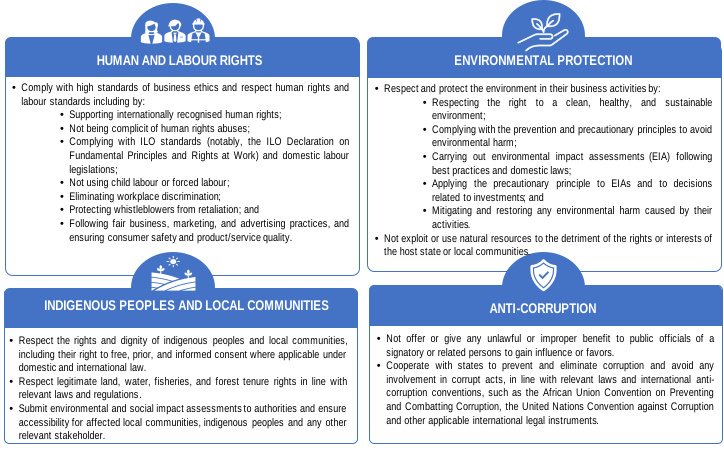
Note:1. (2023[97]), AfCFTA Investment Protocol, Article 38 (Corporate Social Responsibility).
Source: (2023[97]), AfCFTA Investment Protocol, Part V (Investors Obligations), https://au-afcfta.org/wp-content/uploads/2024/11/EN-AfCFTA-Protocol-on-Investment-clean-1.pdf.
RBC clauses may also constitute a basis to promote intergovernmental co‑operation on RBC. In other regions, commitments to co‑operate on RBC have translated into concrete initiatives to exchange best practices and promote RBC. For instance, in the context of the Pacific Alliance, such commitment led to the creation of a subgroup on RBC dedicated to promoting co‑operation between the signatories (see Box 4.4). Similarly, the RBC clause of the Mercosur’s Co‑operation and Facilitation Investment Protocol triggered the adoption of a recommendation mandating co‑operation in areas covered by the MNE Guidelines through various activities. This includes the development of RBC guidelines based on international instruments, which were in progress at the time of writing (MERCOSUR, 2025[98]). Although the Korea-Türkiye FTA mentions CSR as an area on which the signatories commit to initiate co‑operation activities (see Box 4.1), RBC clauses included in MENA+T Programme countries’ agreements have yet to include undertakings by the signatories to co‑operate on RBC.
The Additional Protocol to the Framework Agreement of the Pacific Alliance includes an RBC clause whereby the signatories, among other commitments, undertake to identify and share best practices for implementing the MNE Guidelines, with the aim of enhancing the contribution of multinational enterprises to sustainable development.
Building on this commitment, in 2023, Chile, Colombia, Mexico and Peru, established a Subgroup on RBC (SGCER) within the institutional framework of the Pacific Alliance. The Subgroup serves as a forum for exchanging experiences and best practices regarding the promotion of RBC. Over recent years, the SGCER, with the support of the National Contact Points for Responsible Business Conduct (NCPs), has organised several co‑operation and peer-learning activities to advance the RBC agenda within the Pacific Alliance, across governments, and with stakeholders:
In August 2024, the SGCER launched a series of discussions aimed at deepening the understanding of RBC and its relevance for different workstreams of the Pacific Alliance. The first session, held with the Technical Group on the Environment and Green Growth, focussed on key international RBC instruments, including the MNE Guidelines, with particular attention to the environmental and human rights dimensions. Additional sessions with other technical committees are planned to take place in the future.
In February 2025, the SGCER organised an event to promote intergovernmental dialogue on the role of NCPs, focussing on stakeholder engagement and the strengthening of NCPs as non-judicial grievance mechanisms.
In September 2025, the SGCER organised a technical meeting aimed at identifying best practices for implementing the MNE Guidelines in the environmental field. The meeting also included a dialogue with stakeholders on advancing the promotion of RBC within the Pacific Alliance.
Sources: Government of Chile (2024[99]), “Subgrupo de Conducta Empresarial Responsable inicia ciclo de conversaciones para difundir su trabajo con las otras instancias de la Alianza del Pacífico”, https://www.subrei.gob.cl/sala-de-prensa/noticias/detalle-noticias/2024/08/20/subgrupo-de-conducta-empresarial-responsable-inicia-ciclo-de-conversaciones-para-difundir-su-trabajo-con-las-otras-instancias-de-la-alianza-del-pac%C3%ADfico; (2025[100]), “SUBREI lidera encuentro internacional sobre fortalecimiento de Puntos Nacional de Contacto (PNC) de la Alianza del Pacífico”, https://www.subrei.gob.cl/sala-de-prensa/noticias/detalle-noticias/2025/02/28/subrei-lidera-encuentro-internacional-sobre-fortalecimiento-de-puntos-nacional-de-contacto-(pnc)-de-la-alianza-del-pac%C3%ADfico.
← 1. The analysis in the present report covers publicly available trade and investment agreements signed by MENA+T Programme Countries at the time the background analysis was carried out (i.e. until end of 2025). The expression “trade and investment agreements” in the report refers to a wide range of bilateral, regional and plurilateral agreements relating to trade and foreign investment and related issues. The term “investment agreements” covers bilateral investment treaties (BITs) and investment chapters contained in free trade agreements (FTAs).
← 2. See also (2023[97]) Protocol to the Agreement Establishing the African Continental Free Trade Area on Investment (Part IV: Sustainable Development related issues); (2018[89]) EFTA-Türkiye FTA (Chapter 7: Trade and Sustainable Development).
← 3. See (2009[141]) Canada-Jordan FTA (Chapter 10: Environment and Chapter 11: Labour); (2004[146]) Morocco-USA FTA (Chapter 16: Labor and Chapter 17: Environment); (1993[142]) Treaty Establishing Common Market for Eastern and Southern Africa (COMESA) (Chapter 16: Co‑operation in the development of natural resources, environment and wildlife).
← 4. (1993[142]) Treaty Establishing Common Market for Eastern and Southern Africa (COMESA) (Chapter 24: Women in development and business).
← 5. (1993[142]) Treaty Establishing Common Market for Eastern and Southern Africa (COMESA) (Chapter 16: Co‑operation in the development of natural resources, environment and wildlife).
← 6. (2024[154]) Egypt-Saudi Arabia BIT, Article XV.
← 7. (2024[154]) Egypt-Saudi Arabia BIT, Article XV.
← 8. (2017[95]) Revised Investment Agreement for the COMESA Common Investment Area, Article 20.
← 9. (1993[142]) Treaty Establishing Common Market for Eastern and Southern Africa (COMESA) (Chapter 16: Co‑operation in the development of natural resources, environment and wildlife).
← 10. (1993[142]) Treaty Establishing Common Market for Eastern and Southern Africa (COMESA), Article 15 (Technical Committees Composition and Functions) and Article 16 (Functions of the Technical Committees).
← 11. (2009[92]) Canada-Jordan FTA, Agreement on the Environment, Article 8.
← 12. (2009[92]) Canada-Jordan FTA, Agreement on the Environment, Article 10.
← 13. According to information shared by the Government of Morocco, the BITs recently signed by Morocco with Saint Martin and Sierra Leone also include RBC clauses though they are not publicly available.
← 14. Other provisions found in trade and investment agreements signed by MENA+T Programme Countries may be relevant for the promotion of RBC but they do not include a specific clause in the text of the agreement reflecting the parties’ commitment to encourage businesses to observe RBC principles and standards. That is the case of the (2018[89]) EFTA-Türkiye FTA in which the signatories affirm the importance of CSR and the MNE Guidelines but only in the preamble and not in the main text of the agreement. That is also the case of the (2012[86]) Korea-Türkiye FTA, which includes a provision according to which the signatories shall strive to facilitate and promote trade in goods subject to schemes involving CSR and accountability.
← 15. (2022[145]) Türkiye‑Uruguay BIT, Article 13.
← 16. (2019[94]) Moroccan Model BIT, Article 20 (Social and Environmental Responsibility).
← 17. (2023[144]) Cabo Verde‑Morocco BIT, Article 20 (Social and Environmental Responsibility).
← 18. (2017[95]) Revised Investment Agreement for the COMESA Common Investment Area, Article 29.
← 19. See (2023[144]) Cabo Verde‑Morocco BIT Article 18 (Compliance with Domestic Laws and International Obligations), Article 19 (Anti-corruption, Anti-Money Laundering and Anti-Terrorist Financing), Article 20 (Social and Environmental Responsibility); (2016[143]) Morocco-Nigeria BIT, Article 18 (Post-establishment obligations), Article 19 (Corporate Governance and Practices); (2024[154]) Egypt-Saudi Arabia BIT, Article 14 (Compliance with Legislation); (2023[97]) AfCFTA Investment Protocol, Article 33 (Business Ethics, Human Rights and Labour Standards), Article 34 (Environmental Protection), Article 35 (Indigenous Peoples and Local Communities), Article 37 (Anti-Corruption), Article 38 (Corporate Social Responsibility); (2017[95]) Revised Investment Agreement for the CCIA, Article 29 (Business Ethics and Human rights), Article 30 (Corporate Social Responsibility).
← 20. (2016[143]) Morocco-Nigeria BIT, Article 18.
← 21. (2016[143]) Morocco-Nigeria BIT, Article 19.
← 22. (2024[154]) Egypt-Saudi Arabia BIT, Article 14 (Compliance with Legislation).
← 23. (2024[154]) Egypt-Saudi Arabia BIT, Article 14 (Compliance with Legislation).