Public procurement represents approximately 12.9% of gross domestic product (GDP) in OECD countries and 11% in Romania (OECD, 2023[1]), making it a key economic activity of governments. Public procurement is particularly vulnerable to mismanagement, fraud and corruption, which can undermine fair competition, increase costs, and compromise the quality of public goods, services and works (see Box 1.1 for a typology of integrity breaches in public procurement).
Managing Public Procurement Risks in Romania
Ensuring Integrity and Efficiency

Abstract
Integrity challenges in public procurement can also have broader impacts. Corruption in Romania perpetuates inequality and poverty, impacting citizens’ well-being and undermining opportunities to participate equally in social, economic, and political life (US Department of State, n.d.[2]). As public sector integrity is a key element of democratic governance, corruption, fraud and conflict of interest in public procurement may also impact citizens’ broader trust in their governments (OECD, 2022[3]). Romanians see public procurement as an area particularly prone to corruption. According to the 2022 Eurobarometer survey on corruption, 36% of Romanian respondents thought the giving and taking of bribes and the abuse of power for personal gain was widespread among officials awarding public tenders (European Commission, 2022[4]).
Integrity breaches in public procurement can be divided into four main categories, although a specific integrity breach would usually fall under more than one category.
Corruption: Corruption is the abuse of entrusted power for private gain. Corruption leads to a situation where the contract is not awarded to the best bidder, to the detriment of public funds and/or the quality of the supplies, services, or works delivered.
Fraud: Fraud can be defined as the knowing representation of false facts to be true or the concealing or disguising of true facts with the purpose of obtaining an unlawful gain. In the context of public procurement, this can include false statements and claims, false bid documents, inflated invoices, poor quality works or product substitution.
Conflict of interest: Conflict of interest arises when public officials’ decisions during the public procurement process are biased by their private interests (e.g. financial interests, family relationships, post-employment opportunities). If not adequately identified and managed, these conflicts provide opportunities for public officials to exploit their positions for personal benefit.
Collusion: Collusion in public procurement (often also referred to as ‘bid-rigging’) refers to illegal agreements between economic operators with the aim of distorting competition in award procedures. Such agreements or practices are designed to increase the profits of the cartel members at the public’s expense while maintaining the illusion of competition. Secret agreements between economic operators may take various forms, all aiming to eliminate competition so that prices are higher and the government pays more.
While in the past governments have focused primarily on the risk of corruption and fraud in public procurement, attention has been increasingly directed to other categories of public procurement risk, including digital, financial, reputational, social and environmental risks. These categories of risk are often interlinked with integrity challenges, with the same root causes having varying and cascading impacts. Public procurement risks’ connected nature means that small failures can have large economic, environmental, social, and reputational impact, underlining the need for governments and public buyers to take a systematic approach that addresses the full range of procurement risks (OECD, 2023[8]).
Romania has been making extensive efforts to address these structural challenges in its public procurement system for over two decades. Since 2001, it has developed six National Anticorruption Strategies (NAS) to help curb corruption and enable the public administration to deliver inclusive policies and effective public services, as well as to mitigate risks of corruption. The NAS (2021-2025)1 identifies public procurement as a priority area. Specific measures aimed at public procurement integrity are included under General Objective No. 4 (Strengthening Integrity in Priority Fields of Activity). Specific Objective 4.4 is particularly relevant, as it aims at increasing integrity and reducing vulnerabilities and the risk of corruption in public procurement (Figure 1.1 highlights these objectives in the context of the overall Strategy). This includes specific measures such as performing an analysis of judicial practice in public procurement (4.4.1), developing a national public procurement risk map (4.4.2), and attracting and retaining public procurement staff (4.4.3) (Ministry of Justice, 2021[9]).
The NAS (2021-2025) includes the following 5 general objectives and 18 additional specific objectives
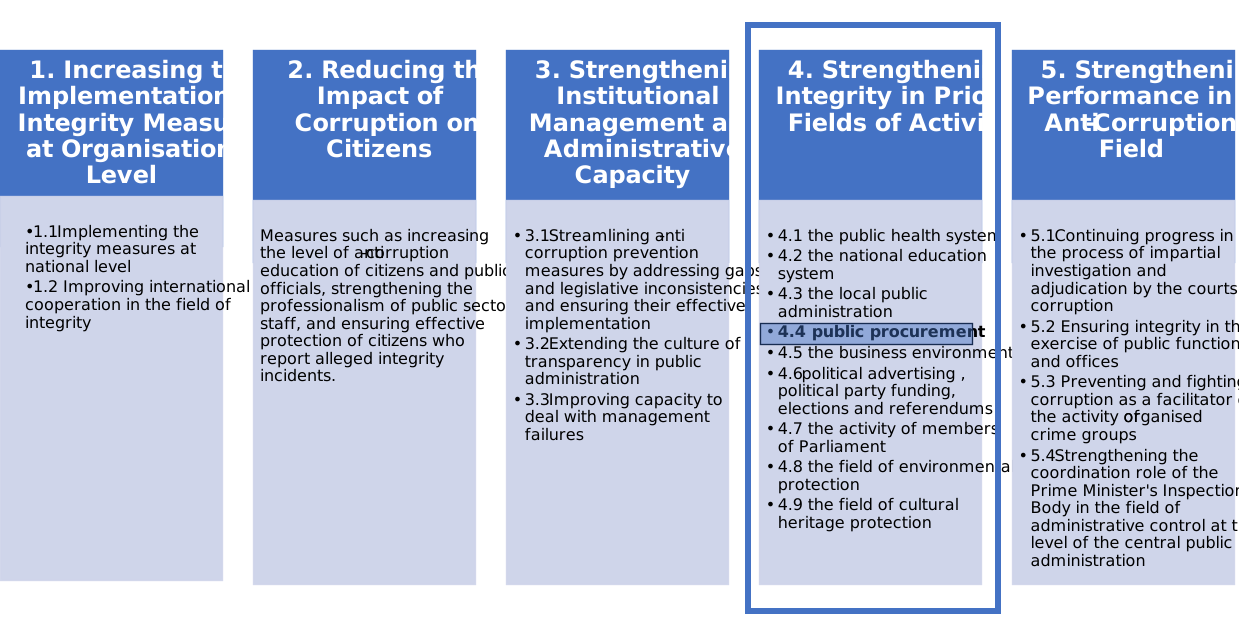
Note: General Objective 2 (Reducing the Impact of Corruption on Citizens) includes seven measures but does not include specific objectives.
Source: Adapted from Ministry of Justice (2021), National Anti-Corruption Strategy 2021-2025.
Romania’s National Public Procurement Strategy 2023-20272 also sets out specific initiatives linked to risk management and integrity, including strengthening confidence in the public procurement system by increasing the transparency of the procurement process and ensuring efficiency and effectiveness through effective use of data and strengthened monitoring, supervision and control functions. The Strategy lays out actions to achieve these objectives, which include (Government of Romania, 2023[10]):
Assessing the current state of publication of procurement information and data against the Open Contracting Data Standard and determining the need to further develop e-procurement functionalities and enhance the publication of data and information.
Assessing the efficiency and effectiveness of the ex ante control system and identifying opportunities for improvement.
Analysing the effectiveness of anti-fraud mechanisms and providing clear guidance on sanctions to effectively, predictably and proportionately address breaches of legal rules.
Finally, Romania’s Recovery and Resilience Plan (RRP) includes measures to improve the quality and effectiveness of public administration by strengthening public procurement processes. In particular, component 14 of the RRP includes measures aimed at improving the public procurement process, including digitalisation and capacity building, as well as the adoption and implementation of the NAS (2021-2025). Under component 7, digital measures such as the implementation of eForms are expected to enhance public procurement transparency (European Commission, 2021[11]).
On the level of the public procurement system, the National Public Procurement Agency (ANAP) plays a central role in identifying and mitigating systemic risks within the public procurement process. ANAP conducts thorough analyses of the procurement cycle, starting from the publication of announcements or invitations to participate, and continuing through to the conclusion of contracts. This analysis is grounded in risk assessments that focus on deviations from average values of specific performance indicators organised into five key groups: the size and characteristics of the market, competition intensity, monitoring of economic activities, efficiency of public procurement (including contract implementation), and irregularities.
Despite the initiatives implemented by the Romanian government, the integrity of the public procurement system is still a challenge. Corruption, the manipulation of procurement processes, and collusion undermine value for money and can discourage competition, reducing the quality of goods and services procured. Integrity breaches also increase the risk of reputational damage to public institutions, diminishing citizens’ trust. This can be explained by different factors including the lack of a strong culture of integrity and the lack of capacity of the public procurement workforce, as well as a lack of harmonisation and coordination of risk management and integrity frameworks and tools. Given the close connection between integrity risks and other risk categories, addressing these problems demands a comprehensive approach that addresses all dimensions of public procurement risk.
This report seeks to complement and support the efforts of the Romanian government by focusing on measures to strengthen public procurement risk management. The first chapter of the report provides an analysis of the main challenges impacting the Romanian public procurement system from a risk management perspective, along with recommendations to address them. This includes an examination of personal and institutional liability in the Romanian system and the distinction between error, fraud and negligence. The second chapter analyses the status of public procurement risk management in Romania and makes recommendations on how it could be strengthened. Finally, chapter three describes the main risks impacting public procurement across the full procurement cycle, with a focus on integrity risks. The key recommendations of this report and an action plan for their implementation are provided in Annexe A.
References
[4] European Commission (2022), Special Eurobarometer 523: Corruption - Country Factsheets in English Romania, https://europa.eu/eurobarometer/api/deliverable/download/file?deliverableId=82840.
[11] European Commission (2021), Analysis of the recovery and resilience plan of Romania.
[5] European Commission (2021), Notice on tools to fight collusion in public procurement and on guidance on how to apply the related exclusion ground 2021/C 91/01, https://eur-lex.europa.eu/legal-content/EN/TXT/?uri=CELEX%3A52021XC0318%2801%29.
[10] Government of Romania (2023), National Strategy in Public Procurement 2023-2027, https://anap.gov.ro/web/hotararea-de-guvern-nr-554-pentru-aprobarea-strategiei-nationale-in-domeniul-achizitiilor-publice-2023-2027/.
[9] Ministry of Justice (2021), National Anti-Corruption Strategy 2021-2025, https://sna.just.ro/en/c/sna-2021-2025.
[1] OECD (2023), Government at a Glance 2023, OECD Publishing, Paris, https://doi.org/10.1787/3d5c5d31-en.
[8] OECD (2023), “Managing risks in the public procurement of goods, services and infrastructure”, OECD Public Governance Policy Papers, No. 33, OECD Publishing, Paris, https://doi.org/10.1787/45667d2f-en.
[3] OECD (2022), Building Trust to Reinforce Democracy: Main Findings from the 2021 OECD Survey on Drivers of Trust in Public Institutions, Building Trust in Public Institutions, OECD Publishing, Paris, https://doi.org/10.1787/b407f99c-en.
[6] OECD (2009), Guidelines for Fighting Bid Rigging in Public Procurement, OECD Publishing, Paris, https://doi.org/10.1787/8cfeafbb-en.
[7] Transparency International (n.d.), What is corruption?, https://www.transparency.org/en/what-is-corruption (accessed on 10 January 2025).
[2] US Department of State (n.d.), 2023 Investment Climate Statements: Romania, https://www.state.gov/reports/2023-investment-climate-statements/romania/ (accessed on 28 April 2024).