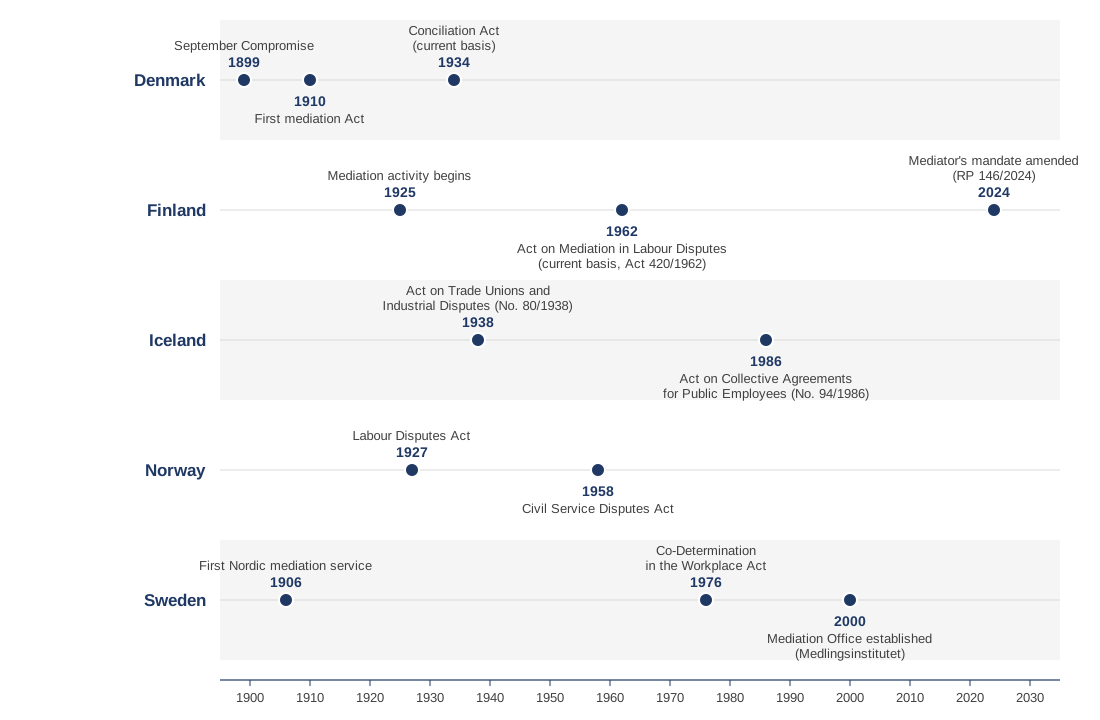
The five Nordic countries – Denmark, Finland, Iceland, Norway and Sweden – each have a public institution whose central purpose is to assist employers and trade unions in resolving collective bargaining disputes before they escalate into industrial action. Taken together, these five mediation offices form part of a broader industrial relations architecture that has delivered comparatively low levels of collective labour conflict and sustained wage co‑ordination over many decades. Yet despite their common heritage and shared functions, these institutions differ substantially in their legal foundations, governance arrangements, the profile of their mediators, the procedural powers available to them, and their role in the wage formation system.
This chapter documents and compares these differences. Its purpose is to provide a granular, evidence‑based account of how each office is designed and how it operates in practice – the institutional foundation needed before any evaluation of performance can be conducted. The comparison draws on a dedicated policy questionnaire sent to all five mediation offices, a shorter questionnaire addressed to social partner organisations in each country, and semi-structured interviews with mediators and social partners in all five countries in 2025-2026. Box 2.1 below provides further details on the methodology.
A striking feature that emerges even before the institutional details are examined is that, although the five mediation offices operate under separate national legal frameworks, they do not work in isolation from one another. They maintain regular contact and convene every two years in a dedicated forum to exchange experience, discuss procedural challenges and innovations, and reflect collectively on how the Nordic systems are performing. This peer network, while informal, reflects the broader Nordic tradition of institutional learning across borders. Stokke (2009[1]) observed that close Nordic ties have facilitated the exchange and selective adaptation of mediation practices; the current forum appears to sustain this dynamic, albeit primarily as a mechanism for learning rather than institutional change. Institutional reform lies largely beyond the remit of mediators, who seek to preserve their independence, including during periods of policy discussion.
The chapter is organised into two main sections. Section 2.2 describes the governance, actors, and resources of the five mediation offices, covering their legal frameworks and institutional origins, their governance and appointment procedures, the existence of sectoral or private mediation arrangements, the profile and powers of their mediators, and their staff and caseloads. Section 2.3 documents the main steps of the mediation process, from the procedural obligations that arise before formal mediation begins through the conduct of mediation itself to the balloting and approval mechanisms that determine whether a mediated proposal takes effect.