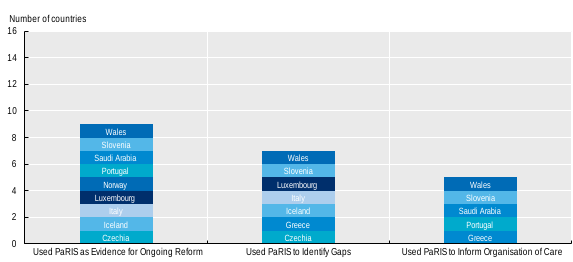
PaRIS results were published about a year before the interviews for this paper took place, which is a short period given the usual length of policy cycles. Nevertheless, most countries have already used the results for health policy and practice, and some have concrete action plans for implementation. The results show that PaRIS has helped countries identify systemic gaps in how care is organised and experienced from the patient perspective, including primary care and digital health. PaRIS has also confirmed known challenges, but this time from patients’ perspectives, giving healthcare performance assessment a new angle. Governments and healthcare providers have been using these insights to plan practical changes, refine contracts and incentives, align ongoing reforms and strategies, and link with administrative data to guide local improvement and policy decisions. This section details how countries have been using the PaRIS data and results for health policy and practice.
Policymakers and stakeholders have been waiting a long time for PaRIS. While the results were published in 2025, the development and implementation of PaRIS took seven years. During these seven years, countries worked together to design the survey in the international context, develop the PaRIS instruments, translate and cognitively test them, and field-test both the survey design and the instruments. All these activities have been necessary to develop a robust study and prepared the terrain to welcome the study results.
While it might still be early to see the policy and practice impact of PaRIS, many countries have already been using insights to identify gaps and advance policies and reforms. In some cases, PaRIS filled a knowledge gap or supported what has been already known in the country. The additional value of PaRIS has been bringing patient perspective into the topic, making it more policy relevant. While the next edition of the impact study might reveal more results, the initial examples are already providing inspiration to advance the use of PaRIS data for health policy and practice in the future.