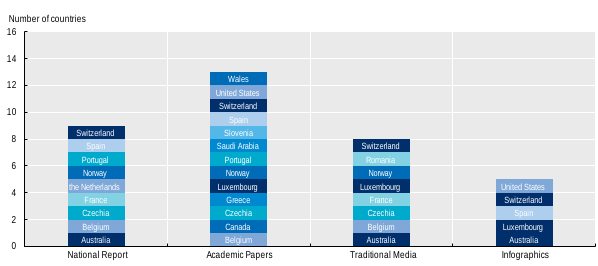
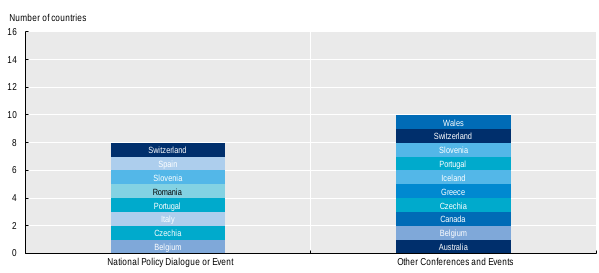
Dissemination and communication of findings, and engagement of key stakeholders has been a priority in all countries. Almost all of them published a national report, summarising the key findings from PaRIS Cycle 1 to their national audience. PaRIS‑10 key indicators have been the driving main content in most national reports and most of the time were presented along with other themes. Most countries organised policy dialogues with the participation of key stakeholders to enhance policy relevance and uptake of findings. National project managers presented the findings at various additional events, including academic conferences as well as sessions hosted by ministries to raise awareness. Some countries also produced analytical reports and academic papers drawing on additional analysis of their national data. This section details the dissemination and communication activities carried out at the national levels.
Dissemination and communication of the results from Cycle 1 were largely led by national project management teams, which varied in composition by country depending on the local context. In some countries, national project management was assigned to the Ministry of Health which also contributed from a policy perspective, while in others national project management was assigned to another institution. In some countries, regional and local authorities also took a role in the project management, by implementing the survey in their local context.
Project Management teams led by the ministry of health with academic advisors characterised Portugal and Spain. Portugal worked through the Ministry of Health and ACSS with the National School of Public Health as methodological partner, along with an advisory board of professional and patient organisations. Spain’s Ministry of Health also co‑ordinated with autonomous communities, scientific associations and patient groups.
National project management was led by academic institutions in collaboration with the Ministry of Health in Czechia, Greece, Italy and Luxembourg. Czechia appointed an academic family doctor affiliated with the Medical Faculty of Charles University to manage delivery with a designated Ministry of Health liaison to keep policy and implementation aligned. Greece placed overall responsibility with the Ministry of Health while the University of Athens led operations and survey implementation. Italy appointed the delegates to the Working Party on PaRIS from the Ministry of Health with survey implementation and analysis co‑ordinated by the Sant’Anna School of Advanced Studies. In Luxembourg, the operationalisation of PaRIS in the country was conducted by the Luxembourg Institute of Health, which was mandated by the Directorate of Health within the Ministry of Health and Social Security.
A ministry and public health institute model operated in Australia, Belgium, The Netherlands, Norway, Romania, Switzerland and Wales. In Australia, the Australian Commission on Safety and Quality in Health Care implemented the survey on behalf of the Department of Health, Disability and Aging. Belgium mandated Sciensano to run the project with a scientific steering committee including the health insurance institute and regional authorities. In the Netherlands, the Netherlands Institute for Health Services Research (NIVEL) was appointed the national project manager by the Ministry of Health, Welfare and Sport. Norway appointed the National Institute of Public Health as the national project manager and as the delegate to the Working Party on PaRIS. Switzerland appointed Unisanté as the operational hub and co‑ordinated with the Federal Quality Commission for decision making. In Romania, the National Authority for Quality Management in Healthcare was delegated by the Romanian Government to manage delivery. Wales located delivery in the NHS Wales Value in Health Centre with policy direction from the Welsh Government.
The United States ran PaRIS within the Medicare Current Beneficiary Survey at Centres for Medicare and Medicaid Services (CMS) with the policy implementation sitting largely decentralised from the project management team, and Saudi Arabia placed leadership with Centre for Value in Health (a policy think tank) under the national health insurance authority and drew in ministries, the health sector transformation programme, the primary care directorate, the national patient experience centre and private payers.
Local service and ministry combination characterised Slovenia, where the Ljubljana community health centre led with a deputy from the Ministry of Health and close co‑operation with the National Institute of Public Health, the Family Medicine Department and professional bodies.
Canada organised co‑ordination through the Canadian Primary Care Research Network with national project management teams from academia and provincial leads engaging each provincial ministry during fieldwork and follow‑up. In Iceland, the national project management and delegation was completely transferred to the University of Iceland, who also provided financing for Cycle 1.