This chapter examines trends in the size and composition of Israel's middle class, proxied by the middle-income group, i.e. people living in households with disposable incomes between 75% and 200% of the national median. It examines the size and evolution of the middle class over the last two decades, putting Israel's experience in international comparison. It then analyses changes in the composition of the middle class along various socio-demographic dimensions, including by age, household type, level of educational attainment, and ethno-religious background.
How is Israel's Middle Class Faring?
Income Trends, Occupational Change and the Rising Cost of Living

Abstract
People in the middle of the income distribution have enjoyed robust income growth in Israel over the last two decades. The Israeli median equivalised disposable household income1 grew by almost 45% between 2001 and 2021 after adjusting for inflation, or at an annualised rate of 1.8% (Figure 2.1). Most of this growth occurred after a short period of income decline in the wake of the dot-com crisis and the Second Intifada in the early 2000s, which negatively impacted the Israeli economy. This income growth rate was substantially higher than that experienced in some other large OECD economies over the same period, such as France (10%), Germany (20%) and the United States (35%) (Figure 2.1). The COVID‑19 crisis put a temporary hold to income growth: Israel successfully cushioned the crisis impact on household incomes through rapid support measures for affected households, including by broadening the eligibility of unemployment benefits, and through one‑time payments to families with children (OECD, 2020[1]; 2023[2]). However, across the income distribution, household incomes have stagnated between 2019 and 2021 in real terms.
As a result of this robust income growth, people in the middle parts of the income distribution have partially caught up with top income earners, while simultaneously pulling away from those at the bottom. While in the early 2000s, top income earners still benefited from more rapid income growth than households in the middle of the income distribution, this trend reversed around the time of the Global Financial Crisis. From around 2009, people between the 25th and 75th percentile of the income distribution enjoyed rapid income growth, slowly narrowing the gap relative to those in the top 10%. This trend of narrowing income inequalities distinguishes Israel from some other advanced OECD economies, such as Germany and the United States, where the gap between top income earners and other parts of the income distribution has widened since the early 2000s. However, people in the bottom of the income distribution are lagging behind in Israel: they experienced a more significant income decline in the wake of the 2001 economic downturn, a gap that did not close again in the two decades that followed.
Real median equivalised disposable household income of people at different points of the income distribution (2001=100), 2001 to most recent years

Note: Equivalised disposable household income assigns post-tax-and-transfer household income, adjusted for household size, to each household member. In 2019, the Israeli Household Expenditure Survey (HES) underwent significant changes: it transitioned to a computer-assisted field survey, revised its weighing system, and expanded its target population. These modifications affected the data series, so caution is needed when comparing income levels before and after these changes.
Source: OECD calculations based on microdata from the Luxembourg Income Study (LIS) database.
2.1.1. Israel’s middle‑income group has grown in the aftermath of the Global Financial Crisis, partially recovering the ground lost in the previous decades
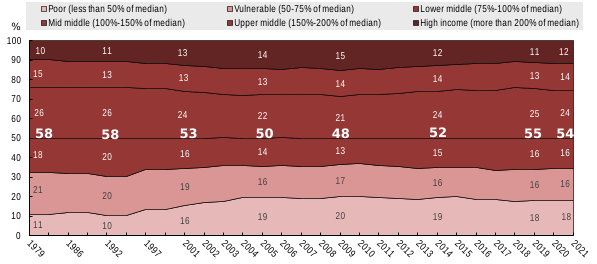
As a result of these income trends,2 the Israeli middle‑income group has expanded over the last decade or so since the GFC, recovering some of the ground lost since the 1980s and early 1990s. The share of people in the middle‑income group, i.e. those living with 75% to 200% of the national equivalised disposable household income (see Chapter 1, Box 1.1), grew from a low of 48% of the population in 2009 to 54% in 2021 (Figure 2.2). The middle part of the distribution (100% to 150% of the median) and the lower-middle‑income group (75% to 100% of the median) accounted for most of this expansion, while the upper middle‑income group (150% to 200% of the median) remained largely stable. Despite this growth, the size of the middle‑income group remains below the historic highs observed in the 1980s and 1990s, when nearly 60% of people in Israel were in the middle‑income group.
Percentage share of the population by income group, Israel, 1979-2021
Note: Income groups based on equivalised disposable household income: post-tax-and-transfer household income, adjusted for household size, attributed to each household member.
Source: OECD calculations based on microdata from the LIS database.
The growth of the middle‑income group is reflected in a corresponding shrinking of the groups in the two tails of the distribution. The share of people in the top-income group (over 200% of the median) dropped from 15% to 12% between 2009 and 2021 as middle and top incomes converged – i.e. broadly back to the values observed in the 1990s (Figure 2.1). The share of poor people (below 50% of the median) also decreased, by almost 2 percentage points (p.p.) since 2009, but it still stands well above the values observed in the 1980s and early 1990s (18% vs. just above 10%).
2.1.2. Israel’s middle‑income group remains among the smallest across the OECD
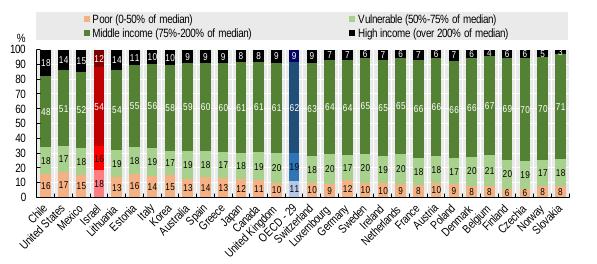
Despite its recent growth, the Israeli middle‑income group remains among the smallest across the OECD. Out of the twenty-nine countries for which data are available, only the United States, Chile and Mexico had a smaller middle‑income group than Israel in 2021. Israel also lagged the OECD average by a large margin, at 54% versus 62% (Figure 2.3). By construction, the size of the middle‑income group relates very closely to the level of income inequality (OECD, 2021[3]). Consequently, the Israeli middle‑income group is similar in size to those in other countries where income inequality is high, such as in the United States and in the Baltic countries. The middle‑income groups are largest in the Nordic and Central European countries, where income inequality is low. The poverty rate in Israel is also high compared to most OECD countries: the share of poor people in Israel reached 18% in 2021, far above the 11% OECD average (Figure 2.3).
Percentage share of the population by income group, 2021 for Israel and most recent year for the remaining countries
Note: The most recent year varies across countries, ranging from 2016 to 2022. Data for the year 2020 has not been used to avoid distortions because of the COVID‑19 crisis. Income groups are based on equivalised disposable household income: post-tax-and-transfer household income, adjusted for household size, attributed to each household member. OECD‑29: unweighted average of the countries shown.
Source: OECD calculations based on microdata from the LIS database.
This section presents evidence on the socio-demographic composition of the middle‑income group in Israel. It documents the extent to which people of different ages, educational levels and ethno-religious groups are represented in the middle‑income group, and how their likelihood of living in a middle‑income household evolved over time.
2.2.1. Younger generations have benefited from rising incomes, but still lost ground relative to older generations
As a result of strong income growth in Israel over the last decades, each generation has been enjoying higher real median incomes than the previous one did at a comparable age (Figure 2.4, Panel A).
Age trajectories in real median equivalised disposable household incomes (2017 PPP-adjusted USD), by generation

Note: For each generation-age group, median incomes are computed by averaging across all survey years from the 1990s to the latest available year in which a generation is observed at a given age. To improve robustness, only generation-age groups that appear in at least two survey years are included, and survey years where the generation-age group represents a larger share of the population receive a greater weight. Income groups based on equivalised disposable household income: post-tax-and-transfer household income, adjusted for household size, attributed to each household member. Adapted from Bassanini et al. (2025[4]). Incomes are expressed in 2017 PPP-adjusted USD. Consumer Price Index data are already available in the LIS database and come from the International Comparison Programme (ICP) at the World Bank.
Source: OECD calculations based on microdata from the LIS database.
Moreover, the generation of Millennials – i.e. people born in the 1980s and early 1990s – benefited from somewhat steeper income trajectories than earlier generations. This distinguishes young Israelis from their peers in most OECD countries, where young people have experienced flatter income trajectories than earlier generations (Figure 2.4, Panel B) or no income growth at all (Figure 2.4, Panel C; see Bassanini et al. (2025[4]) for a comprehensive analysis). As a result, when measured in purchasing power parity (PPP), the living standards of younger generations in Israel have been catching up with those of young people in countries where median incomes are higher, such as Spain and the United Kingdom. This reflects robust wage growth and a significant upskilling of the labour force over the past decades (see Chapter 3).
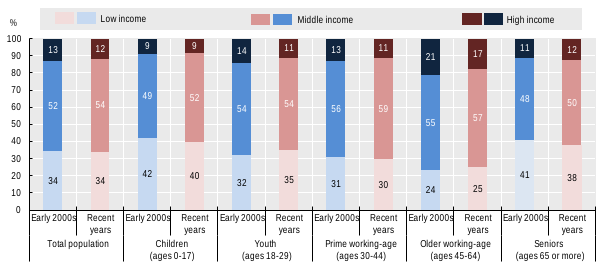
Nonetheless, young people in Israel saw their relative income position deteriorate compared to other age groups (Figure 2.5). Despite the growth in the overall size of the middle‑income group, the share of 18‑29 year‑olds who reach the middle class has stalled in Israel since the early 2000s; meanwhile, their share in the low-income group rose by 3 p.p., to 35%. Demographic change helps explain this shift: older age groups, who have higher incomes on average, now make up a larger share of the population. This has pushed up the income threshold necessary for entering the middle‑income group, making it harder for young people to access this group.
Population share belonging to different income groups by age groups, 2001/02 and 2019/21, Israel
Note: Values are averaged over two years to smooth year-to-year volatility in the data. The year 2020 is excluded to minimise the impact of the COVID‑19 pandemic on the analysis. Income groups based on equivalised disposable household income: post-tax-and-transfer household income, adjusted for household size, attributed to each household member.
Source: OECD calculations based on microdata from the LIS database.
In contrast, families with children and seniors experienced an improvement in their relative income position, even if both groups remain overrepresented in the low-income group. The share of children3 in the middle‑income group rose by 3 p.p., that of seniors by 2 p.p., while the risk of falling into the low-income group declined. Still, children and seniors account for 40% and 38% of this group, compared to just 34% in the overall population.
2.2.2. People with lower educational attainment and ethno-religious minorities have struggled to reach the middle‑income group
People without tertiary education make up a smaller share of the middle‑income group and increasingly struggle to move up the income ladder. In the early 2000s, around one‑third of people in the middle‑income group held a tertiary degree. Twenty years later, those with tertiary education accounted for half of this group. This increase partly reflects the expansion of tertiary education in Israel. Moreover, over the last 15 years, the Israeli labour market has shifted from manufacturing into service‑oriented activities, and most middle‑income jobs are now in high-skilled occupations (see Chapter 3). In this context, people with low education increasingly struggle to leave the low-income group: in recent years, 51% of those without an upper‑secondary qualification were in the low-income group, compared to still just 45% in the early 2000s (Figure 2.6). Among the young, education has become even more crucial: in recent years, two‑in-three of those without a high school diploma were in the low-income group.
Population share belonging to different income groups by education level, 2001/02 and 2019/21, Israel

Note: Values are averaged over two years to smooth potential year-to-year volatility in the data. The year 2020 is excluded to minimise the impact of the COVID‑19 pandemic on the analysis. Income groups based on equivalised disposable household income: post-tax-and-transfer household income, adjusted for household size, attributed to each household member.
Source: OECD calculations based on microdata from the LIS database.
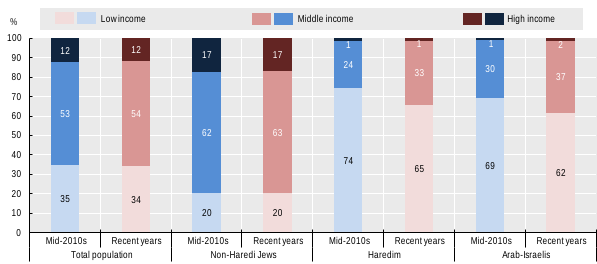
There are also substantial ethno-religious disparities in the access to the middle‑income group in Israel. People from ethno-religious minorities, notably Arab-Israelis and Haredi (ultra‑orthodox Jewish) people, remain strongly underrepresented in the middle‑income group relative to the non-Haredi Jewish majority, even if their situation has improved. In the mid‑2010s, the earliest years for which detailed ethno-religious groups are identifiable in the Israel income data, people in households headed by an Arab-Israeli or a Haredi Jew accounted for only 5% of the middle‑income group; in more recent years, their share had increased to around 8.5%.4 Part of this growth is attributable to improved economic opportunities and participation for these minorities.5 Indeed, the share of Haredim that make it to the middle‑income group has risen by 9 p.p. since the mid‑2010s; that of Arab-Israeli has risen by 7 p.p. (Figure 2.7). The remainder reflects the growing share these minorities make up in the total population.
Still, the incomes of ethno-religious minorities continue to lag well behind those of the non-Haredi Jewish majority.6 In 2021, the latest year with available data, the median equivalised disposable household income of both Haredim and Arab-Israelis was slightly over ILS 60 000 (about USD 18 700), around half that of non-Haredi Jews (ILS 124 000, or about USD 38 600). These minorities consequently remain strongly underrepresented in the middle‑ and high-income groups. In recent years, only 33% and 37% of Haredim and Arab-Israelis made it to the middle‑income group, compared to 63% of the non-Haredi Jewish majority (Figure 2.7). The share of people from ethno-religious minorities who make it into the high-income group are practically negligible.
Various factors can explain why among ethno-religious minorities a much smaller share of people reach the middle‑income group, including disparities in educational outcomes, employment, and demographics. Indeed, educational outcomes in Israel remain closely tied to ethno‑religious background, limiting access to the middle‑income group for minorities. Arab‑Israeli pupils perform substantial less well on the national Meitzav exams (Ayalon et al., 2019[5]), standardised tests for pupils in grades 5 and 8 of primary and lower‑secondary education. They also lag their Jewish peers in high‑school graduation rates, by around 10 p.p., despite improvements over the last decades (Taub Center, 2023[6]). These educational disadvantages translate into a weaker school-to-work transition and poorer labour market outcomes. In 2021, around 35% of Arab-Israelis aged 18 to 24 were not in employment, education or training (NEET), more than twice the share among the non-Haredi Jewish youth (15%) (OECD, 2023[2]). Arab Israelis also exhibit substantially lower employment rates (see Chapter 3, Box 3.1). These types of disadvantage transmit from one generation to the next and undermine upward mobility (OECD, 2026[7]): only 7% of Muslim Arab Israelis born to parents in the bottom quartile of the earnings distribution manage to climb to the top earnings quartile, compared to 18% of non-Haredi Jews (Gordon, Flug and Kenneth, 2022[8]). Closing these educational and employment gaps is therefore essential to provide ethno-religious minorities with equal opportunities to join the middle class. Meanwhile, while most Haredim have obtained a tertiary degree, their education often takes the form of religious studies, which offer limited relevant and transferable labour market skills (see Chapter 3, Box 3.1). Living arrangements and demographics also differ across socio‑economic groups, with both Arab Israelis and Haredim living, on average, in larger households with a greater number of children, with implications for their living standards and their access to the middle‑income group (see Box 2.1).
Population share belonging to different income groups by ethno-religious group of the household head, 2014/15 and 2019/21, Israel
Note: Values are averaged over two years to smooth potential year-to-year volatility in the data. The year 2020 is excluded to minimise the impact of the COVID‑19 pandemic on the analysis. Income groups based on equivalised disposable household income: post-tax-and-transfer household income, adjusted for household size, attributed to each household member.
Source: OECD calculations based on microdata from the LIS database.
Living arrangements play an important role in shaping people’s chances of accessing the middle class. Larger households, including those with many children, need to share the available income among a greater number of household members, which results in a lower equivalised disposable income available to each member (see endnote 1). Large families may also find it harder to balance work and caring responsibilities, which can be an obstacle to parents’ labour market participation (see Chapter 3, Box 3.1).
People from ethno-religious minorities in Israel are more likely to have children, and they have larger families. Among the non-Haredi Jewish majority, couples with children represent less than half of all working-age households; those with two children or more account for 30% of households. By contrast, among Haredi and Arab-Israeli households, couples with children make up a large majority of working‑age households, and those with two or more children account for 73% and 51% of households, respectively (Figure 2.8, Panel A).
As a result, people from ethno-religious minorities are, on average, much younger than the non-Haredi Jewish majority: while around 40% of non-Haredi Jews are under age 30, the share reaches close to 60% among Arab-Israelis and over 70% among Haredim (Figure 2.8, Panel B).
Share of couples among all working-age households by number of dependent children (Panel A) and age distribution of the population (Panel B), by ethno-religious group, Israel, 2021
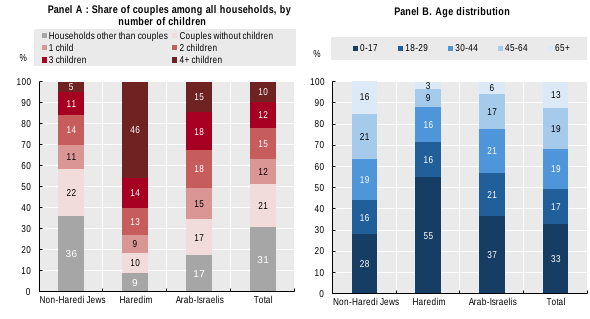
Note: “Total” includes ethno-religious groups other than the three shown in this figure. Information on ethno-religious group is only available for the household head; in the analysis it is then applied to all household members. In Panel A, only households with at least one working‑age individual (25‑64) are included. Household types other than couples include one‑person households, single‑parent households, multigenerational families, and non-relatives living together, among others. A dependent child is defined as a child aged 17 or younger, or a child aged 18 to 24 still enrolled in continuous education.
Source: OECD calculations based on microdata from the LIS database.
This chapter has provided analysis of the evolution of the Israeli middle class over the last two decades. The main findings are:
The Israeli middle class has grown since the Global Financial Crisis but remains among the smallest across the OECD. The share of people belonging to the middle‑income group has risen from a low of 48% in 2008-2009 to roughly 54% in 2021. Even so, the group is much smaller than it was in the 1980s and 1990s and is far below the OECD average of 62%.
Younger people and those without tertiary education have found it increasingly hard to access the middle class over the past two decades. The disadvantage is sharpest for young people without upper-secondary education: two‑thirds of them fall into the low-income group, compared to one‑third of the population overall.
Ethno-religious minorities remain strongly underrepresented in the middle class, even if they have seen their relative income position improve. Only 33% of Haredi (ultra‑orthodox) Jewish people and 37% of Arab-Israelis make it into the middle‑income group, compared to 63% of people from the non-Haredi Jewish majority.
References
[5] Ayalon, H. et al. (2019), “Educational Inequalities in Israel: From Research to Policy”, Taub center, https://taubcenter.org.il/wp-content/uploads/educationinequalityinisraeleng.pdf.
[4] Bassanini, A. et al. (2025), “Chapter 2 - Setting the scene: demographic change, economic growth and intergenerational inequalities”, in OECD Employment Outlook 2025: A labour market that works for all ages, OECD Publishing, Paris, https://doi.org/10.1787/194a947b-en.
[8] Gordon, G., K. Flug and R. Kenneth (2022), Intergenerational Mobility in Israel: Do Gaps Get Smaller from Generation to Generation?.
[7] OECD (2026), Social Mobility in Israel, OECD Publishing.
[2] OECD (2023), OECD Economic Surveys: Israel 2023, OECD Publishing, Paris, https://doi.org/10.1787/901365a6-en.
[3] OECD (2021), Is the German Middle Class Crumbling? Risks and Opportunities, OECD Publishing, Paris, https://doi.org/10.1787/845208d7-en.
[1] OECD (2020), OECD Economic Surveys: Israel 2020, OECD Publishing, Paris, https://doi.org/10.1787/d6a7d907-en.
[6] Taub Center (2023), State of the Nation Report 2023, https://www.taubcenter.org.il/en/states/2023-en/.
← 1. Equivalised disposable household income assigns post-tax-and-transfer household income, adjusted for household size, to each household member. Post-tax-and-transfer household income includes wages and salaries, income from self-employment and unincorporated enterprises, pensions and other social benefits, and income from financial investments, minus payments of taxes, social insurance contributions and interest on financial liabilities. This income is adjusted for household size using the square‑root method, i.e. by dividing the household income by the square root of the household size, to account for within-household sharing of resources. Median equivalised disposable household income is the income of the person in the middle of the income distribution: half of the people have a higher equivalised disposable household income than the median person, half have a lower income.
← 2. Since the analysis in this section defines income groups based on thresholds expressed relative to the median income, their size reflects the income patterns shown in Figure 2.1: when income growth is uneven across different parts of the distribution, people cross these thresholds, moving from one income group to another.
← 3. The income variable used in this report is equivalised disposable household income (see endnote 1). Therefore, the income of children captures the post-tax-and-transfer income of the households where children live, adjusted for household size.
← 4. In LIS data, information on ethno-religious group is only available for the household head. The analysis in this chapter applies the ethno-religious status of the household head to all the household members. In 2021, non-Haredi Jews accounted for roughly 65% of the population, Arab-Israelis for 21%, and Haredim for 11%.
← 5. Arab-Israeli people accounted for roughly 18.5% of the population in 2014 and 21% in 2021; Haredi Jews represented roughly 9% of the population in 2014 and 11% in 2021.
← 6. By contrast, migrant background does not appear to play a key role for access to the middle‑income group, at least among Jewish people in Israel for which it can be measured precisely. Among Jewish people, those living in households headed by a person born outside of Israel had similar chances of making it into the middle‑income group as those in other Jewish households. However, they were overrepresented in the low-income group and underrepresented among high-income households.