This chapter examines the labour market situation of middle-income workers in Israel, putting the country's experience in comparison with other OECD countries. It analyses access to the middle-income group for workers from different demographic and ethno-religious backgrounds, and examines the occupational and sectoral distribution of middle-income workers and how it has evolved over time. The chapter also examines wage trends for middle-income workers and changes in the skill premium, with a focus on inequalities by gender and ethno-religious background.
How is Israel's Middle Class Faring?
Income Trends, Occupational Change and the Rising Cost of Living

Abstract
With earnings from work being the main source of income for most people across the income distribution, the type and quality of jobs that people can access is a key determinant of their family’s chances of making it into the middle class. However, navigating a transforming labour market has become challenging for many middle‑income households. Across OECD countries, megatrends such as digitalisation and demographic change are changing the skills set that workers need to remain competitive. Many traditional middle‑class jobs, notably in manufacturing and clerical occupations, have been in retreat over the past decades. More recently, even high-skilled professional occupations, which permitted workers access to middle‑class incomes, have gotten under pressure with the spread of Artificial Intelligence (AI), to which white‑collar workers have been particularly exposed (Georgieff and Hyee, 2021[1]). Over 20% of workers responding to the 2022 OECD Risks that Matter Survey believed their job is likely to be replaced by a robot, computer software, algorithm or AI system (OECD, 2024[2]).
This chapter examines the key labour market developments for middle‑class workers in Israel over the last two decades. It shows that economic growth, rising skill levels and a progressive employment shift toward higher‑paying service industries have contributed to steady wage growth for middle‑income workers in Israel, unlike in many other OECD countries, where middle‑class workers have faced stagnating wages and occupational polarisation (OECD, 2019[3]). However, the chapter documents also significant inequalities in labour market outcomes across socio-demographic groups, which limit employment and career opportunities for many.
Access to employment is perhaps the most critical factor impacting people’s opportunities to access the middle class. Households in which one or more working-age member do not participate in the labour market are less likely to earn sufficient income to reach the middle‑income group. In Israel, people in the middle and top of the income distribution are much more likely to participate in the labour market than those in the bottom. In 2021, the most recent year for which data are available, virtually all working-age people – both women and men – in the top income quintile were employed, compared to around three‑in‑four among those in the three middle quintiles, and only over one‑in-three in the bottom quintile (Figure 3.1, Panel A). This is despite a sustained increase in female employment at the bottom of the income distribution since 2001.
However, Israel has room to raise employment rates among middle‑ and bottom-income earners, relative to OECD peers. In 2021, just over 70% of working-age people in the middle income quintiles were employed, ranking Israel only above Colombia and Greece among OECD countries with available data, well below the 80% OECD average (Figure 3.1, Panel B). Employment rates in the bottom quintile also trailed the OECD average by almost 10 percentage points (p.p.). In contrast, Israel’s employment rate among those in the top quintile was close to the OECD average. Narrowing these gaps would contribute to a stronger, more resilient middle class in Israel.

Note: Panel B includes OECD countries with available data for 2021, the latest year with data for Israel. Data for countries available for other years are excluded to make results comparable, as the COVID‑19 crisis impacted employment rates in many OECD countries. Income quintiles based on equivalised disposable household income: post-tax-and-transfer household income, adjusted for household size, attributed to each household member. OECD‑17: unweighted average of the countries shown.
Source: OECD calculations based on microdata from the LIS database.
The remainder of this chapter is organised as follows: Section 3.1 illustrates that most workers access the middle‑income group. Section 3.2. highlights that middle‑income workers have experienced occupational advancement in recent decades, but some socio-demographic groups lag behind. Section 3.3 highlights that middle‑income workers have enjoyed robust wage growth, while the skill premium has shrunk.
This chapter adopts the same income‑based definition of the middle class used in Chapter 2, i.e. people with equivalised disposable household incomes1 between 75% and 200% of the national median are considered as being part of the middle class. However, unlike Chapter 2, this chapter presents results only for workers, i.e. those whose main activity status is full- or part-time employment, aged 25 to 64. Although the analysis focusses on middle‑income workers, some sections broaden the scope to include workers across other income groups.
3.1.1. Most workers access the middle‑ or high-income group, but some groups of workers lag behind
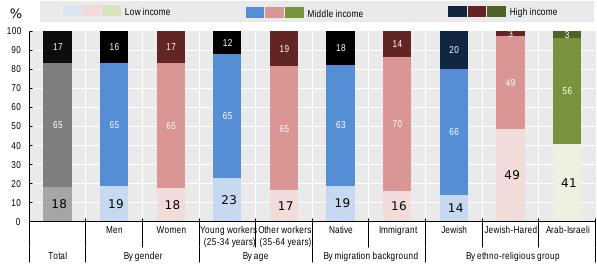
An alternative way of reading the previous analysis is that most people who work reach at least the middle‑income group. In the most recent years for which data are available people in employment were overrepresented both in the middle‑income group (63% vs. 54% of people) as well as in the high-income group (18% vs. 12%) relative to the overall population; meanwhile, they were underrepresented in the low‑income group (19% vs. 35%; Figure 3.2).
Yet, not for all socio-demographic groups does having a job provide equal access to the middle‑income group. As Figure 3.2 illustrates, there exist differences:
Among ethno-religious groups: only 49% of Haredi (ultra-Orthodox) Jews and 56% of Arab-Israeli workers belonged to the middle‑income group, compared to 66% of non-Haredi Jewish workers.2 Very few workers from these minorities reached the high-income group. These gaps reflect, in part, the overrepresentation of non-Jewish workers in low-paying occupations (Taub Center, 2023[4]; Debowy, Epstein and Weiss, 2021[5]). They are also linked to a greater prevalence of single‑earner households among ethno-religious minorities (Chapter 3, Box 3.1). Previous evidence suggests also that attitudes towards ethnic minorities remain quite negative relative to those in most OECD countries, which may create obstacles to their labour market integration (OECD, 2020[6]).
By age: the share of young workers in the low-income group is 5 p.p. greater than that of other workers. This reflects life cycle effects, with earnings increasing with work experience (Mincer, 1974[7]). Recent evidence from Israel suggests that, on average, earnings returns to occupational experience do not peak until after around three decades of work experience (Debowy, Epstein and Weiss, 2021[5]).
By migrant status: immigrant workers were more likely than native workers to make it into the middle‑income group (70% versus 63%), but they are underrepresented both in the high- and low‑ income group. This pattern suggests that Israel has been relatively successful at integrating immigrants into the middle class. A major driver of this success is the strong skill base of the immigrant workforce, especially among those who arrived from the former Soviet Union in the 1990s and early 2000s (Razin, 2017[8]).
People in employment by income group and demographic characteristics, Israel, 2019/21
Note: Workers are defined as people between 25 and 64 years old whose main activity is employment. The year 2020 is excluded to minimise the impact of the COVID‑19 pandemic on the analysis. Income groups are defined based on equivalised disposable household income: post-tax-and-transfer household income, adjusted for household size, attributed to each household member.
Source: OECD calculations based on microdata from the LIS database.
Employment is a key determinant of people’s access to the middle class, as households’ disposable incomes largely depend on the labour market participation of their working-age members. Among couples, who account for the majority of households (see Chapter 2, Box 2.1), those with two earners typically enjoy higher and more stable incomes than couples in which one or fewer adults work.
And there are large differences in labour market participation and work intensity between ethno-religious groups in Israel. Among Arab-Israeli and Haredi couples, a far greater share are workless and single‑earner couples than in the non-Haredi Jewish majority. Meanwhile, two‑earner couples accounted for only 29% of Haredi and 36% of Arab-Israeli couples in recent years, compared with nearly 60% of non-Haredi Jewish couples (Figure 3.4, Panel A). Among the Haredim, part-time work is widespread: in almost half of couples, neither partner works full-time, i.e. even for two‑earner couples the total work intensity may only correspond to one person when measured in full-time equivalents. When one partner does work full-time, it is often the woman. Among Arab-Israeli couples, single‑earner arrangements dominate, with men typically working full- or part-time while women remain outside of the labour force.
As a result, employment rates are substantially lower for people from ethno-religious minorities. In recent years, about 80% of working-age non-Haredi Jews were employed, compared with less than 60% of Haredim and Arab-Israelis. Gender gaps are also more pronounced among these groups: while among the non-Haredi majority there is virtually no gap in employment rates between men and women, employment rates are around 10 p.p. higher for Haredi women than for men, while the opposite is the case among Arab Israelis (Figure 3.4, Panel B).
Ethno-religious disparities in educational opportunities are one driver of these labour market differences. While 60% of working-age non-Haredi Jews hold a tertiary education qualification, the share among Arab Israelis is only 27% (Figure 3.4, Panel C). One reason is the limited instruction in Hebrew and English in Arab-Israeli schools, which makes it harder for students from these schools to access higher education, where these languages dominate. Resource gaps in Arab-Israeli schools relative to Jewish schools further reinforce these disparities (OECD, 2025[9]; 2023[10]). Most Haredim have tertiary education, but in the form of religious studies, which offer limited relevant and transferable labour market skills. Stipends for adults enrolled in advanced religious study institutions (kollels) further disincentivise labour market participation.

Note: “Total” includes ethno-religious groups other than the three shown in this figure. Information on ethno-religious group is only available for the household head; in the analysis, it is then applied to all household members. In Panel A, only households consisting of two working‑age individuals (25‑64) are included. The number of earners is shown in full-time equivalents, i.e. two adults each working part-time are considered as one earner. Values are averaged over two years to smooth potential year-to-year volatility in the data. The year 2020 is excluded to minimise the impact of the COVID‑19 pandemic on the analysis.
Source: OECD calculations based on microdata from the LIS database.
3.1.2. Women and young workers from low-income households are overrepresented among those who have joined the labour force
The Israeli workforce has expanded significantly over the last two decades, with the most pronounced relative growth having occurred in the low-income group. From the early 2000s to recent years, nearly 750 000 people in middle‑income households, 250 000 in low-income households, and 90 000 in high‑income households have joined the labour force. This expansion led to a shift in the composition of workers across income groups. Labour market participation has been historically lower at the bottom of the income distribution (Figure 3.1, Panel A), and the low-income group is relatively small (Chapter 2, Figure 2.2). For these reasons, despite a smaller increase in employment among low-income workers in absolute terms, the share of low-income workers in the total workforce increased by over 3 p.p., compared just 2 p.p. for middle‑income workers (Figure 3.4, Panel A). These gains mirrored a decline in the share of workers in the high-income group by 5 p.p. This relative decline in the high-income group is not necessarily a negative phenomenon: the vast majority of people at the top of the income distribution were already employed in the early 2000s (Figure 3.1, Panel A); therefore, room for employment growth was much larger among those living in low- and middle‑ income households.
Again, however, this overall trend masks important differences in the composition of employment growth for different socio-demographic groups:
Women in low-income households have disproportionally joined the labour force: among female workers, the share of those in the middle‑income group rose by 1 p.p., but by 5 p.p. in the low-income group, while it contracted by 6 p.p. in the high‑income group (Figure 3.4, Panel B). Most of the expansion in female labour force participation was driven by women taking up work as second earners, often part-time, possibly in response to the rising costs of core necessities such as food and housing (Chapter 4, Section 4.2). In contrast, among men, employment expanded most strongly in the middle‑income group, by 3 p.p.
Younger workers increasingly find themselves in the low-income group: among workers aged 25 to 34, there share of those in the low-income group has risen by almost 6 p.p. from the early 2000s to recent years (Figure 3.4, Panel C). In contrast, workers aged 35 and older were more likely to reach middle‑income status in recent years than in the early 2000s.3 The results mirror the deterioration in the relative income position of younger people in a context of rising incomes overall (see Chapter 2, Figure 2.5).4
More non-Jewish women have joined the labour market, particularly in middle‑income households: among non-Jewish workers,5 the share of those in the middle‑income group has risen by over 10 p.p. over the last two decades, a trend mirrored by an equivalent decline in the low‑income group (Figure 3.4, Panel D). This shift was driven by the increased employment of non‑Jewish women from middle‑income households.
Percentage point changes in the composition of employment by income group, Israel, 2001/02 to 2019/21

Note: Decomposition of the group of people between 25 and 64 years whose main activity is employment. Values are averaged over two years to smooth year-to-year volatility in the data. The year 2020 is excluded to minimise the impact of the COVID‑19 pandemic on the analysis. Income groups based on equivalised disposable household income: post-tax-and-transfer household income, adjusted for household size, attributed to each household member.
Data on specific ethno-religious groups were not available in the early‑2000s, so the broader category “Non-Jewish” is used instead. Over 80% of the non-Jewish population are Arab-Israeli.
Source: OECD calculations based on microdata from the LIS Database.
3.2.1. Middle‑income workers have experienced strong occupational advancement over the last 15 years
The large majority of middle‑income workers in Israel are employed in high- and middle‑skilled occupations.6 In recent years, high-skilled professionals were the largest occupational group, accounting for nearly 33% of middle‑income workers (Figure 3.5, Panel A). Occupations dominating this category include IT professionals, scientists, engineers and teachers (Annex 3.A). A further 17% of middle‑income workers were employed as high-skilled technicians and associate professionals, in roles such as business administration officers, nurses and social and community workers. Middle‑skilled crafts and trades workers, clerks, and plant and machine operators, accounted for another one‑fifth of middle‑income workers. Among high-income workers, high-skilled occupations even account for over 85% of all workers.
Still, a significant share of middle‑income workers were employed in low-skilled, low-wage occupations: 17% worked in service and sales jobs, and another 4% in elementary occupations. These roles are nearly absent among high-income workers, while they account for nearly 40% of low-income workers. Given the low wages generally paid in these occupations, workers in these jobs who make it into the middle‑income group usually do so by living with a higher-earning partner or because they have other sources of income.
Since the mid‑2000s, middle‑income workers have benefitted from occupational advancement7 (Figure 3.5, Panel B, vertical bars). The share of middle‑income workers:
In high-skilled occupations rose strongly, by over 10 p.p. for professional occupations and 6 p.p. for managerial roles. The share of middle‑income workers holding technical and associate professional roles also rose modestly.
In middle‑skilled occupations declined substantially, by nearly 6 p.p. for clerks and 5 p.p. for machine operators, with a modest decline also for craft and trades workers.
In low-skilled sales and service and elementary occupations declined modestly, by nearly 2 p.p. each.
As middle‑income workers make up most of Israel’s workers, a similar upskilling pattern is also evident for Israel’s total workforce (Figure 3.5, Panel B, black diamonds). However, the rise in high-skilled occupations, and the corresponding decline in middle‑skilled roles, has been slightly less pronounced for the entire workforce then for middle‑income workers. In other words: middle‑income workers have fared better at moving up in the occupational ladder than workers in other income groups.
The broad occupational advancement observed in the Israeli workforce is by no means standard across OECD countries, with many countries having experienced labour market polarisation in recent decades. Previous studies highlight that, in most major OECD economies, employment in both high- and low-skilled occupations has expanded, at the expense of middle‑skilled employment (OECD, 2019[3]; Salvatori and Manfredi, 2019[11]; Goos, Manning and Salomons, 2009[12]). This shift has been driven partly by the automation of tasks once performed by middle‑skilled workers, particularly in clerical and manufacturing roles. In Israel, this relative contraction of middle‑skilled jobs is also apparent, but it has been fully offset by an increase in high-skilled employment.

Note: Results are for working-age people (aged 25 to 64) in employment. Occupations are classified by ISCO‑08 and sorted by median hourly wages per occupation in 2021. Low-skilled, middle‑skilled and high-skilled occupations are shaded in white, grey, and red. Values are averaged over two years to smooth year-to-year volatility in the data. The year 2020 is excluded to minimise the impact of the COVID‑19 pandemic on the analysis.
Source: OECD calculations based on microdata from the LIS Database.
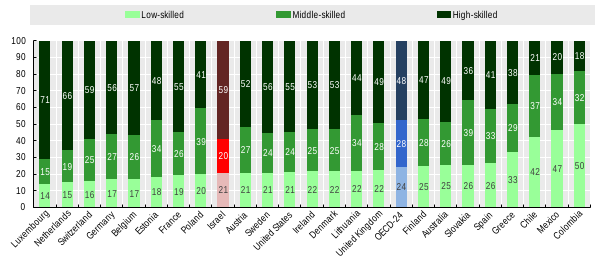
As a result of these trends, middle‑income workers in Israel are more frequently employed in high-skilled occupations than their counterparts across the OECD. In 2021, 59% of middle‑income workers held managerial, professional, technical or associate professional roles – positions that require higher skill levels – compared to just 48% across the OECD (Figure 3.6). This places Israel among the OECD countries with the highest share of high-skilled middle‑income workers. Meanwhile, relative to the OECD average, a low share of middle‑income workers in Israel held middle‑skilled jobs (20% vs. 28%) or low‑skilled jobs (21% vs. 24%).
Skill distribution of middle‑income workers, 2021 for Israel and most recent year for the remaining countries
Note: Results are for working-age people (aged 25 to 64) in employment. Occupations are classified by ISCO‑08. High-skilled occupations include managers, professionals and technicians and associate professionals; middle‑skilled capture clerks, craft and trade workers and plant and machine operators; and low-skilled include sales and service workers and elementary occupations. The most recent year varies across countries, ranging from 2016 to 2022, excluding 2020 because of the effect of the COVID‑19 crisis on the income distribution. OECD‑24: unweighted average of the countries shown.
Source: OECD calculations based on microdata from the LIS Database.
3.2.2. Female middle‑income workers experience greater occupational polarisation than men, despite similar upskilling in recent years
The overall occupational patterns discussed so far mask persistent inequalities across different groups of middle‑income workers, particularly between men and women, and Jewish and non-Jewish workers.
The occupational distribution of female middle‑income workers is more polarised than among their male counterparts. In the most recent years for which data are available, female middle‑income workers were substantially more likely than men to be employed in low-skilled sales and services roles (20% vs. 14%; Figure 3.7, Panel A). At the same time, a greater share of female compared to male middle‑income workers worked in high-skilled professional occupations (38% vs. 28%) and as high-skilled technicians or associate professionals (20% vs. 14%). This pattern may be partly explained by Israel’s substantial gender gap in tertiary education attainment, especially among younger generations. In 2023, 56% of women aged 25 to 34 had completed a tertiary education degree, compared to just 36% of men – a gap that is 7 p.p. larger than the average across OECD countries (OECD, 2024[13]).
Despite being overrepresented in high-skilled professional roles, women continue to face a glass ceiling. Male middle‑income workers were almost three times more likely to hold managerial roles (11% vs. 4%; Figure 3.7, Panel A). Also among high-income workers, most of whom work in high-skilled occupations, a substantial gender gap in the share of workers in managerial roles persist (not shown). This phenomenon is observed in most OECD countries and can be attributed to several factors, including the child penalty that women face in career progression, the struggle to balance work and caregiving responsibilities, which fall disproportionally on women, and outright discrimination in hiring and promotion processes for top roles (OECD, 2023[14]; Bertrand, 2018[15]).

Note: Results are for working-age people (aged 25 to 64) in employment. Occupations are classified by ISCO‑08 and sorted by median hourly wages per occupation in 2021. Low-skilled, middle‑skilled and high-skilled occupations are shaded in white, grey, and red. Values are averaged over two years to smooth year-to-year volatility in the data. The year 2020 is excluded to minimise the impact of the COVID‑19 pandemic on the analysis.
Source: OECD calculations based on microdata from the LIS Database.
High-skilled employment has expanded both among male and female middle‑income workers since the early 2000s. However, men have seen disproportionate growth in managerial occupations, while women experienced relative strong growth among technician and associate professional roles (Figure 3.7, Panel B). Meanwhile, male middle‑income workers have seen the most significant relative decline in plant and machine operator roles, while for female middle‑income workers the largest decline has been in clerical support jobs, reflecting gender differences in the distribution of middle‑skilled occupations (Figure 3.7, Panel A).
3.2.3. Non-Jewish workers struggle to move up the occupational ladder
Occupational divides are strong also between middle‑income workers living in Jewish and Arab-Israeli households (Figure 3.8, Panel A).8 In recent years up to 2021, Jewish workers were more likely than Arab‑Israeli workers to occupy high-skilled managerial positions (7% vs. 4%), as well technician and associate professional roles (18% vs. 8%). Meanwhile, Arab-Israeli workers were around twice as likely to be employed in low-skilled elementary occupations (9% vs. 4%), and middle‑skilled plant and machine operators (10% vs. 6%) and craft and trades worker roles (15% vs. 8%). Overall, the occupational distribution of Arab-Israeli middle‑income resembled more that of low-income workers than that of Jewish middle‑income workers (see Figure 3.5).
These occupational divides can be partly explained by barriers to occupational progression among non‑Jewish workers. Available data on the incomes and labour market outcomes of specific ethno-religious groups do not extend far back in time. However, non-Jewish workers more broadly – 81% of whom are Arab-Israeli – have not benefitted from the same type of occupational advancement observed across workers at large (Figure 3.8, Panel B). Since the mid‑2000s, the share of non-Jewish workers in middle‑skilled plant and machine operator roles has declined by almost 7 p.p. However, unlike for other groups, this decline does not primarily reflect relative employment growth in high-skilled professions. Instead, there has been substantial employment growth for craft and trades workers, linked to an expansion of the construction industry, as well as modest growth in low- and high-skilled occupations. In contrast, among Jewish middle‑income workers, the share of those in low- and middle‑skilled occupations has declined sharply over the same period, with a strong shift towards high-skilled roles.

Note: Results are for working-age people (aged 25 to 64) in employment. Occupations are classified by ISCO‑08 and sorted by median hourly wages per occupation in 2021. Low-skilled, middle‑skilled and high-skilled occupations are shaded in white, grey, and red. Values are averaged over two years to smooth year-to-year volatility in the data. The year 2020 is excluded to minimise the impact of the COVID‑19 pandemic on the analysis.
*Data on specific ethno-religious groups were not available in the mid‑2000s, so the broader category “Non-Jewish” is used instead in Panel B. Over 80% of the non-Jewish population are Arab-Israeli.
Source: OECD calculations based on microdata from the LIS Database.
3.2.4. Middle‑income workers have shifted out of manufacturing and into public services
Public services have become the cornerstone of employment in Israel even as middle‑income jobs remain broadly diversified across sectors. In recent years, over one‑in-three middle‑income workers were employed in public services (Figure 3.9, Panel A). These include civil servants, but also workers in healthcare and education, even if working in the private sector. Outside of public services, larger shares of middle‑income workers are represented in a number of other sectors, including in retail and hospitality (14%), real estate (14%) and manufacturing (13%). The sectoral composition of employment is generally similar across income groups, with some exceptions: middle‑ and high-income workers are overrepresented in the financial, and transport, storage and communications sectors, while low-income workers are overrepresented in construction and community and social work.
As most OECD countries, Israel has seen a relative decline in manufacturing employment (Pierce and Schott, 2016[16]; Berger and Frey, 2016[17]). This contraction has affected workers across all income groups, with declines in employment shares of 7 p.p. for middle‑ and high-income workers, and 8 p.p. for low-income workers. However, the types of employment that have replaced manufacturing jobs differ by income group. Middle‑income workers have dispersed fairly evenly across sectors, moving into real estate and business activities, public services, and transport, storage and communications. In contrast, high-income workers have moved predominantly into transport, storage and communications roles, whereas low-income workers have shifted largely into public service positions.

Note: Results are for working-age people (aged 25 to 64) in employment. Values are averaged over two years to smooth year-to-year volatility in the data. The year 2020 is excluded to minimise the impact of the COVID‑19 pandemic on the analysis. See Annex Table 3.A.2 for an overview of industrial classification.
Source: OECD calculations based on microdata from the LIS Database.
3.3.1. Middle‑income workers have benefitted from robust wage growth, while the skill premium in wages has shrunk
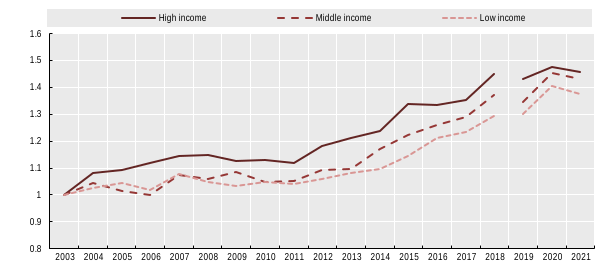
Middle‑income workers have experienced robust wage growth over the last two decades, broadly keeping pace with high-income workers. Between 2003 and 2021, middle‑income workers’ real median hourly wages rose by 43% (Figure 3.10). Most of this growth took place after 2011, following a period of relative stagnation associated with the Second Intifada and later with the global financial crisis. Since earnings from work are the primary income source for middle‑income households, these wage trends closely mirror those observed in equivalised disposable incomes (Chapter 2, Figure 2.1). Real wage growth among middle‑income workers has nearly matched that of high-income workers (46%), while workers in low‑income households slightly fell behind (37%).
Panel A. Real median hourly wages, by income groups (2003=1), Israel, 2003 to 2021
Note: In 2019, the Israeli Household Expenditure Survey (HES) underwent significant changes: it transitioned to a computer-assisted field survey, revised its weighing system, and expanded its target population. These modifications affected the data series, so caution is needed when comparing wage levels before and after these changes.
Source: OECD calculations based on microdata from the LIS database.
Despite robust wage growth, wage disparities across skill levels have declined in recent decades. As discussed earlier, the Israeli workforce – and especially middle‑income workers – have experienced a substantial rise in the skill level since the mid‑2000s, with increasing shares of workers employed in high‑skilled professional and managerial roles, and declining shares in lower- and middle‑skilled occupations (Figure 3.5). However, advancing on the occupational ladder pays off less than it did in the past. While in the mid‑2000s, professionals on average enjoyed wages around 60% higher than the median wage, this gap has fallen to just over 40% in recent years (Figure 3.11, Panel A). Similarly, in the mid‑2000s, technicians and associate professionals earned wages around 30% above the median, while in recent years their hourly wages have moved much closer to the median. This trend partly reflects broad occupational advancement over the last two decades: as a larger share of workers moved into high-skilled roles (Figure 3.5, Panel B), median wages have mechanically caught up with those of high-skilled occupations. However, gaps in hourly wages have also narrowed between workers in high-skilled technician, professional and managerial roles and those in low-skilled elementary occupations (Annex Figure 3.B.1).
Other high‑income countries have experienced a similar decline in the skill premia since the global financial crisis, reversing three decades of widening wage disparities across occupations (Kunst, Freeman and Oostendorp, 2020[18]). In Israel, the expansion of tertiary education may have contributed to the decline, as evidence suggests that a growing supply of educated workers can put downward pressure on the wages of high-skilled workers (Kaymak and Cline, 2025[19]; Boero et al., 2024[20]). Recent OECD work also highlights that Israel is among the OECD countries with a higher share of over-qualified workers (OECD, 2023[10]). This has likely contributed to a more even evolution of wages across income groups over the last two decades (Figure 3.10), with less positive implications for middle‑income workers, most of whom hold high-skilled jobs (see Figure 3.5).
Still, holding a high-skilled job yields greater relative earnings in Israel than in most OECD countries. Among high-income countries where recent data are available, Israel recorded the highest hourly wage gap between workers employed in professional occupations and the median worker, at 42% (Figure 3.11, Panel B). This is in line with other advanced OECD economies such as Ireland, Germany, and the United States, but significantly higher than in most European countries. Only in some upper-middle‑income countries, such Colombia, Chile and Mexico, where the supply of tertiary-educated workers is more limited, the hourly wage of high-skilled professionals is relatively larger.


Note: Results are for working-age people (aged 25 to 64) in employment. Occupations are classified by ISCO‑08 and sorted by median hourly wages per occupation. Panel A: Values are averaged over two years to smooth year-to-year volatility in the data. The year 2020 is excluded to minimise the impact of the COVID‑19 pandemic on the analysis.
Source: OECD calculations based on microdata from the LIS Database.
3.3.2. Wages of women and Arab Israelis lag behind, especially for high-skilled workers
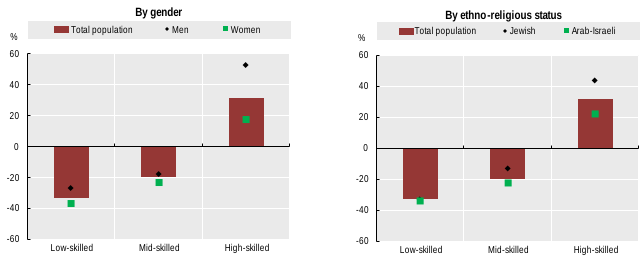
The relatively high skill wage premium in Israel again coincides with persistent inequalities between men and women, as well as between Jews and Arab Israelis, especially among high-skilled workers. In recent years, women earned lower wages than men across all occupations, with the gap being largest in high‑skilled occupations (Figure 3.12). For example, men employed as managers, professionals, and associate professionals earned, on average, 55% more per hour than the median worker; for women employed in similar roles, this gap was only 18%. This represents the bulk of the gender wage gap in Israel, which is among the largest across OECD countries (OECD, 2023[10]). Differences in wages between men and women are significantly smaller for middle‑ and low-skilled workers – at around 6 and 10 p.p., respectively. Similar disparities exist between Jewish and Arab-Israeli workers: Jewish workers earn higher hourly wages across all occupations, but the gap is the largest among high-skilled workers. These results likely reflect in part differences the sectoral composition of employment, but they also suggest that women and non-Jewish workers experience lower returns to skills.
Gap in median hourly wages between occupational groups with different levels of skills and the median worker, by gender and ethno-religious group, Israel, 2019/21
Note: Results are for working-age people (aged 25 to 64) in employment. Occupations are classified by ISCO‑08 and sorted by median hourly wages per occupation. Low-skilled occupations include elementary workers and service and sale occupations; middle‑skilled occupations include plant and machine operators, craft and trades workers and clerks; high-skilled occupations include managers, professionals, and technicians and associate professionals. Values are averaged over two years to smooth year-to-year volatility in the data. The year 2020 is excluded to minimise the impact of the COVID‑19 pandemic on the analysis.
Source: OECD calculations based on microdata from the LIS Database.
This chapter discussed the key labour market developments for middle‑class workers in Israel over the past two decades. The main findings are:
Most workers have access to the middle‑ or high-income group, but substantial shares of Arab Israelis (41%) and Haredim (49%) remain in the low-income group despite having a job. Over the last two decades, employment has increased particularly among people in low-income households, and especially among women.
Middle‑income workers in Israel have experienced occupational advancement, though some groups of workers have remained excluded. A decline in middle‑skilled manufacturing and clerical jobs in Israel has been fully offset by growth in high-skilled roles, unlike in many OECD countries, which experienced occupational polarisation. In recent years, high-skilled occupations have accounted for almost 60% of middle‑income jobs in Israel. However, occupational advancement has been uneven among different groups of middle‑income workers: women remain underrepresented in managerial roles relative to men; non-Jewish workers have barely advanced in the occupational distribution at all.
Middle‑income workers have enjoyed robust wage growth since the global financial crisis, much in line with that of high-income workers. The wage premium for high-skilled roles has decreased over the years, but it remains large compared to most OECD countries. Gender and ethno-religious wage gaps are large, and particularly so in high-skilled occupations.
References
[17] Berger, T. and C. Frey (2016), “Structural Transformation in the OECD: Digitalisation, Deindustrialisation and the Future of Work”, OECD Social, Employment and Migration Working Papers, No. 193, OECD Publishing, Paris, https://doi.org/10.1787/5jlr068802f7-en.
[15] Bertrand, M. (2018), “Coase Lecture – The Glass Ceiling”, Economica, Vol. 85/338, pp. 205-231, https://doi.org/10.1111/ecca.12264.
[20] Boero, G. et al. (2024), “The college wage premium in the UK: decline and fall?”, Oxford Economic Papers, https://doi.org/10.1093/oep/gpae014.
[5] Debowy, M., G. Epstein and A. Weiss (2021), Returns to education and labor market experience in Israel, Taub Centre for Social Policies in Israel, https://www.taubcenter.org.il/wp-content/uploads/2021/12/Returns-to-Education-ENG-2021.pdf.
[1] Georgieff, A. and R. Hyee (2021), “Artificial intelligence and employment : New cross-country evidence”, OECD Social, Employment and Migration Working Papers, No. 265, OECD Publishing, Paris, https://doi.org/10.1787/c2c1d276-en.
[12] Goos, M., A. Manning and A. Salomons (2009), “Job Polarization in Europe”, American Economic Review, Vol. 99/2, pp. 58-63, https://doi.org/10.1257/aer.99.2.58.
[21] International Labour Organization (2023), The International Standard Classification of Occupations (ISCO-08) companion guide, https://ilostat.ilo.org/methods/concepts-and-definitions/classification-occupation/.
[19] Kaymak, B. and A. Cline (2025), “Demand for College Labor in the 21st Century”, Economic Commentary (Federal Reserve Bank of Cleveland) 2025-04, https://doi.org/10.26509/frbc-ec-202504.
[18] Kunst, D., R. Freeman and R. Oostendorp (2020), Occupational Skill Premia around the World: New Data, Patterns and Drivers, National Bureau of Economic Research, Cambridge, MA, https://doi.org/10.3386/w26863.
[7] Mincer, J. (1974), The human capital earnings function, NBER, https://www.nber.org/system/files/chapters/c1767/c1767.pdf.
[9] OECD (2025), OECD Economic Surveys: Israel 2025, OECD Publishing, Paris, https://doi.org/10.1787/d6dd02bc-en.
[13] OECD (2024), Education at a Glance 2024: OECD Indicators, OECD Publishing, Paris, https://doi.org/10.1787/c00cad36-en.
[2] OECD (2024), Megatrends and the Future of Social Protection, OECD Publishing, Paris, https://doi.org/10.1787/6c9202e8-en.
[14] OECD (2023), Joining Forces for Gender Equality: What is Holding us Back?, OECD Publishing, Paris, https://doi.org/10.1787/67d48024-en.
[10] OECD (2023), OECD Economic Surveys: Israel 2023, OECD Publishing, Paris, https://doi.org/10.1787/901365a6-en.
[6] OECD (2020), All Hands In? Making Diversity Work for All, OECD Publishing, Paris, https://doi.org/10.1787/efb14583-en.
[3] OECD (2019), Under Pressure: The Squeezed Middle Class, OECD Publishing, Paris, https://doi.org/10.1787/689afed1-en.
[16] Pierce, J. and P. Schott (2016), “The Surprisingly Swift Decline of US Manufacturing Employment”, American Economic Review, Vol. 106/7, pp. 1632-1662, https://doi.org/10.1257/aer.20131578.
[8] Razin, A. (2017), Israel’s Immigration Story: Globalization Lessons, National Bureau of Economic Research, Cambridge, MA, https://doi.org/10.3386/w23210.
[11] Salvatori, A. and T. Manfredi (2019), “Job polarisation and the middle class: New evidence on the changing relationship between skill levels and household income levels from 18 OECD countries”, OECD Social, Employment and Migration Working Papers, No. 232, OECD Publishing, Paris, https://doi.org/10.1787/4bf722db-en.
[4] Taub Center (2023), State of the Nation Report 2023, https://www.taubcenter.org.il/en/states/2023-en/.
[22] United Nations (2008), International Standard Classification of All Economic Activities. Revision 4, https://ilostat.ilo.org/methods/concepts-and-definitions/classification-economic-activities/.
Note: Occupations sorted by workers’ hourly wages in Israel in 2021 in descending order.
Source: International Labour Organization (2023[21]) and OECD calculations based on microdata from the LIS Database.
Note: Occupations sorted by workers’ hourly wages in Israel in 2021 in descending order.
Source: United Nations (2008[22]) and OECD calculations based on microdata from the LIS Database.
Gap in median hourly wages between each occupational group and workers in elementary occupations, Israel, 2005/06 and 2019/21
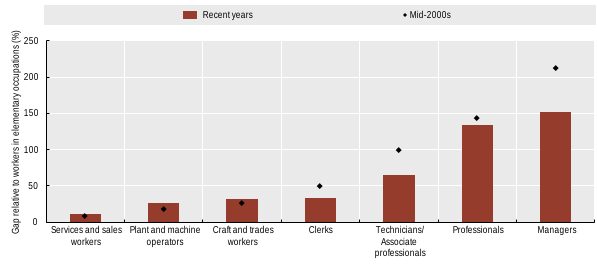
Note: Results are for working-age people (aged 25 to 64) in employment. Occupations are classified by ISCO‑08 and sorted by median hourly wages per occupation. Values are averaged over two years to smooth year-to-year volatility in the data. The year 2020 is excluded to minimise the impact of the COVID‑19 pandemic on the analysis.
Source: OECD calculations based on microdata from the LIS Database.
← 1. Equivalised disposable household income assigns post-tax-and-transfer household income, adjusted for household size, to each household member. Post-tax-and-transfer household income includes wages and salaries, income from self-employment and unincorporated enterprises, from pensions and other social benefits, and from financial investments, minus payments of taxes, social insurance contributions and interest on financial liabilities.
← 2. In LIS data, information on ethno-religious group is only available for the household head. This analysis applies the ethno-religious status of the household head to all workers living in the household. In 2021, non-Haredi Jews accounted for roughly 73% of workers, Arab-Israeli for 16%, and Haredim for 7%.
← 3. These results are relatively similar when defining younger workers as those between 25 and 29 years old, or between 18 and 29 years old, highlighting that the results are not driven by longer educational trajectories of younger people relative to the early 2000s.
← 4. They also reflect the demographic patterns discussed in Chapter 2: older age groups, who enjoy higher incomes on average, now account for a larger share of the working population than in the early 2000s. This has raised the income threshold required for entering the middle‑income group, making it more difficult for young workers to reach middle‑income status.
← 5. Data on incomes for specific ethno-religious groups do not extend far back in time, so the broader category “Non‑Jewish” is used instead. Over 80% of the non-Jewish population are Arab-Israeli.
← 6. Workers in the armed forces are excluded from the analysis.
← 7. LIS data are cross-sectional, so workers cannot be followed over time. Therefore, the analysis does not indicate that individual workers have moved up the occupational ladder, but rather than, among the middle‑income workers’ group, a larger share of them are employed in higher-skilled occupations over time.
← 8. In the LIS database, information on ethno-religious group is only available for the household head. This analysis applies the ethno-religious status of the household head to all workers living in the household.