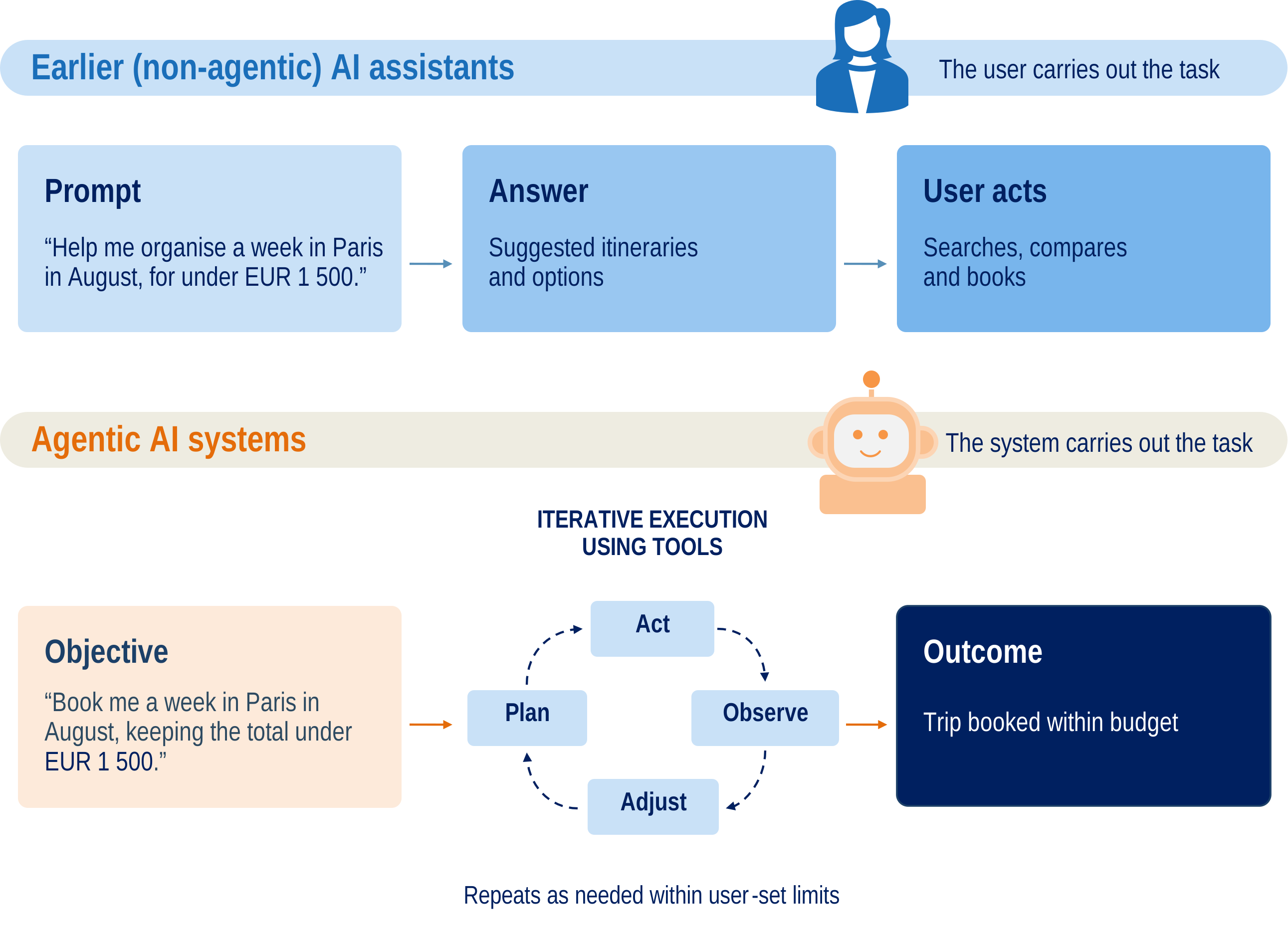
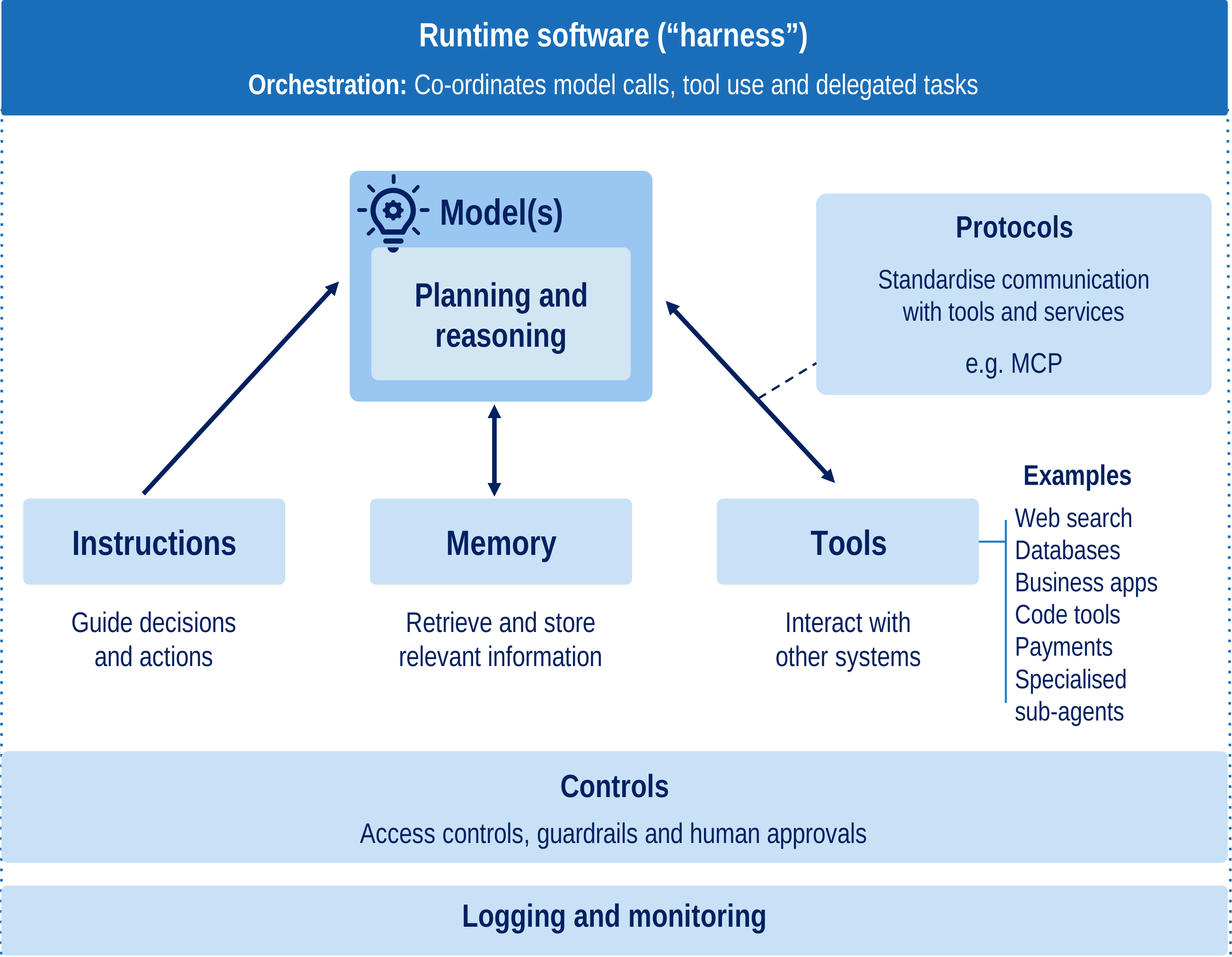
Agentic AI systems combine generative AI models with software, information and connections to carry out such tasks. The following paragraphs describe some of the key components and how they interact. These features underpin the later analysis of access to inputs and services, users’ ability to switch providers, and the consequences of delegating decisions in Sections 3 and 4. Figure 2 draws on existing literature to provide a simplified illustration of these components and their interactions.
In the systems considered here, generative AI models use patterns learned during training to generate outputs from the information they receive. A generative AI model can, for example, process instructions and produce text, propose a plan or request the use of a tool. Organising the sequence of work is the role of “orchestration”. A lead AI agent may plan the task and assign sub-tasks to specialised AI agents. In the travel example, separate AI agents could search for transport and accommodation. The same model need not perform every step: different models may be selected for successive requests according to the capabilities required (Anthropic, 2024[17]; Wang et al., 2024[18]).
The runtime software,1 sometimes termed a “harness”, supports this orchestration and manages how model outputs are translated into actions. It can restrict access to information and tools, impose spending limits and require human approval. For example, the system could be permitted to search for travel options but be prevented from making a payment without confirmation from the user. Some actions may also be confined to restricted execution environments known as “sandboxes”, which can limit access to tools, external systems and data. Such controls can be enforced through the surrounding software rather than relying solely on instructions to the model (AI Security Institute, 2025[19]; Liu, 2026[20]).
Tools and services provide the functions through which the system retrieves information or takes action. A hotel-search tool could return current availability, while a booking tool could submit a reservation and return a confirmation or an error. Connections often use application programming interfaces (APIs), which allow software to request information or actions from other software in a standardised way; systems may also interact through websites or application interfaces. Common protocols can support interoperability between components supplied by different providers. These connections may involve internal applications, external services or other AI agents, depending on technical compatibility and access permissions (Autorité de la concurrence, 2026[14]). The information returned must also be suitable for the task, including in its accuracy, currency and format. In the travel example, the system needs to identify whether a quoted price is per night or for the whole stay, which dates it covers and what cancellation conditions apply. Clearly labelled fields and consistent formats can help it interpret and compare offers, while information in documents or webpages may need to be extracted and checked before use.
As results return, the system needs to retain relevant information for subsequent steps. A language model can consider only a limited amount of information in each call, so the harness may select or summarise material for its current context. This could include the dates and itinerary under consideration, while a preference for refundable bookings could be stored separately as persistent memory for later retrieval. Reusable procedures, workflows or “skills” can supply standardised approaches for tasks, such as checking dates and cancellation terms before booking (Wang et al., 2024[18]). Returned results can then inform the next action: a failed reservation might prompt a revised search or a request for human input. The process can repeat until the objective is met, a limit is reached or human input is required.
While controls are widely used in agentic AI systems, their effectiveness remains an active area of research, practice and debate in AI safety and governance.2 Recent evaluations have found that advanced models, when tasked with escaping sandbox environments, can exploit deliberately introduced vulnerabilities and misconfigurations, illustrating challenges in containing capable systems (Marchand et al., 2026[21]). Security concerns may also affect the adoption of agentic AI systems and, potentially, competition between providers.
Agentic AI systems may also generate logs and records of actions taken, the requests made to tools and information retrieved. However, monitoring such systems remains challenging. Because model outputs are probabilistic and agent behaviours can emerge through sequences of interactions between models, tools and external services, it may be difficult to fully explain why a particular outcome occurred. Logging and observability tools can improve oversight, but they do not necessarily provide complete transparency into system behaviour or decision making processes (Microsoft, 2026[22]; Rao et al., 2026[23]). These limitations may complicate oversight by firms and investigations by regulators, although records of information flows, communications and actions can help reconstruct conduct without fully explaining the model’s internal operations. Importantly, difficulties in fully explaining model behaviour do not necessarily remove firms’ responsibility for outcomes.