This Reader’s guide provides background information on the report’s methodology to enhance the understanding of the analysis and its caveats. In particular, it describes the analytical approach as well as the underlying evidence base and its limitations, including in relation to the use of (composite) indicators.
Better Regulation Practices across the European Union 2025

To provide a practical and action-oriented assessment, this report uses the different stages of the regulatory policy cycle as an analytical lens to track the implementation of better regulation practices. They broadly align with commonly identified stages, including identifying challenges and exploring solutions; regulatory design; monitoring and implementation; and evaluation and review (Figure 1). In addition to Chapters 2 to 5 focusing on individual stages of the cycle, Chapter 1 examines the strategic and institutional foundations for better regulation and trends in the use of core tools, including stakeholder engagement and regulatory impact assessment (RIA) in developing rules and ex post evaluation.
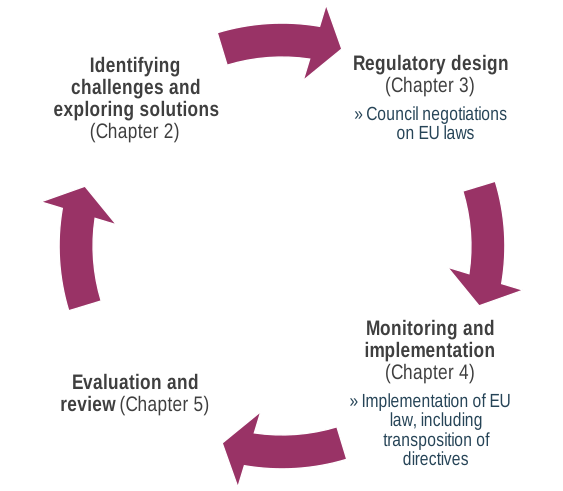
To reflect the unique institutional ecosystem of the European Union, analysis of better regulation practices in relation to EU lawmaking is also embedded in relevant chapters. Based on available data (see below), this focuses mainly on how Member States use better regulation when they engage with EU lawmaking at the Council negotiation stage (Chapter 3) and implementation stage, including transposition (Chapter 4). Underlying data focus exclusively on EU regulations and directives (rather than on implementing and delegated acts for which no data were collected). In addition, Chapter 1 provides highlights from this analysis and reflection on the broader institutional context of EU lawmaking.
The analysis in this report is mainly based on data collected through the Indicators of Regulatory Policy and Governance (iREG) survey, conducted with government officials. The data from three survey rounds are used, respectively reflecting information as of 31 December 2017, 1 January 2021, and 1 January 2024. To cover all EU Member States (EUMS) in the analysis, the surveys were extended to those countries that were not OECD Members at the time of the various data collections. This includes OECD accession candidate countries Bulgaria, Croatia and Romania as well as Cyprus, Malta.
The iREG survey focuses on better regulation practices as described in the OECD Recommendation of the Council on Regulatory Policy and Governance (OECD, 2012[1]). It investigates in detail three principles of the Recommendation: stakeholder engagement, regulatory impact assessment (RIA) and ex post evaluation. For each of these areas, the survey collects information on formal requirements and has gathered evidence on their implementation. While stakeholder engagement, RIA, and ex post evaluation are all core elements of regulatory policy, they do not, in and of themselves, constitute a comprehensive better regulation framework. Other principles from the Recommendation are currently not assessed in as much detail and may be covered in future iterations.
Scope of the Indicators of Regulatory Policy and Governance (iREG) data and their use in the report
Survey results are used throughout the report in different ways. First, results of individual questions are displayed to show trends in the number of EUMS applying particular practices. Second, qualitative information and examples provided through the survey are used to enrich the analysis. Third, composite indicators for stakeholder engagement, RIA and ex post evaluation provide an overview of alignment with the OECD Recommendation (Chapter 1). Fourth, a transparency indicator has been developed, based on the methodology and composite indicators (Chapter 3).
Each composite indicator is composed of four equally weighted categories:
1. Systematic adoption, which records formal requirements and how often these requirements are conducted in practice;
2. Methodology, which gathers information on the methods used in each area, e.g. the type of impacts assessed or how frequently different forms of consultation are used;
3. Oversight and quality control, which records the role of oversight bodies and publicly available evaluations; and
4. Transparency, which records information from the questions that relate to the principles of open government, e.g. whether government decisions are made publicly available.
The iREG survey focuses on the process of developing laws that are carried out by the executive branch of the national government and that apply to all policy areas. However, questions regarding ex post evaluation cover all national regulations regardless of whether they were initiated by parliament or the executive. Based on available information, most national regulations are covered by survey answers, with some variation across countries. Most EUMS have parliamentary systems. The majority of their national primary laws therefore originate from the executive. This is not the case, however, for Austria, France, Lithuania, Portugal and Romania, where fewer than 50% of primary laws are initiated by the executive.
For the purpose of the iREG survey, and in keeping with the OECD Recommendation, regulations are defined as the “[t]he diverse set of instruments by which governments set requirements on enterprises and citizens. Regulation includes all laws, formal and informal orders, subordinate rules, administrative formalities and rules issued by non-governmental or self-regulatory bodies to whom governments have delegated regulatory powers.” However, most questions in this questionnaire refer specifically to a subset of regulation, namely:
Primary laws, which are defined as regulations that must be approved by the parliament or congress. Primary laws are also referred to as “principal legislation” or “primary legislation”;
Subordinate regulation, which is defined as regulations that can be approved by the head of government, by the cabinet or by an individual minister or high-level official – that is, by an authority other than the parliament/congress. Note that many subordinate regulations are subject to disallowance by the parliament/congress. Subordinate regulations are also referred to as “secondary legislation”, “subordinate legislation” or “delegated legislation”.
Results for the European Union apply to all legislative acts (regulations and directives are considered as primary laws; implementing and delegated acts as subordinate regulations for the purpose of iREG) initiated by the European Commission, who is the executive of the European Union. It proposes new legislative acts, which are adopted by the European Parliament and the Council of the EU, usually through the ordinary legislative procedure. Throughout this procedure, the Council, comprised of representatives from EUMS, and the European Parliament can suggest amendments to the European Commission’s proposals. While the Council and the European Parliament can invite the European Commission to submit a legislative proposal, the European Commission is the sole initiator of legislation in the EU system. Further information on the EU’s regulatory system and the legislative process are provided in Chapter 1 and in the country profile of the EU in Chapter 6.
Caveats and limitations of the composite indicators
In interpreting results, it is important to bear in mind the methodological limitations of composite indicators, particularly those based on categorical variables, as in the current survey. Composite indicators are useful in their ability to integrate large amounts of information into an easily understood format (Freudenberg, 2003[2]). However, by their very nature, cross-country comparable indicators cannot be context-specific and cannot fully capture the complex realities of the quality, use and impact of regulatory policy. While the current survey, compared to previous editions, puts a stronger focus on evidence and examples to support country responses, it does not constitute an in-depth assessment of the quality of country practices. For example, while countries needed to provide examples of assessments of some specific elements required in RIA to validate their answers, the OECD Secretariat did not evaluate the quality of these assessments nor discussed with stakeholders the actual impact of the RIAs on the quality of regulations.
In-depth country reviews are therefore required to complement the indicators. Reviews provide readers with a more detailed analysis of the content, strengths and shortcomings of countries’ regulatory policies, as well as detailed and context-specific recommendations for improvement. EUMS have a wide range of governance structures, administrative cultures and institutional and constitutional settings that are important to take into consideration to fully assess regulatory practices and policies. While these are taken into account in OECD peer reviews, it is not possible to reflect all these country specific factors in a cross-country comparison of regulatory practices.
It is also important to bear in mind that the indicators should not be interpreted as a measurement of the quality of regulations themselves. While the implementation of the measures assessed by the indicators aim to deliver regulations that meet public policy objectives and will have a positive impact on the economy and society, the indicators themselves do not assess the achievement of these objectives.
The results of composite indicators are always sensitive to methodological choices, unless country answers are homogeneous across all practices. It is therefore not advisable to make statements about the relative performance of countries with similar scores. Instead, composite indicators should be seen as a means of initiating discussion and stimulating public interest (OECD/European Union/EC-JRC, 2008[3]). To ensure full transparency, the methodology for constructing the composite indicators and underlying data as well as the results of the sensitivity analysis to different methodological choices, including the weighting system, has been published (Arndt et al., 2015[4]).
References
[4] Arndt, C. et al. (2015), “2015 Indicators of Regulatory Policy and Governance: Design, Methodology and Key Results”, OECD Regulatory Policy Working Papers, No. 1, OECD Publishing, Paris, https://doi.org/10.1787/5jrnwqm3zp43-en.
[2] Freudenberg, M. (2003), “Composite Indicators of Country Performance: A Critical Assessment”, OECD Science, Technology and Industry Working Papers, No. 2003/16, OECD Publishing, Paris, https://doi.org/10.1787/405566708255.
[1] OECD (2012), Recommendation of the Council on Regulatory Policy and Governance, OECD Publishing, Paris, https://doi.org/10.1787/9789264209022-en.
[3] OECD/European Union/EC-JRC (2008), Handbook on Constructing Composite Indicators: Methodology and User Guide, OECD Publishing, Paris, https://doi.org/10.1787/9789264043466-en.