The implementation of the new model will require a period of testing, to learn what works well and to adjust things that don’t. National and regional stakeholders will need to work together symbiotically to consistently embed the new model across the network of local structures. This chapter provides an outline of the high-level roles and responsibilities of these different stakeholders as well as a strategic overview of pilot design and implementation, ahead of a full national roll-out. It also outlines how a pilot can allow a period of initial testing of the new model to test parameters and develop practical implementation experience. These preparations are intended to inform the wider national roll-out of the new model.
A New Model for Strengthening Public‑Private Partnerships in Employment Services in Italy

Abstract
The successful implementation of the proposed model requires a structured and sequenced approach that translates the three pillars set out in Chapter 3 into operational arrangements. The objective is not to create parallel governance structures or introduce disruptive reform, but to embed targeted enhancements within Italy’s existing institutional architecture. Therefore, implementation focusses on consolidating gains achieved under GOL, institutionalising effective practices, and introducing new elements in a phased and proportionate manner.
This approach is particularly important in the context of the transition beyond the current PNRR funding cycle. The expansion of contracted-out employment services over recent years has been supported by time‑bound EU resources. As these funds expire, implementation must support a shift from an extraordinary expansion phase to a stable and sustainable steady-state model. The proposed roadmap therefore emphasises predictability, gradual adjustment and alignment with ordinary funding and governance mechanisms, ensuring that improvements are durable rather than programme dependent.
The implementation design also seeks to institutionalise continuous feedback and learning across the system. Strengthened information flows between central and regional authorities, providers and monitoring bodies are intended to link policy conception, contracting practice, performance management and evaluation in a coherent cycle. Rather than episodic reform driven by new initiatives, the model envisages an embedded process of monitoring, evidence generation and iterative refinement. The following sections outline the respective roles and responsibilities of key actors, the proposed sequencing and timing of reforms, and the supporting governance framework required to move from policy design to nationwide delivery.
A clear governance structure will underpin implementation of the new model (Figure 4.1). This will delineate roles and responsibilities between national and regional actors and ensure robust co‑ordination. The governance model builds on Italy’s constitutional setup, based on central-regional roles, giving regions a key role in labour market policies implementation and public service centres governance and on lessons from GOL’s governance.
The schema in Figure 4.1 is designed to provide a conceptual visualisation for the high-level institutional programme design and governance framework. It does not depict a comprehensive account of the minutia of responsibilities and stakeholders involved. Data and information management are depicted separately to policy implementation to provide greater clarity on the need for the new provider performance management and participant choice information portal development that will be important enablers for the new system. Once the system is well established, these may be viewed more routinely as part of the policy implementation.
Beyond clarifying institutional roles, the governance framework is designed to strengthen co‑ordination around the strategic objectives of the new system, rather than focussing solely on delivery mechanics. At the national level, the Ministry of Labour and Social Policies – supported by SLI – and informed through the Commissione Tecnica Lavoro – Conferenza delle Regioni e delle Province Autonome’s (CTL-CRPA – interregional co‑ordination role), will define a small number of strategic objectives for the programme. These objectives will include the intended balance between activation and training, the role of different service pathways, and the degree of targeting of specific population groups in each pathway. This will build on the foundation already provided by the current GOL programme. In particular, the framework will allow objectives to differentiate between jobseekers who are job-ready and can be supported through activation focussed services, and those who require more intensive upskilling, reskilling or integrated support. Within this structure, regions will retain flexibility to adapt delivery to local labour-market conditions – for example, by modifying the precise parameters guiding individuals’ referrals into pathways – but within a common logic anchored in the pathways. This will ensure that activation intensity, training provision and outreach efforts are aligned with clearly articulated objectives, including for inactive and harder-to-reach groups.
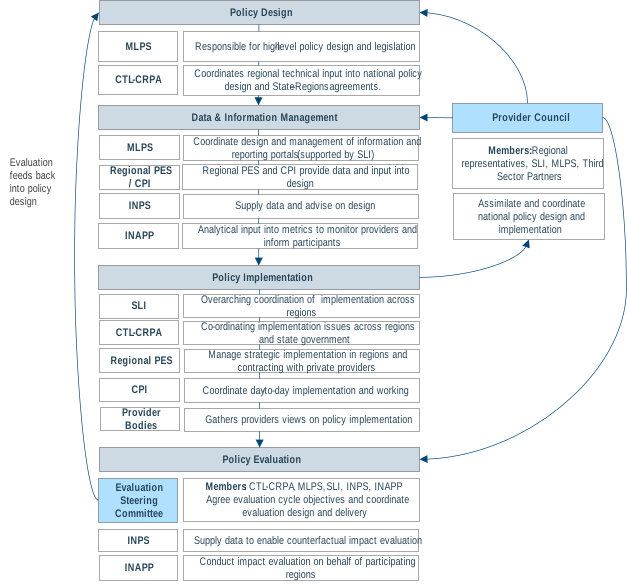
Note: Acronyms as follows: CPI – Centri per l’Impiego; CTL-CRPA – Commissione Tecnica Lavoro – Conferenza delle Regioni e delle Province Autonome; INAPP – Istituto Nazionale per l’Analisi delle Politiche Pubbliche; PES – Public Employment Services; INPS – Istituto Nazionale della Previdenza Sociale; MLPS – Ministero del Lavoro e delle Politiche Sociali; SLI – Sviluppo Lavoro Italia S.p.A.
This strategic co‑ordination will be complemented by an evolution in how programme performance is steered and assessed. While existing targets have largely focussed on inputs and uptake (such as enrolments or participation in training), the new model envisages a progressive shift towards outcome‑based targets, defined at national level but differentiated by pathway and participant profile. These could include indicators related to sustained employment, progression towards work for more vulnerable groups, or intermediate outcomes that capture meaningful engagement and progress where immediate employment is unrealistic. Nationally agreed outcome frameworks would provide a common reference point, while allowing regions to calibrate target levels and implementation approaches based on their starting position and labour-market context. This approach reinforces accountability for results without undermining regional autonomy, and creates a clearer feedback loop between strategic objectives, programme design and evaluation. The approach is also facilitated by the proposed additional individual-level data sharing on programme participation, which facilitates the calculation of these outcomes.
Key responsibilities for the main stakeholders include:
Ministry of Labour and Social Policies (MLPS): The ministry will lead policy oversight, set the strategic framework, and ensure consistency across regions. It will issue or sponsor necessary national legislation or inter-ministerial decrees to authorise the new model (as was done for GOL in 2021). Throughout implementation, the MLPS chairs the national steering of the programme, monitors progress towards national targets, and represents Italy in discussions with the European Commission regarding use of EU funds. The MLPS also allocates funding (national and EU co-funding) to regions, linked to performance and needs.
Sviluppo Lavoro Italia S.p.A. (SLI): SLI will continue to act as the technical supporting body and co‑ordination hub. SLI’s mandate as of 2024 is to support and accelerate ALMPs implementation across Italy. It will support MLPS for the new national Provider Council for ongoing consultation (see proposal in Section 3.2.2. of Chapter 3 and below) also by providing the dedicated secretariat for the Provider Council; support both the MLPS and regions in operational matters; co- facilitate cross-region collaboration. SLI’s specific tasks might also include: developing unified tools (e.g. a national provider performance portal, data systems), providing training and capacity-building for regional staff and providers, and helping to resolve implementation issues on the ground. SLI will have representatives embedded in regional co‑ordination networks as a member, given its co‑ordinating role. The agency might play a key role in “bridging” national and regional levels, also ensuring that best practices are shared and challenges addressed collectively. For the initial pilot, SLI will support, according to the MLPS indication, the working group that will manage the pilot implementation, alongside participating regions.
Commissione Tecnica Lavoro – Conferenza delle Regioni e delle Province Autonome (CTL-CRPA – Technical Working Committee – Conference of Regions and Autonomous Provinces): The CTL-CRPA will play a key role as the interregional co‑ordination and alignment forum for the implementation of the new model. It provides the main technical venue through which regions jointly discuss labour market policies, share implementation experiences, and develop common positions vis-à-vis the national government. In the context of the new programme, the CTL-CRPA will support horizontal co‑ordination across regions, facilitating convergence on the interpretation of national guidelines, service standards and operational requirements, while respecting regional autonomy. It will serve as a channel for regions to raise implementation challenges, propose adjustments to programme design, and exchange good practices emerging from pilots or early roll-out. It will also play an important role in preparing and underpinning any State – Regions Agreements related to the new model, helping to ensure that regional perspectives are reflected and that commitments are jointly owned. Through this function, it will strengthen collective ownership, reduce fragmentation, and support consistent implementation across Italy.
Regional Governments and Agencies: Regions will be responsible for on-the‑ground implementation of the new model, in line with the national framework. Each region will define Regional Implementation Plan (similar to GOL’s PAR). Regional authorities will manage the procurement or accreditation of service providers in their territory, run CPIs, and co‑ordinate with other local actors. They will retain autonomy over certain design aspects – for instance, how to integrate the new model with any existing regional schemes or how to organise provider networks – but must meet the nationally agreed minimum requirements. Formal co‑ordination agreements will be established where needed: for example, an updated State‑Regions Agreement can codify each side’s commitments. During GOL, a harmonised approach was achieved by embedding the programme’s design in the LEP and having every region sign on to common targets. The new model will likewise “lock in” regional commitment via jointly approved frameworks.
Local Public Employment Services (CPIs): The CPIs, managed by regional or provincial authorities, remain the front-line public interface for jobseekers. Their role in the new model is pivotal in identifying participants, providing initial orientation, and co‑ordinating with contracted providers. Following the GOL approach, CPIs will conduct profiling and assign jobseekers to appropriate service pathways (e.g. reintegration, upskilling, etc.), and then refer them to either in-house services or an external provider under contract. CPIs will also continue to deliver certain services themselves, especially for those needing lighter support or statutory functions like registering unemployment status. Under the new model, CPIs are expected to focus their own staff efforts on the most disadvantaged clients (with complex needs), while digitally capable job-ready clients may be diverted to self-service or lighter-touch streams. To make this work, CPIs must collaborate closely with providers: clear protocols will define how CPIs hand over clients to providers, how they share data on participant progress, and how they jointly ensure no one “falls through the cracks.” The plan may require CPIs to formally agree on referral and data-sharing procedures with contracted providers (potentially via regional directives or Memoranda of Understanding). CPIs will also likely supervise certain conditionality aspects (e.g. ensuring those on unemployment benefits meet participation obligations), even as providers deliver the actual services.
Istituto Nazionale della Previdenza Sociale (INPS): INPS will play a key supporting role in implementation by underpinning the programme with administrative data, benefit management and outcome verification. Given its responsibility for administering unemployment benefits and other income‑support measures linked to activation (e.g. NASPI, DIS-COLL, ADI), INPS will ensure timely and reliable data flows to support both service delivery and performance management. In particular, INPS will: support verification of employment outcomes used for outcome‑based payments to providers, drawing on contribution and employment records; enable data-sharing arrangements with CPIs, regions and national platforms to support profiling, monitoring of participation, and enforcement of conditionality; and co‑operate with CPIs in the application of benefit-related obligations and sanctions where participation in employment services is mandatory. Utilisation of INPS’ administrative data will help reduce reporting burdens, strengthen accountability, and improve the credibility of performance‑based contracting under the new model.
Istituto Nazionale per l’Analisi delle Politiche Pubbliche (INAPP): INAPP will provide analytical, monitoring and evaluation support to the implementation of the new model. As the national public research institute for labour market, education and training policies, INAPP will support the MLPS and regions in ensuring that implementation is evidence‑informed and continuously improved. The new programme envisages mandatory cycles of CIEs and INAPP would have a key role in co‑ordinating these evaluation cycles. This role might include: conducting the joint CIE for participating regions; further developing and maintaining common monitoring indicators and analytical frameworks across regions; supporting the design and quality assurance of CIEs, including methodological guidance to regions; and producing periodic learning and synthesis reports that consolidate evidence from administrative data, evaluations and stakeholder feedback. INAPP’s work will help ensure that implementation lessons are systematically captured and fed back into programme governance, supporting mid-course corrections and longer-term policy development.
National Provider Council: A new Provider Advisory Council will be established at the national level to improve governance through stakeholder engagement. This Council, housed in the MLPS and supported by SLI might also include representatives from the MLPS, SLI, Regions and selected employment service providers (or their associations). The Council institutionalises regular dialogue between public authorities and providers – a practice found in successful systems abroad. Its remit includes advising on programme design tweaks, addressing operational problems raised by regions or providers, and ensuring alignment of standards and innovations across Italy. Notably, any major changes to programme rules or national guidelines should be consulted with this Council before adoption. The Council meets quarterly (or more often if needed during critical rollout periods). Regions may decide how to organise their networks of providers and stakeholders to efficiently feed their viewpoint into the national council.
Provider Bodies/Third Sector Partners: National provider associations play an important representative and consultative role in the governance of the new model. In particular, associations representing private employment service providers – such as Assolavoro and Assosomm – as well as umbrella bodies representing relevant third-sector providers (e.g. Forum Nazionale del Terzo Settore) provide structured channels through which the perspectives of providers are aggregated and conveyed to public authorities. These associations do not deliver services directly under the programme, but support implementation by participating in formal consultation mechanisms, including the National Provider Council and ad hoc technical working groups, contributing to discussions on programme design, operational feasibility, and proposed adjustments to standards or payment models. They also play a role in disseminating guidance and information to their member organisations, supporting capacity-building, and facilitating dialogue between providers and public authorities during rollout. Through these functions, provider associations help ensure that programme rules are implementable in practice while maintaining alignment with national objectives and accountability requirements.
The proposed framework assigns strategic governance – and funding – to the national level (MLPS, supported by SLI) and creates formal co‑ordination bodies (Provider Council and networks) to tie the system together. This model of co‑operation respects Italy’s decentralisation while providing the national leadership and consistency needed for a uniform high-quality programme.
The new model should be implemented over a long enough time period to ensure sufficient leeway for proper development of policy parameters and to allow a period of live running to inform improvements to design and implementation. A period for piloting, expected to take around 18 months (Figure 4.2), allows for testing and feedback to ensure that national policy roll-out builds on this testing.

4.3.1. The model should be piloted over the course of 2027 and 2028
Planning for the pilot should begin in Q4 2026, after the completion of the current project which will provide the overall design of the new model. The planning phase should proceed over six months, allowing sufficient time to set-up the required project infrastructure and to ensure that the necessary legal and techinical solutions are in place to pilot the new model. To facilitate the timely implementation of the pilot, keeping the accreditation requirements already in place for GOL would be highly recommended for the pilot. Any subsequent changes to the accreditation requirements for the new model can be adapted as part of the learning from the pilot period.
Later project outputs will build on the broad outline presented here to provide more detailed guidance on implementation of the new model. Output 6 in the project will set out a detailed schedule for piloting the new model, including all the necessary strategic, operational and technical aspects that need to be put in place to successfully test policy delivery. In addition to this, the output will provide a more structured roadmap on how Italy moves from successful smaller-scale piloting to widescale national rollout.
Once the initial set-up has been put in place, the licensing and assimilation of providers in the pilot should take place. It is likely that providers will already be participating in one of the previous contracted-out programmes, so the main objective will be to orientate providers to the main differences in the new programme, relative to the other programmes they deliver. Prior to commencement of licensing, in Q1 2027 a prototype provider council should be convened. Although the regional leads will be representing existing GOL providers, it should give the opportunity to influence the design of new licensing protocols in the pilot regions. This will change organically over time, as more providers are embedded into the new model.
The pilot should be delivered over the course of one year, to give sufficient time for providers to adapt to the new model, and to allow a sufficient number of participants to enter the programme. A full year of referrals will also allow for any potential seasonal calendar effects to be accounted for. It will also give sufficient time for learning on the new model to occur, and to enable the findings to be fed into the eventual design of the new national model.
Evaluation of the pilot can begin once the pilot is running. Firstly a process evaluation can be started, to look at implementation issues and to gather feedback from providers and participants. This can be used to tweak implementation in live‑running of the pilot and to inform the eventual policy parameters of the national rollout.
In parallel quantitative and qualitative research can be conducted. These evaluations should begin one‑quarter after the process evaluation (six months after the start of the pilot), to allow sufficient time for the first cohorts of participants to have completed their participation. They will run for one‑quarter after the end of the pilot, to continue collecting data on longer-term outcomes of participants, particularly relevant due to the extended payment structure implemented in the new model. The earlier IT development should ensure that necessary data are being collected and retained so that evaluation can have all necessary data to accurately compare similar participants and non-participants.
4.3.2. IT and legal development can run in parallel to model piloting
The necessary changes to both IT and legal infrastructure need to be developed in sequence with the current design changes for the new model. Only after the strategic design for the new model has been agreed can the necessary IT and legal changes be foreseen. To this extent, alongside the implementation of the pilot, development of the legal provisions and IT tools can begin, to ensure that both aspects are ready for national implementation of the new model.
One-quarter after initial planning for the pilot has started, IT development should start. This can proceed over the course of 2027. Organisation over this timeframe will enable the beta testing of some of the new IT functionality with providers implementing the pilot – for example to implement the new rating portal to gather provider and participant feedback, prior to its full-scale roll-out.
Despite the period of development necessary for strategic long-term IT solutions, the pilot can begin with clerical electronic exchange systems in place to record and share necessary information. This could build on existing platforms and tools where possible or be developed as temporary bespoke solutions for the trial implementation.
Development of the necessary legal changes will begin later and there is no imperative for testing of these changes during the live running of the pilot. Starting legal development in Q3 2027, will also allow for the period of licencing providers in the new model. This can provide further information on whether any changes to legal provision should be implemented due to any lessons learned from licensing practices during the pilot.
4.3.3. Supporting framework from policy conception to nationwide delivery
This report will be complemented by two further project outputs that will focus on operationalisation, evaluation and learning. Output 5 will create a set of targeted training for staff in the MLPS, SLI and regional authorities to build capacity ahead of final policy design and implementation. This training will strengthen their capacity to implement the new model and to use performance, monitoring and evaluation evidence as part of day-to-day programme management. It will also provide further insight to adapt final design specifications ahead of the next output. Output 6 will build directly on this report and the training activities by developing a detailed pilot concept, including the selection of pilot sites and target groups, the specification of model features to be tested, and a robust monitoring and evaluation framework. Together, these outputs establish a structured learning cycle in which evidence from pilot implementation feeds back into policy refinement, supports informed decision making during roll-out, and underpins continuous improvement of the model over time.