This chapter provides an overview of the evolution of antitrust enforcement in all, OECD and non-OECD participating jurisdictions. It presents the aggregated information for the ten years collected across relevant competition enforcement indicators in CompStats related to enforcement action against cartels and abuse of dominance.
A Decade of OECD Competition Trends, Data and Insights

Abstract
Competition enforcement is essential for maintaining fair and dynamic markets. It ensures that businesses compete on the merits of their enterprise and seeks to protect consumer welfare by preventing firms from colluding to raise prices or exploit their dominant positions. In addition to competition enforcement, authorities contribute to open and competitive markets also through their important role in advocating for laws and regulations to be designed in a pro-competitive manner. Often authorities will undertake market studies to further understand sectors with outcomes potentially being the launch of competition enforcement investigations or recommendations for policy changes.
This chapter explores data collected by the OECD CompStats survey relating to the competition enforcement activity of competition authorities including action taken against cartels and abuse of dominance activity.
Competition enforcement includes a range of different case types including unilateral conduct cases which this report refers to as abuse of dominance and anticompetitive agreements which this report refers to as cartels. While different case types often exhibit distinct trends that merit separate analysis, given the similar directional trends observed in both cartel and abuse of dominance cases, this report first examines the general trajectory and potential drivers of overall enforcement activity before comparing the relative changes between the two case types.
As set out in Figure 4.1, there have been thousands of decisions and investigations as well as tens of billions of euros in fines in the ten-year period.
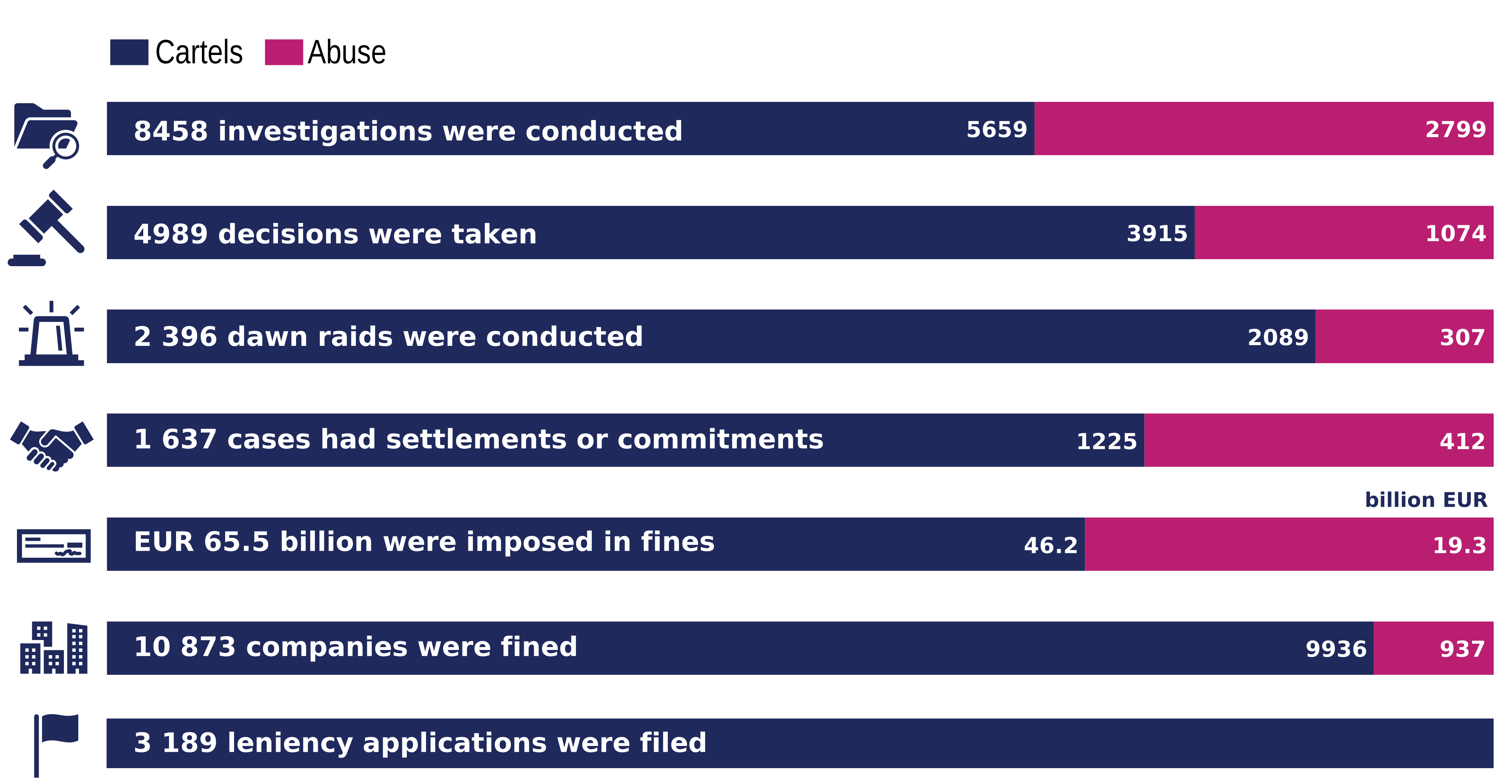
Note: Data based on the jurisdictions in the OECD CompStats database that provided data for each of the variables for the period 2015-2024.
Source: OECD CompStats database
Over the past ten years, there has been an overall downward trend in several key competition enforcement activity measures. The number of competition enforcement investigations for example, was at its highest in the beginning of the decade and has since fallen by around a third for both cartels and abuse of dominance (see Figure 4.2). There is a similar picture for enforcement decisions, with the most recent three‑year period having the lowest total overall number of decisions in the decade, down around 20% for cartels and 52% for abuse from the earlier peak. The decline in both variables is consistent across both OECD and non-OECD jurisdictions, with 60% of jurisdictions showing a decline in enforcement decisions over the ten-year period, for both cartels and abuse of dominance.

Note: For 2023, for the sample of jurisdictions who provided details on the sources of their investigations, total investigations are the sum between investigations started after a complaint and investigations started by the authority’s own initiative. A three-year average is used to smooth out volatility caused by random fluctuations. Data based on the 60 jurisdictions in the OECD CompStats database that provided data for cartel and abuse decisions, 59 for abuse investigations and 52 for cartel investigations for the period 2015-2024.
Source: OECD CompStats database.
Looking at regional differences, Europe and the Americas have both seen a large drop off in enforcement decisions from the beginning of the ten-year period to more recently, particularly on abuse of dominance cases. In Asia-Pacific, the number of cartel decisions did not significantly change, while abuse decisions presented a similar drop as in other regions (Figure 4.3).
Europe experienced the largest relative decline in enforcement investigations, in both cartels and abuse cases, with a consistent downward trend across jurisdictions: 18 out of 26 authorities reported fewer cartel investigations and 25 saw a drop in abuse of dominance cases. In Asia-Pacific, enforcement activity also declined significantly. Around half of the jurisdictions in the sample for the region initiated fewer cartel (4 out of 8) and abuse (4 out of 7) investigations during the 2022-2024 period compared to 2015-2017. In contrast, Americas followed a different trajectory, with cartel investigations increasing between the two periods. This growth was primarily driven by a surge in two jurisdictions in the region. The trend was not uniform across the Americas, as more than half of the jurisdictions recorded a decrease in the number of cartel investigations launched (8 out of 14).

Note: For 2023, for the sample of jurisdictions who provided details on the sources of their investigations, total investigations are the sum between investigations started after a complaint and investigations started by the authority’s own initiative. Information from MEA is not presented as the sample of jurisdictions providing data for both variables was too small. Three-year average is used to smooth out volatility caused by random fluctuations. Data based on the 53 jurisdictions in the OECD CompStats database that provided data for cartel and abuse decisions and abuse investigations, and 46 for cartel investigations for the period 2015-2024 excluding the MEA region.
Source: OECD CompStats database.
The headline trend for activity declines does not appear to be limited to just decisions and investigations with the value of cartel fines, number of settlements, leniency applications and dawn raids all also falling over the decade (see Figure 4.4). In abuse of dominance, fines and dawn raids presented an increase over the period.

Note: This figure does not present information from the United States competition authorities on dawn raids and leniency applications. Data based on the jurisdictions in the OECD CompStats database that provided data for each of the variables for the period 2015-2024.
Source: OECD CompStats database.
These overall activity declines can signal different and potentially conflicting interpretations. For example, it could be that the prevalence of anticompetitive behaviour has declined or that less is being detected.1 The remainder of this section seeks to explore the potential causes of the decline in enforcement activity. Potential explanations for the decline in activity, by looking at the data from CompStats are:
priorities increasing beyond enforcement
COVID-19 disruption and the decline in leniency applications
increased complexity of enforcement cases
increased deterrence following major cases.
4.1.1. Authorities are increasingly having priorities beyond enforcement
As discussed in the 2025 version of the OECD Competition Trends 2025 (and further highlighted in the next chapter on resources), overall competition authority budgets have increased in recent years. This indicates that the decline in enforcement activity is unlikely to be driven by budget cuts. However, over the same period competition authorities also faced needs in other areas, including in relation to mergers, market studies and advocacy.
As highlighted in Chapter 2, merger activity peaked in the period following COVID-19 and the number of decisions remains over 20% higher than at the start of the decade. Typically, authorities have a fixed level of resources which is not directly linked to the level of mergers and acquisitions’ activity in the economy. Although many authorities are set up with separate merger teams, it is likely that in areas of intense periods of merger activity, authorities may choose to divert some resources away from other activities, such as opening new enforcement investigations, to ensure they have sufficient resources to deal with merger notifications, for which decisions are typically time limited and often legislatively mandated.
This may particularly be the case given that authorities have maintained intervention rates relatively stable despite the higher number of notifications. It also may be the case that merger cases have become more complex. As highlighted earlier, the period has seen an increase in cross-border transactions as well as novel theories of harm being tested.
Similarly, as will be seen below, market studies continue to be an important part of authorities’ toolkits to assess whether competition in a market is working correctly or if measures need to be taken. They are part of the advocacy activity of authorities but can also be used as an alternative to enforcement, particularly when competition issues are emerging, and enforcement actions may not be required. As is the case with increased merger activity, competition authorities may choose to divert a share of their set resources to other activities, including market studies. The last ten years have seen an increase in OECD market study activity. Although, given the limitations of the available information in the survey, which does not fully capture the complexity or depth of the studies, it is not possible to establish a clear link between the continued relevance of these studies and the dynamics of decreased competition enforcement activity.
More generally there also may have been an increased demand for broader advocacy measures. It may be the case that authorities have had to divert their work to non-enforcement activity, for example, focusing more on implementing the new regulatory regimes in the digital space and delivering complex market studies. This could highlight a shift in approach towards more forward-looking interventions. For example, the recent OECD Note on Algorithmic pricing and competition in G7 jurisdictions (OECD, 2025[1]) highlighted that competition authorities have spent a significant amount of resources carrying out market studies, issues notes, public consultations and other advocacy activities to understand the complexities of digital markets and the challenges and risks they may generate to competition.
4.1.2. COVID-19 impact and leniency applications decline
The last ten years has seen another ten jurisdictions in the CompStats sample introduce leniency programmes with Ireland being the latest to do so in 2023 and Malta and the Dominican Republic in 2021. Now, 61 out of the 66 jurisdictions in CompStats have a leniency programme in force (see Figure 4.5).

Source: OECD CompStats database.
While many authorities rely on these programmes as one of the ways to initiate investigations against cartels, the average number of leniency applications declined from 2015 to 2020, with the strongest fall in 2020, when the COVID-19 pandemic struck (see Table 4.1). The pandemic had also a major impact on investigations, with restrictions preventing on site visits (dawn raids) and potentially discouraging firms from applying for leniency while investigation risks were lower. Although trends in fines are more erratic, a decreased was also observed between 2019 and 2020. Most of the variables observed a subsequent recovery in 2021.
Note: For 2023, for the sample of jurisdictions who provided details on the sources of their investigations, total investigations are the sum between investigations started after a complaint and investigations started by the authority’s own initiative. Sanctions are adjusted using exchange rates for 31 December 2015 per jurisdiction. This figure does not present information from the United States competition authorities on dawn raids and leniency applications. Data based on the jurisdictions in the OECD CompStats database that provided data for each of the variables for the period 2015-2024.
Source: OECD CompStats database.
In response to this decline in leniency applications the OECD Competition Committee discussed possible reasons for declining leniency applications beyond the COVID-19 interruption and some of the ways authorities responded to the challenges this has caused. Box 4.1 highlights the key points from the session.
In 2023, the OECD held a roundtable on the future of effective leniency programmes. In the background note for the discussion, several reasons for the potential decline in leniency applications and approaches to facilitate cartel detection were presented and are summarised as follows.
Possible reasons highlighted for decline in leniency:
Possible natural decline after introduction: following the introduction of leniency programmes, leniency applications typically increase as the programmes bed in but then may begin to decline as it matures.
Impact of deterrence: there may be a deterrence effect from previous leniency applications, making cartels less likely and reducing applications in the future.
Overreliance on leniency: due to the initial success of leniency programmes, authorities may shift resources away from detection and that, in turn, may reduce firm incentives for submitting leniency applications.
Impact of private enforcement: the growth of private enforcement and liability may make firms less willing to come forward for leniency.
Risks of criminal sanctions: although criminal sanctions may increase the incentives for individuals to encourage firms to apply for leniency, it may also conversely make firms more vigilant and adopt stricter mechanisms to avoid detections and defection.
Cartel complexity: the growing complexity of cartels may have resulted in higher co-operation costs and unpredictability for companies over time, affecting the incentives to apply for leniency.
The paper also presents some approaches to increase detection, including facilitating complaints, using cartel screens and other skills and implementing whistleblowing programmes.
Source: OECD (2023[31]). The Future of Effective Leniency Programmes: Advancing Detection and Deterrence of Cartels, https://doi.org/10.1787/9bc9dd57-en.
The decline in authorities’ ability to conduct searches and the reduction in leniency applications had an impact on the number of investigations launched, although it remains unclear why they have not yet recovered to the same pre-COVID-19 levels. The large growth in leniency applications in 2022-2023, however, may indicate that investigations and decisions may also increase again in future years. In 2024, there was a decrease, with 20% applications less compared to 2023.
4.1.3. Potential increase in case complexity
In addition, it may also be the case that competition enforcement itself has become more complex. The last decade has been one with rapid technological development, with the consolidation of the biggest tech platforms in multiple markets and AI beginning to emerge. Such developments have led to authorities needing to invest resources in technical expertise as a response to the complexity (see Box 5.1 below). In addition, there seems to have been a general move towards competition cases relying on complex economic analysis. Box 4.2 presents key findings from OECD work during the last decade that illustrate this increased complexity in enforcement cases.
OECD roundtable on the standard and burden of proof in competition cases
In 2024 the OECD held a roundtable discussing the standard and burden of proof in competition cases (OECD, 2024[32]). The background paper highlighted that there are increasing requirements in many jurisdictions to engage in effects-based analysis and this has led to an increased need to rely on economic analysis to establish competition law violations.
The paper highlighted that the increasing role of economic analysis in the competition decision-making processes have made decisions more accurate, but at the same time it may have also added complexity, making violations harder to prove to the required legal standard. It discussed whether the burden of proof has been set too high and jurisdictions shared their views on whether future investigations should take this into consideration.
OECD roundtables on the use of economics in cartel cases and abuse cases
The need for and complexity of economic analysis was also discussed in two sessions of the OECD’s global forum.
In 2021 the Global forum on competition held a roundtable on Economic analysis and evidence in abuse cases. The background note highlighted that economic evidence and approaches have become increasingly important in the context of effects-based approaches to assessing possible abuse of dominant positions. It highlighted challenges that authorities in developing and middle-income countries face and the practical challenges in gathering evidence and undertaking appropriate assessments.
Even in cartel cases which are typically not effects based, there appears to be increasing demand for economic analysis. In 2023 the Global forum on Competition discussed the use of economic evidence in cartel cases. It highlighted that the growing complexity of economic analysis has had a substantial impact, not only on general competition cases but also on cartel cases. It stated that the increasing need for economic analysis has become a crucial component on these cartel cases as well.
Sources: OECD (2024[32]), The standard and burden of proof in competition law cases, https://doi.org/10.1787/0199f63f-en; OECD (2021[33]), Economic Analysis and Evidence in Abuse Cases, https://doi.org/10.1787/63e6d5f0-en; OECD (2023[34]), Use of Economic evidence in cartel cases, https://one.oecd.org/document/DAF/COMP/GF(2023)5/en/pdf.
The combination of complexity of markets and the required analysis is likely to mean that each case will take longer and take more resources. This is therefore another potential reason for seeing the overall decline in activity. Moreover, it is important to note that the number of cases does not reveal any information on their length and complexity.
4.1.4. Increased deterrence from major cases at the beginning of the decade
One possible explanation for the activity decline could be a deterrent effect following large fines and cases with global coverage potentially acting to discourage businesses from entering cartels or conducting anticompetitive unilateral conduct. While this cannot be observed from the CompStats data to the extent this is true, the lower activity would be a positive sign (Davis and Ormosi, 2017[35]). The OECD Competition Committee Working Party No. 2 for Competition and Regulation recently discussed measuring deterrence as part of a broader session on measuring authority impact highlighting the importance of trying to capture the deterrence effect of authority action but also the practical challenges of doing so.2 While several authorities have implemented one-off studies into the deterrence effect of enforcement to date there is no comprehensive ongoing measurement on which time series analysis can be conducted.
It is beyond the scope of this report to further model the deterrence effect across the OECD by jurisdiction. However, this is a potential area for further research. Competition authorities themselves have begun to explore further the levels of deterrence in their jurisdictions. For example, the EU has recently commissioned a survey of practitioners on the deterrent effects of EU Competition Enforcement.3 This work could help to determine the impact of past enforcement with regards to deterrence and contribute to better understanding the value and dynamics of competition enforcement.
Although extensive quantitative information on deterrence is not available it is perhaps worth noting that the start of the period (2016-2018) did coincide with cases resulting in some of the largest fines for competition enforcement of all time across both cartels and abuse of dominance. For example, in Europe there were record fines for Google abusing its dominant position as well as record breaking fines for participants of the trucks cartel.4 Similarly, in the United States, the top three Sherman Act violations resulting in criminal fines and penalties were also in 2017 (relating to the foreign currency exchange manipulation) (US DOJ, 2023[36]). The auto-parts cartel also spanned many jurisdictions and total fines were in the multibillion dollars, many of these decisions were also in the same 2015-2018 period (Connor, 2019[37]). Given these high-profile cases with significant fines, it is not unreasonable to consider whether there was a deterrent effect on activity later in the decade.
The first part of this chapter focused on the overall trends in competition enforcement activity over the ten-year period. This section looks to explore the balance between cartels and abuse of dominance cases. The section explores how the different activity measures vary between the two case types and the extent to which there appears to have been any shift over time.
4.2.1. Enforcement decisions against abuse of dominance saw the greatest decline
Overall, in the period between 2015-2024, there were close to 5 000 competition infringement decisions. Almost 80% of these decisions related to cases involving multiple firms coming to an anticompetitive agreement, with the remainder relating to decisions for abuse of dominance.
Looking at how the balance between the case types changed over time, it is possible to see that earlier in the decade, there were relatively more abuse of dominance infringement decisions, as shown in Figure 4.6. At the start of the period, abuse of dominance decisions took up about a quarter of overall activity compared to only around a 15 to 20% in the recent years. The number of investigations, however, does not follow the same trend, with abuse of dominance investigations representing around 30% of the total, reaching a peak of over 36% during 2019 and 2021.

Note: For 2023, for the sample of jurisdictions who provided details on the sources of their investigations, total abuse investigations are the sum between investigations started after a complaint and investigations started by the authority’s own initiative. Three-year average is used to smooth out volatility caused by random fluctuations. Data based on the 60 and 59 jurisdictions in the OECD CompStats database that provided data for abuse decisions and investigations respectively for the period 2015-2024.
Source: OECD CompStats database
It is unclear what has driven the relatively lower number of abuse of dominance decisions over time, particularly as the percentage of investigations has not followed the same trend. One potential explanation is that cartel cases, as by object/per-se infringements, are less affected by the increasing complexity of investigations.5 On the contrary, developments that have led to more complex and often novel approaches for the analysis of abuse of dominance cases (as explained in Box 4.2) will potentially require additional resources compared to cases which follow similar paths to previous enforcement. Therefore, if the balance of resources stayed similar between teams’ investigating cartels and teams investigating abuses of dominance, it is logical that the level of decisions on the latter declined.
In relation to fines, given the higher number of cartels decisions over the decade there has been in total more than EUR 54 bln of fines for cartel infringements compared to EUR 24 bln in abuse of dominance decisions.6 Looking at the period as a whole, the overall value of fines has fallen significantly in line with the number of decisions dropping, particularly in the last five years as it can be seen in Figure 4.7.

Note: Sanctions are adjusted using exchange rates for 31 December 2015 per jurisdiction. A three-year average is used to smooth out volatility caused by random fluctuations. Data based on the 61 and 59 jurisdictions in the OECD CompStats database that provided data for cartel and abuse fines respectively, for the period 2015-2024.
Source: OECD CompStats database.
4.2.2. Jurisdictions are becoming more likely to settle or accept commitments in abuse cases relative to cartels
The use of settlements and commitments by competition authorities when investigating anticompetitive behaviour can mean investigations are concluded more quickly and a resolution found with lower administrative burden. Settlements typically involve an admission of guilt for a lower fine and are mostly used in cartel cases,7 whereas commitments may not involve admission of guilt but can be a binding agreement on behavioural change. These are mostly used in non-cartel cases, including vertical agreements and unilateral conduct.
As shown in Figure 4.8, in line with the overall fall in activity over the decade, the number of settlements and commitments accepted fell. This is particularly the case in relation to cartel cases.

Note: A three-year average is used to smooth out volatility caused by random fluctuations. Data based on the 46 and 52 jurisdictions in the OECD CompStats database that provided data for settlements and commitments in cartels and abuse, respectively, for the period 2015-2024.
Source: OECD CompStats database.
Comparing the change relative to the overall number of decisions, it is possible to see that, at the start of the period, cartel settlements and commitments formed a higher proportion of decisions. This has switched in the last years, with abuse cases seeing a higher proportion of accepted commitments.
Recognising the increasing importance of remedies and commitments in abuse cases, the OECD Global Forum on Competition discussed remedies and commitments in abuse of dominance cases in 2022 (OECD, 2022[38]). The discussion highlighted that remedies are a crucial element for enforcement and that, as markets become increasingly complex and dynamic, authorities have a difficult task ensuring that the remedy is sufficient but also proportionate in relation to the identified problem. It also emphasised the importance of ensuring that competition authorities have the power, resources and expertise to design and oversee effective monitoring and, when possible, to evaluate the effectiveness of the remedies imposed.
← 1. (Armoogum, 2017[51]) discuss deterrence and how the number of investigations could be evidence both that an authority is either ‘weak’ both in enforcement and in deterring, or ‘strong’ because it so effectively deters many potential anticompetitive behaviours, it leaves less anticompetitive behaviour to detect.
← 2. For further discussion see “Assessing the impact of competition authorities’ activities” (OECD, 2025[47])
← 3. Survey of Practitioners on the Deterrent Effects of EU Competition Enforcement - Lear, https://www.learlab.com/news/survey-of-practitioners-on-the-deterrent-effects-of-eu-competition-enforcement/.
← 4. The EU fined:
Google EUR 4.34 billion for illegal practices regarding Android mobile devices to strengthen dominance of Google's search engine (European Commission, 2018[48])
Google EUR 2.42 billion for abusing dominance as search engine by giving illegal advantage to own comparison-shopping service (European Commission, 2017[50])
Truck producers EUR 2.93 billion for participating in a cartel (European Commission, 2016[49])
← 5. See for example OECD (2021[33]; 2021[43]) for discussions on the increasing complexity of analysis needed for abuse of dominance cases.
← 6. In addition to monetary sanctions several authorities have criminal sanctions for cartel behaviour. The trends in criminal sanctions are not assessed in this report due to limitations in the available data. Therefore, the analysis presented is only a partial picture of the evolving trend in cartel sanctions.
← 7. Different competition regimes have different definitions and considerations for settlements. For a review of those, see (ICN, 2018[44]).