Whole‑of‑Government Approaches to Development Co‑operation: Australia

Table of contents
This country note provides an overview of key characteristics of Australia’s development co-operation as it relates to whole-of-government co-ordination. It is based on desk research and interviews held with relevant stakeholders. This note complements the OECD DAC peer-learning exercise, Whole‑of‑Government Approaches to Development Co-operation (OECD, 2026[1]). It highlights institutional arrangements, co-ordination mechanisms and quality assurance processes in place to support a whole-of-government approach to development co-operation. Data in this note reflect the latest available year (2025/26 budget and strategic plans).
Anchored in the 2023 International Development Policy and framed explicitly as a tool of statecraft, Australia’s development co-operation is positioned at the intersection of foreign, security, economic and regional priorities. This approach is underpinned by a centralised model led by the Department of Foreign Affairs and Trade (DFAT), with contributions from over 20 other Australian government entities. DFAT has a clear mandate to co-ordinate Australia’s international development co-operation. Australia has introduced institutional features that support stronger co-ordination such as two whole-of-government offices based within DFAT. Since 2024, bilateral and regional Development Partnership Plans aim to present a whole-of-government view of the development priorities Australia shares with partner countries. The concentration of responsibilities within DFAT and the diversity of Australia’s development portfolio create both opportunities for alignment and risks of fragmentation. While Australia faces some challenges in reconciling geographical silos, building institutional capacity, and maintaining coherence across diplomatic, defence, trade, and development objectives, there are opportunities to consolidate these gains and address remaining gaps.
Australia’s efforts towards whole-of-government co-ordination in development co-operation are anchored in political commitments and policy directions. The 2023 International Development Policy describes Australia’s whole-of-government approach and has established Australia’s development co-operation as a “tool of statecraft”, i.e. an integral part of foreign affairs. It makes an explicit commitment to a whole-of-nation approach to positive development impact, outlining how relevant government departments and agencies should strive to contribute coherent and integrated development and foreign policy (DFAT, 2023[2]; OECD, 2026[3]).
Australia has a centralised, single ministry model where the development function is integrated with trade and the broader foreign affairs function in a single ministry (OECD, 2026[1]). Such an arrangement often allows for efficient decision-making, and alignment across foreign policy and development co-operation activities (OECD, 2009[4]). While integration can help in increased proximity, it does not automatically produce co-ordinated action (Calleja and Zattler, 2024[5]). Multiple parts of the ministry having greater involvement in development co-operation makes co-ordination even more crucial, for Australia to ensure coherence and manage meaningful contributions from other government departments. While integration can support policy coherence and alignment across government priorities, it also increases the importance of safeguards that ensure development objectives are not subordinated to other strategic short-term interests.
DFAT has an explicit mandate to lead Australia’s whole-of-government approach to international development and co-ordinate development finance with 25 other departments and agencies. DFAT oversees approximately 93% of Australia’s official development assistance (ODA)1 (AUD 4.74 billion in 2025/26 expected allocations) and co‑ordinates both ODA and expanding non‑ODA engagement across the Indo‑Pacific (OECD, 2026[3]). Policies and strategies, such as the 2023 International Development Policy, are developed by DFAT through consultative processes with a variety of Australian government stakeholders.
Since 2025, three ministers with development responsibilities sit in Cabinet: the Minister for Foreign Affairs, the Minister for International Development and the Minister for Pacific Island Affairs.2 This reflects the breadth of Australia's engagement, but also introduces potential challenges: notably, International Development and Pacific Island Affairs portfolios are now split between two ministerial roles. Following the changes in portfolio responsibilities, the Minister for Pacific Island Affairs retained responsibility for Defence Industry. Clear delineation of ministerial responsibilities and active inter-ministerial communication is essential to avoid overlapping or competing signals (OECD, 2026[3]).
Respective appropriations for ODA by key agencies in the 2025/26 budget

Notes: AIFFP = Australian Infrastructure Financing Facility for the Pacific. Ministerial responsibility for Export Finance Australia sits with both the Minister for Trade and Tourism and the Minister for Finance. The Foreign Affairs and Trade Portfolio currently has six ministers. In addition to the four listed in the figure, these are: the Assistant Minister for Foreign Affairs and Trade and the Assistant Minister for Pacific Island Affairs. In 2025, the Prime Minister also appointed a new non-Ministerial Special Envoy for Indian Ocean Affairs.
Source; OECD (2026), OECD Development Co‑operation Peer Reviews: Australia 2025, OECD Development Co-operation Peer Reviews, OECD Publishing, Paris, https://doi.org/10.1787/c58230a4-en
In the lead, DFAT co-ordinates with a wide range of other Federal government actors3. Key partner government agencies include:
The Attorney‑General’s Department, which supports law, justice and policing systems and strengthens legal and policy responses to human trafficking and modern slavery.
Agriculture, Fisheries and Forestry, which enhances Indo‑Pacific biosecurity partnerships by strengthening regional capacity through long‑standing bilateral and technical collaboration.
The Australian Centre for International Agricultural Research, which advances development goals by funding agricultural research to improve productivity across Africa, Asia and the Pacific.
The Australian Federal Police, which contributes to regional peace, security and prosperity through bilateral partnerships in the Indo-Pacific.
Climate Change, Energy, the Environment and Water, which supports Pacific engagement in multilateral environmental agreements and delivers blue carbon projects in Indonesia and Papua New Guinea.
Commonwealth Scientific and Industrial Research Organisation, which works with government, research organisations, businesses and communities to develop science‑based solutions to regional challenges and strengthen innovation and resilience.
Employment and Workplace Relations, which jointly manages the Pacific Australia Labour Mobility scheme with DFAT, supporting Pacific and Timor‑Leste economic growth through employment opportunities in Australia.
Health and Aged Care, which supports global health security, including through the Coalition for Epidemic Preparedness Innovations and vaccine access for lower‑income countries.
The Treasury, which supports multilateral development banks, including the International Bank for Reconstruction and Development and the International Finance Corporation (DFAT, n.d.[6]).
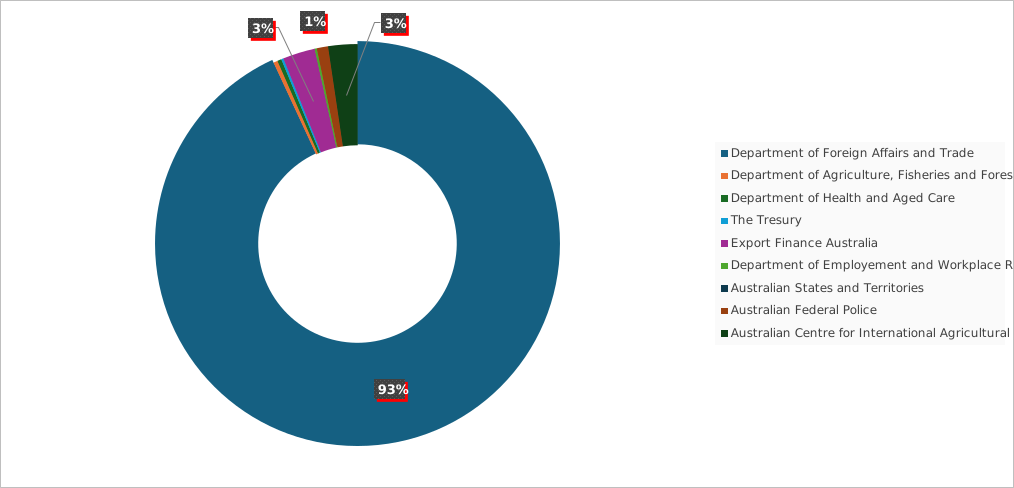
Upstream discussion of ODA delivered by other government departments strengthens the strategic significance of these contributions. ODA spent by other Federal government departments is concentrated in areas of Australian comparative advantage on issues such as biosecurity, health security, and labour mobility. Annual budget discussions prior to allocation are a strong mechanism that allows for greater co-ordination and coherence between DFAT’s strategic direction and the individual departmental allocations. Reporting to the OECD shows ODA as being reported 100% through “Australian Government”. However, DFAT’s annual budget document, Performance of Australian Development Co-operation Reports4 and Official Development Assistance Statistical Summary5 track the contributions of each of the different departments and agencies, illustrating the involvement of a wide variety of technical agencies and line ministries/departments.
Australia's institutional set-up also includes several public bodies that play a growing role in development finance. Export Finance Australia (EFA), Australia’s export credit agency, has in recent years grown in its role in delivering Australian development finance through its role in relation to the Australian Infrastructure Financing Facility for the Pacific (AIFFP). AIFFP sits within the Foreign Affairs and Trade portfolio and its loan agreements are conducted by the EFA-based back-office. Ministerial responsibility for EFA is shared between the Minister for Trade and Tourism and the Minister for Finance. Such an arrangement creates potential for co-ordination complexity (OECD, 2026[3]).
DFAT has established two whole-of-government offices – one each for the Pacific and for South-East Asia – to support co-ordination in these priority regions. Beyond development co-operation, the functions of the office for South-East Asia, for example, include trade and economic relations, security co-operation, cultural diplomacy and other bilateral and regional diplomatic activities. The Office of the Pacific has enhanced co-ordination on policy challenges that go beyond ODA, benefitting from secondees from a range of government departments. This approach facilitates collaboration by building understanding and buy-in among staff across government beyond information exchange. Working across two distinct geographic regions requires continued effort to avoid silos and ensure cross-learning, demanding strong policy and evidence functions (OECD, 2026[3]).
The Development Program Committee (DPC) is DFAT’s primary governance body for overseeing and co‑ordinating development co-operation. Established in 2023 (replacing the Aid Governance Board), it ensures alignment with government development policy, performance frameworks, and broader foreign, trade and regional priorities, and meets regularly to review programme direction and major investments. While the DPC introduces a degree of cross‑government input through the participation of “whole-of-government” officials, it remains largely DFAT‑led, with limited broader engagement from other departments. Its contribution to policy coherence may depend on the influence of these participants and the extent to which insights are shared across government. The DPC also plays a key role in risk oversight, working alongside the Delivery and Operations Committee6 to review high‑value or high‑risk investments at an early stage and maintain consistency in decision‑making across the system (DFAT, 2025[8]; OECD, 2026[3]).
Australia also establishes regular inter-departmental committees on issues such as climate, trade and multilateral engagement. These structures have been instrumental in advancing policy coherence in key areas in the Pacific as well as in supporting the clear political imperative to build and sustain strong whole of-government bilateral relationships with neighbours (OECD, 2026[3]).
The International Development Finance Advisory Committee (IDFAC) provides a complementary governance function aimed at strengthening Australia’s expanding development finance architecture. Operating as a subcommittee of the DPC, the IDFAC provides an annual strategic update to the DPC on Australia's portfolio of development finance investments (DFAT, 2025[8]). It is chaired by DFAT, with representation from the departments of Prime Minister and Cabinet, Treasury and Finance (DFAT, 2026[9]). This creates a dedicated architecture for coherence between ODA grants and the growing set of non-ODA instruments. This reporting function helps maintain strategic coherence as Australia's development finance toolkit expands; a function that could be strengthened through public release.
Whole-of-government co-ordination at the country level is supported by the Heads of Mission and Senior Responsible Officers (SROs). Heads of Mission in embassies and High Commissions oversee all of Australia’s engagements in the respective country, including where other government agencies are present at the country level. SROs in particular are mandated with helping to reconcile other diplomatic priorities with development priorities. The SROs, typically Deputy Head of Mission level, support co-ordination efforts by driving alignment and integration between the development programme and Australia’s strategic objectives and broader engagement in a country or region. In Timor-Leste, for example, the introduction of the SRO function has enabled greater alignment between strategic context and development programming (OECD, 2026[3]).
Development Partnership Plans (DPPs) support coherent country presence and decision-making. Country DPPs are formulated by embassies and high commissions in consultation with partners, and regional DPPs are prepared in Canberra. They capture global, regional and bilateral programmes, whole-of-government engagement and non-ODA programmes. Where relevant, DPPs include the country level contributions of other government departments or agencies7 and offer DFAT a means to foster coherence across the development programmes in countries and regions. As of August 2026, 16 country DPPs and 4 regional DPPs have been completed. While time-consuming to prepare, DPPs are considered as a robust strategic output that can guide coherent engagement in priority partner countries and regions across government (OECD, 2026[3]). DPPs therefore provide a shared strategic reference that frames the contributions of multiple agencies within a coherent country or region-level narrative.
Several whole-of-government programmes showcase how co-ordination improves development impact in partner countries. For example, the Australian Government Department of Agriculture, Fisheries and Forestry (DAFF) delivers a substantial programme funded by DFAT on combating illegal, unreported and unregulated fishing and promoting sustainable fisheries in South-East Asia. Initially, the programme struggled to address gender equality in male-dominated fisheries sectors in the Pacific. The programme has since co-designed delivery adjustments that have raised women’s participation in training to 44% in 2024. This evolution shows that DFAT's normative frameworks can influence other government departments delivery when communication channels are active and that improved co-ordination can deliver better impact (DFAT, 2025[10]).
The Pacific Australia Labour Mobility (PALM) scheme is an example of co-ordination occurring through joint management between DFAT and the Department of Employment and Workplace Relations (DEWR), with additional oversight and collaboration from the Fair Work Ombudsman, Department of Home Affairs, and the Australian Border Force. The scheme allows workers from nine Pacific Island countries and Timor-Leste to take up temporary jobs in Australia in sectors with labour shortages. DEWR leads domestic delivery, matching Pacific Islander and Timor-Leste workers to Australian employers facing workforce shortages, while DFAT manages the policy and Pacific engagement dimensions, including remittance flows and skills transfer to sending countries (DFAT, 2025[10]). PALM illustrates the governance demands of joint delivery: worker protection standards, minimum pay guarantees and deduction transparency rules require active co‑ordination across at least six agencies, each with distinct mandates and accountability frameworks. While evaluations have found that the scheme has delivered positive development impacts for partner countries, cross-government management of the scheme has sometimes presented challenges in managing dual international and domestic priorities. In response, efforts are ongoing to strengthen inter-agency management. DFAT and DEWR have conducted a governance review of the programme, co-hosted interdepartmental workshops to develop a scheme-wide theory of change, and sought to clarify ways of working (OECD, 2026[3]; Clear Horizon, 2024[11]; DFAT, 2024[12]).
Australia's monitoring and evaluation system for development co-operation is designed to capture the full scope of its contributions across government. The Performance and Delivery Framework (PADF), tracks Australia’s performance across whole-of-programme, country and regional, multilateral, and investment levels. The PADF explicitly reflect contributions from various Australian government departments and agencies, incentivising all departments in being accountable for progress on the development programme (DFAT, 2026[9]). DFAT’s annual report8 against the PADF, and the interactive AusDevPortal constitute the principal public accountability mechanisms. All are available online and DFAT’s Annual Report is also tabled in the Australian Parliament.
Translating available data into institutional learning remains a challenge. The 2025 OECD DAC Peer Review notes that the DPC has an important role to play in providing space for critical reflection and debate, and potential to drive a stronger focus on upstream programme design based on evaluation evidence (OECD, 2026[3]). DFAT has a strong foundation of performance and evaluation data and could further strengthen development effectiveness by improving how lessons and evidence are shared, retained and applied across programs, delivery partners and decision-making processes.
The value of a whole-of-government approach to workforce capacity and expertise is acknowledged but still emerging. Recognising that valuable expertise is distributed across government DFAT has also committed to a capability plan to ensure sustained access to the skills required for long-term delivery. A key pillar of this approach is the integration of whole-of-government agencies into DFAT-led training initiatives, including though the Australian Diplomatic Academy, which helps build a common understanding of development effectiveness and ensures that all actors involved in ODA implementation and broader Indo-Pacific engagement apply consistent, partner-focused approaches. This is particularly important given that line ministries often possess strong sectoral knowledge but may have limited familiarity with OECD-DAC standards and cross-cutting development principles. Targeted training, staff mobility and secondments therefore play an important role in strengthening system-wide capacities, facilitating knowledge sharing and embedding development expertise across agencies (OECD, 2026[3]).
The Indo-Pacific Centre for Health Security, established in 2017, is regarded as one of Australia's most effective models of whole-of-government co-ordination for development co‑operation. The Centre is led by Australia's Ambassador for Global Health and brings together sector experts and representatives from across Australian government, including Treasury and the Department of Health, Disability and Ageing, alongside external partners from universities, non-governmental organisations and the private sector (OECD, 2026[3]; Australia Minister for Foreign Affairs, 2017[13]).
The rationale for cross-government collaboration has been made explicit since the establishment of the Centre: Australia's health security is linked to the health security of the Indo-Pacific region, and no single department holds all the levers needed to strengthen regional disease surveillance, emergency response capacity or health systems. By making this interdependence a founding principle, the Centre built political and bureaucratic buy-in from across government from the outset (Australia Minister for Foreign Affairs, 2017[13]; Australian Government, 2026[14]).
The Centre's flagship Partnerships for a Healthy Region initiative addresses a range of cross-cutting priorities including gender equality, disability and social inclusion, One Health, climate and environmental change and community engagement. This is operationalised through specific guidance on how each technical and policy angle of partner agencies can support programme delivery, and thus is a practical mechanism for translating whole-of-government intent into co-ordinated action (DFAT, 2023[15]).
Co-ordination arrangements and meetings with a range of government agencies9 that have an interest in supporting health security in the Indo-Pacific are taking place in a structured manner, providing an opportunity for DFAT and other government agencies to discuss public health developments and areas for alignment across programme implementation. Monitoring, evaluation and learning (MEL) is embedded in the Centre's model as a dedicated MEL team maintains a strategic framework, performance assessment framework, and regular partner meetings. This provides a coherent platform for whole-of-government co‑ordination, enabling Australia to leverage diverse departmental capabilities collectively in response to complex regional health security challenges (DFAT, 2023[15]).
Overall, three features stand out that make the Indo-Pacific Centre for Health Security a model that works:
A clear mandate and dedicated institutional home
An explicit framing of shared risk that generates buy-in from other departments
An embedded monitoring, evaluation and learning framework that treats learning as integral to co‑ordination, not an afterthought
Australia has a well-developed approach to whole-of-government co-ordination, anchored in clear institutional mandates and politically signalled incentives for the participation of other government departments in delivering Australia’s ODA and development partnerships. Some key aspects emerge from this study:
Clear political commitment supports effective institutional practices. The 2023 International Development Policy provides a high-level political signal and commitment to whole-of-government co-ordination. The impact remains contingent on the authority, engagement and feedback loops of participating actors.
At the operational level, co-ordination is most effective where it is anchored in clear shared interests. Subject-matter-specific co-ordination models such as the Indo-Pacific Centre for Health Security or the PALM scheme are effective where domestic policy interests and development objectives closely align, providing replicable models for other thematic areas.
Australia operationalises the whole-of-government ambition at the regional and country levels through clear arrangements. The SRO function, the regional and country DPPs and the introduction of regional whole-of-government offices provide durable incentives for coherence, and can bridge the gap between policy and implementation.
Systemic recognition of cross-government contributions strengthens accountability and responds to demands from partner countries. An established framework for monitoring and acknowledgment of the contributions of all key government departments in the yearly Performance of Australian Development Co-operation reports is a good practice that enhances transparency and system-wide accountability while incentivising engagement from across government. However, the value remains dependent on the extent to which the data are used to inform future decisions.
Continuing to invest in awareness and understanding across government of the value of international development and of Australia’s global and regional role would sustain a coherent whole-of-government approach. Particularly given uneven understanding of global and regional development challenges and Australia’s role across agencies, efforts such as cross-government training, secondments and skills-building initiatives play a critical role in embedding shared standards and approaches.
Positioning development co-operation within a national security framing, as evidenced in the case of the Indo-Pacific Centre for Health Security can generate political durability and cross-government buy-in, but must be actively managed to prevent development objectives from being subordinated to shorter-term strategic interests.
References
[13] Australia Minister for Foreign Affairs (2017), Indo-Pacific Health Security Initiative, https://www.foreignminister.gov.au/minister/julie-bishop/media-release/indo-pacific-health-security-initiative.
[14] Australian Government (2026), Partnerships for a Healthy Region, https://indopacifichealthsecurity.dfat.gov.au/partnerships-healthy-region.
[5] Calleja, R. and J. Zattler (2024), A Merger in the Making? What Germany Should Learn From the Department Mergers of the Past, https://www.cgdev.org/blog/merger-making-what-germany-should-learn-department-mergers-past.
[11] Clear Horizon (2024), Pacific Labour Facility (PLF) Independent Evaluation: Final report, https://www.dfat.gov.au/sites/default/files/pacific-australia-labour-mobility-scheme-pacific-labour-facility-evaluation-report.pdf.
[9] DFAT (2026), Performance of Australian Development Cooperation Report 2024-25, https://www.dfat.gov.au/sites/default/files/performance-australian-development-cooperation-report-2024-2025.pdf.
[7] DFAT (2025), Development Budget Summary 2025-26, https://www.dfat.gov.au/sites/default/files/oda-development-budget-summary-2025-26.pdf.
[8] DFAT (2025), Development Programme Committee Terms of Reference, Unpublished.
[10] DFAT (2025), Performance of Australian Development Cooperation Report 2023-24, https://www.dfat.gov.au/sites/default/files/performance-australian-development-cooperation-report-2023-2024.pdf.
[12] DFAT (2024), DFAT Management Response to the Independent Evaluation of teh Pacific Labour Facility, https://www.dfat.gov.au/sites/default/files/pacific-australia-labour-mobility-scheme-pacific-labour-facility-evaluation-report-management-response.pdf.
[2] DFAT (2023), Australia’s International Development Policy: For a peaceful, stable and prosperous indo-pacific, https://www.dfat.gov.au/sites/default/files/international-development-policy.pdf.
[15] DFAT (2023), Partnerships for a Healthy Region Initiative Strategic Investment Famework, https://www.dfat.gov.au/sites/default/files/partnerships-healthy-region-strategic-investment-framework.pdf.
[6] DFAT (n.d.), Whole of government, https://www.dfat.gov.au/aid/who-we-work-with/whole-of-government/Pages/whole-of-government.
[3] OECD (2026), OECD Development Co‑operation Peer Reviews: Australia 2025, OECD Development Co-operation Peer Reviews, OECD Publishing, Paris, https://doi.org/10.1787/c58230a4-en.
[1] OECD (2026), Whole‑of‑Government Approaches to Development Co‑operation: Insights and Lessons from Practice, OECD Publishing, Paris, https://doi.org/10.1787/05846ace-en.
[4] OECD (2009), Managing Aid: Practices of DAC Member Countries, Better Aid, OECD Publishing, Paris, https://doi.org/10.1787/9789264062689-en.
This work is issued under the responsibility of the Secretary-General of the OECD, and does not necessarily reflect the official views of OECD Member countries.
This document, as well as any data and map included herein, are without prejudice to the status of or sovereignty over any territory, to the delimitation of international frontiers and boundaries and to the name of any territory, city or area.
The full book is available in English: OECD (2026), Whole-of-Government Approaches to Development Co-operation: Insights and Lessons from Practice, OECD Publishing, Paris, https://doi.org/10.1787/05846ace-en.
© OECD 2026
 Attribution 4.0 International (CC BY 4.0)
This work is made available under the Creative Commons Attribution 4.0 International licence. By using this work, you accept to be bound by the terms of this licence (https://creativecommons.org/licenses/by/4.0/).
Attribution – you must cite the work.
Translations – you must cite the original work, identify changes to the original and add the following text: In the event of any discrepancy between the original work and the translation, only the text of original work should be considered valid.
Adaptations – you must cite the original work and add the following text: This is an adaptation of an original work by the OECD. The opinions expressed and arguments employed in this adaptation should not be reported as representing the official views of the OECD or of its Member countries.
Third-party material – the licence does not apply to third-party material in the work. If using such material, you are responsible for obtaining permission from the third party and for any claims of infringement.
You must not use the OECD logo, visual identity or cover image without express permission or suggest the OECD endorses your use of the work.
Any dispute arising under this licence shall be settled by arbitration in accordance with the Permanent Court of Arbitration (PCA) Arbitration Rules 2012. The seat of arbitration shall be Paris (France). The number of arbitrators shall be one.
← 1. Australia provides almost the totality of its development co-operation finance in the form of grants.
← 2. The Minister for Trade and Tourism is also part of the DFAT portfolio but has no direct development co-operation responsibility.
← 3. This peer learning exercise focuses exclusively on the national level; while interactions with state and local governments are also important, they fall outside its scope. For further information on this topic, please refer to the OECD’s recent work on decentralised development co-operation (See: OECD (2026), The Impact of Decentralised Development Co-operation: Driving Local Governance and the SDGs, OECD Regional Development Studies, OECD Publishing, Paris, https://doi.org/10.1787/59c2f7c7-en.)
← 4. Performance of Australian Development Co-operation Reports are produced by DFAT, presented to parliament and published publicly (See: https://www.dfat.gov.au/sites/default/files/performance-australian-development-cooperation-report-2024-2025.pdf)
← 5. See https://www.dfat.gov.au/publications/development/australias-official-development-assistance-statistical-summary-2024-25
← 6. The DPC operates alongside the DOC when considering major or high‑risk ODA and non‑ODA investments: proposals valued at AUD 100 million or more, deemed high- or very high-risk, or structured as facilities must be reviewed by the DPC at the concept stage before proceeding to design (DFAT, 2025[8]). For investments combining ODA and non‑ODA funds, oversight responsibility is determined on a case‑by‑case basis by the respective Secretariats. Regular cross‑briefings between the two Committees’ Chairs establish a formal feedback loop, helping to promote consistency in decision‑making and enhance system‑wide coherence.
← 7. Annex 1 of the DPPs shows who are the key contributing partners, including Australian government departments, to specific programmes or projects.
← 8. Annex C of the Framework provides a detailed selection of the contribution of other Australian government departments to development co-operation.
← 9. The Department of Health and Aged Care, the Department of Defence, the Department of Agriculture, the Department of Fisheries and Forestry (DAFF), the Australian Centre for International Agricultural Research, the Commonwealth Scientific and Industrial Research Organisation, the National Health and Medical Research Council and the Australian Institute of Health and Welfare.