Improvements in air quality may explain approximately one-third of labour productivity growth in Europe between 2011-2022.
A 1 µg/m³ decrease in PM2.5 concentration causes a 0.55% increase in labour productivity, based on analysis of 2.5 million European firms over 2000-2022. To put this in perspective, average PM2.5 concentration decreased by about 0.4 μg/m3 per year in Europe between 2011-2022, which would contribute approximately 0.22% to annual productivity growth. During this period, average labour productivity growth was 0.75% per year.
Construction workers and high-skill workers are disproportionately affected by air pollution exposure, and therefore benefit most from air quality improvements.
The impacts of air pollution on productivity are driven primarily by high pollution days above 25 µg/m³, which are particularly detrimental, not average annual exposure alone.
Air quality improvements have contributed to economic convergence in Europe, with larger gains in Central and Eastern European countries.
Air pollution control policies can strengthen economic performance and should be pursued, including market-based instruments (such as emissions trading and pollution offset markets) to cost-effectively reduce emissions, targeted urban interventions (such as Low Emission Zones and clean fuel subsidies) to immediately reduce heavy ambient pollution where the density of the workforce is highest, and direct regulation, such as ambient air quality standards and technology mandates, which have historically driven the sharpest declines in ambient air pollution.
The hidden cost of air pollution on European productivity
While the health impacts of air pollution are well documented, its economic consequences through reduced worker productivity have been less understood at scale. The World Health Organization reports that 99% of the global population breathes air that can impact their health. Beyond causing cardiovascular and respiratory diseases, mounting evidence shows that air pollution impairs cognitive function and reduces physical capacity, affecting workers even when they do not require hospitalisation.
Fine particulate matter (PM2.5) penetrates indoors and affects brain function by reducing blood flow and cell oxygenation. This can lead to increased workplace absenteeism when workers or their relatives fall ill, and reduced productivity for those who do attend work. However, most previous studies have examined specific settings like individual factories or single countries, leaving a gap in understanding the broader economic impact across diverse industries and regions.
Measuring these causal effects is challenging because the relationship between air pollution and economic activity runs in both directions: pollution reduces productivity, but economic growth also generates more pollution. A recent OECD Working Paper (Dechezleprêtre and Vienne, 2025) overcomes this challenge using innovative meteorological data to isolate the causal impact of air pollution on firm-level productivity.
Using data from over 2.5 million firms across 22 European countries combined with satellite-based air quality measurements and meteorological data, this study provides the first large-scale cross-country evidence on air pollution's impact on labour productivity. By leveraging variations in the planetary boundary layer height – a meteorological parameter that affects pollutant dispersion – as an instrument for air pollution, the analysis establishes causal relationships that cannot be attributed to reverse causality or other confounding factors.
The core finding of the study is that a 1 µg/m³ increase in PM2.5 concentration causes a 0.55% reduction in labour productivity in the same year. This effect is statistically significant and robust across multiple specifications and alternative estimation approaches. Importantly, the estimates are conservative compared to existing literature. Studies focusing on specific sectors or countries with higher pollution levels often find larger effects, suggesting the true costs of air pollution may exceed even these substantial estimates.
To put this in context, the average PM2.5 concentration across the sample is 14.8 µg/m³, meaning that typical year-on-year fluctuations in pollution levels have measurable impacts on economic output. The study captures both the extensive margin (workers being absent due to illness) and the intensive margin (reduced productivity while at work), though the data do not allow for separating these two channels.
A crucial finding is that the negative productivity effects are concentrated on days with particularly high PM2.5 concentrations: just one additional day above 50 µg/m³ reduces annual productivity by 0.16%. This suggests that policies targeting peak pollution episodes may be particularly effective. Since the average firm is exposed to approximately 49 days per year above 25 µg/m³ and 4.5 days above 50 µg/m³, eliminating these high-pollution episodes could yield substantial productivity gains.
Construction stands out as the most affected sector, with a 1.13% productivity decline per µg/m³ increase in PM2.5 – more than double the average effect. This is unsurprising given that construction workers spend most of their time outdoors and are directly exposed to ambient air pollution. The sector's labour-intensive nature and limited ability to substitute capital for labour in the presence of pollution exacerbates these effects. However, the services sector also shows statistically significant impacts (0.35% decline), which is particularly noteworthy given that many service workers operate indoors. This confirms that PM2.5 penetrates buildings and affects cognitive performance even in office environments. Manufacturing shows similar effects (0.35% decline), though with considerable underlying heterogeneity.
Two firm characteristics emerge as critical moderators of pollution's impact.
Firms with higher capital intensity can better mitigate pollution's negative effects. This suggests that capital-intensive operations – through automation, enclosed production facilities, or air filtration systems – can partially shield workers from pollution's effects. This finding has equity implications: labour-intensive firms and industries face disproportionate productivity penalties from air pollution.
Sectors employing more high-skilled workers show greater productivity losses. This finding aligns with medical research demonstrating that PM2.5 particularly impairs cognitive functions such as memory, attention, and executive function – precisely the capacities that high-skill tasks demand.
The magnitude of these effects is substantial when compared to broader economic trends. Between 2010-2019, average labour productivity growth in Europe was 0.75% per year. During this period, PM2.5 concentrations decreased by approximately 0.4 µg/m³ annually, which would contribute approximately 0.22% to annual productivity growth. This suggests that roughly one-third of Europe's labour productivity gains during this decade can be attributed to air quality improvements.
This finding reframes environmental policy as a productivity-enhancing investment rather than merely a compliance cost. Figure 1 illustrates this vividly: the blue line shows actual productivity growth, while the orange line shows a counterfactual scenario where PM2.5 remained at 2001 levels. The widening gap after 2011 demonstrates the substantial economic dividend from cleaner air.
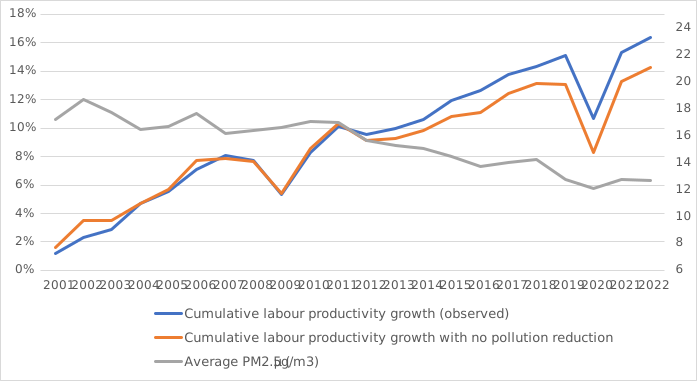
Note: Unweighted average of PM2.5 concentration across European countries, from 0.01° × 0.01° resolution grid (∼1 km × 1 km). See Dechezleprêtre and Vienne (2025) for details on the data construction.
Source: Labour productivity growth is from Eurostat (Database - National accounts - Eurostat). PM2.5 is from the 2023 update (V5.GL.04) of van Donkelaar et al. (2021) available at SatPM2.5 (Satellite-derived PM2.5) | Atmospheric Composition Analysis Group | Washington University in St. Louis.
The economic implications are striking: with the EU's GDP at approximately EUR 19 trillion, a 1 µg/m³ reduction in PM2.5 translates to an annual GDP increase of roughly EUR 106 billion – equivalent to the entire economy of a country like Slovakia or Bulgaria.
Beyond aggregate impacts, the study reveals important distributional effects. Central and Eastern European countries – including Poland (4.80% productivity gain), Slovakia (4.71%), and Hungary (4.45%) – experienced the largest improvements in air quality and consequently the greatest productivity benefits. This suggests that environmental policies have contributed to economic convergence within Europe, narrowing productivity gaps between regions.
These findings demonstrate that air pollution control measures deliver substantial co-benefits beyond health improvements. They represent an often-overlooked component of productivity-enhancing policies and suggest that environmental regulations can be economically beneficial rather than merely costly compliance burdens.
Combine policies that have been shown to reduce pollution
These include market-based instruments (such as emissions trading and pollution offset markets) to cost-effectively reduce emissions, command-and-control regulations (direct regulatory mandates) that have historically driven the sharpest declines in ambient air pollution, such as ambient air quality standards and technology mandates, and targeted urban interventions (such as Low Emission Zones and clean fuel subsidies) to immediately reduce heavy ambient pollution where the density of the workforce is highest.
Focus air pollution control policies on high-pollution episodes
The revised EU Ambient Air Quality Directive provides new limit values for PM2.5 concentration: a maximum of 18 days per year above 25 µg/m³, and an average yearly concentration below 10 µg/m³. Particular attention should be paid to reducing high-pollution episodes above 25 µg/m³ where productivity impacts are concentrated
Integrate productivity co-benefits into cost-benefit analyses
When evaluating environmental policies, explicitly account for economic gains through improved worker productivity alongside traditional health benefits to provide a more complete assessment of policy value
Support regional convergence through targeted air quality programmes
Continue investments in air quality improvements in Central and Eastern Europe, recognising their dual benefits for both environmental justice and economic development
Complement structural policies with environmental measures
Recognise air pollution control as a mainstream productivity policy that can complement education, innovation, and labour market reforms in driving economic growth
References
Dechezleprêtre, A. and V. Vienne (2025), "The impact of air pollution on labour productivity: Large-scale micro evidence from Europe", OECD Science, Technology and Industry Working Papers, 2025/14, OECD Publishing, Paris.
Contact
Antoine DECHEZLEPRETRE (antoine.dechezlepretre@oecd.org)